
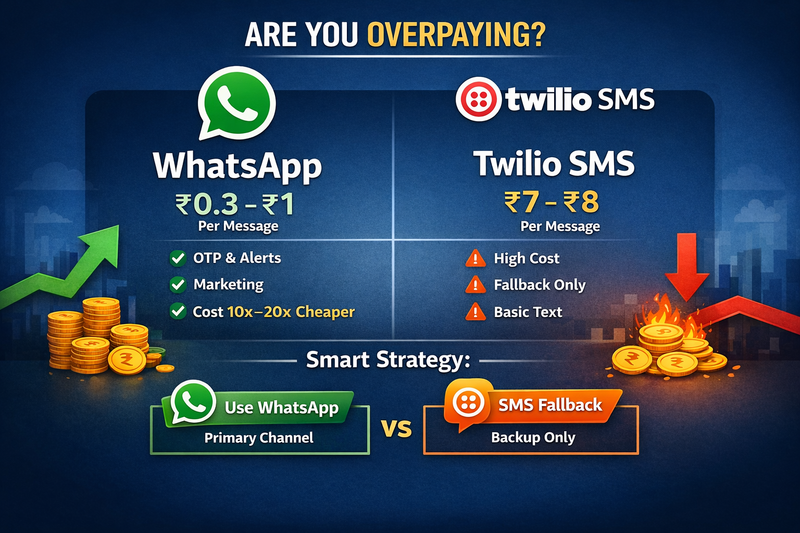
WhatsApp vs SMS Pricing in India: Complete Guide for OTP, Marketing & Notifications (2026)
Introduction
If you're building a product, SaaS platform, or customer communication system in India, one question always comes up:
Should I use WhatsApp or SMS for sending OTPs, marketing messages, or notifications?
At first glance, both seem similar — they deliver messages to users. But when you go deeper, you’ll realize:
- Pricing models are completely different
- Use cases vary significantly
- Cost impact can be huge at scale
This guide will give you a complete, practical, and real-world understanding of:
- WhatsApp pricing (Meta direct)
- SMS pricing (Twilio India)
- Cost comparison for OTP, marketing, and notifications
- Best strategy for your business
By the end, you won’t need any other resource.
Table of Contents
- What is WhatsApp Business API?
- What is SMS (Twilio)?
- WhatsApp Pricing Model (India)
- SMS Pricing Model (India)
- WhatsApp vs SMS Cost Comparison Table
- OTP Pricing Comparison
- Marketing Pricing Comparison
- Notification Pricing Comparison
- Real-Life Use Cases
- Best Practices
- Common Mistakes to Avoid
- FAQs
- Conclusion
1. What is WhatsApp Business API?
WhatsApp Business API (Meta) allows businesses to send:
- OTPs (Authentication)
- Notifications (Utility)
- Marketing campaigns
- Customer support messages
Key Features:
- Rich media (images, buttons, links)
- Two-way communication
- High engagement rates
- Template-based messaging
2. What is SMS (Twilio)?
SMS is the traditional way to send messages using telecom networks.
With Twilio, you can:
- Send OTPs
- Send alerts
- Run marketing campaigns
Key Features:
- Works on all phones
- No internet required
- Simple implementation
3. WhatsApp Pricing Model (India)
WhatsApp pricing is not fixed per message. It depends on:
Message Categories:
- Authentication (OTP)
- Utility (notifications)
- Marketing
- Service (support replies)
Important Rules:
- Service messages = FREE (within 24 hours)
- User replies open a 24-hour window
- Charges apply only for template messages outside window
Approx Pricing (India):
| Category | Approx Cost (INR) |
|---|---|
| Authentication (OTP) | ₹0.30 – ₹0.80 |
| Utility (Notification) | ₹0.20 – ₹0.60 |
| Marketing | ₹0.80 – ₹2.50 |
| Service (Reply) | FREE |
4. SMS Pricing Model (India)
SMS pricing is simple but expensive.
Twilio India Pricing:
- $0.0832 ≈ ₹7.8 per SMS segment
Important Points:
- Charged per segment (160 characters)
- Long messages = multiple SMS charges
- No free window
5. WhatsApp vs SMS Cost Comparison Table
| Use Case | WhatsApp Cost (INR) | SMS Cost (INR) | Winner |
|---|---|---|---|
| OTP | ₹0.30 – ₹0.80 | ₹7.80 | |
| Marketing | ₹0.80 – ₹2.50 | ₹7.80+ | |
| Notification | ₹0.20 – ₹0.60 | ₹7.80 | |
| Support Reply | FREE | ₹7.80 |
6. OTP Pricing Comparison
WhatsApp OTP:
- Category: Authentication
- Cost: ~₹0.30 – ₹0.80
SMS OTP:
- Cost: ~₹7.80 per SMS
Example:
If you send 1000 OTPs:
| Channel | Total Cost |
|---|---|
| ₹300 – ₹800 | |
| SMS | ₹7800 |
Insight:
👉 WhatsApp is 10x cheaper for OTP
7. Marketing Pricing Comparison
WhatsApp Marketing:
- Cost: ₹0.80 – ₹2.50
-
Includes:
- Buttons
- Images
- Links
SMS Marketing:
- Cost: ₹7.80+
- Plain text only
Example (1000 messages):
| Channel | Total Cost |
|---|---|
| ₹800 – ₹2500 | |
| SMS | ₹7800+ |
Insight:
👉 WhatsApp gives better ROI + lower cost
8. Notification Pricing Comparison
WhatsApp Notification:
- Utility messages
- Cost: ₹0.20 – ₹0.60
- FREE if within support window
SMS Notification:
- Cost: ₹7.80
Example (1000 messages):
| Channel | Total Cost |
|---|---|
| ₹200 – ₹600 | |
| SMS | ₹7800 |
Insight:
👉 Notifications are extremely cheap on WhatsApp
9. Real-Life Use Cases
Case 1: E-commerce Platform
- Order confirmation → WhatsApp
- Delivery updates → WhatsApp
- Backup → SMS (if WhatsApp fails)
Case 2: Banking App
- OTP → WhatsApp + SMS fallback
- Alerts → WhatsApp
Case 3: SaaS Platform
- Login OTP → WhatsApp
- Notifications → WhatsApp
- Marketing → WhatsApp campaigns
10. Best Practices
1. Use Hybrid Strategy
- Primary: WhatsApp
- Fallback: SMS
2. Optimize Message Length
- SMS charges per segment
3. Use WhatsApp Templates Smartly
- Avoid unnecessary marketing messages
4. Track Delivery Rates
- Improve ROI
5. Use Automation
- Trigger-based messaging
11. Common Mistakes to Avoid
❌ Sending all messages via SMS
❌ Ignoring WhatsApp free window
❌ Not using fallback system
❌ Sending long SMS (cost increases)
❌ Poor template approval strategy
12. FAQs
1. Is WhatsApp cheaper than SMS in India?
Yes, 5x–20x cheaper depending on use case.
2. Can WhatsApp replace SMS completely?
No, because:
- Some users don’t use WhatsApp
- SMS is still needed as fallback
3. Which is better for OTP?
👉 WhatsApp (cost) + SMS (reliability)
4. Are WhatsApp replies free?
Yes, within 24-hour service window
5. Why is SMS expensive?
Because it uses telecom networks + carrier charges
13. Conclusion
If you are building a modern application in India:
Best Strategy
- Use WhatsApp as primary channel
- Use SMS as backup only
Final Comparison:
- WhatsApp = Cheap + Rich + Interactive
- SMS = Expensive + Basic + Reliable
Actionable Advice:
Start with:
- WhatsApp OTP system
- WhatsApp notifications
- SMS fallback
This will:
- Reduce cost by 80–90%
- Improve user experience
- Increase engagement



Top comments (0)