
Introduction
Every day brings new headlines, reports, and opinions. Some stories matter for hours. Others can shape businesses, markets, and daily life for years. Finding the useful ones takes time.
An AI News Aggregator helps bring news from different sources into one organized place. It can group related stories, create short summaries, and help readers explore wider topics.
This makes news discovery easier. But easy access does not always mean accurate information. Readers still need to check sources and understand the full story.
The real value comes from using technology wisely. It should help people find better information, not make decisions for them.
The Problem With Reading News From Too Many Places
Many readers follow several news websites and apps. They may also receive updates through email and social media. Each source brings new headlines, but the same story often appears many times.
This creates a few common problems:
- Important reports get lost among repeated headlines.
- Readers struggle to compare different accounts.
- Short headlines leave out useful background.
- Older reports may appear beside fresh updates.
- Searching across many websites takes extra time.
- Readers may miss stories outside their usual interests.
More news does not always create better understanding. Readers need a simple way to find, sort, and review information.
An organized news platform can reduce this effort. It can help readers move from endless scrolling to focused discovery.
From Headlines to Connected Stories
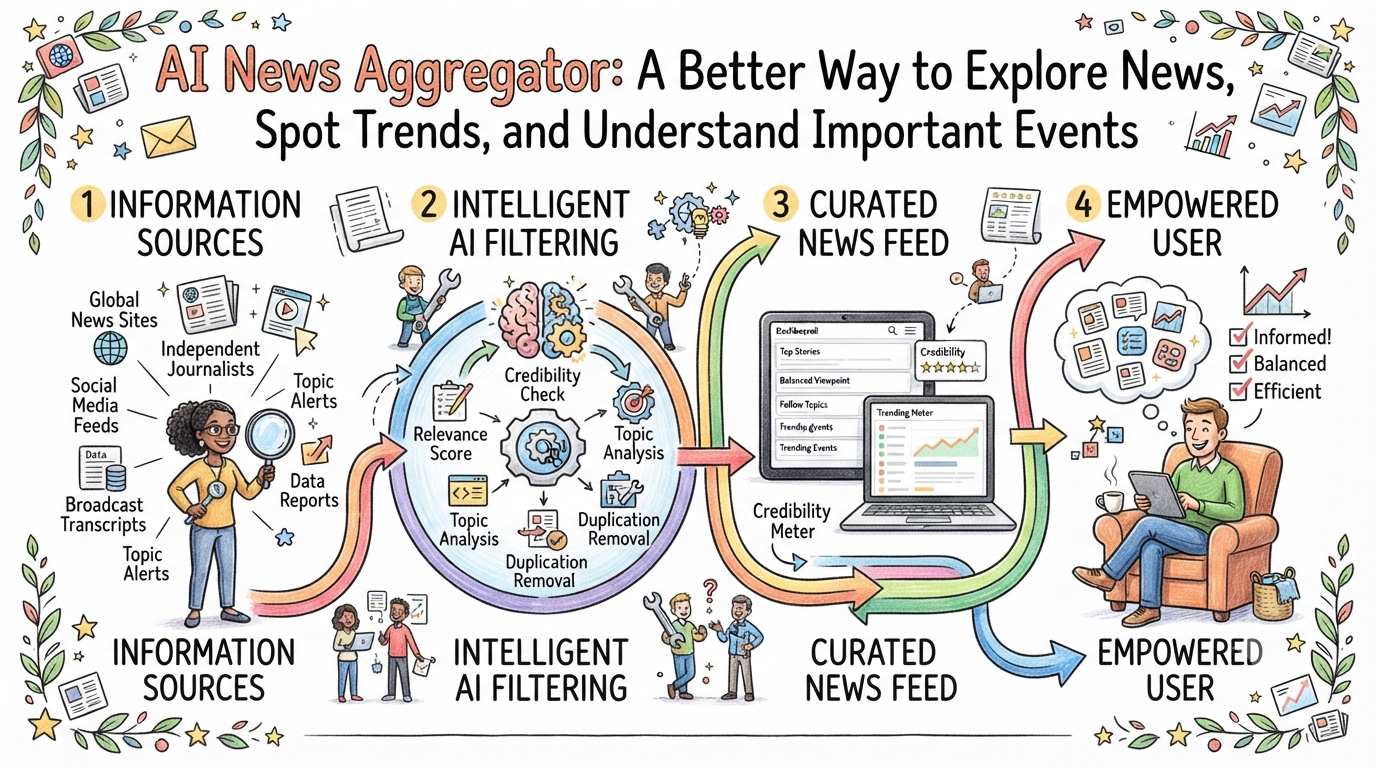
An AI News Aggregator does more than collect headlines. It can help connect reports that cover similar subjects.
For example, a major company announcement may appear in business, technology, and financial news. Each report may focus on a different effect. A useful aggregation system can help readers discover these related angles.
A typical process may include:
- Gather available content: Collect headlines and article information from supported publishers.
- Recognize topics: Identify subjects, people, companies, and places.
- Connect related reports: Group stories that appear to cover the same development.
- Organize the results: Place reports into useful categories.
- Prepare summaries: Create shorter views of selected articles.
- Show source details: Help readers find the original publisher and report.
These steps can make news easier to explore. However, related reports do not always confirm the same facts. Readers should check each article before accepting its claims.
Choose Stories Before Spending Time Reading Them
Not every headline deserves a full reading session. Some stories offer useful information. Others repeat details that readers already know.
An AI News Aggregator can help readers review headlines before opening complete articles.
This approach works well when readers have limited time. They can scan several topics, select useful stories, and explore them in greater depth.
A simple review method includes:
- Start with the subjects that matter most.
- Check the headline and publication date.
- Read a short overview when available.
- Open reports that contain useful new information.
- Compare sources when the subject is important.
The goal is not to read fewer stories blindly. It is to spend more time on information that adds value.
Get the Main Points With an AI News Summarizer
Long reports often contain background, quotes, examples, and detailed explanations. Readers may not need every detail during their first review.
An AI News Summarizer can turn selected article content into a shorter overview. It may highlight the main event, key people, and important developments.
This can help readers decide whether a full article deserves attention.
However, summaries have limits. They may leave out important conditions or opposing views. They may also misunderstand unclear statements.
Use a summary to guide your next step. Do not use it as the only source for important decisions.
For topics involving public safety, law, finance, health, or business risk, read the original report carefully. Check the evidence behind important claims.
Discover News Beyond Your Usual Reading List
Readers often follow the same publishers every day. This creates a familiar routine, but it can also limit their view.
A Global News Aggregator can help people discover reports from different countries and regions. This matters when an event affects several markets or communities.
Consider an international trade decision. One country may focus on exports. Another may discuss higher costs for buyers. A third may examine the effect on local jobs.
These reports can explain different parts of the same development.
When exploring global news, check:
- The country or region involved.
- The local background behind the event.
- The date and location of each report.
- The groups affected by the development.
- Differences between local and international coverage.
A wider source range can improve understanding. Readers should still assess the quality and context of each report.
Find Useful Topics Through Better News Curation
A large list of headlines can feel difficult to manage. Readers need more than a long feed. They need a way to find related information.
Curated News Headlines can group stories by topic, category, or shared subject. This makes it easier to explore a specific area.
Useful categories may include:
- World affairs and government.
- Business and company developments.
- Technology and digital services.
- Science and education.
- Financial markets and economic policy.
- Climate and environmental news.
- Employment and industry changes.
Good curation should help readers discover useful stories. It should not hide important differences between reports.
Readers should also look beyond popular headlines. Source quality, freshness, relevance, and evidence matter just as much.
Handle Breaking News Without Rushing to Conclusions
Breaking stories often change as new details appear. Early reports may include limited information. Later updates can correct or explain the first account.
A Breaking News Aggregator can help readers discover developing events across sources. But speed should never replace careful checking.
Use these steps when following a major event:
- Check the original publication time.
- Look for later updates from the publisher.
- Compare reports from separate sources.
- Check whether officials or named sources support the claims.
- Treat early numbers as unconfirmed when needed.
- Avoid sharing uncertain information.
This habit is useful during elections, natural disasters, major company announcements, and international events.
A fast headline can tell readers that something happened. Careful reporting helps explain what actually happened.
Follow Technology Developments With More Context
Technology changes affect many parts of daily life. Software updates, AI tools, security issues, and cloud services can influence how people work.
A Technology News Aggregator helps readers follow these developments across different publishers.
Instead of focusing only on product launches, readers can explore the larger questions:
- Does a new tool solve a real problem?
- Could a security issue affect existing systems?
- What changes for developers and users?
- Does a new rule affect data or software use?
- How might businesses respond to the change?
For technical readers, the original source matters. Product announcements, research papers, security notices, and independent reports serve different purposes.
Compare them before deciding what a development means.
Read Business Stories From More Than One Angle
A business headline may report a merger, new product, leadership change, or company expansion. Each event can affect several groups.
A Business News Aggregator can help readers follow company and industry developments from different sources.
When reading a business story, consider these questions:
- What changed?
- Why did the company make this move?
- Which customers or workers may feel the effect?
- Does the report include clear evidence?
- Are the results confirmed or only expected?
Company announcements can explain what an organization wants readers to know. Independent reporting may offer additional context.
Readers should compare both when possible. This creates a fuller picture than a headline alone.
Make Financial News Easier to Understand
Financial reports often include numbers, forecasts, and market terms. A headline may show a rise or fall without explaining the reason.
Useful Financial News Headlines can help readers find reports about markets, companies, banking, and economic policy.
Before drawing conclusions, review the details.
| Detail to check | Question to ask |
|---|---|
| Figures | What do the numbers measure? |
| Time period | Which dates does the report cover? |
| Data source | Who provided the information? |
| Comparison | What earlier result does it use? |
| Forecast | Is this a prediction or a confirmed result? |
| Risk | What could change the outcome? |
Financial news helps readers understand economic developments. It does not replace personal financial advice.
Always review the full report before making decisions involving money.
Understand Why a News Story Matters
Some events have effects beyond the people named in a headline. A change in government policy may affect businesses. A technology update may change how teams protect data. A market shift may influence customer costs.
This is where News Impact Analysis can help readers explore possible effects.
A useful analysis may consider:
- Who could be affected?
- Which industries or regions may face change?
- What facts support the expected impact?
- What remains uncertain?
- Which future developments should readers watch?
AI-generated insights can help organize these questions. But they may miss local details or present uncertain outcomes too strongly.
Treat impact analysis as a starting point for research. Check the evidence before accepting its conclusions.
A Practical Framework for Reviewing Any News Story
Readers can use the same basic method across different subjects. This makes it easier to compare reports without spending too much time.
| Review stage | What to do | Expected benefit |
|---|---|---|
| Discover | Find stories related to your interests | Better topic selection |
| Check | Review publisher and date | Stronger source awareness |
| Compare | Read other reports about the event | Wider perspective |
| Verify | Check original evidence and claims | Fewer unsupported conclusions |
| Understand | Review background and possible effects | Better context |
| Revisit | Check important updates later | More current understanding |
This method works for both quick reading and deeper research. Readers can spend more time on stories that affect their work or daily lives.
Ten Habits That Can Improve Your News Reading
Small changes can make a daily reading routine more useful.
- Do not judge a story by its headline: Read the article before forming a strong opinion.
- Check the date: Older reports may not include recent developments.
- Compare different publishers: Separate reports can reveal missing details.
- Do not trust every summary: Verify important facts in the original article.
- Avoid sharing early claims: Wait until reliable sources support the information.
- Look for evidence: Check whether the report names sources or provides documents.
- Separate fact from opinion: Notice when an article presents analysis instead of confirmed information.
- Watch for missing context: Check the background behind figures and quotes.
- Limit unnecessary topics: Follow subjects that support your interests and needs.
- Review major updates: Important stories may change after the first report.
These habits help readers stay informed without accepting every new claim.
Four Fictional Situations That Show How News Discovery Helps
Different readers need different kinds of information. These examples show how an organized news process can support their daily work.
Example 1: A Developer Following Software Security
Amit works on web applications. He wants to know about major security issues and software changes.
He reviews technology headlines and selects stories about tools he uses. He reads short summaries to find relevant updates. Then he opens original security notices for technical details.
This helps him focus on useful information instead of browsing every technology headline.
Example 2: A Business Owner Watching Industry Trends
Pooja manages a small retail company. She wants to understand changes in delivery costs and customer demand.
She follows business reports from different regions. She compares stories about shipping and supplier changes. Before changing company plans, she checks the original reports.
This gives her more context for business discussions.
Example 3: A Student Studying International Events
Karan studies global affairs. He needs reports from different countries for his research.
He searches related headlines and compares local coverage. He checks dates, sources, and important statements. He then reads full articles for his notes.
This helps him build a stronger starting point for research.
Example 4: A Reader Following Economic Changes
Riya wants to understand economic news. She follows reports about interest rates, banking, and company results.
She uses summaries to find relevant stories. When a report includes important numbers, she checks the original data and publication date.
This makes her reading more focused while keeping important details in view.
How HeadlineSift Brings News Discovery Together
HeadlineSift aims to help readers explore news from different publishers and categories. It brings together headlines from hundreds of news sources across multiple countries.
Its AI-based approach helps organize topics and identify relevant stories. Readers can review concise summaries of selected reports. They can also follow source links to read original coverage.
HeadlineSift focuses on several parts of the discovery process:
- Broader coverage: Explore headlines from different countries and subject areas.
- Organized topics: Find related stories through topic-based discovery.
- Short summaries: Review selected reports before opening full articles.
- Source details: Identify publishers and visit original reports.
- Story insights: Explore AI-generated context about why major developments may matter.
These features can make daily news discovery easier to manage. Readers should still check the original reports for full context and important facts.
What AI Can Do and Where Readers Must Step In
AI can help organize information. It can also make large news collections easier to explore. But some tasks still need human judgment.
| AI may help readers | Human judgment remains important for |
|---|---|
| Grouping similar headlines | Checking whether reports share the same facts |
| Creating short summaries | Understanding full context |
| Finding related topics | Assessing the quality of each source |
| Highlighting important details | Verifying names, dates, and figures |
| Showing possible story effects | Separating evidence from predictions |
| Organizing global reports | Understanding local background and viewpoints |
No AI tool can guarantee that every summary or insight is correct. Readers should use these features to guide further research.
Create a Reading Routine That Does Not Feel Overwhelming
A useful news routine should fit into daily life. It should not become another source of stress.
Try a simple approach:
- Pick your main topics: Choose a few subjects that matter to your work or interests.
- Scan the latest headlines: Look for new developments in those areas.
- Select useful reports: Skip repeated stories that add little information.
- Review short summaries: Use them to decide what deserves attention.
- Open original articles: Check the full details of important reports.
- Compare major stories: Look for agreement and differences across sources.
- Return when needed: Follow later updates on important developments.
You can change this routine as your needs change. The main aim is to build awareness without spending the entire day reading news.
Frequently Asked Questions
What does an AI News Aggregator do?
An AI News Aggregator gathers headlines and available news information from multiple publishers. It can organize related reports, sort stories by topic, and create short summaries. This helps readers discover information from one place. However, it does not guarantee that every report is accurate. Readers should check the original sources before trusting important claims.
How is an AI News Aggregator different from a regular news website?
A regular news website mainly presents its own reporting and editorial content. An AI News Aggregator helps readers discover stories from several publishers. It may also group related reports and offer summaries. This makes comparison easier. However, readers should visit the original publisher when they need full reporting, evidence, and detailed context.
Can an AI News Summarizer replace full news articles?
No. An AI News Summarizer provides a shorter view of selected content. It can help readers understand the main points quickly, but it may leave out important details. Full articles often include background, quotes, and evidence that summaries cannot fully capture. Use summaries for discovery and original reports for deeper understanding.
Why should readers use a Global News Aggregator?
A Global News Aggregator can help readers discover reports from different countries and regions. This is useful when an event affects several markets or communities. Different publishers may explain different local effects. Comparing their reports can provide a wider view. Readers should still check source quality, publication dates, and regional context.
What makes Curated News Headlines valuable?
Curated News Headlines help organize stories by subject, category, or related development. This can save time and make useful reports easier to find. Good curation should consider relevance, freshness, and source information. Readers should not assume that a curated headline list contains every important viewpoint. They should open original reports when a story needs deeper review.
When should someone use a Breaking News Aggregator?
A Breaking News Aggregator is useful when readers want to follow developing events across several publishers. It can help them find new reports in one place. However, early information may change as more facts emerge. Check publication times, later updates, and reliable sources. Avoid sharing uncertain claims before stronger evidence becomes available.
How does a Technology News Aggregator help professionals?
A Technology News Aggregator can help professionals follow developments in software, AI, cybersecurity, cloud services, and digital products. It brings related reports together and supports topic discovery. Developers and technical teams can use it to find subjects for deeper research. They should still check original documentation, security notices, and technical sources before taking action.
What should I check in a Business News Aggregator?
Look for clear publisher details, publication dates, topic categories, and links to original reports. These features help readers review company and industry developments. Also, compare company announcements with independent reporting. A business headline may leave out risks or wider effects. Check the full story before making decisions based on a reported development.
How can readers make sense of Financial News Headlines?
Start with the numbers and the period they cover. Check who provided the data and whether the report uses estimates or final results. Compare the information with other reliable reports. Financial News Headlines can help readers discover economic and market developments. They should not be treated as personal investment recommendations or predictions.
What is News Impact Analysis?
News Impact Analysis explores how an event may affect people, companies, industries, or regions. It can help readers identify possible consequences and questions for further research. AI tools may organize this information, but their conclusions can be incomplete. Readers should check the evidence and separate confirmed facts from predictions or opinions.
How can I check the credibility of a news source?
Review the publisher, author, date, and evidence behind the story. Check whether the report uses named sources or links to original documents. Compare important claims with other reliable coverage. Also, notice whether the article separates facts from opinion. A familiar publisher name is useful context, but each report still deserves careful review.
What does HeadlineSift offer readers?
HeadlineSift brings headlines together from hundreds of news sources across countries and categories. Its AI-based approach helps organize topics and provide concise summaries of selected reports. Readers can also find source attribution and links to original coverage. These features support news discovery, while full articles remain important for checking facts and context.
Final Thoughts
Finding useful news should not require endless scrolling. An AI News Aggregator can help readers explore different publishers, discover related topics, and review important developments. Short summaries can make the first review easier, while source links support deeper reading. Still, technology cannot replace careful judgment. Check the date, compare reports, and verify important claims. HeadlineSift aims to bring these discovery steps together through organized headlines, AI summaries, and story insights. Use it as a starting point for better research. A thoughtful reading routine will always matter more than the number of headlines you see.



Top comments (0)