
Every time a video call holds steady or a file transfers without stalling, a thin bundle of copper is doing quiet, precise work somewhere behind the wall. We spend a lot of time thinking about switches, routers, and access points, but the Cat6 Ethernet cable connecting them is what carries the signal from one device to the next. Understanding what's inside that cable, and why it's built the way it is, makes it much easier to buy the right product and install it in a way that holds up over time.
The basic anatomy
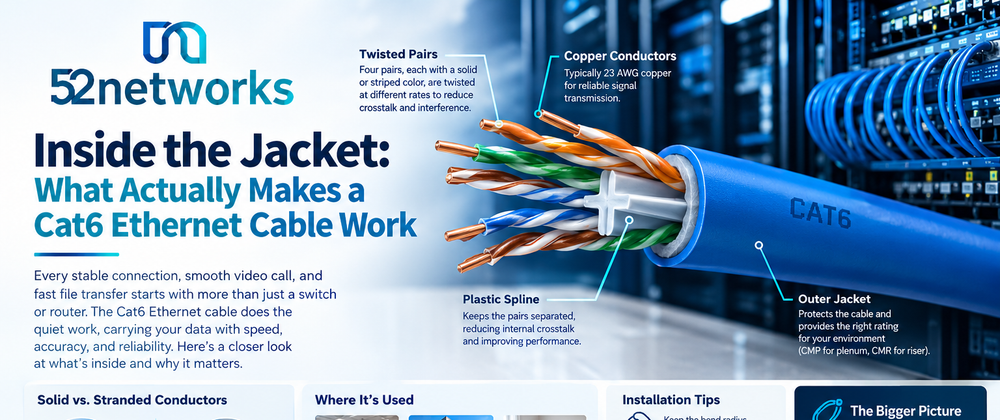
A Cat6 cable is made up of four twisted pairs of copper conductors, usually 23 AWG, wrapped in an outer jacket. Each conductor carries its own color-coded insulation, typically a solid color paired with a striped version of the same color. The four pairs are twisted at different rates along their length, and that variation is deliberate. Identical twist rates would let neighboring pairs interfere with each other more easily, so engineers stagger them.
Inside the jacket, many Cat6 designs also include a plastic spline, a cross-shaped divider that physically separates the pairs from one another. Think of it as a set of internal walls. Keeping each pair isolated reduces the chance that signals on one pair leak into another.
The outer jacket does more than protect the copper from scrapes. Its material determines whether the cable can be installed in plenum spaces such as drop ceilings and air-handling areas, where fire-safety codes call for low-smoke, flame-resistant materials. That's why you'll see markings like CMP for plenum-rated cable and CMR for riser-rated cable on the jacket.
Why twisting matters
Data moves through Ethernet cable as electrical signals, and any pair of wires carrying a signal creates a small electromagnetic field. When two wires run side by side, each one can pick up some of the field from the other. This is called crosstalk, and it's one of the main enemies of clean data transmission.
Twisting the pairs helps in two ways. First, when each wire crosses over its partner repeatedly, interference induced on one wire is roughly canceled out by the opposing interference on the other. Second, the varied twist rates keep the four pairs from interfering with each other in a predictable pattern. The result is a cable that can carry multiple signals in close proximity without them corrupting one another.
Twisting only works as designed when it stays intact. Untwisting a pair to fit it into a termination block, or pulling a cable so hard that the pairs stretch apart, weakens that protection. Good installers keep the untwisted section at the connector as short as possible, typically well under half an inch, and avoid sharp bends that deform the cable's geometry.
Solid copper versus stranded conductors
Not all Cat6 cable is built the same way inside. The conductors are either solid or stranded, and the choice affects where the cable belongs.
Solid copper conductors are a single strand of wire per conductor. They hold their shape well, transmit signals with less loss over distance, and are the standard choice for permanent installations: wall runs, ceiling pulls, and patch panel-to-outlet connections. The tradeoff is rigidity. Solid conductors crack if they're flexed repeatedly, so they aren't suited to cords that get moved around.
Stranded conductors are made from many thinner wires bundled together. They flex far better, which makes them the right choice for patch cords that get plugged and unplugged, or moved behind equipment. They're slightly more lossy over long distances, so they're generally used for short connections rather than building-length runs.
A useful rule of thumb: solid for the walls, stranded for the last few feet.
Practical uses in offices, commercial buildings, and homes
In a typical office, Cat6 cabling runs from wall jacks back to a patch panel in a network closet, where it connects to a switch. Those permanent runs are usually solid-core, and the short patch cords that link the panel to the switch and the desk to the wall are usually stranded.
Commercial buildings place extra demands on the cable. Dozens of runs may share a single cable tray or conduit, which increases the chance of crosstalk between bundles. Here, cable separation, bend radius, and consistent termination matter more than in a small installation. Power over Ethernet devices such as wireless access points, cameras, and phones also add heat when many cables are bundled together, which is worth factoring into the design.
Home networks tend to be simpler, but the same principles apply. A Cat6 run to a media room or home office can improve reliability over Wi-Fi alone, especially for devices that need consistent throughput. Keeping runs away from electrical wiring and fluorescent fixtures helps reduce interference, and a neat, labeled installation makes future changes far less frustrating.
Installation details that affect performance
Several installation habits have an outsized effect on how a Cat6 channel performs. Bend radius is one. Cat6 should not be bent tighter than about four times its outside diameter during installation, and tight zip ties or staples that compress the jacket can distort the pairs inside. Pulling tension is another. Exceeding the manufacturer's maximum pull force can stretch conductors and change their twist geometry.
Termination quality is often the most common failure point. Each conductor needs to land in the correct position according to the T568A or T568B wiring standard, with the jacket stripped back only as far as necessary and the pairs kept twisted right up to the connector. A poorly terminated jack can undo much of the benefit of a well-made cable.
Separation from power cabling also matters. Running Ethernet parallel to high-voltage lines for long distances invites interference, and crossing them at right angles is the usual recommendation.
Finally, testing after installation is worth the time. A basic certifier can confirm that a link meets the performance requirements for its intended category, catching miswired or damaged runs before they cause intermittent problems.
A note on what Cat6 can deliver
The cable is only one component of a network channel. A complete channel includes the patch cords, the keystone jacks, the patch panel, and the connection to the active equipment. Cat6 is specified to support 10 Gbps over distances up to 55 meters under standard test conditions, and 1 Gbps over the full 100-meter channel length. Real-world performance depends on the whole channel being installed correctly, the environment, and the equipment at each end. A high-quality cable terminated poorly will underperform a good installation built with well-matched components.
Where 52Networks fits in
We supply Cat6 cable in solid-core and stranded versions, in both plenum and riser ratings, along with the patch panels, jacks, and cord assemblies that complete a channel. Our customers are mostly installers and IT teams who need consistent cable from one reel to the next, and we pay attention to conductor quality and jacket markings because those are the details that show up later when something goes wrong.
Why the construction matters to buyers and installers
Understanding how Cat6 is built changes how you shop and how you install. When you know what the twisted pairs and spline are doing, a spec sheet becomes more useful. You can ask better questions about conductor material, jacket rating, and how a product was tested. On the job site, the same knowledge helps you avoid the habits that quietly degrade a network: over-untwisting, tight bends, and careless pulls.
Cat6 is a mature, well-understood technology. Its reliability comes less from any single feature than from the careful combination of twisted pairs, insulation, separation, and clean installation. Get those right, and the cable disappears into the background, which is exactly what good network infrastructure should do.



Top comments (0)