
Introduction
Manual server setup and slow software releases create major headaches for growing tech teams. When engineers spend hours fixing routine bugs, innovation slows down. Learning what is NoOps shows teams how to replace manual work with smart cloud automation.
NoOps means "No Operations." It builds an automated environment where software deploys, scales, and heals itself without daily operations support. This guide explores how NoOps works, the tools that power it, and the career paths it creates.
Breaking Down What is NoOps in Cloud Computing
To grasp what is NoOps, think about how traditional software reaches users. In older setups, developers write code and pass it to an operations team. That team builds servers, configures networks, and watches the live app for crashes.
NoOps removes these manual handoffs completely. Developers write their application code and save it to a central system. Automated pipelines immediately test the code, build the cloud servers, and launch the update to users.
Even with high automation, human experts remain essential. Skilled engineers still design the cloud layout, set strict security rules, and fix rare system failures. Automation simply takes over the boring, repetitive tasks.
Key Pillars of a NoOps Environment
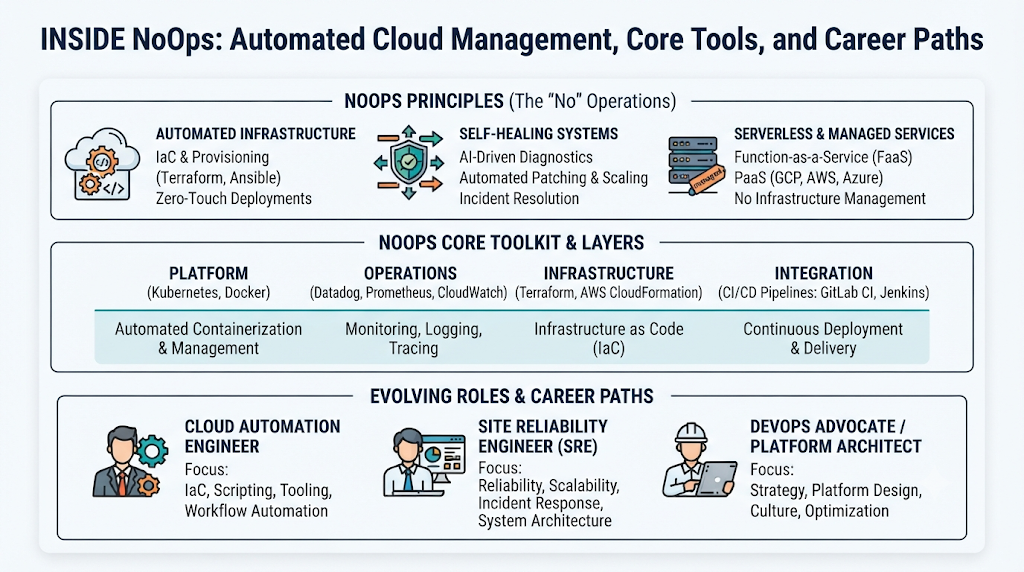
Successful NoOps setups rely on four simple practices. Together, they keep cloud apps fast, safe, and steady.
- Code-Driven Setup: Teams write simple text files to build servers and networks instead of clicking buttons manually.
- Hands-Off Delivery: Automated pipelines test and release every code change without waiting for human approval.
- Automatic Recovery: Monitoring tools spot broken servers and replace them in seconds with zero downtime.
- Built-In Security: Automated scanners block unsafe code and bad settings before they ever go live.
How Automated Workflows Run Daily Operations
Cloud computing provides the foundation that makes NoOps possible. Cloud platforms offer software interfaces that let code control servers, databases, and networks directly. Teams link these tools together into one smooth workflow.
The process starts when a programmer pushes new code to a Git repository. An automated pipeline wakes up and runs dozens of quality and security tests. If the code passes, the system packs it into a portable container.
Next, an orchestration engine sends that container to live cloud servers. The engine balances user traffic across healthy machines automatically.
Finally, smart monitoring tools watch the running app every second. When user traffic jumps, the cloud adds extra servers to handle the load. When traffic drops, it shuts down extra machines to save money.
NoOps vs DevOps: How Both Approaches Compare
Tech leaders often debate NoOps vs DevOps when planning team upgrades. Both methods aim to release better software faster and prevent system crashes. However, they organize people and daily workflows differently.
DevOps focuses on strong teamwork between developers and operations staff. Both groups share tools, plan releases together, and split the work of running live servers. It relies heavily on communication and shared responsibility.
NoOps pushes automation to the next level. Rather than having operations staff manage daily deployments alongside developers, NoOps automates the operations work itself. Developers focus purely on writing code, while the platform handles hosting and scaling.
| Aspect | DevOps Model | NoOps Model |
|---|---|---|
| Core Idea | Shared work between dev and ops teams | Full automation of daily server tasks |
| Team Setup | Developers and ops collaborate closely | Platform builders support pure developers |
| Release Speed | Fast, often with manual review gates | Continuous and completely automated |
| Ideal Workload | Custom systems and hybrid environments | Cloud-native and microservices apps |
One method does not replace the other for every business. Many organizations adopt DevOps first to improve team habits. Once their cloud systems mature, they apply NoOps practices to speed up delivery even further.
Top NoOps Automation Tools in Modern IT
Running a hands-off cloud platform requires reliable software. Modern NoOps automation tools handle server creation, app packaging, code delivery, and live tracking.
Infrastructure and Packaging Software
- Terraform: Engineers use Terraform to write code that builds cloud networks and servers. It guarantees identical setups across testing and live environments.
- Docker: Docker wraps software code and its dependencies into small, standardized containers. These containers run smoothly on any cloud server.
- Kubernetes: Kubernetes controls large groups of containers. It automates app updates, balances traffic, and restarts failed containers automatically.
Deployment and Monitoring Software
- GitOps Platforms: Tools like ArgoCD watch Git folders for code updates. They automatically adjust the live cloud system to match the newest files.
- CI/CD Engines: Systems like Jenkins, GitLab CI, and GitHub Actions automate code building and testing. They move safe code to production without manual steps.
- Serverless Computing: Services like AWS Lambda and Azure Functions run code directly. The cloud vendor manages all underlying servers and scaling behind the scenes.
- AI Operations Tools: Smart monitoring platforms analyze system logs in real time. They detect unusual spikes and trigger automated fixes before users experience slowdowns.
Advantages and Challenges of Adopting NoOps
Moving toward automated operations brings major rewards to software teams. Still, companies must weigh the practical limits before diving in.
Main Advantages
- Rapid Feature Launches: Automated pipelines deliver new updates to customers in minutes rather than weeks.
- Higher Reliability: Software scripts execute tasks the exact same way every time, eliminating human typing mistakes.
- Better Productivity: Developers spend their energy solving user problems instead of fixing broken test servers.
- Smart Cost Control: Automatic scaling ensures companies only pay for the exact server power they use each hour.
Common Challenges
- Steep Learning Curve: Designing a self-healing cloud platform requires deep technical knowledge across many tools.
- Legacy App Limits: Older software built years ago often cannot run in containers or serverless setups without major rewrites.
- Complex Troubleshooting: When a deeply automated chain breaks, finding the exact root cause takes sharp diagnostic skills.
Career Paths and Skills in NoOps
As businesses shift to cloud automation, demand grows for professionals who can build these systems. System administrators and developers often transition into specialized automation roles.
Key Roles in the Field
- NoOps Engineer: Writes Infrastructure as Code, builds CI/CD pipelines, and manages Kubernetes clusters.
- NoOps Architect: Designs secure, scalable cloud blueprints and chooses the right automation stack for the business.
- NoOps Manager: Oversees engineering teams, manages cloud spending, and guides long-term automation plans.
- Platform Engineer: Builds easy self-service portals so developers can launch apps safely without learning complex cloud rules.
| Job Title | Primary Focus | Essential Skills |
|---|---|---|
| NoOps Engineer | Build pipelines and automate cloud setups | Terraform, Kubernetes, Docker, Scripting |
| NoOps Architect | Plan cloud design and automated security | Multi-cloud design, GitOps, Networking |
| NoOps Manager | Lead teams and align business goals | Cloud governance, Budgeting, Agile leadership |
Building Your Technical Foundation
Beginners should start by learning Linux basics and core cloud concepts like virtual networks and storage. Understanding how servers talk to each other is vital.
Next, learn a scripting language like Python or Bash alongside Terraform for Infrastructure as Code. Practice packing apps into Docker containers and deploying them on Kubernetes. Finally, master Git workflows, CI/CD pipelines, and automated log monitoring.
Structured Learning and Certification Paths
Piecing together complex cloud tools through random tutorials takes a long time. Enrolling in a structured NoOps training course gives you a clear path with hands-on labs. Guided lessons teach you how individual tools connect inside real cloud environments.
Earning a NoOps certification helps validate your technical skills to hiring managers. It proves you know how to build, secure, and run automated cloud platforms safely.
Professionals can choose credentials that fit their specific career goals:
- Hands-On Builders: Engineers who create pipelines and manage clusters often pursue a NoOps engineer certification. This track focuses on practical deployment, container management, and automated testing.
- System Planners: Senior engineers who design company-wide cloud layouts benefit from NoOps architect training. It teaches high-availability design, automated compliance, and multi-cloud strategy.
- Technical Leaders: Managers who oversee teams and cloud budgets can pursue a NoOps manager certification. This option focuses on operational governance, team workflows, and risk management.
Platforms like NoOpsSchool provide focused training, certification tracks, and practical learning resources tailored to these roles. Practicing inside real lab environments builds the skills needed to manage live production systems confidently.
How Businesses Use Consulting and Freelance Experts
Many companies want faster releases and lower error rates, yet their internal staff lacks cloud automation experience. Rebuilding live infrastructure without careful planning can cause costly outages.
To bridge this gap, organizations often use NoOps consulting services. Experienced consultants audit current workflows, identify manual bottlenecks, and create a step-by-step automation plan. They guide teams through Kubernetes adoption, GitOps setup, and automated security checks.
Other times, a company only needs extra help for a short-term goal. For instance, a team might need custom Terraform modules or help moving one app to serverless. In those cases, managers often hire NoOps freelancers to complete specific technical tasks quickly.
Tips for Selecting Outside Talent
When hiring consultants or freelancers, look for proven experience with your specific cloud provider. Ask them how they handle security rules and recover from pipeline failures.
Strong experts explain complex ideas clearly without hiding behind buzzwords. Make sure they define clear deliverables and train your internal staff before the project ends. NoOpsSchool helps organizations connect with technical consulting and freelance specialists to speed up cloud automation initiatives.
Frequently Asked Questions
What is NoOps in plain English?
NoOps is a cloud strategy that automates server setup, software deployment, and system repairs. It allows developers to push code updates quickly without relying on manual help from an operations team.
Will NoOps eliminate all IT operations jobs?
No, IT professionals are still vital in a NoOps setup. Instead of doing repetitive manual server work, operations staff move into engineering roles where they design, secure, and improve the automated platform.
What is the main difference in NoOps vs DevOps?
DevOps emphasizes collaboration between developers and operations teams to manage software together. NoOps goes further by automating operational tasks completely, removing the need for daily operations involvement during releases.
Which NoOps automation tools should beginners learn first?
Beginners should start with Git for version control, Docker for containers, and Terraform for Infrastructure as Code. Learning a popular CI/CD tool and Kubernetes provides a strong foundation for most automation jobs.
Can legacy software run in a NoOps environment?
Legacy applications often struggle in pure NoOps setups because they were built for static servers. Companies usually modernize older apps step by step before moving them to fully automated cloud platforms.
Who gets the most value from a NoOps training course?
System administrators, DevOps engineers, cloud engineers, and software developers benefit greatly from structured courses. Beginners with basic IT knowledge can also use guided training to enter the cloud automation field.
Why pursue a NoOps engineer certification?
A certification demonstrates verified skills in Infrastructure as Code, CI/CD pipelines, and container orchestration. It helps engineers stand out when applying for modern cloud and platform engineering roles.
What skills are taught in NoOps architect training?
Architect training covers large-scale cloud design, automated security policies, disaster recovery, and tool selection. It prepares senior engineers to plan reliable, self-healing systems across entire organizations.
When are NoOps consulting services useful for a business?
Consulting services help when a company faces slow release cycles, frequent deployment bugs, or rising cloud costs. Consultants design a safe roadmap and help internal teams adopt modern automation tools smoothly.
How do companies successfully hire NoOps freelancers?
Companies should check a freelancer's past projects in Kubernetes, Terraform, and cloud security. Setting clear project goals and requiring thorough documentation ensures the internal team can maintain the work afterward.
Conclusion
Grasping what is NoOps helps IT professionals and businesses keep pace with modern cloud demands. By automating infrastructure setup, software delivery, and system recovery, teams ship updates faster with far fewer errors. Human expertise remains critical for architecture and security, while machines handle the repetitive daily load.
Developing practical automation skills creates strong career opportunities for engineers, architects, and technical managers. Meanwhile, organizations can accelerate their cloud transformations with the right external guidance. Whether you are building new technical skills, seeking certification, or looking for expert project support, NoOpsSchool offers dedicated resources to help you succeed in IT automation.



Top comments (0)