
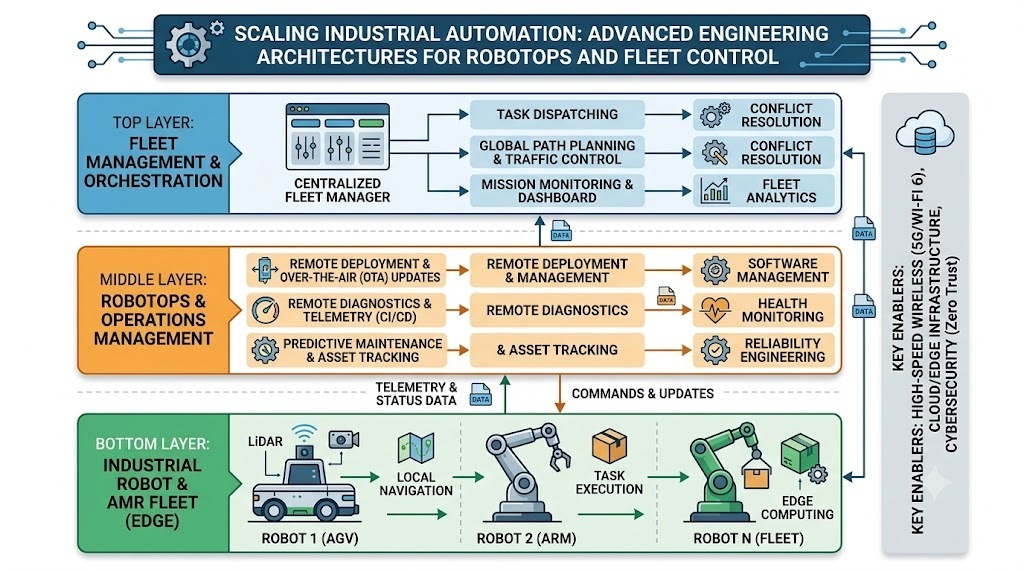
Moving sophisticated mechanical hardware out of a controlled test facility and onto a bustling production floor demands rigorous technical oversight. RobotOps delivers proven software DevOps methodologies directly to physical machinery so engineering groups can govern multi-unit fleets seamlessly. Operators must supervise live deployments, monitor power thresholds, and push code updates to maintain continuous productivity across every single machine. RobotsOps.com supplies developers and students with practical educational resources to master these essential operational skills.
Architecture of Modern Robotics Operations
Robotics operations govern every stage of a machine lifecycle from initial design to active deployment. Architects construct physical frames and draft foundational control logic before field crews commission units inside commercial warehouses. Technicians track live telemetry streams to identify anomalies prior to mechanical failure while developers push remote code patches to refine navigation routines. Rapid incident resolution protocols restore baseline performance immediately whenever unexpected collisions occur.
Conquering Multi-Robot Fleet Complexity
Managing a single robot in isolation remains straightforward, but scaling up to dozens of active units introduces severe operational hurdles. Wireless network degradation freezes critical transit corridors instantly, while heavy motors overheat, batteries deplete prematurely, and obscured sensors disrupt navigation paths. Comprehensive fleet monitoring systems empower maintenance teams to detect impending faults before human safety risks emerge on the active floor.
Table 1: Core Robot Operations Framework
| Domain | Operational Scope | Primary Objective |
|---|---|---|
| Fleet Provisioning | Commissioning new hardware units | Prepare autonomous assets for live tasks |
| Telemetry Monitoring | Observing real-time machine health | Mitigate minor faults before escalation |
| Remote Patching | Distributing software updates securely | Enhance navigational efficiency and safety |
Unified Fleet Management Architecture
Centralized dashboard platforms allow operators to govern large groups of autonomous machinery from a single monitoring console. Teams track precise robot coordinates across digital facility maps to evaluate active task assignments and power thresholds simultaneously. Automated notification triggers alert technicians immediately whenever mechanical lockups or low battery states occur. Remote intervention tools let engineers resolve minor software glitches without physically walking the factory floor.
| Dashboard Feature | Functional Capability | Operational Value |
|---|---|---|
| Status Visualizer | Displays active versus idle assets | Accelerates warehouse workflow pacing |
| Voltage Tracker | Monitors battery drain rates | Prevents mid-aisle vehicle stalls |
| Remote Terminal | Executes remote debugging scripts | Saves critical time for technical staff |
Modernizing Factory Infrastructure
Factory environments rely heavily on robust mechanical arms and automated controllers to accelerate manufacturing output. These industrial systems execute complex welding, precision painting, and heavy material assembly with absolute accuracy. Integrating RobotOps practices ensures that factory automation infrastructure maintains high availability and safe kinematic movement throughout every operational shift.
| Industrial Asset | Typical Factory Duty | Critical Operational Requirement |
|---|---|---|
| Articulated Arm | Welding structural steel | Stable power delivery and calibration checks |
| Logistics AMR | Transporting heavy inventory crates | Real-time mapping and telemetry tracking |
| Aerial Drone | Inspecting high-bay inventory | High-bandwidth wireless communication links |
Streamlining Software Development With ROS 2
Controlling complex physical movements requires modular, reliable middleware architecture. Developers leverage ROS 2 to build scalable robot behaviors through independent nodes communicating via topics and service actions. This structured framework simplifies motor control logic and accelerates software integration across diverse hardware platforms within a standard RobotOps pipeline.
Validating Safety Through Virtual Simulation
Virtual simulation environments allow software engineers to test navigation algorithms and sensor feedback loops before investing in expensive physical hardware. Teams subject virtual robots to simulated collisions and edge-case navigation failures repeatedly without risking real equipment damage. Although simulation accelerates initial software validation, physical testing on actual facility floors remains necessary due to real-world friction and dust.
Deploying Autonomous Mobile Robots
Autonomous mobile robots navigate dynamic commercial spaces independently without physical guide rails or human drivers. Onboard LiDAR sensors and spatial maps empower these vehicles to dynamically bypass obstacles while moving inventory across fulfillment centers. RobotOps frameworks support autonomous mobile robot ecosystems by tracking transit efficiency and managing automated charging routines.
Orchestrating a Robotics Operations Center
A dedicated robotics operations center functions as the command hub for large automated facilities. Operators monitor live diagnostic telemetry, review system error logs, and coordinate fleet-wide software rollouts from large monitoring displays. This centralized oversight model enables rapidly growing enterprises to scale their autonomous operations while maintaining zero unplanned downtime.
Real-World Operational Scenarios
- A facility transport robot loses wireless connectivity and transmits an instant alert to the central monitoring console.
- An automation engineer schedules an overnight navigation firmware upgrade across a fleet of fifty delivery units.
- A manufacturing robotic arm signals an elevated motor temperature, prompting a scheduled component swap prior to failure.
- An autonomous mobile vehicle maps an alternate storage aisle to optimize daily parcel delivery times.
Critical Operational Pitfalls to Avoid
- Neglecting emergency stop verification checks before deploying mobile units near human workers.
- Ignoring dead zones in facility wireless coverage that cause robots to stall mid-corridor.
- Skipping periodic battery health audits, resulting in unexpected power loss during transit.
- Failing to generate system backups prior to executing major firmware updates.
- Exceeding rated payload capacities on autonomous transport platforms during peak demand shifts.
- Disregarding sensor cleaning maintenance schedules, which degrades spatial awareness and causes wall collisions.
- Omitting comprehensive staff training on manual override procedures for stalled machinery.
- Retaining default administrative credentials on fleet management dashboard accounts.
Expanding Knowledge Through RobotsOps.com
RobotsOps.com delivers exceptional educational content designed for professionals studying industrial automation and infrastructure scaling. The platform covers robotics operations, fleet orchestration, and virtual simulation workflows with absolute clarity. Students and systems engineers utilize these technical guides to master ROS 2 integration and modern automation engineering principles.
Structuring the RobotOps Lifecycle
First, architects define project requirements and outline mechanical hardware specifications. Next, developers fabricate physical assemblies and write baseline control scripts. Then, validation teams test software builds inside local development environments. After that, engineers execute virtual simulations to verify path planning algorithms. Next, technicians commission the hardware units within active commercial facilities. Then, operators track ongoing fleet telemetry metrics closely. If runtime anomalies emerge, support personnel deploy immediate software patches. Finally, iterative infrastructure upgrades restart the continuous operational loop.
Frequently Asked Questions
### Why should development teams adopt RobotOps methodologies?
RobotOps adapts established software DevOps principles to physical robotics ecosystems. Organizations utilize these methodologies to deploy, monitor, update, and govern automated hardware throughout its lifecycle. This discipline prevents unexpected downtime and maintains stringent safety standards across large industrial fleets.
### What causes unpredictable anomalies in operational field environments?
Robots operate within unpredictable physical environments unlike traditional web applications. Hardware degradation, battery depletion, sensor obstruction, and spatial collisions introduce complex variables. Continuous active monitoring and rapid remote management remain essential to handle these real-world conditions effectively.
### How do central monitoring consoles simplify multi-unit supervision?
Fleet management platforms unify control of numerous autonomous units under a single administrative interface. Operators track live geographic coordinates, battery levels, and task queues simultaneously. Automated alerting mechanisms notify technical staff instantly when a machine encounters an operational obstruction.
### What architectural strengths make ROS 2 popular among engineers?
ROS 2 supplies a modular middleware framework designed for building complex robotic behaviors. It relies on distributed nodes that communicate via topics and actions to share sensor data efficiently. This architectural design enables engineers to write clean control logic and scale applications rapidly.
### How do virtual simulators mitigate financial prototyping risks?
Virtual simulators allow developers to evaluate navigation algorithms and sensor feedback within safe digital environments. Teams catch logical flaws early without incurring the financial cost of physical hardware prototypes. While valuable, simulation workflows still require subsequent validation on physical floors.
### What material transport tasks do Autonomous Mobile Robots execute?
Autonomous Mobile Robots navigate complex warehouse environments independently without tracks or human operators. They utilize onboard sensors and digital maps to calculate collision-free paths dynamically. These machines accelerate inventory movement while reducing manual material handling expenses.
### What core functions operate inside a Robotics Operations Center?
A robotics operations center acts as the primary command hub for managing enterprise automation fleets. Technicians analyze live telemetry feeds, audit system error logs, and initiate batch software deployments from this facility. Centralized monitoring ensures high operational efficiency across scaling deployments.
### How do learners utilize the technical guides on RobotsOps.com?
RobotsOps.com offers comprehensive educational resources focused on robotics operations and software fundamentals. It organizes complex subjects like fleet orchestration and ROS 2 middleware into digestible learning modules. Technical practitioners rely on these materials to expand their professional competency.
### What industrial manufacturing processes rely on articulated robotic arms?
Industrial robotics utilizes heavy mechanical manipulators to automate demanding factory production processes. These machines execute precise welding, finishing, and assembly tasks with extreme repeatability. They maximize manufacturing throughput while keeping human workers away from hazardous environments.
### How do software teams distribute secure over-the-air packages?
Remote update frameworks transmit compiled code packages over the network when units dock at charging stations. The fleet management software verifies package integrity, installs the update safely, and initiates a controlled software restart. This process maintains device security and introduces new features seamlessly.
### What automated checks prevent unexpected mid-route power failures?
Robot power supplies deplete rapidly during intensive transport operations across large industrial facilities. Fleet management software tracks battery voltage continuously and commands units to return to charging docks automatically. This proactive routing prevents stalled vehicles from obstructing narrow transport corridors.
### Does RobotOps apply to smaller commercial fulfillment hubs?
No, RobotOps benefits any organization operating multiple autonomous machines, including clinical hospitals and urban delivery hubs. Even compact fleets consisting of a few mobile units require systematic software updates, power tracking, and remote supervision to guarantee reliable service.
Securing Ultimate Operational Excellence Across Automated Networks
Maximizing equipment uptime and operational output across autonomous hardware networks demands continuous technical oversight rather than a passive initial setup. Forward-thinking engineering organizations combine robust fleet management software, modular ROS 2 frameworks, virtual simulation environments, and reliable industrial hardware to guarantee sustained operational performance. Comprehensive learning platforms like RobotsOps.com furnish the essential technical knowledge required to excel in this rapidly evolving automation domain.



Top comments (0)