
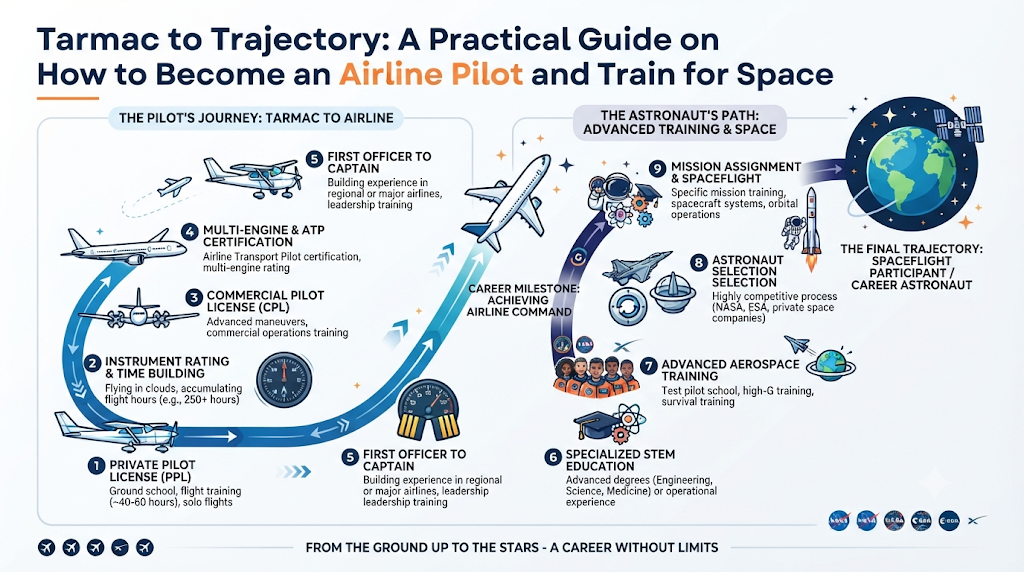
Guiding a commercial airliner across continents and running experiments inside an orbiting station both demand years of disciplined preparation. You need steady nerves, solid math skills, and strict respect for safety checklists. Airline flyers read Earth's weather and airspace, while astronauts adapt to working in microgravity.
Students looking into flight schools, pilot licences, and space agency rules often hit a wall of heavy jargon. Sorting out these facts early helps you pick the right school classes and avoid costly mistakes.
At AstroPilot – Astronaut & Pilot, we turn dense aviation and space rules into plain English. Our educational articles help future pilots, students, and space fans understand licensing steps, cockpit gauges, and orbital physics. Here is a clear look at how to build a career in flight or space exploration.
How to Become an Airline Pilot
Understanding how to become an airline pilot means climbing a steady ladder of exams and flight hours. Aviation regulators write different rulebooks in every country, yet the main milestones stay remarkably alike worldwide. You advance through classroom study, medical exams, and steady hours at the controls.
High School Subjects and Medical Clearances
Airlines require a high school diploma, and major carriers often favor applicants with a college degree. Good grades in physics and math make aviation theory far easier to grasp. Before paying for flight lessons, book an exam with an approved aviation medical doctor. They check your eyesight, hearing, and heart health to verify you are safe to fly.
Climbing the Licence Ladder
You earn your credentials one stage at a time. Most beginners start with a private licence, earn a commercial licence, and then build flight time. Under Federal Aviation Administration (FAA) rules in the USA, airline candidates typically need 1,500 total flight hours. In India, the Directorate General of Civil Aviation (DGCA) sets different flight-hour rules for commercial entry.
Airline Hiring and Jet Simulators
Once you reach the required hours, you apply to regional or major airlines. Recruiters test your flying accuracy, technical knowledge, and crew communication. Newly hired pilots spend weeks inside full-motion jet simulators practicing normal routes and engine emergencies. You begin in the right seat as a First Officer and can later upgrade to Captain.
Private Pilot License Requirements
A Private Pilot Licence (PPL) marks your first major milestone as a flyer. It lets you carry family or friends on personal trips in light aircraft. You cannot, however, accept pay for flying passengers or cargo with this licence.
Age Minimums and Medical Certificates
Reviewing private pilot license requirements before enrolling keeps your schedule realistic. In the United States, the FAA lets you fly solo at age 16 and earn your PPL at age 17. Aviation regulators in Canada, the UK, India, and Australia set similar age rules. You also need a valid medical certificate, such as an FAA Third-Class Medical, prior to your first solo flight.
Ground School and Practical Checkrides
Ground school covers weather charts, airspace rules, and basic aerodynamics. You must pass a written knowledge test before taking your final flight exam. In the cockpit, an instructor teaches you takeoffs, landings, and navigation. While the FAA sets a 40-hour minimum for a PPL, most students log 55 to 70 hours before passing their oral and practical checkride.
Commercial Pilot License Requirements
To earn a paycheck in the cockpit, you need a Commercial Pilot Licence (CPL). A CPL allows you to work as a flight instructor, charter pilot, or aerial survey flyer. Commercial flying demands tighter maneuver control and sharper weather judgment than private flying.
Flight Hours and Precision Flying
Meeting commercial pilot license requirements takes focused practice. Under standard FAA Part 61 rules in the USA, you need 250 total flight hours. By comparison, the DGCA in India and CASA in Australia require 200 flight hours for a standard CPL. You will master steep turns, night operations, and long cross-country routes.
Essential Cockpit Ratings
Alongside stricter written and flight tests, commercial students add key ratings. An Instrument Rating (IR) teaches you to fly safely through clouds by referencing cockpit gauges alone. A Multi-Engine Rating qualifies you to handle aircraft with two engines. Airlines look closely at both ratings during hiring reviews.
Pilot Licence Comparison
Specific rules depend on your country's aviation authority, such as the FAA, DGCA, CAA, or CASA.
Licence Main Purpose Typical Training Focus Important Considerations
Private Pilot Licence (PPL) Personal and recreational flying Basic aircraft control, weather reading, and visual routes Paid commercial flying is prohibited
Commercial Pilot Licence (CPL) Getting paid to fly aircraft High-precision maneuvers, night flights, and long trips Flight-hour minimums vary by country
Airline Transport Pilot Licence (ATPL) Serving as Captain on commercial airlines Multi-crew coordination and heavy jet operations Highest level of civilian pilot certification
Pilot Training Programs in the USA
Aspiring flyers worldwide look at pilot training programs in the USA for their year-round flying weather and busy airspace. You can choose a training format that matches your budget and learning pace.
Independent Academies vs. University Degrees
Private flight schools focus strictly on ground school and flying, allowing full-time students to finish quickly. University aviation programs combine flight lessons with a four-year college degree. Both tracks follow FAA regulations under Part 61 (flexible pacing) or Part 141 (a structured, approved syllabus).
Integrated vs. Modular Training
Integrated programs take beginners from zero flight time to commercial readiness in one full-time schedule. Modular routes allow you to pay and train for one licence at a time while working or studying. Both options blend classroom theory, real airplanes, and certified simulators.
Student Visas and School Inspections
Total training expenses depend on aircraft rental rates, fuel costs, and how fast you progress. International students must enroll at a school certified by the Student and Exchange Visitor Program (SEVP) to apply for an M-1 or F-1 visa. Inspect the school's maintenance hangars and speak with current students before paying deposits.
Airline Transport Pilot License Requirements
The Airline Transport Pilot Licence (ATPL) represents the highest civilian pilot credential. Aviation laws require an ATPL before you can serve as Captain on major passenger airlines. Earning it proves you can manage complex jets and lead a flight crew safely.
Age, Medical, and Hour Milestones
Meeting airline transport pilot license requirements demands years of steady flying. Under FAA rules, you must be at least 23 years old and hold a First-Class Medical certificate. You must log 1,500 total flight hours, including specific night and cross-country requirements, and finish an Airline Transport Pilot Certification Training Program (ATP CTP).
Frozen and Restricted Licences
In Europe, India, and the UK, pilots commonly earn a "Frozen ATPL." They pass all ATPL theory exams right after their CPL, and the licence "unfreezes" once they reach 1,500 flight hours. In the USA, graduates from approved university aviation programs can qualify for a Restricted ATP (R-ATP) at 1,000 or 1,250 hours.
How to Become an Astronaut
Exploring how to become an astronaut shows just how selective human spaceflight remains. Agencies like NASA, ESA, ISRO, and JAXA screen thousands of applicants to choose only a small group every few years.
STEM Degrees and Work Experience
Space agencies look for deep mastery in science, technology, engineering, or mathematics (STEM). NASA, for instance, requires a master’s degree in a STEM field, such as engineering, biological science, physical science, or computer science. Applicants also need at least three years of related professional experience, or 750 to 1,000 hours of pilot-in-command time in high-performance jets.
Physical Health and Crew Resilience
Finalists pass exhaustive medical checks and psychological interviews. Doctors evaluate heart endurance, eyesight, and stress tolerance. Because astronauts live together in cramped modules for months, agencies prize calm communicators and dependable teammates. Selected candidates spend roughly two years in basic astronaut training before receiving a mission assignment.
Astronaut Training for Students
You do not need to wait until college graduation to build aerospace habits. Looking into astronaut training for students gives you practical ways to prepare during school and university. No single program guarantees selection, yet strong technical skills open doors across the space industry.
Core Math, Science, and Coding
School and college students should focus on calculus, physics, chemistry, and biology. Learning programming languages like Python, C++, or MATLAB is equally important. Spacecraft rely heavily on automated code, and engineers must understand how software controls hardware.
Hands-On Clubs and Stamina
Join robotics teams, astronomy clubs, or university rocketry groups. Building and launching model rockets teaches real lessons about aerodynamics and propulsion. Stay active through swimming, running, or scuba diving to build physical endurance and comfort in demanding environments.
Pilot Training vs Astronaut Training
Comparing pilot training vs astronaut training reveals two demanding professions built around safety. Both require strict checklist discipline and sharp situational awareness, yet their daily environments differ completely.
Atmosphere vs. Microgravity
Pilot training focuses on aerodynamics, weather systems, and air traffic rules. Pilots move passengers and freight safely between airports inside Earth's atmosphere. Astronaut training covers orbital mechanics, life-support hardware, and microgravity research aboard space stations or capsules.
Do All Astronauts Fly Airplanes?
Early space programs recruited almost exclusively from military test-pilot ranks. Today, space agencies regularly select doctors, geologists, biologists, and engineers with zero flight hours. Still, flying experience remains a strong advantage for spacecraft commander roles.
Comparison Area Pilot Training Astronaut Training
Main Focus Operating aircraft safely inside Earth’s atmosphere Running space missions and science experiments in orbit
Education High school diploma; college degree often preferred Master’s degree or doctorate in a STEM field
Practical Training Single-engine planes, multi-engine trainers, and simulators Spacecraft mockups, neutral buoyancy pools, and T-38 jets
Safety Storm avoidance, engine failures, and traffic separation Radiation protection, oxygen supply, and orbital re-entry
Career Goal Airline, cargo, corporate, or charter pilot Space station crew member or mission specialist
Spaceflight Basics for Beginners
Understanding spaceflight basics for beginners makes rocket launches and orbital missions easy to follow. Spaceflight means traveling beyond Earth’s dense atmosphere, which starts roughly 100 kilometers (62 miles) above sea level.
Rockets, Thrust, and Orbits
Rockets climb off the launchpad by burning fuel and blasting hot exhaust downward. That downward blast creates an upward push called thrust. Once in space, Earth’s gravity still pulls on the spacecraft. However, the craft moves sideways at roughly 28,000 kilometers per hour. Moving that fast lets the vehicle continuously fall around Earth's curve instead of hitting the ground, creating an orbit and weightlessness.
Life Support and Re-Entry
Inside a capsule, life-support units remove carbon dioxide while regulating oxygen, pressure, and cabin heat. When returning to Earth, thick heat shields absorb intense friction as the capsule hits the upper atmosphere. Meanwhile, teams at Mission Control monitor every sensor from the ground to protect the crew.
Best Flight Simulator Software for Student Pilots
Using the best flight simulator software for student pilots lets you study cockpit layouts from home. Simulators allow you to practice procedures without paying for airplane fuel. Remember that home software never counts toward official licence hours.
Top Software Choices
Two programs stand out for student flyers: Microsoft Flight Simulator and X-Plane. Microsoft Flight Simulator offers detailed global scenery and live weather, making it great for visual navigation. X-Plane models airflow over wings with high aerodynamic accuracy, and many flight schools use FAA-certified versions of X-Plane for instrument training.
Smart Ways to Practice
Use your home setup to memorize checklists, tune radio frequencies, and scan cockpit instruments. Adding a physical yoke, throttle quadrant, and rudder pedals builds helpful muscle memory before your next real lesson.
Feature Learning Purpose Student Benefit
Flight controls Practicing pitch, roll, and yaw coordination Builds basic control familiarity before real flights
Navigation tools Setting GPS waypoints and tracking VOR beacons Strengthens route planning and airway awareness
Weather settings Testing crosswinds, turbulence, and low visibility Teaches safe decision-making in rough weather
Instrument displays Scanning altimeters, airspeed, and attitude gauges Prepares students for instrument flight rules
Aircraft systems Rehearsing startup, shutdown, and emergency steps Saves cockpit time and rental money during real lessons
Common Mistakes and Their Solutions
Beginners exploring aviation and space often run into avoidable setbacks. Watch out for these eight common mistakes:
Skipping the Medical Check Early: Paying for flight lessons before seeing an aviation doctor can waste money if a hidden health issue appears. Solution: Pass your aviation medical exam before paying for flight training.

Choosing a School Solely on Price: The cheapest flight academy often has grounded planes and long instructor waitlists. Solution: Compare fleet maintenance, instructor availability, and graduate timelines before enrolling.

Underestimating Total Costs: Weather delays and extra practice flights often push final bills above initial quotes. Solution: Keep a 15% to 20% financial buffer for unexpected training hours.

Confusing PPL and CPL Rules: Some beginners assume a private licence lets them fly sightseeing tours for pay. Solution: Remember that earning money as a pilot requires a Commercial Pilot Licence.

Ignoring Country-Specific Licence Rules: A pilot licence earned abroad does not automatically grant flying rights at home. Solution: Check licence conversion rules with your home aviation authority before training overseas.

Picking Up Bad Habits on Home Simulators: Practicing without guidance at home can reinforce poor visual flying habits. Solution: Use home simulators strictly to rehearse checklists and navigation taught by your instructor.

Assuming a Licence Guarantees an Airline Job: Earning a CPL qualifies you to apply, not to skip competitive airline interviews. Solution: Maintain a clean safety record, build teamwork skills, and prepare thoroughly for simulator checks.

Believing One Degree Guarantees Astronaut Selection: No college major or flight school promises a spot in space. Solution: Pick a STEM field you genuinely enjoy so you build a rewarding career on Earth too.
Benefits of Learning About Aviation and Space Careers
Researching aerospace careers early gives students a clear advantage. You can pick high school math and science classes with purpose instead of guessing what universities want. Families also gain realistic expectations around training timelines and costs.
Studying flight and space builds strong analytical thinking. You learn how weather, physics, and computer systems interact in real time. Employers across engineering, logistics, and technology value the discipline and safety mindset that aviation training teaches.
At AstroPilot, we break these technical subjects down into clear, practical guides. Reading our articles on pilot licences, avionics, and space systems helps you explore your options before committing to formal programs.
Practical Career Scenarios
To see how students apply these steps in practice, look at these four fictional examples:
Fictional Scenario 1 – Planning an Airline Path: Kian, a 17-year-old student in India, wants to fly commercial airliners. He focuses on physics and math in school, passes his DGCA Class 1 medical exam early, and compares approved flying academies.

Fictional Scenario 2 – Reviewing US Flight Schools: Camila, an aspiring pilot from Chile, evaluates three FAA Part 141 schools in Florida. She checks their SEVP student visa approval, inspects their multi-engine fleet, and talks to current students.

Fictional Scenario 3 – Building Space Credentials: Liam, a college sophomore studying mechanical engineering in Canada, joins his campus rocketry club. He learns Python coding and earns his scuba certification to practice staying calm in demanding environments.

Fictional Scenario 4 – Practicing with Simulation: Mia, a student pilot in the UK, uses X-Plane at home between weekend flights. She practices air traffic radio calls and traffic patterns on her simulator to make her real cockpit hours more productive.
Frequently Asked Questions
How long does it take to learn how to become an airline pilot?
Going from zero flight experience to an airline cockpit usually takes two to four years. Full-time flight academies can help you complete your Commercial Pilot Licence in roughly 18 months. Afterward, you need extra time to accumulate required flight hours, such as the 1,500-hour FAA benchmark in the USA, before applying to commercial airlines.
What are the basic private pilot license requirements?
To earn a Private Pilot Licence, you must meet the minimum age requirement, which is 17 years old in most countries. You also need a valid aviation medical certificate, ground school lessons, and minimum flight hours. In the USA, the FAA requires at least 40 flight hours, a written exam, and a practical flight test.
How do commercial pilot license requirements differ from a private licence?
A Commercial Pilot Licence lets you get paid for flying, whereas a private licence covers personal trips only. Commercial pilots must log more flight time—250 hours under standard FAA rules or 200 hours in India and Australia. They must also fly maneuvers within tighter altitude and speed tolerances and pass harder written and flight exams.
Are pilot training programs in the USA open to international students?
Yes, many flight academies and universities across the USA accept international students. However, you must enroll at a school approved by the Student and Exchange Visitor Program (SEVP) to qualify for an M-1 or F-1 student visa. You also need security clearance from the Transportation Security Administration (TSA) before starting flight lessons.
What are the main airline transport pilot license requirements?
An Airline Transport Pilot Licence requires applicants to be at least 21 to 23 years old, depending on national rules. You must hold a First-Class Medical certificate and pass advanced multi-crew theory exams. Most authorities, including the FAA, mandate 1,500 total flight hours and a jet simulator checkride before issuing a full ATPL.
Do I need to be a pilot to learn how to become an astronaut?
No, you do not need a pilot licence to become an astronaut. Modern space agencies select physicians, engineers, biologists, and physical scientists alongside military test pilots. While flying high-performance jets builds strong operational habits, earning a master’s degree in a STEM field and gaining three years of professional experience is the primary path today.
What is the best astronaut training for students in high school or college?
Students should build strong grades in mathematics, physics, chemistry, and computer science. Joining robotics clubs, science fairs, and model rocketry groups turns classroom theory into hands-on engineering skill. Staying physically active through swimming, running, or team sports also develops the stamina and teamwork habits that space agencies look for during selection.
What is the biggest difference in pilot training vs astronaut training?
Pilot training teaches you how to operate airplanes safely inside Earth’s atmosphere using weather radar and air traffic rules. Astronaut training prepares crews to live and conduct research in microgravity aboard spacecraft. Astronauts spend years mastering orbital mechanics, spacewalk tools, life-support repair, and scientific experiments rather than commercial passenger transport.
What are the core spaceflight basics for beginners to learn first?
Beginners should start by learning how rocket engines generate thrust to overcome Earth’s gravity. Next, study how high sideways orbital speed keeps a spacecraft falling around Earth, creating weightlessness. Learning how life-support systems, thermal heat shields for atmospheric re-entry, and Mission Control teams work together provides a clear foundation in spaceflight.
What is the best flight simulator software for student pilots?
Microsoft Flight Simulator and X-Plane rank among the best flight simulator programs for student pilots. Microsoft Flight Simulator provides realistic global scenery and live weather for practicing visual navigation. X-Plane models aircraft aerodynamics with high precision and is widely used by students to rehearse instrument flying, radio calls, and emergency checklists at home.
Can home flight simulator hours count toward my pilot licence?
No, flight hours logged on a home computer with consumer software never count toward official pilot licences. Aviation authorities only credit simulator time completed on certified flight training devices under the supervision of an authorized flight instructor. Even so, home simulators remain a helpful, low-cost study aid for memorizing cockpit procedures.
Does AstroPilot provide official pilot licences or flight training?
No, AstroPilot – Astronaut & Pilot is strictly an educational website, not a flight academy or licensing organization. We publish beginner-friendly articles, career guides, and technical explanations covering aviation and space exploration. Always consult your country’s official aviation authority, such as the FAA or DGCA, for approved schools and current legal rules.
Conclusion
Learning how to become an airline pilot or prepare for a space career starts with solid research, steady study, and careful planning. Whether you aim for a Private Pilot Licence, work toward an Airline Transport Pilot Licence, or earn a STEM degree for astronaut selection, every step builds on technical discipline and safety awareness. Comparing flight programs, rehearsing procedures on home simulators, and checking national aviation rules will keep your goals realistic. AstroPilot – Astronaut & Pilot supports your curiosity with clear, practical guides on flight and spaceflight. Keep asking questions, build your skills one milestone at a time, and start preparing for your future in aerospace today.



Top comments (0)