
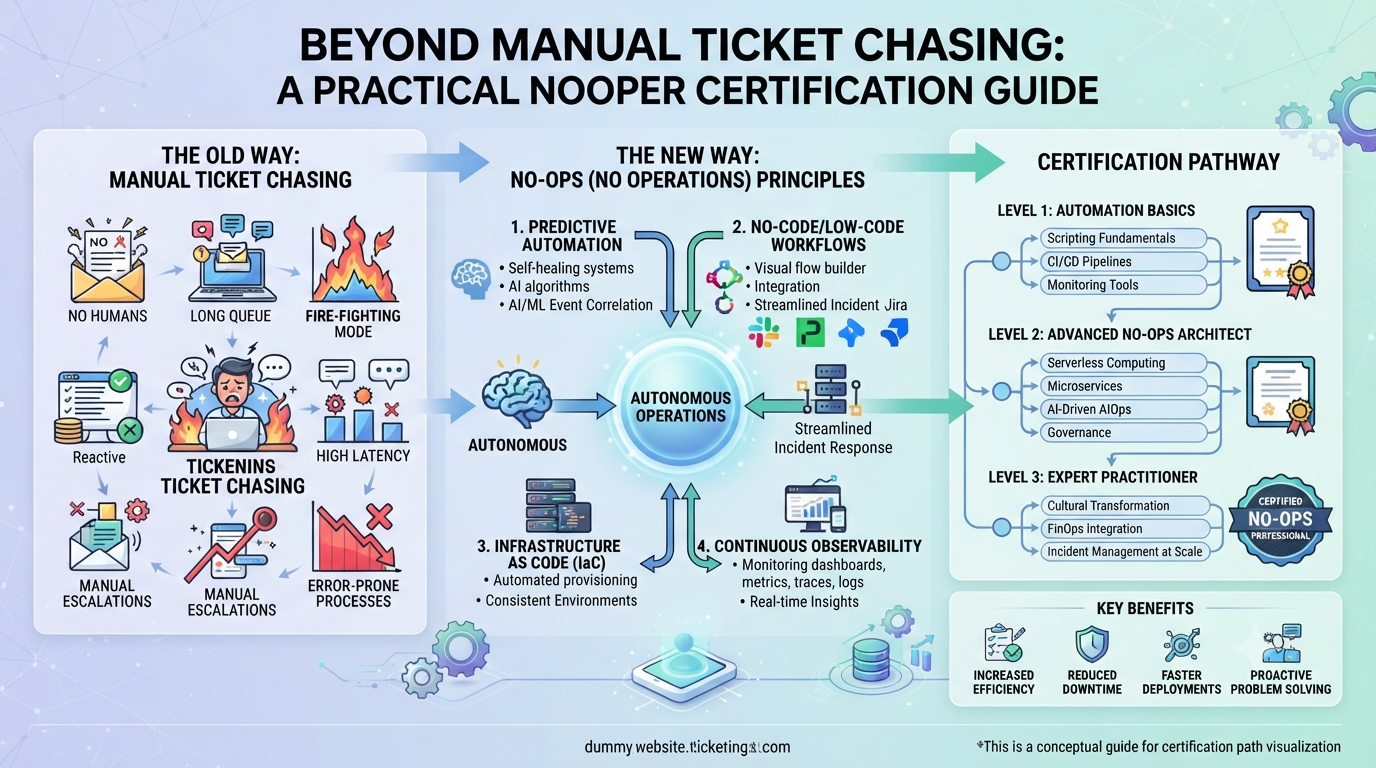
Introduction
Spending evenings patching servers or walking through manual release checklists drains energy that engineering teams need for product work. A NoOps certification gives IT practitioners, architects, and team leads a structured path to automate routine cloud chores safely. Below is a clear breakdown of what is NoOps, how it compares with DevOps, which tools keep infrastructure steady, and how NoOpsSchool supports training, certifications, consulting, and freelance support.
What Is NoOps
When engineers ask what is NoOps, they are talking about letting code and cloud platforms handle repetitive daily upkeep. It does not erase IT operations staff or human accountability. Instead, it removes routine ticket work so engineers can focus on architecture, security policies, and system reliability.
Infrastructure Provisioning: Code templates spin up servers, networks, and databases on demand rather than relying on manual console clicks.
Automated Deployment: Verified code moves from Git repositories to live systems through automated pipelines with fewer manual handoffs.
Monitoring and Observability: Continuous telemetry tracks metrics, logs, and traces so teams catch slowdowns early.
Self-Healing Systems: Orchestration layers spot crashed containers or unhealthy nodes and replace them automatically.
Automated Incident Response: Pre-written runbooks fix common snags—like restarting stuck workers or clearing old logs—without waking on-call staff.
Human Oversight: People still write automation rules, approve risky changes, and investigate outages outside scripted boundaries.
Terraform infrastructure provisioning workflow. Source: CloudOptimo
NoOps vs DevOps
Looking at NoOps vs DevOps works best when you treat them as connected stages rather than rival camps. DevOps brings developers and operations staff together to share delivery duties, while NoOps pushes automation further so routine infrastructure upkeep runs with minimal manual steps.
Comparison Area DevOps NoOps
Main Focus Shared team ownership and faster releases High automation of routine infrastructure tasks
Infrastructure Managed with shared scripts and team coordination Built on self-managing, code-driven cloud setups
Deployment Automated CI/CD pipelines with team review checks Automated delivery and rollback workflows
Monitoring Dashboards alert staff to step in and resolve issues Systems detect faults and trigger automated recovery
Human Role Developers and ops share daily operational duties Engineers set policies and oversee system behavior
Main Goal Cut friction between development and operations Reduce repetitive manual operations work
NoOps Certification
A NoOps certification shows employers and peers that you can automate cloud workflows without creating hidden risks. When comparing programs, check lab access, practical exams, and role coverage—such as the tracks offered by NoOpsSchool—while keeping in mind that industry certifications test applied technical skills rather than serving as government degrees.
Core NoOps Concepts: Spotting manual operational toil and replacing repetitive steps with event-driven automation.
Infrastructure Automation: Writing reusable templates that spin up consistent cloud environments on demand.
Cloud-Native Systems: Running workloads across managed Kubernetes clusters and serverless platforms.
CI/CD Practices: Building automated build, test, and deployment pipelines with reliable rollback triggers.
Observability: Tracking latency, error rates, and resource usage across production services.
Security Automation: Embedding vulnerability scans and policy checks directly into delivery pipelines.
NoOps Training Course
A practical NoOps training course helps engineers connect separate cloud utilities into reliable, self-regulating workflows. Programs with live sandbox labs, realistic troubleshooting tasks, and experienced instructors teach far more than slide lectures alone.
NoOps Fundamentals: Auditing manual operational chores and setting safe boundaries for automation.
Infrastructure as Code: Managing cloud compute, networking, and permissions using Terraform files.
Containers and Orchestration: Packaging applications with Docker and scaling or recovering them via Kubernetes.
GitOps Workflows: Using Git pull requests as the single trigger for infrastructure and application updates.
CI/CD Pipelines: Automating builds, automated tests, and zero-downtime releases to production.
Serverless Architecture: Deploying event-driven functions where the cloud provider manages server patching and scaling.
Self-Healing Infrastructure: Configuring health checks and recovery rules that restore failed workloads automatically.
NoOps Engineer Certification
Working toward a NoOps engineer certification gives system administrators and DevOps engineers a focused path into production automation. Engineers combine Linux skills, scripting, Infrastructure as Code, and container orchestration to keep cloud environments steady.
Automated Infrastructure Management: Provisioning and updating cloud resources cleanly through version-controlled code.
Deployment Automation: Building repeatable delivery pipelines that ship tested updates without manual steps.
Monitoring and Alerting: Calibrating alert thresholds so on-call engineers act on real issues rather than constant noise.
Incident Response Automation: Writing scripts that isolate unhealthy servers, restart services, or roll back faulty releases.
Security and Compliance: Automating credential rotation, access controls, and container image checks.
NoOps Architect Training
Targeted NoOps architect training prepares senior engineers to design automated systems that stay secure, scalable, and cost-aware under heavy traffic. Structured pathways like those at NoOpsSchool help architects give developers self-service speed while keeping strong governance and human oversight in place.
Cloud Architecture Design: Planning multi-zone, fault-tolerant cloud environments that adjust capacity with demand.
Automation Strategy: Standardizing tools across Kubernetes clusters, GitOps controllers, and serverless workloads.
Security and Governance: Enforcing policy-as-code guardrails so automated deployments respect compliance rules.
Cost Management: Setting auto-scaling caps and billing alerts so cloud bills remain predictable.
Platform Engineering: Building internal portals that expose pre-approved, self-service infrastructure templates.
NoOps Manager Certification
Earning a NoOps manager certification helps team leads and IT managers weigh automation trade-offs across budgets, risks, and staffing. NoOpsSchool provides a management track built for leaders who coordinate teams, track reliability metrics, and guide cloud modernization without writing daily scripts.
Automation Roadmap: Phasing in automation gradually so teams modernize workflows without disrupting live services.
Team Coordination: Aligning software developers, security engineers, and platform staff around shared reliability goals.
Risk and Compliance: Keeping human approval gates and audit trails where infrastructure changes carry high risk.
Budget Planning: Balancing cloud compute expenses alongside team training and tooling investments.
Continuous Improvement: Using post-incident reviews to turn recurring manual fixes into permanent safeguards.
Role Main Responsibility Useful Skills Learning Focus
NoOps Engineer Build infrastructure and code workflows Terraform, Kubernetes, CI/CD, scripting Practical hands-on automation
NoOps Architect Design automated cloud systems Cloud architecture, GitOps, security System design and governance
NoOps Manager Lead teams, budgets, and strategy Leadership, risk management, planning Operations strategy and oversight
NoOps Professional Apply automation in daily tech work Cloud basics, containers, monitoring Cross-functional cloud skills
NoOps Automation Tools
No single product automates every layer of an IT stack, so teams combine NoOps automation tools matched to their cloud setup, security rules, and budget. Choosing widely supported tools with clear documentation keeps maintenance manageable for everyone on the team.
Tool Category Common Examples Main Purpose
Infrastructure as Code Terraform, OpenTofu Create and update cloud servers using code
Containers Docker Package apps so they run the same everywhere
Container Orchestration Kubernetes Manage, scale, and heal large groups of containers
CI/CD Platforms GitHub Actions, GitLab CI, Jenkins Test and deliver new code automatically
GitOps Workflows Argo CD, Flux Sync cloud setups directly with Git changes
Observability Prometheus, Grafana, OpenTelemetry Track metrics, logs, and system health
Configuration Tools: Utilities like Ansible keep operating system packages and settings uniform across servers.
Cloud-Native Services: Managed databases and serverless functions cut down routine OS patching and hardware upkeep.
Security Automation: Scanners catch vulnerable dependencies or risky container layers before code reaches production.
AIOps Platforms: Automated correlation engines group related alerts and highlight unusual traffic patterns early.
NoOps Consulting Services
Businesses often bring in NoOps consulting services when moving older applications to the cloud, untangling fragile release pipelines, or adding automated security checks. NoOpsSchool advertises consulting support across operational assessments, cloud-native modernization, CI/CD setup, and AIOps integration to help organizations plan transitions carefully.
Operational Assessments: Reviewing daily support tickets and release bottlenecks to identify high-value automation targets.
Automation Strategy: Building a realistic, phased adoption plan matched to existing cloud accounts and team skills.
Cloud-Native Modernization: Refactoring monolithic applications into containerized or serverless architectures where appropriate.
Infrastructure Provisioning: Delivering reusable Terraform modules for networks, compute, and storage layers.
CI/CD and AIOps Setup: Connecting automated software delivery pipelines with cleaner monitoring and alert routing.
Security Automation: Embedding automated compliance checks and access guardrails directly into cloud workflows.
Hire NoOps Freelancers
When a project requires specialized technical help for a bounded period rather than a full-time hire, teams often choose to hire NoOps freelancers. NoOpsSchool connects companies with independent specialists experienced in Terraform, Kubernetes, and automated monitoring, though hiring managers should still review past work and run technical interviews before signing on.
Terraform Implementation: Writing modular Infrastructure as Code templates for new cloud environments.
Kubernetes Configuration: Deploying, securing, and tuning container clusters for production workloads.
CI/CD Pipeline Development: Automating code builds, test suites, and staged production rollouts.
Monitoring and Dashboards: Configuring clear observability metrics and low-noise alert rules.
Self-Healing System Design: Implementing health probes and automated recovery rules for critical applications.
Common NoOps Adoption Mistakes and Their Solutions
Rushing into infrastructure automation creates avoidable operational headaches if teams skip foundational steps. Keeping these eight pitfalls in mind helps keep rollouts steady.
Trying to Automate Everything at Once: Automate one repetitive task first and verify its reliability before expanding to other workflows.
Ignoring Security Requirements: Integrate secret handling, least-privilege access, and vulnerability scans into pipelines from day one.
Skipping Documentation: Maintain clear architecture diagrams and runbooks so any engineer can debug automated scripts during an outage.
Using Tools Without a Clear Strategy: Fix messy manual processes on paper before purchasing extra automation platforms.
Neglecting Monitoring and Observability: Put logs, metrics, and alerts in place before scripts run unattended so silent failures surface quickly.
Removing Human Oversight Too Early: Keep manual approval gates on destructive actions like database drops until automation proves dependable.
Failing to Test Automation Code: Validate Terraform plans and pipeline changes in isolated staging environments before touching production.
Ignoring Cloud Costs: Enforce strict auto-scaling limits and billing alerts so traffic spikes never trigger surprise cloud invoices.
Benefits of NoOps Training and Automation
Thoughtful automation cuts repetitive busywork and makes software releases far more consistent, though actual outcomes depend on sound architecture, clean code, and team habits. Platforms like NoOpsSchool support skill-building through structured training and practical guidance.
Reduced Repetitive Work: Engineers spend fewer hours on routine server chores and more time improving core products.
Consistent Environments: Infrastructure as Code eliminates configuration drift between test, staging, and production servers.
Faster Software Delivery: Automated tests and pipelines allow teams to ship smaller, safer updates frequently.
Improved System Visibility: Clear observability dashboards help teams diagnose slowdowns and outages faster.
Better Resource Efficiency: Scaling rules trim idle capacity during quiet hours to conserve cloud resources.
Stronger Career Growth: Practical cloud automation skills prepare IT professionals for engineering, architecture, and leadership roles.
Practical NoOps Scenarios
These fictional examples illustrate how practitioners and organizations apply NoOps habits to everyday operational problems.
Fictional Example 1 — DevOps Engineer Learning GitOps: In this fictional example, Rohan, a DevOps engineer tired of stressful Friday night releases, completes a hands-on course in Terraform and Argo CD to build a GitOps workflow that deploys tested updates during normal work hours.
Fictional Example 2 — Cloud Architect Planning Self-Healing Apps: In this fictional example, Elena, a cloud architect designing a busy healthcare portal, configures Kubernetes auto-scaling and health probes so failing containers restart automatically while human engineers focus on database performance.
Fictional Example 3 — Startup Hiring a Freelance Specialist: In this fictional example, a three-person fintech startup brings in a freelance Terraform and CI/CD specialist for three weeks to set up automated security checks and deployment pipelines ahead of launch.
Frequently Asked Questions
What is NoOps in simple words?
NoOps stands for "No Operations," an approach where software scripts and cloud platforms handle routine server, network, and deployment tasks automatically. Instead of manual clicks through checklists, code provisions and maintains infrastructure. Human teams still design the system, enforce security rules, and investigate unusual problems that automation cannot resolve on its own.
How is NoOps different from DevOps?
DevOps focuses on collaboration between developers and operations engineers so teams can build, test, and release software faster. NoOps extends DevOps by automating routine infrastructure upkeep so platforms handle common tasks with minimal manual steps. In practice, many teams build DevOps habits first and automate routine operations gradually over time.
Does NoOps mean IT operations teams lose their jobs?
No, automation does not erase the need for skilled IT professionals. Scripts take over repetitive work like provisioning instances, patching containers, and restarting stuck services. Engineers, architects, and managers remain essential for designing reliable systems, governing security, watching cloud costs, and solving complex failures that require human judgment.
What does a NoOps certification cover?
Certification programs typically cover cloud basics, Infrastructure as Code, container orchestration, and automated CI/CD pipelines. Learners also study observability, self-healing workflows, and automated security checks. Strong programs pair conceptual study with hands-on labs that test real troubleshooting skills rather than memorization alone.
Who should take a NoOps training course?
DevOps engineers, system administrators, cloud engineers, and software developers gain direct value from practical automation training. Architects and IT managers also take courses to plan scalable systems and realistic adoption steps. Anyone comfortable with basic Linux and cloud concepts can start building these practices.
What skills does a NoOps engineer need?
A NoOps engineer needs solid Linux skills, cloud networking basics, and scripting ability in languages like Python or Bash. Hands-on experience with Terraform, Docker, Kubernetes, and CI/CD tools is equally key. Knowing observability tools and automated security checks helps engineers keep automated workflows dependable.
What is the focus of NoOps architect training?
Architect training centers on designing complete, resilient cloud systems rather than writing daily operational scripts. Learners study Kubernetes architecture, GitOps workflows, serverless patterns, and cloud cost controls. The curriculum emphasizes building safe self-service platforms while keeping clear human oversight for major system changes.
Why would an IT leader pursue a NoOps manager certification?
IT managers need enough technical understanding to judge automation risks, cloud budgets, and team workflows accurately. A manager certification helps leaders plan realistic rollouts, track reliability metrics, and align engineering teams. It combines technical awareness with governance and leadership skills needed during cloud changes.
What are the most common NoOps automation tools?
Teams often pair Terraform for Infrastructure as Code with Docker and Kubernetes for running containers. Automated delivery pipelines commonly use GitHub Actions, GitLab CI, or Jenkins alongside GitOps tools like Argo CD. For system visibility, engineers widely rely on Prometheus, Grafana, and OpenTelemetry.
When should a company use NoOps consulting services?
Organizations often seek consulting when migrating older apps to the cloud, untangling slow deployment pipelines, or adding automated security checks. Experienced advisors review current bottlenecks, recommend suitable tools, and help internal teams set up cleaner foundations without repeating common mistakes during big transitions.
When is it smart to hire NoOps freelancers?
Bringing in a freelancer works well for short-term, focused tasks where your team lacks specific tool expertise. Common examples include writing Terraform modules, setting up a Kubernetes cluster, or building monitoring dashboards. Freelancers help finish defined technical tasks quickly without adding permanent full-time staff.
How does human oversight work in a NoOps setup?
Human oversight means engineers set the rules, thresholds, and approval gates that automated tools follow. Teams check system dashboards, review high-impact changes, and update security policies regularly. When an unusual failure happens outside scripted rules, human engineers step in to diagnose and fix it.
Final Thoughts
Good automation clears out routine busywork so engineering teams can focus on building reliable software and solving real problems. When Infrastructure as Code, CI/CD pipelines, observability, and self-healing rules are set up carefully, daily operations become steadier—while human judgment stays essential for architecture, security, and cost control. Hands-on lab practice and structured learning help engineers, architects, and managers turn these tools into dependable habits. Whether you are building individual credentials through a NoOps certificatioN.



Top comments (0)