
Introduction
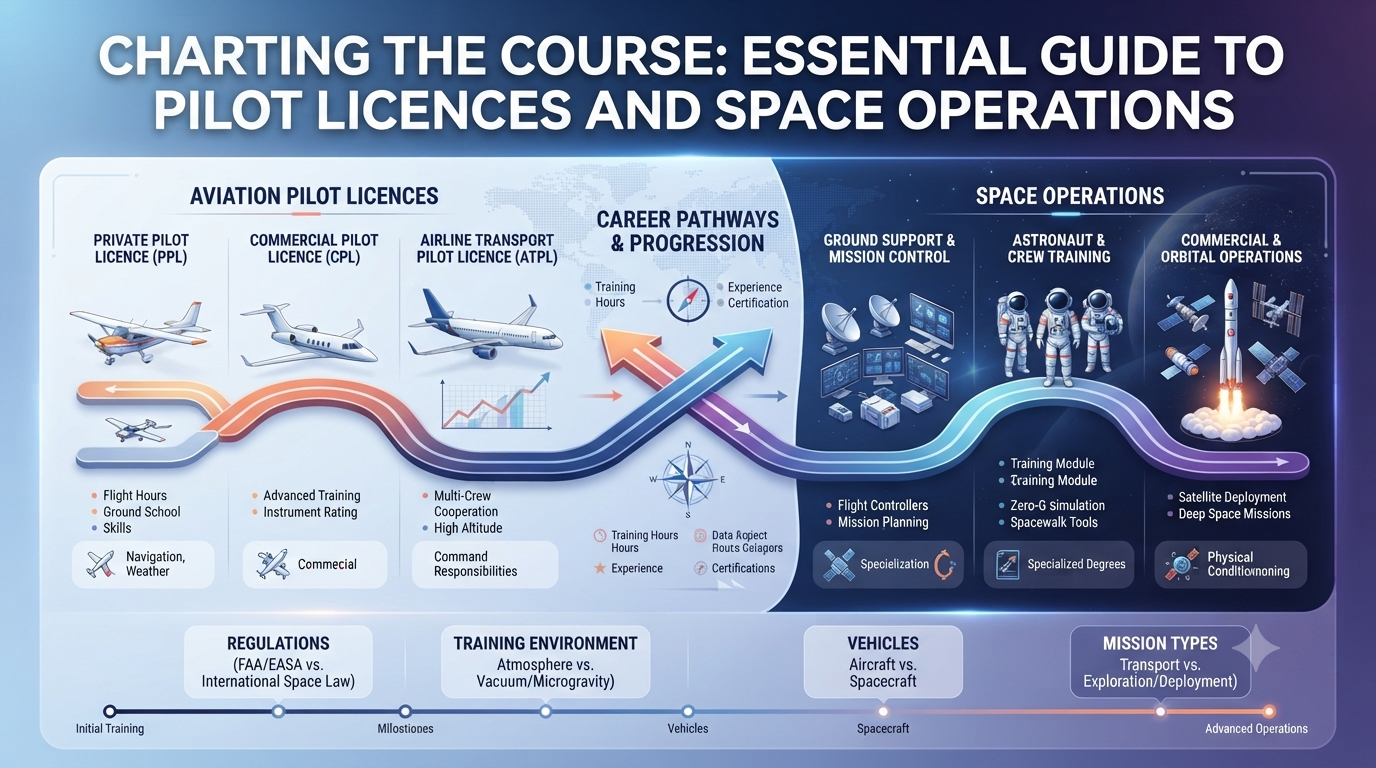
Piloting commercial jets or training for crewed space missions requires a calculated commitment to safety, physical endurance, and regulatory mastery. Stepping from a beginner interest into professional cockpit operations or astronaut selection demands an understanding of licensing tiers, school structures, and orbital fundamentals. This reference guide outlines the specific milestones, regulatory distinctions, and simulation techniques essential for building a resilient aerospace career.
Mastering Airline Pilot Qualifications
Transitioning from a first-time flight student to an airline captain involves a tightly regulated sequence of skill-building and hour accumulation.
The standard path includes:
Foundational Academics: High school algebra and physics supply the core analytical tools required for flight planning.
Aviation Medical Checks: Candidates clear formal physical and mental evaluations authorized by medical examiners.
Ground Instruction: Trainees master meteorology, airspace classifications, and air traffic control rules in structured classes.
Flight Hour Accrual: Students operate dual-control aircraft alongside certified flight instructors to develop coordination.
Certification Tiers: Aviators advance methodically from private certificates to commercial privileges and instrument ratings.
Building Professional Hours: Pilots log necessary time through regional flight operations, banner towing, or flight instruction.
Airline Screening: Applicants face rigorous simulator evaluations and panel interviews administered by commercial carriers.
Type Rating Training: New hires complete intensive simulator courses tailored specifically to their assigned aircraft type.
Legal hour requirements and regulatory frameworks vary substantially across global civil aviation authorities.
Private Pilot Certificate Requirements
A Private Pilot Licence (PPL) grants the legal privilege to operate small aircraft for personal recreation and non-commercial travel.
Core requirements encompass:
Age Minimum: Candidates must be at least 17 years old to hold the certificate.
Language Proficiency: Applicants must read, speak, and write English fluently for radio communications.
Medical Clearance: Trainees must secure a valid medical certificate from an approved aviation doctor.
Ground Curriculum: Students complete required coursework covering weather patterns, airspace rules, and flight planning.
Flight Minimums: Candidates log specified dual instruction and solo hours across varied meteorological conditions.
Written Examination: Trainees pass a computer-based aeronautical knowledge test administered by aviation authorities.
Practical Checkride: The final evaluation features an oral quiz and an in-flight practical test with an examiner.
Privilege Restrictions: A PPL strictly prohibits flying for hire or carrying paying passengers for commercial gain.
Earning a Commercial Pilot Certificate
A Commercial Pilot Licence (CPL) is mandatory for anyone seeking to work professionally as a paid aviator.
Important elements feature:
Prerequisite Holding: Applicants must already possess a valid private pilot certificate.
Age Requirement: Candidates generally need to be at least 18 years old.
Medical Tier: Pilots require a stricter first-class or second-class medical certificate depending on regional rules.
Flight Time Thresholds: Regulatory bodies mandate much higher experience, typically targeting 150 to 200 total hours.
Advanced Ground Training: Studies cover complex navigation, cross-country routing, and commercial operations law.
Skill Evaluations: Practical checkrides assess advanced aircraft control and precise maneuver execution.
Instrument Rating: Most professional positions require an instrument rating to navigate through poor visibility safely.
Career Scope: A CPL qualifies pilots for agricultural flying, banner towing, flight instruction, and charter operations.
Comparing Pilot Licence Tiers
Licence Category Primary Objective Core Training Focus Key Operational Restrictions
Private Pilot Licence Personal recreation and private travel Basic aircraft handling and VFR navigation Cannot carry passengers or cargo for commercial hire
Commercial Pilot Licence Professional flying and employment Advanced maneuvers and multi-engine operations Requires strict compliance with national commercial rules
Airline Transport Pilot Licence Major airline command and leadership Multi-crew coordination and advanced turbine systems Demands high flight-hour thresholds and rigorous checkrides
Note: Specific training hours and test benchmarks depend directly on your regional national aviation authority.
Exploring Flight Training Pathways in the United States
The United States hosts one of the most developed aviation training networks in the world.
Students can select from several distinct pathways:
Independent Flight Schools: Local airfields offer flexible scheduling and modular training options.
University Aviation Programs: Four-year academic courses combine college coursework with professional flight training.
Accelerated Academy Courses: Intensive full-time programs take students from zero experience to commercial readiness rapidly.
Modular Training Approach: Students complete individual ratings and licences at their own personal pace.
Ground Classrooms: In-person or digital lessons prepare trainees for FAA written tests.
Training Fleets: Flight operations utilize single-engine and multi-engine aircraft maintained under tight safety standards.
Flight Simulation Tools: Advanced flight training devices let students practice emergency protocols safely on the ground.
Financial Planning: Careful budgeting is vital since training costs vary widely depending on location.
Student Visas: International students often acquire M-1 vocational visas to study legally at US flight schools.
Comparing school fleets, instructor availability, and local weather patterns ensures a productive training experience.
Airline Transport Pilot Licence Benchmarks
An Airline Transport Pilot Licence (ATPL) represents the highest level of professional pilot certification attainable.
Key details cover:
Captain Qualification: An ATPL is required to act as pilot-in-command for scheduled commercial air carriers.
Flight Hour Thresholds: Candidates in the United States must log 1,500 total hours, though international rules vary.
Medical Maintenance: Holders must renew their first-class medical certificates periodically to stay active.
Advanced Written Exams: Tests cover high-altitude aerodynamics, turbine systems, and airline transport law.
Practical Checkrides: Evaluations test leadership, decision-making, and emergency handling under intense pressure.
Multi-Crew Cooperation: Training emphasizes teamwork and communication inside shared airline cockpits.
Global Variations: Different civil aviation bodies enforce unique qualification standards worldwide.
Pathways Toward an Astronaut Career
Becoming an astronaut is an extraordinary career path requiring exceptional scientific dedication and physical resilience.
The selection process involves:
Higher Education: Candidates typically hold advanced university degrees in science, engineering, or mathematics.
STEM Specialization: Deep expertise in physics, aerospace engineering, or computer science is essential.
Professional Experience: Space agencies look for years of specialized work experience or jet flight hours.
Physical Assessments: Applicants pass intense medical evaluations to handle high-G forces and space conditions.
Psychological Testing: Evaluation checks emotional stability, stress tolerance, and teamwork under pressure.
Clear Communication: Astronauts must communicate effectively with international crewmates and ground controllers.
Intensive Survival Training: Selected candidates learn wilderness survival, scuba diving, and spacecraft systems.
Selection Scarcity: Thousands apply for very few open slots, making the process extraordinarily competitive.
Student Preparation for Aerospace Careers
Students can build strong foundations for future space careers while still in school.
Effective steps include:
Math and Science Focus: Excelling in school physics and algebra builds necessary analytical thinking.
Engineering Projects: Building model rockets or simple circuits develops practical problem-solving skills.
Coding Literacy: Learning programming languages helps students understand modern spacecraft software systems.
Science Competitions: Participating in fairs and robotics challenges sharpens critical thinking.
Robotics Training: Designing automated robots teaches automation concepts used in space exploration.
Teamwork Experience: Joining sports teams builds the collaborative spirit needed in crew environments.
Physical Conditioning: Maintaining an active lifestyle prepares students for demanding endurance tasks.
Astronomy Clubs: Joining science clubs connects learners with mentors who share similar interests.
While early preparation helps build great skills, it does not guarantee selection due to the limited number of astronaut jobs available.
Contrasting Pilot Training and Astronaut Training
Comparison Domain Pilot Training Focus Astronaut Training Focus
Core Objective Safe aircraft operation and passenger transit Mission execution and scientific research
Academic Background Aviation certificates and flight schooling Advanced STEM degrees and research experience
Practical Sessions Aircraft flight hours and flight simulators Centrifuge runs, spacewalk pool training, and simulators
Primary Responsibility Passenger safety and aircraft navigation Mission success and survival in harsh space environments
Ultimate Career Goal Professional airline or cargo pilot positions Human spaceflight missions to orbit and beyond
Pilot Training Versus Astronaut Training
While both jobs involve flying advanced vehicles, their daily goals differ greatly. Pilot training focuses on mastering weather patterns, air traffic procedures, and aircraft handling. Astronaut training goes far beyond flight skills, including microgravity adaptation, spacewalk simulations, orbital mechanics, and scientific payload management. Many astronauts start as military test pilots, but modern crews also include scientists and engineers with minimal prior flight experience. Both career paths require immense discipline, lifelong learning, and a constant focus on safety.
Fundamentals of Spaceflight for Beginners
Grasping basic spaceflight concepts helps enthusiasts appreciate the physics behind rocket launches.
Key ideas include:
Defining Spaceflight: Spaceflight involves traveling past Earth's atmosphere into the vacuum of space.
Rocket Propulsion: High-pressure gas expulsion pushes rockets upward according to basic physical laws.
Gravity and Freefall: Earth's gravity pulls spacecraft while continuous forward speed keeps them in orbit.
Orbital Velocity: Vehicles must travel at immense horizontal speeds to remain in stable orbit.
Spacecraft Architecture: Thermal control and life support systems protect crews in hostile environments.
Launch and Atmospheric Re-entry: Heat shields protect vehicles during fiery returns through the atmosphere.
Orbital Habitats: Space stations offer long-term living quarters for microgravity research.
Ground Control Teams: Flight controllers monitor every telemetry stream to guide missions safely.
Flight Simulator Software for Student Pilots
Flight simulator programs offer helpful practice tools for aviation students around the globe.
Important learning features include:
Virtual Controls: Software lets students practice joystick and throttle inputs for basic aircraft control.
Navigation Practice: Virtual maps allow pilots to practice cross-country routing and radio tuning.
Weather Simulation: Programs let users practice flying through fog, crosswinds, and turbulence safely.
Instrument Familiarisation: Trainees learn to scan artificial horizons and altimeters smoothly.
Flight Planning Practice: Pilots simulate entire routes and fuel calculations before real flights.
System Checklists: Interactive menus teach normal and emergency aircraft checklist steps.
Spatial Awareness: Virtual flight builds scanning habits in busy airspace environments.
Realistic Limits: While great for procedural practice, simulation cannot replace real aircraft motion and feel.
Flight Simulator Learning Features
Feature Name Primary Learning Purpose Key Student Benefit
Flight controls Basic aircraft handling and response Builds muscle memory and coordination
Navigation tools Route planning and tracking Supports cross-country navigation studies
Weather settings Wind and visibility management Teaches hazard recognition in flight
Instrument displays Gauge interpretation and scanning Builds technical instrument familiarity
Aircraft systems Checklist execution Improves emergency response readiness
Common Mistakes to Avoid
Enrolling blindly in flight schools: Always check school safety records, fleet quality, and instructor turnover before signing up.
Skipping medical checks early: Complete your aviation medical exam before spending money on training that you might not medically qualify for.
Misreading licence rules: Review civil aviation authority guidelines carefully to understand exact hour requirements.
Underestimating total expenses: Keep a financial buffer to cover checkride retakes and extra training hours.
Confusing PPL and CPL rules: Remember that private licences strictly forbid carrying paying passengers for hire.
Ignoring local aviation laws: Ensure your flight training meets the legal standards of your specific national authority.
Relying solely on home simulators: Treat simulation software as a study aid rather than a substitute for real aircraft hours.
Assuming jobs are guaranteed: Understand that getting hired by airlines requires networking, interviews, and ongoing performance checks.
Why Early Career Research Matters
Studying aviation and space careers early gives students a major advantage. Structured research helps learners choose the right high school subjects and plan their college degrees effectively. Knowing licence prerequisites prevents costly delays and mistakes during training. Furthermore, exploring aerospace topics builds critical problem-solving skills and a deep respect for safety rules. AstroPilot provides educational resources to help enthusiasts explore these exciting career paths, understand technical requirements, and discover new opportunities in modern aviation and space exploration.
Practical Career Scenarios
Scenario One: The Future Airline Pilot
Rahul, a high school student in India, wants to fly commercial airliners. He uses AstroPilot to research civil aviation authority licensing steps, medical requirements, and flight school options in the USA and India. By understanding the difference between private and commercial licences early, Rahul plans his higher education to focus on physics and mathematics, setting a clear course for his future career.
Scenario Two: The Space Enthusiast
Maya is an engineering undergraduate fascinated by orbital mechanics. She reads educational guides on spacecraft systems and astronaut training pathways. Although she knows selection is extremely competitive, Maya participates in university robotics projects and maintains rigorous physical fitness to build a strong profile for future aerospace opportunities.
Frequently Asked Questions
How long does training take?
Flight training duration varies based on whether students study full-time or part-time. Most people finish their commercial training in two to three years. Weather delays, personal schedules, and financial readiness also impact how fast learners progress through private, commercial, and instrument rating milestones.
What are medical standards?
Medical standards vary by licence level. Private pilots need basic health certificates, while commercial pilots require stricter examinations.Doctors check vision, hearing, heart health, and neurological stability to ensure safe flight operations.
Do I need a degree?
Many airlines hire pilots with high school diplomas and commercial licences. However, major global carriers often prefer candidates holding university degrees. Policies differ by airline and country, so checking specific employer guidelines beforehand is always wise.
What separates PPL from CPL?
A private licence lets you fly for personal recreation without getting paid. A commercial licence permits you to work professionally and earn money for flying tasks. Commercial candidates must complete far more flight hours and pass advanced written tests.
Are degrees required for astronauts?
Space agencies generally expect candidates to hold advanced university degrees in science, engineering, or math fields. Exceptional professional experience or jet flight hours can sometimes substitute for specific degrees, but strong academic backgrounds remain standard.
How useful are flight simulators?
Flight simulators let student pilots practice radio comms, instrument scans, and emergency steps safely. While they do not replace real aircraft flight hours, they build great muscle memory and speed up procedural learning.
What subjects should students study?
Students interested in aerospace should focus heavily on mathematics, physics, and computer science. Engineering principles and basic electronics also provide wonderful foundations for understanding complex vehicle systems and navigation calculations.
Are global standards identical?
Training standards differ because national aviation authorities regulate licensing rules independently. Organizations like the FAA in America and civil aviation bodies elsewhere maintain unique curricula. Pilots flying internationally must ensure local compliance.
What is an ATPL?
An Airline Transport Pilot Licence is the highest certification available to aviators. It is required to serve as captain for scheduled commercial airlines. Candidates must meet strict age, medical, and high-hour experience prerequisites.
How do students prepare for space?
Students prepare for space careers by pursuing rigorous STEM education, keeping fit, and building teamwork skills. Joining science clubs and coding groups helps. Because selection rates are tiny, most candidates build successful primary careers first.
What physics drives spaceflight?
Spaceflight relies on basic Newtonian physics and gravity. Rockets generate thrust by pushing hot gases backward. To stay in orbit, vehicles travel at immense horizontal speeds, balancing gravitational pull with centrifugal force continuously.
Is AstroPilot a flight school?
AstroPilot operates strictly as an educational website and informational resource rather than a flight training school or licensing authority. The platform shares helpful guides and learning articles. Readers should always consult official aviation authorities for binding regulations.
Final thoughts
Navigating the transition from classroom theory to actual flight decks or aerospace engineering roles demands both resilience and meticulous planning. Because certification pathways and regional rules constantly evolve, keeping your practical strategy aligned with verified authority standards is vital. Rely on structured tools like AstroPilot to help demystify licensing prerequisites, training benchmarks, and orbital concepts as you map out your professional future.



Top comments (0)