
Introduction
Good code and shiny deployment tools cannot rescue a service once real users hit it. When latency jumps during a promotion, a release breaks a dependency, or a cloud bill balloons overnight, strong engineering habits matter more than clever scripts.
Teams have to inspect how they run software before failures turn into customer churn or pager fatigue. Relying on memory or quick patches after an outage usually leaves the same cracks exposed.
OpsRoadmaps approaches this work as an engineering operations assessment and improvement platform. It links structured checks and maturity scoring with technical guidance and improvement roadmaps so teams can turn findings into planned work.
Instead of focusing on solo developer training tracks, the platform centers on how engineering teams and organizations operate in production. Leaders and practitioners can review operational habits across disciplines and plan changes together.
Understanding Engineering Operations Maturity
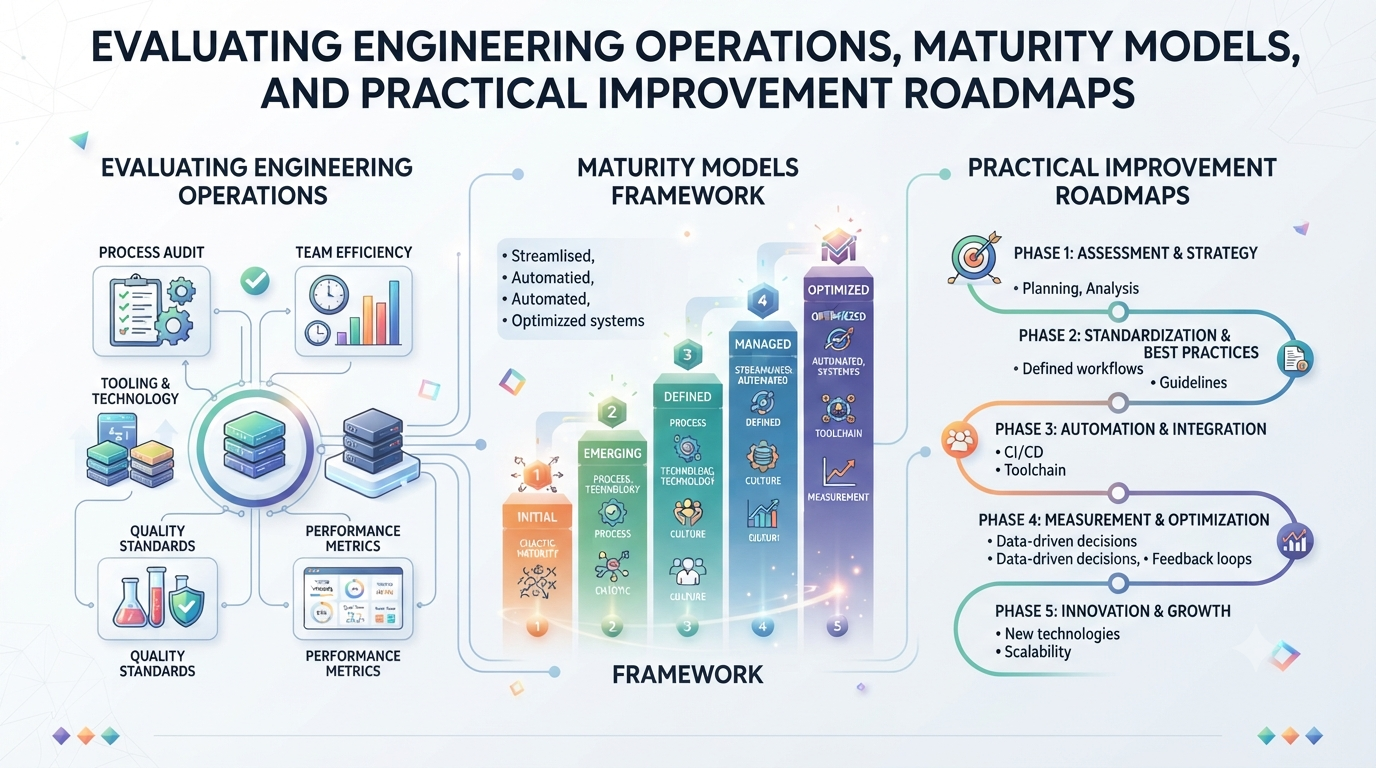
Engineering operations maturity shows how reliably, predictably, and measurably an organization runs software and infrastructure in live environments. It is not about adding approval layers or paperwork; it is about repeatable habits, clear ownership, and feedback loops that catch problems early.
Operational maturity affects release speed, customer trust, and team energy. Engineers who spend half their week putting out fires have little bandwidth left for product work or structural fixes.
Ten core capabilities shape operational maturity across an organization:
- Software delivery practices: How safely and smoothly changes move from commit to production.
- Infrastructure automation: Provisioning and configuring compute, networks, and environments through code instead of manual console clicks.
- Reliability engineering: Setting service targets, managing failure risk, and preventing repeat outages.
- Security integration: Building security checks, secret hygiene, and policy guardrails into routine work.
- Incident response: Spotting, triaging, resolving, and learning from live production disruptions.
- Observability: Figuring out what happens inside running systems from external telemetry.
- Cloud operations: Handling cloud accounts, permissions, networking, and workloads day to day.
- Platform engineering: Creating internal capabilities that reduce cognitive load and standardize self-service paths.
- Cost management: Tracking, assigning, and tuning cloud and infrastructure spend.
- Continuous improvement: Reviewing operational data, holding retrospectives, and refining habits over time.
A maturity assessment gives teams a clear baseline across these areas instead of relying on guesswork. Leaders can tell which practices hold up under pressure, which ones slip, and where fixing a bottleneck will pay off first.
What Is a Production Readiness Assessment?
A production readiness assessment checks whether a service, release, or system is safe to run in front of live users. Teams usually run one before a launch, a migration, or a major architectural change.
Skipping this check often pushes avoidable flaws straight into production. A service can pass every test in a staging environment and still fail under live traffic because timeouts, alerts, or rollback steps were never verified.
Thorough coverage in a production readiness assessment spans ten areas:
- Application reliability: Timeouts, retries, circuit breakers, graceful fallbacks, and dependency resilience.
- Infrastructure readiness: Compute capacity, network layout, load balancing, and parity across environments.
- Security controls: Authentication, authorization, encryption, least privilege, and vulnerability scanning.
- Monitoring and alerting: Core health signals, actionable thresholds, and clear on-call routing.
- Backup and recovery: Backup schedules, tested restore steps, and recovery time expectations.
- Deployment procedures: Rollout steps, health checks, feature flags, and fast rollback paths.
- Incident response: Severity tiers, escalation paths, and runbooks for known failure modes.
- Performance testing: Load, stress, and latency checks under realistic traffic patterns.
- Capacity planning: Scaling behavior during traffic spikes and steady growth.
- Operational documentation: Architecture notes, service ownership, and troubleshooting steps.
A structured production readiness assessment brings missing safeguards into view before users feel the impact. Teams can fix gaps before launch or make an explicit choice about any remaining risk.
Keep in mind that an assessment evaluates readiness based on available evidence and team input. It supports sound engineering judgment, but it does not replace an independent audit or formal compliance certification.
DevOps Maturity Assessment: Evaluating Software Delivery Practices
A DevOps maturity assessment examines how effectively engineering teams plan, build, test, release, and support software. Rather than counting tools, it checks how smoothly and safely changes reach production.
When delivery workflows are tangled, releases become high-stress events full of manual handoffs and long bug hunts. Evaluating delivery practices helps teams spot where changes stall across coding, testing, and operations.
Important areas to review include:
- Continuous integration and delivery: Automated builds, consistent pipelines, and repeatable deployment steps.
- Infrastructure as Code: Versioned, declarative infrastructure definitions that keep environments aligned.
- Version control practices: Clear branching or trunk workflows, thorough code reviews, and clean commits.
- Automated testing: Unit, integration, and regression checks that catch regressions early.
- Deployment frequency: Shipping small, frequent changes that carry lower risk than big-bang releases.
- Release management: Coordinated rollouts, clear release notes, and tested rollback paths.
- Team collaboration: Shared ownership across developers and operators rather than siloed ticket queues.
- Monitoring and feedback: Feeding production metrics and error patterns back into testing and development.
- Change management: Practical approval workflows that protect stability without slowing delivery unnecessarily.
- Automation practices: Cutting out repetitive manual checks and error-prone steps across the release lifecycle.
Findings from a DevOps maturity assessment help teams separate real bottlenecks from surface noise. Instead of adopting every new CI/CD tool at once, leaders can focus on fixes that shorten lead time and cut failed releases.
Kubernetes Production Readiness Checklist
Kubernetes gives teams strong orchestration tools, yet default cluster settings rarely fit production workloads safely. A small mistake in resource limits, probes, or network access can cause cascading failures when traffic rises.
A thorough Kubernetes production readiness checklist helps teams review key safeguards before deploying workloads:
- Cluster architecture: Multi-zone control planes and worker nodes, separate node pools, and upgrade readiness.
- Resource requests and limits: CPU and memory requests and limits tuned to avoid noisy neighbors and pod evictions.
- Readiness and liveness probes: Accurate health probes so traffic skips unready pods and stuck containers restart cleanly.
- Container image security: Minimal base images, vulnerability scanning or signing, and running containers as non-root users.
- Network policies: Default-deny rules and explicit east-west traffic rules to limit lateral movement.
- Secrets management: Encrypted secret storage, external secret injection, and tight access controls instead of plain-text manifests.
- Persistent storage: Defined storage classes, volume snapshots, and safe handling for stateful workloads during node restarts.
- Autoscaling: Pod and cluster autoscaling configured with sensible thresholds and scaling behavior.
- Monitoring and logging: Cluster metrics, pod logs, control-plane visibility, and clear alert rules.
- Backup and recovery: State backups and tested restore procedures for critical cluster resources and data.
- Deployment strategies: Rolling updates, surge and unavailable limits, or canary and blue-green rollouts.
- Disaster recovery planning: Multi-region or multi-cluster failover plans and documented recovery steps.
Using a Kubernetes production readiness checklist gives reviewers a consistent way to check operational risks before deployment. Even so, a checklist is only a review aid—it does not by itself guarantee a secure or reliable cluster without proper configuration, testing, and maintenance.
Platform Engineering Adoption Roadmap
Platform engineering focuses on building an internal developer platform that reduces friction for application teams. Instead of forcing every product team to wire up CI/CD templates, clusters, and telemetry from scratch, a platform team provides paved roads.
A well-built internal platform speeds up developers while keeping standards consistent across services. Treating the platform as a product—with clear docs, active support, and honest feedback loops—helps adoption grow naturally.
A practical platform engineering adoption roadmap moves through ten stages:
- Understand developer needs: Talk with application engineers to see where daily workflows slow them down.
- Evaluate existing engineering workflows: Trace how code currently moves from local development to staging and production.
- Identify repeated operational tasks: Spot common setup steps, boilerplate configs, and recurring support requests.
- Define platform goals: Set clear outcomes around developer speed, consistency, reliability, and maintainability.
- Design the platform architecture: Shape modular components, APIs, and interfaces around existing cloud and tooling choices.
- Build reusable infrastructure capabilities: Create vetted building blocks for environments, pipelines, deployments, and telemetry.
- Introduce self-service workflows: Let teams provision infrastructure and ship services safely on demand.
- Integrate security and governance: Embed policy checks, access controls, and compliance rules directly into platform workflows.
- Measure adoption and developer experience: Track real usage, onboarding time, support tickets, and developer feedback.
- Improve the platform continuously: Refine templates, retire unused features, and adapt as team needs change.
Pushing out a platform without real team demand often leads to shelfware that engineers bypass. A gradual platform engineering adoption roadmap aligned with actual organizational needs builds trust and lasts.
SRE Adoption Roadmap: Building Reliable Software Systems
Site Reliability Engineering (SRE) applies software engineering principles to infrastructure and operations. Rather than treating reliability as a wish or an afterthought, SRE treats it as a measurable engineering trade-off alongside shipping features.
Core SRE practices give engineering and product teams a shared way to reason about reliability:
- Service Level Indicators (SLIs): Quantitative measures of service behavior, such as request success rate, latency, or throughput.
- Service Level Objectives (SLOs): Target reliability levels or bounds for SLIs measured over a defined window.
- Error budgets: The allowable amount of unreliability (100% minus the SLO) teams can spend on releases or experiments.
- Reliability reviews: Structured checks of architecture, dependencies, and readiness before major launches.
- Incident response: Clear responder roles, steady communication, and fast mitigation during live issues.
- Automation: Replacing repetitive manual operations with reliable, maintainable code.
- Capacity planning: Forecasting demand and headroom so systems handle growth safely.
- Toil reduction: Spotting repetitive, manual, automatable tasks that add no lasting value and shrinking them over time.
- Post-incident learning: Reviewing incidents openly to uncover systemic causes and preventive actions.
- Continuous improvement: Tuning SLOs, alerts, and automation as user expectations and systems evolve.
Organizations introducing reliability engineering benefit from a staged SRE adoption roadmap. Starting with one important service—defining clear SLIs and SLOs, introducing error budgets, and automating high-toil tasks—proves the approach before expanding across the fleet.
Lasting SRE adoption depends on collaboration across product developers, operations engineers, and leadership. It requires measurable targets and ongoing engineering effort rather than a one-time tooling change.
Incident Management Maturity Model
An incident management maturity model helps organizations judge how effectively they detect, respond to, resolve, and learn from operational incidents. Instead of measuring success only by how fast someone restarts a service, it looks at the full incident lifecycle.
Ten dimensions shape maturity in incident management:
- Incident detection: How quickly signals and user impact surface real service degradation.
- Alert quality: High signal-to-noise ratio, useful context, and freedom from alert fatigue.
- Incident classification: Clear severity levels tied to customer impact and response expectations.
- Escalation procedures: Fast, clear paths to bring in secondary responders or specialists when needed.
- On-call responsibilities: Fair schedules, clean handoffs, and sustainable on-call load.
- Communication: Timely, clear updates for responders, internal stakeholders, and affected users.
- Root cause analysis: Structured digging into the technical and process factors behind an outage.
- Post-incident reviews: Blameless reviews focused on system resilience rather than finger-pointing.
- Corrective actions: Concrete follow-up tasks prioritized alongside regular feature and platform work.
- Incident trend analysis: Reviewing past incidents to spot recurring failure modes, noisy alerts, and systemic weak points.
Moving up an incident management maturity model takes steady practice. Effective incident management focuses on learning and strengthening the system rather than assigning blame to individuals.
DevSecOps Implementation Roadmap
DevSecOps embeds security checks directly into everyday development and delivery instead of saving them for a final gate before release. Catching issues early saves teams from late-stage rewrites and risky hotfixes.
Key areas in a working DevSecOps program include:
- Secure coding practices: Input validation, safe cryptography, and language-specific security guidelines.
- Code security analysis: Static application security testing (SAST) to spot unsafe patterns in source code.
- Dependency scanning: Checking third-party libraries and packages for known vulnerabilities.
- Container security: Scanning base images, pinning digests, and enforcing runtime guardrails.
- Infrastructure security: Checking Terraform, Kubernetes manifests, and cloud policies before provisioning.
- Secrets management: Keeping credentials out of code and rotating keys or tokens safely.
- Compliance automation: Checking configuration rules and gathering audit evidence continuously where feasible.
- CI/CD security controls: Protecting pipelines, build runners, artifacts, and deployment access.
- Vulnerability management: Prioritizing findings by real risk and tracking fixes on realistic timelines.
- Security monitoring: Watching audit logs, runtime behavior, and unusual access in production.
A practical DevSecOps implementation roadmap rolls out controls in stages without grinding feature work to a halt:
- Baseline current risk: Map critical services, repositories, pipelines, and cloud access.
- Protect secrets and access: Put MFA, least privilege, secret scanning, and proper secret stores in place first.
- Add early code and dependency checks: Turn on fast, low-noise checks in pull requests and CI pipelines.
- Secure infrastructure and containers: Scan container images and infrastructure code before deployment.
- Automate policy and runtime guardrails: Enforce admission policies, deployment rules, and security telemetry.
- Review and tune continuously: Adjust thresholds, cut false positives, and adapt controls as threats shift.
Security automation speeds up feedback and removes repetitive checks, but it should support—rather than replace—security expertise and clear governance. Human judgment still matters for threat modeling, risk sign-off, and complex edge cases.
Observability Maturity Model: Improving Operational Visibility
Observability means understanding what is happening inside a system from the external outputs it produces. In distributed systems, knowing a host is up rarely tells you why requests are slow or failing across services.
Three core observability signals give teams complementary views of system behavior:
- Metrics: Numeric values aggregated over time, such as request rate, error rate, CPU load, or queue depth.
- Logs: Timestamped event records capturing discrete actions, errors, or state changes.
- Traces: End-to-end paths of requests across services, showing where time goes or where calls fail.
Strong observability also relies on day-to-day operational practices around those signals:
- Distributed tracing: Following requests across microservices, queues, and APIs to locate slowdowns.
- Application performance monitoring: Tracking endpoint latency, throughput, database queries, and runtime errors.
- Alert management: Routing high-signal alerts to the right owners with helpful context.
- Service dashboards: Focused views showing golden signals and health indicators per service.
- Telemetry collection: Consistent instrumentation and collectors that gather data without heavy overhead.
- Dependency visibility: Mapping upstream and downstream links to see blast radius quickly.
- Service health monitoring: Combining uptime, errors, and saturation into clear health views.
- Troubleshooting workflows: Moving smoothly from an alert or dashboard to traces, logs, and recent changes.
An observability maturity model helps teams move past basic server checks and scattered log searches toward connected diagnostics. Teams can start with key service metrics and structured logs, then add distributed tracing and SLO-driven alerts as systems grow more complex.
Collecting more telemetry does not automatically give you better observability. Dumping large volumes of noisy logs and unlinked metrics only drives up billable volume and slows down debugging.
Cloud Cost Optimization Roadmap
Cloud cost management belongs inside engineering operations because architecture and deployment habits drive monthly bills. Without visibility and ownership, teams can easily run oversized instances or leave test environments active around the clock.
Common causes of wasted cloud spend include:
- Oversized infrastructure: Instances, databases, or nodes sized well above real peak traffic.
- Idle resources: Compute nodes, load balancers, or managed databases sitting unused after tests finish.
- Unused storage: Unattached disks, old snapshots, and stale object buckets kept around indefinitely.
- Inefficient workloads: Slow queries, excessive network chatter, or memory leaks wasting compute.
- Poor resource allocation: Mismatched requests and limits or over-provisioned clusters across teams.
- Unmonitored data transfer: Cross-zone, cross-region, or egress traffic charges missed during system design.
- Unnecessary environments: Always-on dev, QA, or staging setups running outside working hours.
- Lack of cost ownership: Shared accounts without tags or clear team accountability for spend.
A practical cloud cost optimization roadmap brings spending under control in ten steps:
How Engineering Operations Assessments Turn Findings into Improvement Roadmaps
An assessment only pays off when it leads to practical, sequenced changes. A score sitting on a dashboard helps very little if teams do not know what to fix next or how long it will take.
Turning assessment findings into an improvement roadmap works well across ten stages:
- Evaluate existing engineering capabilities: Review current workflows, tooling, and operational habits in the target area.
- Collect assessment responses and evidence: Gather structured answers along with configs, runbooks, metrics, or incident records.
- Identify operational gaps: Pinpoint missing safeguards, fragile steps, or inconsistent habits exposed by the review.
- Understand risks and dependencies: Check how each gap affects reliability, security, or cost—and what must happen first.
- Review maturity levels: Map findings onto clear maturity stages to see where practices stand today.
- Prioritize improvement opportunities: Rank items by risk reduction, effort required, and operational impact.
- Define practical actions: Turn broad goals into concrete engineering tasks with clear done criteria.
- Assign responsibilities: Give each action a clear owner and support path so work moves forward.
- Track progress: Follow task completion steadily and watch real operational signals rather than checkboxes alone.
- Reassess operational maturity: Run follow-up assessments later to verify progress and pick the next priorities.
A realistic improvement roadmap weighs business priorities, available capacity, technical dependencies, and team readiness. Chasing edge cases before fixing flaky deployments or noisy alerts rarely helps a busy team.
OpsRoadmaps supports this assessment-to-improvement flow by linking structured evaluations with maturity insights, technical guidance, and prioritized next steps. Teams can move straight from spotting gaps to planning practical work.
Understanding Maturity Scoring and Explainable Assessments
Black-box scores breed skepticism among engineers. If a tool spits out a single number with no clear reasoning behind it, teams may question the output or ignore it.
Explainable, transparent assessment scoring relies on clear mechanics:
- Published scoring rules: Clear criteria showing how answers map to scores so teams understand the rules.
- Versioned assessment methodologies: Explicit versions so teams can compare results accurately as criteria evolve.
- Capability-based evaluation: Scoring concrete operational practices rather than vague impressions.
- Maturity levels: Clear tiers describing how established and consistent a practice is.
- Risk identification: Pointing out concrete failure modes or gaps linked to lower scores.
- Prioritized findings: Ordering issues so teams see what needs attention first.
- Evidence and supporting context: Tying scores to actual configurations, practices, and operational signals.
- Repeatable assessments: Consistent questions and rules that let teams run the same check across services or over time.
- Progress tracking: Comparing baseline and later runs to see how operational habits shift.
Self-reported operational maturity differs from independently verified audit results. A self-assessment reflects team answers and available evidence at a given time, whereas an independent audit or formal certification involves external verification against specific standards.
Explainable scoring helps teams see why a score came out where it did and which specific changes will move it. OpsRoadmaps focuses on deterministic, explainable scoring and source-backed recommendations grounded in its defined evaluation rules and platform guidance.
Exploring the Nine Domains of Engineering Operations
Engineering operations cuts across overlapping technical disciplines rather than sitting inside one silo. How you deploy code shapes how you monitor it, and how you design cloud resources affects both reliability and cost.
OpsRoadmaps covers 42 engineering operations disciplines across nine domains. Key disciplines include:
- DevOps and GitOps for automated delivery and Git-driven declarative operations
- DevSecOps for continuous security checks and policy guardrails
- Site Reliability Engineering for SLOs, error budgets, toil reduction, and resilience
- Observability Engineering for metrics, logs, traces, and diagnostic workflows
- Incident Management for detection, response, post-incident learning, and trend tracking
- Cloud Operations for cloud governance, networking, scaling, and environment management
- Platform Engineering for internal developer platforms and self-service tooling
- FinOps for cloud financial visibility, unit economics, and cost accountability
- MLOps, LLMOps, and other specialized operational practices for machine learning, large language model systems, and domain-specific workloads
These disciplines interact constantly in daily work. Weak observability slows incident response, while loose resource governance inflates cloud spend and complicates Kubernetes operations.
Evaluating capabilities across teams gives a fuller picture than judging each discipline alone. At the same time, each discipline has its own practices and nuances, so assessments should reflect domain realities rather than forcing identical checks onto every practice.
Technical Knowledge Resources for Engineering Teams
Assessments show where you stand, but engineers also need practical technical guides when solving real problems. Having clear reference material handy saves teams from starting from scratch or guessing under pressure.
A useful engineering knowledge library brings together several formats:
- Engineering improvement roadmaps: Step-by-step sequences for building capabilities over time.
- Operational checklists: Structured review lists for releases, clusters, and critical changes.
- Incident troubleshooting runbooks: Diagnostic steps and commands to investigate live faults calmly.
- Architecture blueprints: Reference patterns showing how components, controls, and data flows fit together.
- Technology decision guides: Comparisons of trade-offs, fit criteria, and adoption factors for tools or patterns.
- Software tools: Utilities that help teams inspect configurations, plan work, or automate checks.
- Reusable templates: Starting points for policies, readiness reviews, runbooks, or workflow definitions.
Teams can use these materials to make sense of unfamiliar failures, compare design trade-offs, and turn assessment findings into concrete work. Examples include Kubernetes readiness guidance, SRE adoption steps, incident response procedures, observability frameworks, and cloud cost optimization playbooks.
How to Choose the Right Engineering Operations Assessment Platform
Picking an assessment platform for engineering operations shapes how teams evaluate risk and plan work. A flashy dashboard packed with generic questions adds little value if the output feels disconnected from day-to-day engineering.
Use this checklist when evaluating an engineering operations assessment platform:
- Assessment coverage: Does it cover the operational domains and practices relevant to your stack?
- Clear scoring methodology: Are scoring rules documented and straightforward for engineers to follow?
- Explainable results: Can you see how each score and finding was reached?
- Maturity evaluation: Does it distinguish basic habits from mature, repeatable operations?
- Technical accuracy: Do the questions and checks match real production systems and modern tooling?
- Source-backed recommendations: Are suggested next steps backed by clear reasoning and technical guidance?
- Improvement prioritization: Does it help separate high-impact fixes from low-priority items?
- Roadmap usability: Can teams turn findings into practical tasks without heavy process overhead?
- Assessment versioning: Are assessment versions tracked so comparisons over time stay accurate?
- Progress tracking: Can you rerun assessments later to measure movement across teams or services?
- Practical knowledge resources: Does it pair assessments with usable checklists, runbooks, or guides?
- Security and data handling: Are access controls, data retention, and privacy practices clear and suitable?
Teams should choose a platform around their actual operational needs rather than chasing big feature lists or large assessment counts. A clear, practical tool that engineers actually use beats a sprawling catalog that gathers dust.
Common Challenges in Improving Engineering Operations
Even motivated teams hit friction when trying to upgrade how they run software. Spotting common roadblocks early makes planning much easier.
Typical challenges include:
- Unclear improvement priorities: Trying to fix everything at once and losing focus on high-risk areas.
- Legacy infrastructure: Older systems, tight coupling, or manual steps that resist quick change.
- Limited engineering resources: Small teams balancing feature work, support, and reliability tasks.
- Skill gaps: Limited familiarity with containers, telemetry, cloud controls, or automation patterns.
- Inconsistent processes: Different teams using different release, alerting, or review habits.
- Tool fragmentation: Overlapping or disconnected monitoring, CI/CD, and security tools.
- Poor observability: Missing context or noisy alerts that slow down root-cause work.
- Security weaknesses: Broad permissions, unpatched dependencies, or inconsistent secret handling.
- Cloud cost visibility: Missing tags or unclear ownership making cloud spend hard to trace.
- Resistance to organizational change: Habit, skepticism, or fear of extra overhead when new workflows arrive.
- Unclear ownership: Shared systems where no team feels responsible for upkeep or reliability.
- Difficulty measuring progress: Relying on hunches rather than clear baselines and follow-up checks.
Practical habits help teams work through these obstacles steadily:
- Use structured assessments to set a shared baseline and rank priorities objectively.
- Build realistic roadmaps that fit team capacity and respect technical dependencies.
- Encourage collaboration across development, operations, platform, and security roles.
- Document runbooks, architecture choices, and workflows where engineers actually look for them.
- Automate repetitive checks and deployments gradually to cut manual toil.
- Run regular reviews to adjust priorities as systems and teams evolve.
How OpsRoadmaps Supports Engineering Operations Improvement
OpsRoadmaps is an engineering operations assessment and improvement platform built to help teams evaluate operational practices and plan structured improvements. It connects diagnostic assessments with maturity insights and practical technical resources.
Its core capabilities include:
- Structured engineering operations assessments designed to evaluate operational practices systematically.
- A free operational health scan without requiring an account for quick initial checks.
- More detailed production readiness and reliability assessments for signed-in users when deeper evaluation is needed.
- Published and versioned scoring rules so evaluations stay transparent and comparable over time.
- Explainable maturity scoring that shows how results are formed.
- Prioritized findings to help teams focus on meaningful gaps first.
- Source-backed recommendations tied to clear technical guidance.
- Dependency-aware improvement plans that respect technical order and sequencing.
- Technical roadmaps and checklists for structured rollout and readiness reviews.
- Troubleshooting runbooks to support systematic investigation during issues.
- Architecture blueprints to illustrate sound system patterns.
- Technology decision guides to help weigh options and trade-offs.
- Reusable templates to standardize operational artifacts across teams.
In practice, a team can explore a relevant technical resource, run an assessment to see where current practices stand, and use the findings to plan targeted improvements. Starting small and iterating keeps the process grounded in real engineering work.
Self-assessment results from any tool—including OpsRoadmaps—reflect team inputs and available evidence; they are not independent audits, formal compliance certifications, or guarantees of production readiness.
Frequently Asked Questions About Engineering Operations and OpsRoadmaps
What is a production readiness assessment?
A production readiness assessment checks whether a service, release, or system is prepared to run safely in front of real users. It reviews reliability controls, infrastructure, security, monitoring, backups, deployment and rollback steps, incident response, performance and capacity plans, and documentation before launch so teams can fix gaps early.
How does a DevOps maturity assessment help engineering teams?
A DevOps maturity assessment evaluates how reliably teams build, test, release, and support software across pipelines, infrastructure as code, version control, testing, and collaboration. The findings help teams spot delivery bottlenecks, cut manual handoffs, and prioritize changes that improve release speed and stability.
What should a Kubernetes production readiness checklist include?
A Kubernetes production readiness checklist should cover cluster architecture, CPU and memory requests and limits, readiness and liveness probes, container image security, network policies, and secrets management. It should also check persistent storage, autoscaling, monitoring and logging, backups, deployment strategies, and disaster recovery plans.
What is a platform engineering adoption roadmap?
A platform engineering adoption roadmap is a staged plan for building an internal developer platform that reduces friction for application teams. It moves from understanding developer needs and existing workflows to designing reusable infrastructure, self-service capabilities, security guardrails, adoption metrics, and continuous iteration.
How can organizations start an SRE adoption roadmap?
Organizations can start an SRE adoption roadmap by picking a key service, defining clear SLIs and SLOs, and using error budgets to balance reliability with release pace. Pairing those targets with toil reduction, automation, clear incident response, and blameless post-incident reviews builds reliability over time.
What is an incident management maturity model?
An incident management maturity model shows how an organization moves from reactive firefighting to structured, measurable incident handling and learning. It evaluates detection, alert quality, severity classification, escalation, on-call health, communication, root-cause analysis, post-incident reviews, corrective actions, and trend analysis.
How does a DevSecOps implementation roadmap improve security practices?
A DevSecOps implementation roadmap builds security checks—such as secrets protection, code and dependency scanning, container and infrastructure checks, and policy controls—into everyday development and CI/CD workflows. Catching issues earlier cuts risk and rework while keeping human security expertise central to governance.
What is an observability maturity model?
An observability maturity model guides teams from basic system checks toward deep visibility into distributed services using metrics, logs, and traces. It focuses on context, service health monitoring, distributed tracing, and actionable alerting rather than simply collecting high volumes of raw telemetry.
How can organizations create a cloud cost optimization roadmap?
Organizations can create a cloud cost optimization roadmap by first establishing cost visibility and tagging, then identifying major spend drivers and idle or oversized resources. Adding workload right-sizing, budgets and alerts, unit cost tracking, and architecture reviews keeps spending aligned with reliability and business needs.
How do you troubleshoot Kubernetes CrashLoopBackOff errors?
Start Kubernetes CrashLoopBackOff troubleshooting by running kubectl get pods and kubectl describe pod to check restart counts, events, exit codes, and probe or memory issues. Then inspect kubectl logs and kubectl logs --previous, along with kubectl get events and kubectl get deployments, to pinpoint and fix the underlying error.
Final Thoughts
Steady software operations come from everyday habits—checking practices honestly, fixing weak spots early, and keeping technical work tied to business goals. Frameworks and tools help, but durable progress comes from clear ownership and feedback loops across teams.
Production readiness, DevOps, SRE, platform engineering, security, observability, incident management, and FinOps reinforce one another when practiced together. Each discipline tackles a distinct part of running healthy systems at scale.
OpsRoadmaps brings assessments, technical knowledge resources, and improvement roadmaps together so teams can see where they stand and plan practical next steps. Consistent evaluation and careful execution remain the backbone of resilient engineering operations.



Top comments (0)