
Introduction
Choosing an affordable mobile plan across international borders requires looking past flashy carrier promotions. Wireless providers routinely spotlight low starting prices while burying extra taxes, short validity cycles, and speed restrictions inside dense terms. Checking every condition before checkout protects your monthly budget and guarantees dependable connectivity wherever you live or travel.
How RankeSIM Delivers Verified Plan Comparisons
Telecom providers update rates, data caps, and promotional terms constantly, turning stale comparison charts into costly traps. RankeSIM solves this challenge as an independent SIM and eSIM comparison platform that displays official-source references, verification statuses, last-checked dates, warnings for ageing records, and clear labels whenever a carrier leaves a restriction unconfirmed.
Through its interactive tool and personalized plan-fit scores, RankeSIM empowers users to evaluate effective costs, validity days, 5G access, hotspot rules, SIM formats, MNO and MVNO provider pages, and user-submitted corrections across nine active markets: Australia, Canada, France, Germany, India, Ireland, New Zealand, the United Kingdom, and the United States. The platform showcases published comparison snapshots covering 68 plans in the UK, 35 in Australia, 29 in the USA, and 27 in Germany, while introducing a separate travel eSIM comparison mode for international trips.
Nine Core Factors That Define Plan Value
Low introductory prices rarely guarantee lasting wireless value, so evaluate these nine essential details before choosing any carrier:
- True effective cost: Calculate your actual daily or monthly expense after adding activation fees, taxes, and short billing windows.
- Monthly data allowance: Match your gigabyte (GB) cap with real video streaming, browsing, and map navigation habits.
- Voice and SMS limits: Confirm whether local calls and text messages come unlimited or trigger per-use fees.
- Recharge validity: Check whether your payment covers 7, 28, or 30 days of active service.
- Local signal reach: Verify strong indoor and outdoor reception across your home, campus, and daily commute.
- 5G network access: Confirm whether the package unlocks high-speed 5G towers or restricts your phone to 4G LTE.
- Hotspot tethering limits: Check if the carrier blocks personal hotspots or slows shared data after a small threshold.
- SIM format support: Verify whether the provider supplies a physical card, a digital eSIM, or both for your device.
- Rollover and renewal rules: Learn whether unused data rolls into the next cycle or expires at month-end.
Physical SIM Cards vs Digital eSIMs
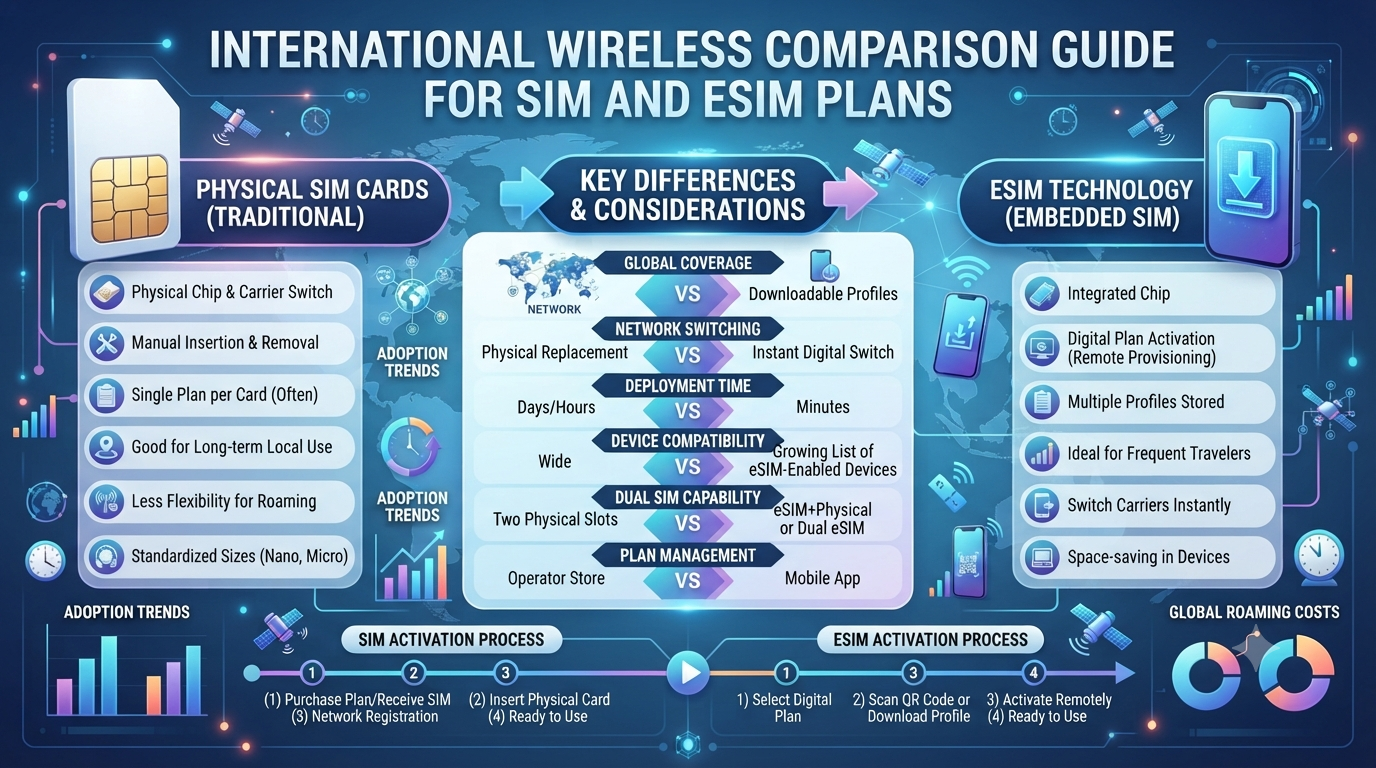
Deciding between SIM vs eSIM plans depends on your phone hardware and daily convenience. A physical SIM is a small plastic card that slides into a handset tray, whereas an eSIM is an integrated chip inside modern smartphones that downloads carrier profiles over the air. Digital eSIMs activate within minutes via QR code and hold multiple lines for international travel, while physical SIM cards fit older phones and transfer immediately if your main device breaks.
| Evaluation Criteria | Physical SIM Card | Digital eSIM |
|---|---|---|
| Installation Step | Slide plastic card into handset slot | Scan QR code or install via carrier app |
| Setup Speed | Wait for mail delivery or visit a store | Connect digitally within minutes |
| Device Support | Fits virtually all unlocked phones | Requires newer eSIM-compatible devices |
| Hardware Swaps | Move card into backup phone instantly | Contact carrier support to transfer line |
| Profile Capacity | Limited by physical SIM tray slots | Stores multiple travel and home lines |
Seven Wireless Plan Models Explained
Carriers organize cellular service into seven core structures, and matching the right structure to your routine saves money immediately:
- SIM-only plans: You keep your unlocked phone and pay strictly for cellular data, calls, and texts at a lower monthly rate.
- Prepaid plans: You pay upfront for a fixed bundle of service, eliminating surprise overage charges when your balance runs out.
- Postpaid plans: You use mobile services throughout the month and settle one invoice afterward, often gaining roaming perks or family sharing.
- Data-only plans: You get mobile internet without traditional voice minutes, which serves tablets, travel hotspots, and internet calling apps.
- Bundled plans: Providers pair a new phone with a multi-year service contract so you pay off the hardware alongside monthly airtime.
- Pay-as-you-go options: You deposit cash credit into your account and pay solely for the exact megabytes, minutes, or messages you consume.
- eSIM plans: Carriers deliver prepaid, postpaid, or data-only packages straight to your smartphone's embedded chip without mailing plastic cards.
Network Operators vs Virtual Providers
Understanding who owns the wireless infrastructure helps you separate raw reception quality from true plan value. A Mobile Network Operator (MNO) builds and owns physical cell towers alongside wireless spectrum, giving direct subscribers top data priority and retail store support at higher prices. A Mobile Virtual Network Operator (MVNO) rents tower access from an MNO to sell lower-priced plans, though MVNO subscribers may experience slower speeds during peak traffic or miss out on 5G and roaming perks.
| Evaluation Area | Mobile Network Operator (MNO) | Mobile Virtual Network Operator (MVNO) |
|---|---|---|
| Tower Assets | Owns physical cell sites and spectrum | Leases network capacity from an MNO |
| Retail Pricing | Charges higher standard monthly rates | Delivers lower, budget-friendly pricing |
| Network Priority | Grants direct customers top traffic priority | May slow speeds during busy hours |
| Extra Perks | Includes roaming, bundles, and retail shops | Focuses on streamlined digital plans |
Regional Rules for Comparing Mobile Plans
Wireless markets follow distinct billing cycles, registration laws, and speed policies across five major destinations:
- United Kingdom: When you compare SIM only deals UK carriers offer, balance flexible 1-month rolling contracts against lower-priced 12-month agreements. Buyers examining unlimited data SIM only deals UK networks advertise must check fair-use speed caps carefully, while light users exploring pay as you go SIM deals UK providers sell should check mandatory top-up intervals and 5G access.
- United States: When you compare prepaid phone plans USA carriers list, confirm whether checkout totals include state taxes and regulatory fees. Shoppers who compare 5G mobile plans USA operators promote should inspect rural coverage maps and check whether budget tiers unlock mid-band 5G speeds and generous hotspot caps.
- Australia: When you compare mobile plans Australia providers sell, watch for 28-day recharge cycles that require 13 payments per year alongside regional tower reach. Visitors and international students searching for prepaid eSIM plans Australia carriers support enjoy rapid airport activation, though not every budget plan includes online eSIM setup.
- Germany: Anyone researching prepaid SIM plans Germany networks offer must prepare for mandatory passport or national ID verification via video call or post office before activation. Most German prepaid packages run on 4-week cycles with compact data buckets, so verify EU roaming rules and current speed limits before paying.
- Canada: When you compare mobile phone plans Canada operators publish, check whether rates apply nationwide or strictly within individual provinces. Compare major networks against their budget flanker brands for 5G speeds, US-Canada roaming add-ons, and speed throttling rules once you exhaust your monthly data allowance.
| Destination | Typical Billing Cycle | Key Local Requirement | Crucial Terms to Verify |
|---|---|---|---|
| United Kingdom | 1-month rolling or 12–24 months | Fair-use caps on unlimited plans | Speed limits, tethering rules, and EU roaming |
| United States | 30-day monthly period | Taxes and fees often add at checkout | Mid-band 5G access, rural reach, and hotspot caps |
| Australia | 28-day or 30-day recharge | 28-day cycles mean 13 payments per year | Data rollover banks, regional signal, and eSIM setup |
| Germany | 28-day (4-week) period | Mandatory government ID verification | EU roaming terms and current data bonuses |
| Canada | Monthly billing period | Province-specific pricing structures | Nationwide reach, 5G access, and overage throttling |
Ten-Point Pre-Purchase Verification Audit
Review these ten practical questions before you order a new SIM card or switch mobile providers:
- How many gigabytes of data do I consume during a typical month?
- Does a fixed data allowance cover my habits, or do I require an unlimited bundle?
- Does my daily routine demand 5G speeds, or does 4G LTE work fine?
- Does the underlying network deliver strong signal inside my home and workplace?
- Does my unlocked smartphone support digital eSIM profiles or only physical cards?
- Does the base price cover unlimited local calls and text messages?
- Does the carrier restrict or block mobile hotspot tethering?
- How many days does each recharge stay active before renewal?
- Did an independent source verify the listed price and terms recently?
- Will taxes, activation fees, or auto-renewal terms raise my final bill?
Frequently Asked Questions
1. Can you explain how SIM-only plans differ from prepaid plans?
SIM-only plans supply wireless service without a phone and allow either monthly billing or upfront payment. Prepaid plans require paying in advance before you consume data, calls, or texts, preventing unexpected bills at cycle end.
2. Which steps help shoppers compare wireless plans across providers?
Measure your monthly data usage first, then evaluate effective costs, validity days, coverage maps, and hotspot caps across MNOs and MVNOs. Checking an independent platform with verified review dates helps you catch hidden restrictions before paying.
3. Does an eSIM always outperform a physical SIM card?
No, because phone compatibility and backup needs differ. An eSIM installs in minutes and stores multiple travel profiles, whereas a physical SIM fits almost any unlocked handset and moves straight into a spare device if your primary phone breaks.
4. Where can UK shoppers locate affordable SIM-only deals?
Compare MVNO providers operating on major British networks, weigh 30-day rolling contracts against 12-month deals, align data allowances with real habits, and verify whether 5G and EU roaming come included.
5. Do unlimited data SIM plans ever cap connection speeds?
Yes, many providers enforce fair-use policies that lower your connection speed during peak hours once you exceed a high usage threshold, while some budget unlimited tiers cap maximum download speeds or limit hotspot sharing.
6. Do prepaid wireless plans support 5G networks?
Many prepaid packages grant 5G access, though entry-level tiers often restrict users to 4G LTE. Reaching 5G requires an unlocked 5G phone, local 5G tower coverage, and a prepaid plan that explicitly includes 5G access.
7. Which details matter most when choosing a prepaid eSIM plan in Australia?
Confirm that your smartphone is unlocked and eSIM-ready, then compare Australian providers on 28-day versus 30-day recharge validity, data rollover rules, regional coverage, and instant online eSIM activation for new prepaid accounts.
8. What separates an MNO from an MVNO?
An MNO owns physical cell towers and wireless spectrum, whereas an MVNO leases network capacity from an MNO to sell lower-priced plans that may carry lower data priority during busy hours.
9. Why should buyers check official plan terms right before checkout?
Carriers adjust rates, promotional bonuses, and hotspot caps without loud announcements. Inspecting current official terms protects you from expired discounts, extra taxes, and strict tethering limits.
10. How does RankeSIM help users evaluate SIM and eSIM plans?
RankeSIM offers an interactive comparison tool with personalized plan-fit scores that break down effective costs, data allowances, validity, 5G availability, hotspot rules, and SIM compatibility alongside official-source references and last-checked dates.
Final Thoughts
Maximizing your mobile budget means looking past low introductory prices to match data caps, recharge cycles, signal strength, 5G access, and device compatibility with your lifestyle. Always verify current terms directly with the carrier before purchasing, and explore RankeSIM whenever you want transparent, verification-backed insights to compare SIM and eSIM plans across major international markets.



Top comments (0)