
Introduction
Ordering food online, checking live train delays, or joining a video call—your phone and laptop handle those jobs without breaking a sweat. Hand those same chips a complex chemical reaction to model or ask them to split a massive number into prime factors, and even giant supercomputers stall for ages. That sharp divide explains why programmers, researchers, and security engineers pay close attention to quantum computing. Instead of pushing electricity through ordinary switches, it uses subatomic physics for narrow, heavy puzzles. Anyone diving into quantum computing for beginners does not need heavy physics equations on day one. QuantumUting helps learners unpack these ideas through clear guides and practical tutorials, and this walkthrough covers the core pieces in plain English.
Inside a Quantum Machine: How the Hardware Differs
Regular laptops and phones send electrical pulses through tiny silicon switches that stay either off or on. A quantum machine works with microscopic physical systems—such as trapped ions, superconducting loops, or light particles—that obey quantum mechanics. Picture a regular bit like a ten-rupee coin lying flat on a desk: heads or tails. A quantum processor acts closer to a coin spinning on its edge, holding a mix of possibilities until someone stops it to see where it lands. Labs and cloud services run early versions of these machines to test chemistry, battery materials, and scheduling, while the hardware itself stays fragile and experimental.
What Is a Qubit and Why Does It Change Information?
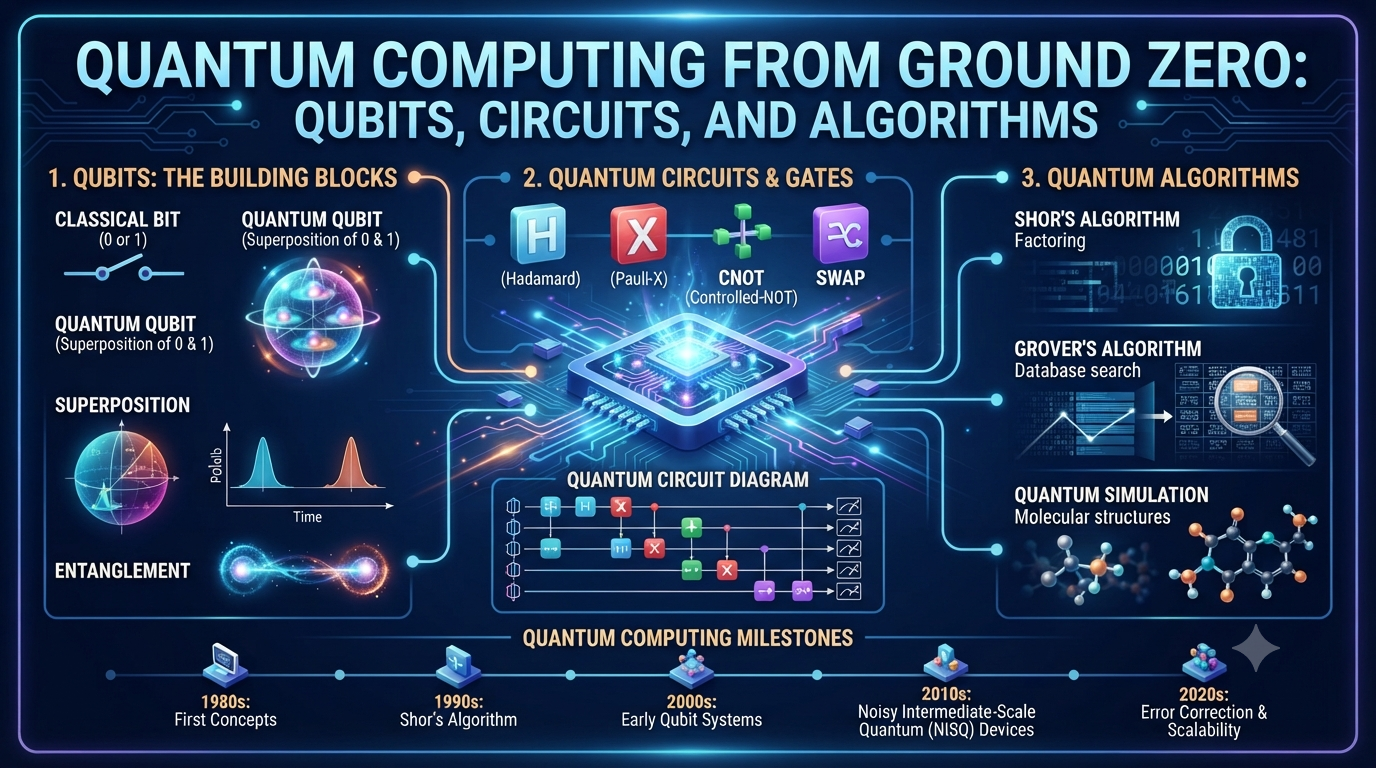
Ask any engineer what is a qubit, and the talk quickly shifts to two strange traits of quantum physics. Short for quantum bit, a qubit is the basic unit of data inside a quantum processor, and it refuses to act like a rigid on-off switch.
- Superposition: A qubit can hold a weighted blend of 0 and 1 at once, letting an algorithm shape probabilities across multiple paths before reading an output.
- Entanglement: Two or more qubits can link so tightly that checking one immediately tells you something about its partner, even across a wide gap.
- Measurement: Measuring a qubit knocks it out of its delicate state and leaves behind a plain 0 or 1 that a normal screen can show.
Quantum Computing vs Classical Computing: Choosing the Right Machine
Comparing quantum computing vs classical computing is like setting a heavy goods train next to a rally car. Each does a job the other cannot match. Classical machines are steady, affordable workhorses for web apps, databases, gaming, and daily office tasks. Quantum processors are fragile, high-maintenance tools built for narrow math and physics problems.
| Feature | Classical Computing | Quantum Computing |
|---|---|---|
| Core Data Unit | Bit (strictly 0 or 1) | Qubit (0, 1, or a superposition of both) |
| Governing Physics | Classical electromagnetism | Quantum mechanics |
| Processing Logic | Standard logic gates (AND, OR, NOT) | Reversible quantum gates |
| Hardware Stability | Reliable at room temperature | Sensitive to heat, vibration, and noise |
| Ideal Workload | Web apps, databases, gaming, daily work | Molecular simulation, factoring, optimization |
Quantum Gates Explained: Steering Qubits Without Heavy Math
Putting a qubit into superposition does not solve a problem on its own. You have to steer it, which is why quantum gates explained simply is so useful. Classical gates overwrite bits as they pass through. Quantum gates rotate or link qubit states while staying reversible, meaning you can undo the math steps.
- Pauli-X Gate: Flips a 0 to a 1 and a 1 to a 0, acting like a classical NOT gate.
- Hadamard Gate: Moves a plain 0 or 1 into an even superposition of both states.
- Pauli-Z Gate: Leaves 0 alone while flipping the hidden wave phase of 1.
- CNOT Gate: Connects two qubits and flips the second target qubit only when the first control qubit is 1.
Quantum Circuits Tutorial: Reading the Diagram and Testing Code
Think of a quantum circuit like sheet music read from left to right. In this quantum circuits tutorial, each horizontal line stands for one qubit starting at 0, passing through gate boxes, and ending at a measurement symbol on the right. You do not need lab gear to try this. Free Python tools like Qiskit let you build circuits and run simulations right on a normal laptop.
- Begin with two qubits, Qubit A and Qubit B, both initialized to 0 on the far left.
- Drop a Hadamard gate onto Qubit A so it enters an even blend of 0 and 1.
- Connect Qubit A to Qubit B with a CNOT gate so their states lock together.
- Measure both wires on the right; instead of random noise, you record matching pairs of 00 or 11.
Quantum Computing Algorithms Explained: How Interference Shapes Results
A circuit shows the wiring on paper, while an algorithm supplies the math plan. When looking at quantum computing algorithms explained in plain words, the key trick is interference. Programmers line up gates so wrong answers cancel out like opposing waves, while right answers grow stronger. Grover's algorithm speeds up searches through unsorted data, and Shor's algorithm targets prime factors of large numbers. Both show why quantum logic helps on structured math tasks rather than everyday apps.
Shor's Algorithm Explained: Why Prime Factoring Matters for Security
You often see Shor's algorithm explained in stories about online security. Created by mathematician Peter Shor, it finds the prime factors of big numbers much faster than known classical methods. Multiplying two huge primes takes a normal computer almost no time. Working backward from that large product to find the original primes would take a classical supercomputer millions of years. Many current security locks rely on that gap. A large, error-corrected quantum computer running Shor's algorithm could break those locks, though today's machines are still far too small.
Real-World Applications of Quantum Computing in Research and Industry
Most real-world applications of quantum computing are still in early research and lab testing. Even so, teams are running experiments in several areas to see where quantum processors add real value.
- Drug Discovery: Simulating how molecules interact so researchers can test candidate compounds faster.
- Battery and Material Design: Modeling electron behavior to find better battery materials, solar cells, and catalysts.
- Logistics and Routing: Testing ways to plan delivery routes, schedules, and supply chains more efficiently.
- Financial Risk Modeling: Running complex simulations to study market risk and spot unusual patterns.
- Machine Learning Research: Exploring how quantum circuits might help train or process certain models.
Post-Quantum Cryptography Explained: Preparing Digital Locks Early
Having post-quantum cryptography explained clearly helps keep security planning grounded. Because future large quantum machines could weaken some public-key encryption in use today, engineers are rolling out quantum-resistant defenses. Post-quantum cryptography uses new math problems—such as lattice-based puzzles—that are hard for both classical and quantum computers to crack. It runs as software on regular phones and servers today, unlike hardware-based quantum cryptography that uses physical light signals like photons to share keys.
How to Learn Quantum Computing: Ten Practical Steps to Start
If you want to know how to learn quantum computing, start small and skip heavy physics textbooks at the beginning. A steady sequence of basics and coding works better.
- Review foundational math: Brush up on algebra, probability rules, and complex numbers.
- Study basic linear algebra: Focus on vectors and matrices, since qubit states and gates rely on them.
- Learn core quantum rules: Read clear guides on superposition, entanglement, and measurement.
- Trace basic gate behavior: Follow how X, H, Z, and CNOT gates alter simple states on paper.
- Practice reading circuits: Track small diagrams from left to right to predict final measurements.
- Write simple Python scripts: Get comfortable with variables, lists, loops, and functions.
- Run circuits in Qiskit: Install Qiskit and simulate small quantum circuits on your laptop.
- Walk through classic algorithms: Study small examples of Deutsch-Jozsa, Grover's search, and Shor's factoring.
- Build tiny test projects: Code a quantum random number generator or a basic coin-flip script.
- Stick to a steady habit: Practice a little each week and jot down short notes as concepts click.
Common Mistakes Beginners Should Avoid
Newcomers often run into the same misconceptions early on. Keeping these points in mind helps you avoid wasted effort.
- Assuming quantum computers beat classical ones at everything: They only help on specific math and simulation tasks.
- Thinking a qubit stores two normal bits at once: A qubit holds a probability state, not two separate binary slots.
- Confusing superposition with ordinary parallel computing: Quantum machines do not just test every answer at once like millions of normal CPUs.
- Believing entanglement sends instant messages: Entangled qubits are correlated, but you still need a regular channel to send usable information.
- Expecting classical computers to go away: Classical systems will stay central and work alongside quantum hardware.
- Waiting to master physics before coding: Basic linear algebra and Python are enough to start writing simple circuits.
- Treating lab experiments as finished products: Most quantum tools today are for research, testing, and learning.
How QuantumUting Helps Readers Explore Quantum Technology
Learning a technical subject gets much easier when complex ideas are put into plain language. QuantumUting focuses on decoding the quantum future for students, developers, security professionals, and curious beginners. Through structured guides, Qiskit examples, circuit walkthroughs, and articles on algorithms and post-quantum security, it gives readers a practical place to build knowledge step by step.
Frequently Asked Questions About Quantum Computing
- 1. What is quantum computing in simple words? It is a way of computing that uses quantum physics to solve specialized math and science problems that are tough for regular computers.
- 2. What is a qubit, and how is it different from a bit? A classical bit is 0 or 1, while a qubit can hold a combination of 0 and 1 until measured.
- 3. Is quantum computing better than classical computing? Only for specific problems like molecular simulation or factoring; normal computers are far better for everyday work.
- 4. Do I need to know physics to learn quantum computing? No. Basic linear algebra, probability, and beginner Python are enough to start building circuits.
- 5. What are quantum gates used for? They are operations inside a circuit that change qubit states, create superposition, or entangle qubits.
- 6. How does a quantum circuit work? Qubits move from left to right through gates and finish with a measurement that gives classical 0s and 1s.
- 7. What is Shor's algorithm used for? It factors large numbers quickly, which matters for public-key encryption.
- 8. Can quantum computers break current encryption? Not today. Current machines are too small, though stronger future ones could threaten older encryption.
- 9. Where can quantum computing be used in real life? Active research covers drug discovery, battery materials, routing and logistics, financial modeling, and machine learning.
- 10. How can a beginner start learning quantum computing? Review basic linear algebra and Python, read beginner guides on qubits and gates, and try simple circuits in Qiskit.
Final thoughts
Treat quantum computing as a specialized tool rather than a replacement for your daily laptop or phone. Qubits, gates, circuits, and algorithms follow logical patterns once you build and run a few small examples yourself. Standard machines will continue handling everyday apps, while quantum processors tackle targeted puzzles in chemistry, optimization, and security.



Top comments (0)