
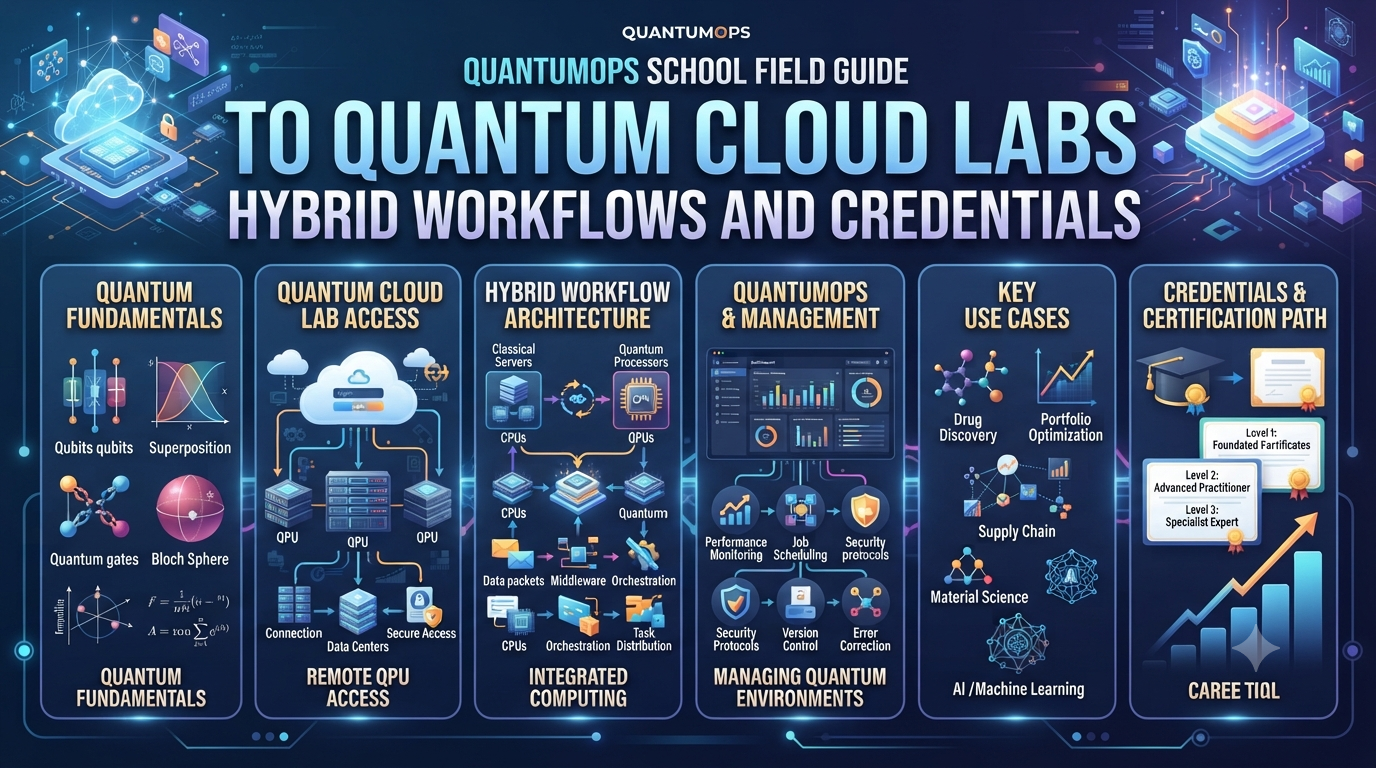
Introduction
Quantum devices compute by shaping probability amplitudes and interference rather than toggling fixed silicon switches, which explains why software engineers, cloud engineers, system architects, researchers, and IT managers are exploring them early—while QuantumOps School offers structured courses, role-based certification tracks, and consulting support centered on hands-on capability.
Understanding Quantum Computing in Simple Terms
Rather than flipping fixed zeros and ones, quantum systems work with probability weights, wave interference, and linked states, though a quantum processor will not beat classical hardware on every task because real speedups depend on matching the right problem and algorithm to quantum mechanics.
Qubits: Quantum two-state units that can hold superpositions of basis states rather than a single fixed value before measurement.
Classical bits: Standard binary units locked to either 0 or 1 at any moment.
Quantum gates: Operations that rotate or transform qubit states and create entanglement.
Superposition: A state combining basis possibilities with complex probability amplitudes until measured.
Entanglement: Correlation between qubits where joint measurement outcomes cannot be factored independently.
Quantum measurement: Reading out a quantum state, collapsing superposed probabilities into classical bit results.
Quantum circuits: Ordered sequences of gates and measurements acting on a register of qubits.
Quantum algorithms: Step-by-step procedures designed to use interference and phase structure for specific tasks.
Quantum Computing vs Classical Computing
Conventional servers and laptops still handle everyday enterprise software, databases, and web services far better than quantum machines, meaning quantum processors are far more likely to run narrow subroutines beside classical systems rather than replace them wholesale.
Dimension Classical Computing Quantum Computing
Information representation Deterministic bits (0 or 1) Qubits in superposition with probability amplitudes
Processing methods Boolean logic gates and sequential pipelines Quantum gates, interference, and entanglement
Hardware design Silicon transistors near room temperature Superconducting, trapped-ion, or photonic chips with cooling or vacuum
Programming approaches Standard imperative, object-oriented, or functional code Quantum circuits, SDK abstractions, and hybrid loops
Error handling Mature hardware redundancy and error correction Noise, decoherence, and quantum error correction overhead
Practical applications Databases, web apps, enterprise software, analytics Research in simulation, optimization, cryptography, and algorithms
Infrastructure requirements Standard servers, laptops, and cloud data centers Quantum processors, control hardware, cloud access, and classical hosts
Quantum Cloud Computing: Accessing Quantum Technology Through the Cloud
Running circuits over the cloud lets learners and technical teams experiment with simulators and remote quantum processors—across platforms like IBM Quantum, AWS Braket, and Azure Quantum—without building a physical lab, while practical quantum cloud computing training builds comfort with job queues, quotas, and remote execution habits.
Cloud-based quantum access: Reaching simulators and remote quantum backends over managed APIs and cloud consoles.
Quantum hardware availability: Dealing with shared access windows, queue wait times, and scheduled maintenance on real devices.
Quantum simulators: Emulating qubit states and noise models on classical servers for fast iteration and debugging.
Quantum circuit execution: Packaging circuits with shot counts and backend options for remote runs.
Job submission: Sending tasks to cloud queues and polling or retrieving execution outputs.
Workload management: Sequencing experiments, handling retries, and separating noisy hardware runs from simulator checks.
Cloud integration: Connecting quantum notebooks or jobs with cloud storage, IAM roles, and existing pipelines.
Access permissions: Managing credentials, project quotas, and team permissions across cloud accounts.
Resource limitations: Working around qubit counts, circuit depth limits, shot caps, and simulator memory ceilings.
Quantum Programming: Tools and Frameworks to Learn
Developers write quantum software by defining circuits, testing logic on simulators, and submitting jobs to quantum backends through SDKs, and because each library brings distinct syntax, compilation passes, and workflow habits, no two frameworks behave identically.
Qiskit: Open-source Python framework for building circuits, running transpilation passes, and executing on simulators and IBM backends.
Cirq: Python library focused on gate-level circuit construction and noisy intermediate-scale circuit workflows.
Microsoft Quantum Development Kit: Toolset supporting quantum programming workflows and integration with Azure Quantum targets.
AWS Braket SDK: Python SDK for defining circuits or hybrid jobs and running them on Braket simulators and devices.
IBM Quantum tools: Cloud services, runtime primitives, and software utilities for circuit execution and backend inspection.
Azure Quantum development tools: Cloud workspace tools and SDK integrations for submitting quantum workloads on Microsoft's cloud.
Qiskit Programming Course: Learning Practical Quantum Development
Working through a Qiskit programming course gives Python programmers a direct way to assemble circuits, apply gates, simulate runs, and inspect shot distributions, making gate behavior and probability shifts click much faster than reading definitions alone.
Setting up the development environment: Installing Python packages, configuring local simulators, and checking version compatibility.
Creating quantum circuits: Initializing quantum and classical registers and adding gate operations in order.
Working with qubits: Tracking individual qubit indices, layouts, and state changes across steps.
Applying quantum gates: Using single-qubit rotations and multi-qubit entangling gates to shape amplitudes and phase.
Measuring quantum states: Mapping measured qubits to classical bits and repeating shots to sample output frequencies.
Running circuit simulations: Executing circuits locally or on cloud simulators before touching physical hardware.
Understanding circuit results: Reading histogram counts, probabilities, and expected values rather than assuming single deterministic answers.
Exploring basic quantum algorithms: Implementing small textbook routines to see interference and phase kickback in action.
AWS Braket Training: Exploring Quantum Computing on AWS
Structured AWS Braket training walks learners through workspace setup, local or managed simulators, cloud task submission, and cost or quota tracking, while reinforcing that cloud access never guarantees unlimited capacity or every quantum device.
Understanding the Amazon Braket environment: Navigating Braket notebooks, S3 result buckets, IAM permissions, and service regions.
Exploring quantum simulators: Comparing fast local testing against managed cloud simulators for larger or parameterized runs.
Creating quantum circuits: Writing circuits in the Braket SDK and specifying observables or measurement outputs.
Submitting quantum tasks: Dispatching single tasks or batch runs and monitoring status through completion.
Understanding supported quantum hardware: Checking device specifications, connectivity, and availability before routing tasks.
Managing cloud-based workloads: Tracking shot counts, task concurrency, and execution timing across team accounts.
Reviewing execution results: Parsing output files from S3 or SDK objects and checking for device-specific quirks.
Understanding service costs and resource limitations: Watching per-task and per-shot charges alongside service quotas so experiments stay controlled.
Quantum Computing for Software Engineers
Approaching quantum computing for software engineers as an extra technical skill complements everyday software development rather than replacing it, letting developers lean on existing Python, algorithm, testing, and cloud habits once they brush up on basic linear algebra and probability.
Programming fundamentals: Writing clean, modular code, managing dependencies, and handling asynchronous execution cleanly.
Python: Using Python comfortably for circuit scripting, numerical checks, and result analysis.
Algorithms: Reasoning about complexity, search structure, and step counts rather than relying on trial-and-error coding.
Data structures: Organizing state vectors, graph inputs, parameter sets, and experiment logs systematically.
Quantum circuits: Translating logical steps into gates, measurements, and parameterized circuit templates.
Quantum programming frameworks: Navigating SDK APIs, transpiler levels, and backend target differences without getting stuck.
Cloud computing: Handling API keys, cloud storage, queues, and cost controls like any other distributed service.
Mathematical foundations: Refreshing complex numbers, matrix multiplication, tensor products, and probability distributions.
Software testing: Verifying circuit behavior against small analytical cases and simulator baselines before scaling up.
Problem-solving: Spotting where classical algorithms already solve a task well and where quantum methods might fit.
Quantum Computing Architecture: Understanding the Main Components
A quantum computing architecture course connects physical qubits and control electronics with software compilers, runtime layers, and cloud interfaces, helping engineers separate hardware limits from workload orchestration.
Qubits and quantum processors: Physical or logical quantum units arranged on a chip or trap with specific connectivity.
Quantum gates: Calibrated physical pulses or optical/ion operations that implement logical gate transformations.
Control systems: Microwave, laser, or electronic signal generators that drive and tune qubit operations.
Measurement systems: Readout hardware and signal processing that classify qubit states into classical bits.
Quantum circuits: The high-level logical representation compiled down to hardware-supported gates and native topologies.
Classical control systems: Low-latency controllers and classical processors that coordinate calibration, sequencing, and feedback.
Quantum software layers: Compilers, optimizers, and runtime libraries that lower circuits to executable instructions.
Cloud access layers: APIs, schedulers, queues, and authentication gateways exposing backends to remote users.
Error correction methods: Techniques such as error mitigation or fault-tolerant encoding used to manage noise and errors.
Hardware limitations: Coherence times, gate fidelities, qubit counts, and routing overhead that cap circuit depth.
Hybrid Quantum-Classical Computing: Combining Two Computing Approaches
In hybrid quantum classical computing training, engineers see how classical code and quantum circuits pass parameters and measurement feedback back and forth in iterative loops for near-term optimization and quantum machine learning research, though this setup does not guarantee beating classical solvers.
Classical preprocessing: Cleaning inputs, encoding problem data, and setting initial parameter values on classical hardware.
Quantum circuit execution: Running parameterized circuits on a simulator or quantum processor to sample measurement outcomes.
Classical optimization: Updating parameters with classical optimizers based on objective values estimated from quantum outputs.
Result evaluation: Checking convergence, variance, and solution quality against classical reference methods.
Iterative computation: Repeating circuit runs and parameter updates across many cycles until a stopping rule triggers.
Workload coordination: Managing latency, network hops, and job queues between classical hosts and quantum backends.
Cloud-based execution: Hosting classical workers and cloud quantum calls together while tracking runtime and budget limits.
Quantum Computing Certification: Building Professional Knowledge
A quantum computing certification course gives self-paced learners a structured syllabus and tests practical understanding through labs, exams, or projects, even though a certificate never guarantees employment or universal recognition.
Quantum fundamentals: Core concepts including qubits, superposition, entanglement, interference, and measurement.
Quantum programming: Practical circuit construction and simulation using mainstream SDKs.
Quantum algorithms: Familiarity with foundational algorithms and how quantum advantage is evaluated.
Quantum hardware: Awareness of physical qubit modalities, noise sources, and connectivity limits.
Cloud quantum platforms: Experience running jobs and managing quotas across cloud quantum environments.
Quantum architecture: Understanding how compilers, control electronics, runtime layers, and cloud APIs fit together.
Hybrid computing: Building iterative loops that pair classical optimization with quantum circuit evaluation.
Practical exercises: Guided coding drills that reinforce gate behavior and debugging habits.
Technical assessments: Quizzes, exams, or practical checks that test applied comprehension.
Applied projects: End-to-end mini-projects that document problem framing, circuit design, and results.
QuantumOps Certification: Understanding the Four Professional Learning Tracks
Reviewing QuantumOps certification paths lets candidates match four role-focused tracks—Architect, Engineer, Manager, and Professional—to their daily work by checking published syllabi, exam rules, and credential details directly rather than assuming external accreditation.
QuantumOps Architect: Focused on system design, hardware-software boundaries, cloud integration patterns, and technical trade-offs.
QuantumOps Engineer: Focused on circuit coding, SDK workflows, simulator and cloud job execution, and hybrid loop implementation.
QuantumOps Manager: Focused on use-case screening, team readiness, budget planning, vendor evaluation, and realistic milestones.
QuantumOps Professional: Focused on broad foundational literacy across quantum concepts, tools, workflows, and practical limitations.
Quantum Computing for IT Managers: Planning Technology Adoption
Practical quantum computing for IT managers centers on clear problem framing, team bandwidth, realistic budgets, and measured expectations rather than hype, keeping exploratory work useful without derailing core delivery.
Understanding business problems: Pinpointing bottlenecks first and checking whether a classical solution is already faster or cheaper.
Evaluating possible use cases: Screening candidate problems for real structural fit rather than chasing headlines.
Identifying technical requirements: Mapping out Python and cloud skills, simulator needs, and integration touchpoints.
Assessing cloud platforms: Comparing available SDK ecosystems, queue behavior, and access models against team goals.
Planning budgets: Setting aside controlled exploration funds for training, simulators, and cloud job quotas.
Managing technical teams: Giving engineers protected time to learn without pulling critical staff off production systems.
Reviewing security considerations: Checking data handling, access controls, and cryptographic planning implications responsibly.
Evaluating vendor capabilities: Asking clear, technical questions about maturity, benchmarks, and real limits.
Understanding research and development needs: Treating early quantum work as R&D rather than a near-term production replacement.
Setting realistic expectations: Keeping leadership and stakeholders aligned on current hardware capabilities and timelines.
Quantum Computing Use Cases Across Different Industries
Most industry activity around quantum computing today stays within exploratory research and early pilots rather than proven commercial advantage, so keeping research initiatives separate from live business systems keeps evaluation honest.
Industry Potential or Research Focus Current Maturity Note
Finance Optimization research, portfolio analysis, selected financial modeling Experimental study; classical models lead production
Healthcare Molecular simulation and complex scientific modeling Research-focused; clinical systems remain classical
Pharmaceuticals Molecular modeling and chemistry research Active research; commercial breakthroughs depend on future progress
Logistics Routing and optimization problems Studied alongside classical optimization tools
Research Institutions Quantum algorithms, simulations, experimental studies Core hub for testing new methods
Technology Companies Quantum software development, cloud integration, hybrid experiments Focused on tooling, education, and early prototypes
Quantum Computing Consulting Services: Helping Organizations Explore Adoption
Working with quantum computing consulting services—including QuantumOps School's advertised advisory offerings—can help organizations scope a narrow problem, benchmark it against classical baselines, and structure early experiments, though outside guidance never guarantees commercial outcomes.
Quantum technology assessments: Reviewing where an organization stands and separating practical exploration from noise.
Quantum cloud integration: Setting up cloud workspaces, credentials, and repeatable experiment pipelines.
Quantum algorithm development: Prototyping small circuits and testing candidate routines on simulators.
Workload optimization: Inspecting circuit depth, shot counts, and hybrid loop structure to avoid wasted runs.
Hybrid quantum-classical systems: Designing clean interfaces between classical solvers and quantum subroutines.
Cloud security considerations: Reviewing identity, permissions, and data governance around cloud experiments.
Implementation planning: Phasing small pilot steps with clear exit criteria and checkpoints.
Technical feasibility evaluation: Checking whether a proposed problem actually suits quantum methods or belongs on classical hardware.
Research and development guidance: Structuring internal learning and experimental milestones for R&D teams.
Skills Required for a Career in Quantum Computing
Building career readiness usually means layering math, Python, algorithmic thinking, and cloud fluency onto existing technical experience, expanding professional range without guaranteeing specific salaries, job placements, or career outcomes.
Mathematics: Comfort with vectors, matrices, inner products, and basic probability.
Linear algebra: Understanding state vectors, unitary matrices, and basis transformations.
Probability: Reading sampling distributions, expectation values, and variance from repeated shots.
Python programming: Writing clean scripts, notebooks, and tests with standard scientific libraries.
Algorithms: Following how problems are structured and how runtime scaling is analyzed.
Quantum mechanics fundamentals: Grasping states, observables, superposition, and entanglement without getting lost in heavy physics jargon.
Quantum programming frameworks: Working fluently in at least one SDK such as Qiskit or AWS Braket.
Cloud computing: Managing cloud accounts, storage, CLI/API workflows, and usage quotas.
Problem-solving: Breaking unfamiliar bugs or noisy results down into small testable hypotheses.
Research skills: Reading technical papers, benchmarks, and documentation critically.
System architecture: Seeing how software, hardware constraints, and cloud services connect in a complete stack.
How QuantumOps School Supports Practical Quantum Learning
QuantumOps School pairs guided instruction with labs, simulations, assessments, and capstone work across tools like Qiskit, Cirq, Microsoft Quantum Development Kit, AWS Braket, IBM Quantum, and Azure Quantum, offering online and classroom formats in India.
Instructor-led training: Live sessions that walk through concepts and coding examples with room for questions.
Practical labs: Hands-on exercises where learners build, run, and inspect circuits themselves.
Quantum simulations: Controlled practice on simulators to test logic and observe noise effects.
Technical exercises: Targeted drills on gates, circuits, cloud tasks, and hybrid steps.
Case studies: Practical scenarios showing how problems and constraints are analyzed.
Technical assessments: Checks that verify whether learners can apply ideas rather than just recall terms.
Capstone projects: Larger exercises tying together circuit design, simulation or cloud execution, and write-ups.
Professional learning tracks: Structured paths across Architect, Engineer, Manager, and Professional roles.
How to Choose the Right Quantum Computing Training Program
Pick a course that fits your current background, schedule, and goals—and delivers real coding practice rather than passive slides—while verifying labs, instructor support, assessments, and fee or refund policies upfront.
Course curriculum: Check whether the syllabus covers core foundations, coding, cloud workflows, and realistic limits.
Quantum fundamentals: Make sure qubits, gates, superposition, entanglement, and measurement are taught clearly.
Programming exercises: Look for regular coding tasks rather than lecture-only slides.
Cloud platform access: Confirm how simulator or cloud backend practice is handled during the course.
Practical laboratories: Check that labs give learners real environment setup and debugging practice.
Instructor guidance: See whether instructors answer technical questions and review work meaningfully.
Framework coverage: Verify which SDKs or cloud platforms—such as Qiskit or AWS Braket—are actually used.
Assessment methods: Look for practical tests or exercises that measure real skill building.
Capstone projects: Check if there is a culminating project to tie concepts together.
Certification requirements: Understand what exams, labs, or criteria are needed to earn a certificate.
Credential recognition: Keep expectations realistic and verify exact program details rather than assuming external endorsement.
Learning support: Check office hours, documentation resources, or cohort channels available to students.
Course format: Compare online, live instructor-led, or classroom options in India against your schedule.
Fees and refund policies, where publicly available: Review tuition, payment terms, and refund rules before enrolling.
Common Challenges When Learning Quantum Computing
Rusty linear algebra, counterintuitive qubit behavior, hardware noise, and simulator or queue limits catch many newcomers off guard, yet steady simulator runs, reading official documentation, and debugging small circuits turn confusion into steady progress.
Mathematical complexity: Relearning matrix math and complex numbers can slow down early chapters if skipped.
Understanding qubits: Treating qubits like tiny classical switches trips up learners at first.
Learning quantum gates: Remembering what each gate does to amplitudes and phase takes repeated circuit practice.
Understanding superposition and entanglement: Relying on loose metaphors alone often breaks down when writing multi-qubit circuits.
Programming framework differences: Switching between SDKs can feel awkward due to different APIs and compilation defaults.
Limited hardware access: Queue delays, maintenance windows, and shared quotas can interrupt tight study schedules.
Quantum noise: Real hardware outputs look messy compared with clean textbook state diagrams.
Error correction complexity: Understanding why fault tolerance requires extra physical qubits and overhead takes time.
Cloud resource limitations: Hitting runtime caps, shot limits, or simulator memory bounds requires careful experiment sizing.
Identifying practical use cases: Telling realistic research problems apart from overhyped claims takes honest comparison against classical methods.
Frequently Asked Questions About Quantum Computing Training
- What is quantum cloud computing training?
It is hands-on practice using cloud platforms to write circuits, submit jobs to simulators or quantum hardware, and inspect results remotely.
- What should a quantum computing certification course include?
A solid program covers quantum basics, circuit programming, core algorithms, hardware limits, cloud platforms, architecture, hybrid loops, labs, and assessments.
- What is QuantumOps certification?
It covers the four role-based tracks offered by QuantumOps School—Architect, Engineer, Manager, and Professional—across technical and management areas.
- Is a Qiskit programming course suitable for beginners?
Yes, provided it starts with basic Python and eases into qubits, gates, and simulations step by step without requiring advanced physics upfront.
- What can learners do with AWS Braket training?
Learners can set up Braket, run circuits on simulators, submit cloud tasks, review outputs, and track costs and resource limits.
- Why should software engineers learn quantum computing?
It builds familiarity with probabilistic computation and lets developers apply Python, testing, and cloud habits when evaluating future systems.
- What does a quantum computing architecture course teach?
It shows how physical qubits, control electronics, compilers, and cloud layers interact alongside hardware constraints and error correction.
- What is hybrid quantum-classical computing?
It is a workflow where classical software and quantum circuits trade steps—covering data prep, optimization loops, and targeted circuit runs.
- When do businesses need quantum computing consulting services?
They are most useful when testing feasibility, planning cloud experiments, shaping hybrid prototypes, or helping teams avoid hype.
- Why should IT managers understand quantum computing?
Practical insight helps leaders plan budgets, support team learning, evaluate cloud options, and keep timelines grounded.
Final Thoughts
Keep your expectations sober and your testing methodical: start with small circuits on local simulators, check cloud quotas before queuing tasks, compare results against classical code, and turn to QuantumOps School when your team wants structured labs, role tracks, or consulting support.



Top comments (0)