
Introduction
Developers ship fresh code every single day, yet confirming what actually runs live still creates friction. Engineers merge pull requests in Git, build pipelines compile software packages, and deployment scripts push updates across separate environments.
Because these tools rarely share context, vital operational details slip between handoffs. A teammate checks chat logs to verify a rollout time. Another engineer compares spreadsheets just to confirm which fixes reached customers.
Disconnected release records delay incident response and turn audit prep into exhausting manual work. Building a reliable delivery habit starts with linking every technical signal into one clear release record.
How a Release Intelligence Platform Goes Beyond Basic Logs
Simple deployment scripts only show whether a rollout command ran without errors. Manually written status reports consume hours of engineering time and go stale the moment another patch merges.
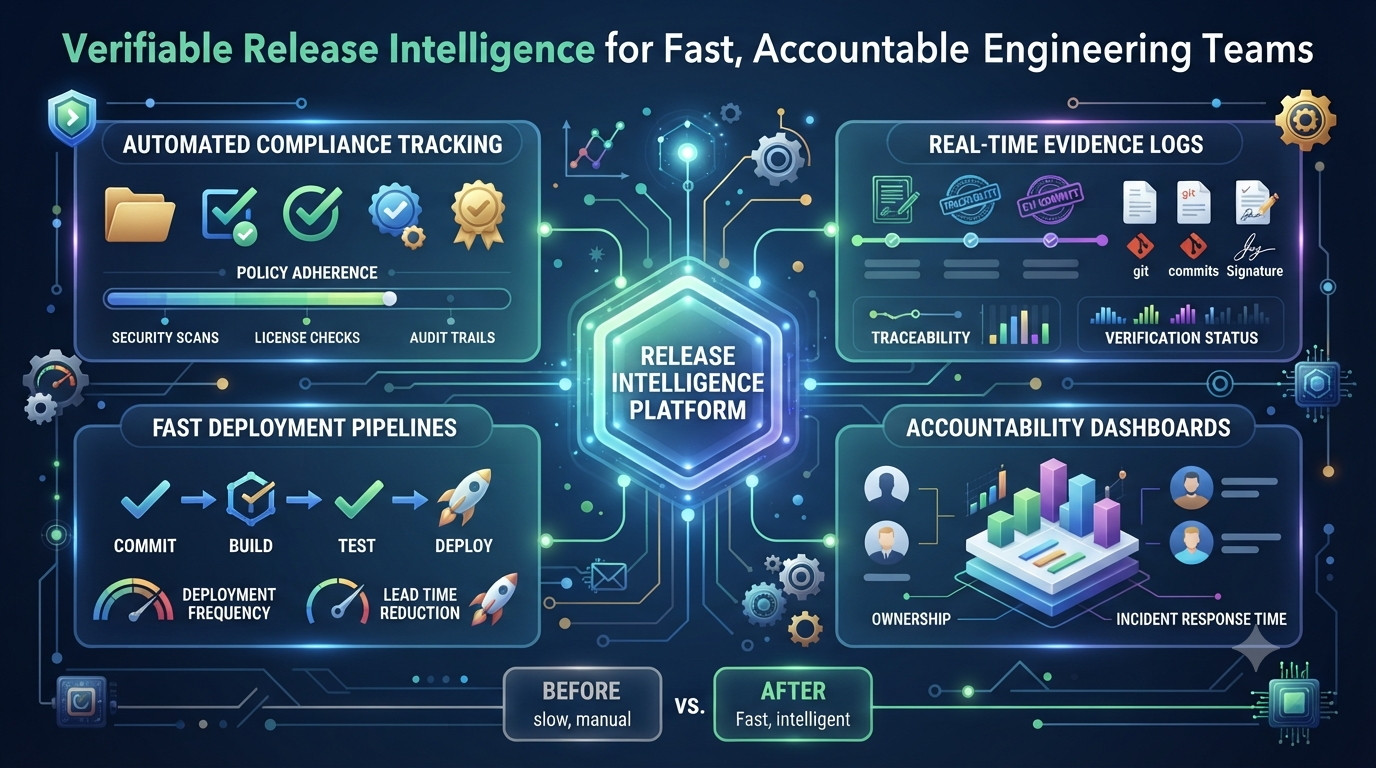
A release intelligence platform goes much deeper than basic pass-or-fail checks. It collects raw technical evidence across your engineering stack and connects those facts into a verified release record.
Reloqui brings this intelligence straight into your daily delivery workflow. Rather than replacing your code repositories, issue trackers, or pipelines, it links their data together to reveal the full story behind every version.
What a Software Release Tracking Tool Connects for Every Version
A dependable software release tracking tool acts as the central map for every version you ship. It follows code changes from initial planning tasks all the way to live production servers.
Instead of switching between separate dashboards, teams inspect one unified timeline. This clarity answers four core delivery questions right away:
- Code scope: Which pull requests and commits entered this release?
- Task alignment: Which planned features and bug reports match the shipped code?
- Build lineage: Which pipeline execution compiled and packaged the software?
- Runtime state: Which staging or production clusters currently run this version?
Clear answers remove guesswork before, during, and after every rollout.
How the 11-Stage Reconciliation Engine Builds Confidence
Matching records across separate developer tools requires smart, automated logic. Reloqui performs this work through an 11-stage release reconciliation engine.
First, the engine collects technical signals from your connected platforms and classifies each piece of data. Next, it links matching pull requests, issue tickets, builds, packaged artifacts, and deployments to the proper software version.
To help teams judge release health, the platform calculates an explainable confidence score using concrete signals:
- Valid Git tags paired with linked pull requests.
- Passing continuous integration build logs.
- Verified package entries inside your artifact registry.
- Confirmed rollout records from target deployment environments.
- Orphaned code changes missing an associated issue ticket.
- Late force-push activity that altered commit history near release time.
This score gives teams an objective, evidence-backed indicator. Still, engineers treat it as a practical decision aid rather than a guarantee of bug-free code.
Tracing Changes From Ticket to Live Production Traffic
End-to-end software release change traceability lets engineers follow any single update from initial ticket to live production traffic. You can trace a running feature straight back to its build artifact, pull request, and original business requirement.
This unbroken chain of technical proof strengthens daily engineering work in practical ways:
- Rapid incident triage: On-call responders isolate the exact commit behind a latency spike within minutes.
- Thorough peer reviews: Tech leads confirm that every merged change connects to an approved task.
- Clear post-incident reviews: Teams reconstruct rollout timelines using verified system records rather than memory.
- Smooth compliance audits: Security reviewers inspect clear proof showing who authored, built, and approved each update.
Reliable traceability turns tedious historical searches into instant, single-click lookups.
Linking GitHub, Jira, and CI/CD Workflows Across Teams
Engineering teams rely on specialized tools for every stage of development. Developers review code in Git platforms, product managers organize sprints in issue trackers, and pipelines automate builds.
Configuring GitHub Jira release tracking ties code commits directly to project issues. Whenever an engineer merges a pull request, the release record updates the matching task status automatically.
Pairing this context with a CI/CD deployment tracking dashboard gives everyone real-time visibility into build and rollout progress. Teams watch verified artifacts advance from test environments into live production.
Reloqui supports these connections across twelve distinct connector types. Its ecosystem integrates with GitHub, GitLab, Bitbucket, Azure DevOps, Jira, and Linear, alongside CI/CD tools, artifact registries, Terraform, and incident platforms. Because each tool structures data differently, every connector gathers tailored signals suited to that specific platform.
Checking Release Readiness Before You Ship Code
Shipping quickly only succeeds when teams catch missing requirements before customers notice problems. Confirming release readiness means verifying that code merges, builds, packages, and approvals all align properly.
Using release readiness assessment software flags potential gaps prior to deployment. If an artifact fails to publish or a critical ticket stays open, the system highlights the issue immediately.
Even with automated checks, human judgment remains essential. Release owners must review flagged exceptions and inspect incomplete evidence before authorizing any production rollout.
Governing Releases With Policies and Approval Workflows
Growing engineering organizations need clear guardrails to prevent accidental production changes. Regulated industries and enterprise teams enforce strict controls to protect service stability.
Strong release governance combines clear approval thresholds, publishing rules, scheduled freeze windows, and permanent version snapshots. Adopting release approval workflow software keeps sign-off decisions consistent across every squad.
Reloqui embeds these controls directly into your delivery lifecycle. Teams define required reviewers, pause rollouts during scheduled freeze windows, and enforce policy rules automatically. While these guardrails reduce operational risk, no software platform can prevent every possible deployment failure.
Automating Release Notes and Preserving Audit Records
Writing release summaries manually drains hours from busy engineering and product teams. Different stakeholders across the company also need different levels of detail from the exact same rollout.
An automated release notes generator pulls verified facts directly from your connected release record. It formats tailored summaries for every stakeholder group automatically:
- Developers review commit histories, pull requests, and resolved technical bugs.
- Operations and SRE teams inspect infrastructure updates, configuration shifts, and deployment targets.
- Product managers track shipped features and resolved customer tickets.
- Business leaders read concise summaries of delivery milestones and product progress.
- Compliance specialists examine verified sign-off chains and time-stamped change logs.
Alongside clear release notes, Reloqui captures immutable release snapshots. These permanent records preserve all supporting evidence inside a software release audit trail. While thorough records support audit reviews, documentation alone never guarantees full regulatory compliance.
Choosing Between Self-Hosted and Managed Hosting
Infrastructure rules and security standards vary widely across organizations. Some teams prefer cloud convenience, while others require strict control over their internal servers.
| Evaluation Factor | Self-Hosted Edition | Managed Enterprise Cloud |
|---|---|---|
| Server Control | Runs inside your private infrastructure | Runs on dedicated managed servers |
| Operations & Backups | Internal engineers manage updates and backups | Provider handles operations, backups, and recovery |
| Support Channels | Technical documentation and community resources | Dedicated enterprise support and service commitments |
| Platform Capabilities | Complete feature set included | Complete feature set included |
Organizations with strict data privacy policies frequently choose self-hosted release management software. Hosting the platform internally keeps sensitive repository metadata and deployment logs inside private networks.
Reloqui supports both hosting models clearly. Teams can install a free self-hosted edition featuring the complete capability set. Organizations seeking managed operations can select an enterprise deployment with dedicated infrastructure, operational support, backups, and disaster recovery.
Mapping Service Catalogs and Downstream Dependencies
Cloud-native applications rarely run as isolated programs. A single user request often travels across dozens of microservices, databases, and shared infrastructure modules.
Updating one small component can trigger unexpected issues in connected services. To avoid blind spots, engineering teams organize their architecture using service catalogs and dependency graphs.
Comparing two versions through impact analysis reveals which downstream systems might feel the effects of a rollout. Teams spot cross-service dependencies early and coordinate deployments safely.
How Different Roles Use Release Intelligence
Connected release evidence simplifies daily responsibilities for people across the entire technology organization:
- DevOps engineers replace fragile custom glue scripts with unified pipeline tracking.
- Site Reliability Engineers diagnose live incidents faster using exact deployment histories.
- Platform engineers give developers a standardized, self-service path for safe releases.
- Release managers verify readiness and collect approvals without chasing updates in chat threads.
- Engineering leaders identify delivery bottlenecks using objective data rather than rough estimates.
- Compliance officers retrieve verified change records without interrupting active sprints.
Practical Checklist for Evaluating Release Platforms
Selecting the right solution starts with testing how well it fits your existing tools and governance rules. Ask these practical questions during your evaluation:
- Does the software integrate smoothly with our Git hosts, issue trackers, and CI/CD pipelines?
- Can engineers trace a single code commit from an issue ticket straight to production?
- Does the platform detect missing artifacts, orphaned commits, and incomplete evidence?
- Can teams inspect the exact signals behind every release confidence score?
- Does the tool enforce custom approval workflows and scheduled freeze windows?
- Can it lock immutable snapshots to preserve historical audit evidence?
- Does it offer both self-hosted and managed deployments to fit our security standards?
- Are thorough technical guides and REST APIs available for custom automation?
Teams evaluating Reloqui can launch a no-login guided demonstration right away. You can inspect synthetic release evidence, read the technical documentation, and test its REST API capabilities before deploying anything.
Frequently Asked Questions
1. How does a software release tracking tool improve daily engineering work?
A software release tracking tool removes blind spots across coding, testing, and deployment apps. It links commits, tickets, builds, and artifacts to specific versions so teams immediately see what shipped and where it runs.
2. Why do engineering teams adopt a release intelligence platform?
A release intelligence platform collects and verifies technical evidence across your entire stack rather than just displaying script statuses. It evaluates readiness, calculates evidence-based confidence scores, and maintains complete version histories automatically.
3. What enables end-to-end software release change traceability?
Teams establish software release change traceability by linking unique identifiers across every delivery stage. Connecting an issue ticket to a pull request, build artifact, and deployment record lets engineers trace live features back to their source.
4. Who relies on a software release audit trail during compliance reviews?
Auditors, security officers, and engineering leaders rely on a software release audit trail to verify delivery controls. It preserves a tamper-proof record showing what code shipped, when it deployed, and who approved the release.
5. How does an automated release notes generator save engineering time?
An automated release notes generator pulls verified details from linked tickets and pull requests to build tailored summaries. Developers see technical commits, product managers track features, and leaders review milestone progress without manual writing.
6. Which checks happen during a release readiness assessment?
A release readiness assessment verifies that code merges, build runs, stored artifacts, open tickets, and required approvals meet your team rules before deployment. Spotting gaps early helps teams prevent avoidable rollout issues.
7. Why should teams connect GitHub Jira release tracking?
Connecting GitHub Jira release tracking links actual code changes directly to planned project issues. Product managers track real feature progress, while developers catch unlinked commits before a release reaches production.
8. What visibility does a CI/CD deployment tracking dashboard provide?
A CI/CD deployment tracking dashboard shows real-time build and rollout activity across testing, staging, and production environments. Teams verify which software version runs in each environment without searching raw pipeline logs.
9. When should an enterprise choose self-hosted release management software?
An enterprise should choose self-hosted release management software when strict security policies require keeping repository metadata and deployment histories inside private networks. This setup gives internal teams complete control over their infrastructure.
10. How can teams evaluate release management software effectively?
Teams can evaluate release management software by testing real tool integrations, checking evidence traceability, and reviewing approval controls against their workflow. Exploring sample release data and reading technical API docs confirms how well the platform fits.
Final thoughts
Reliable software delivery demands verified technical facts rather than guesswork. Connecting development evidence, deployment records, and approval workflows removes friction from every release cycle.
Replacing scattered spreadsheets with unified release records helps engineering teams catch risks early and resolve incidents faster. Everyone operates from the same accurate view of what enters production.



Top comments (0)