
Good troubleshooting starts with a calm question: what exactly is failing, and what evidence do we have? Engineers use this habit every day when a service misbehaves. The same habit can be applied one level higher, to the team and its processes. If the same kind of failure keeps returning, the cause is often a gap in how the team works, not only a flaw in one system.
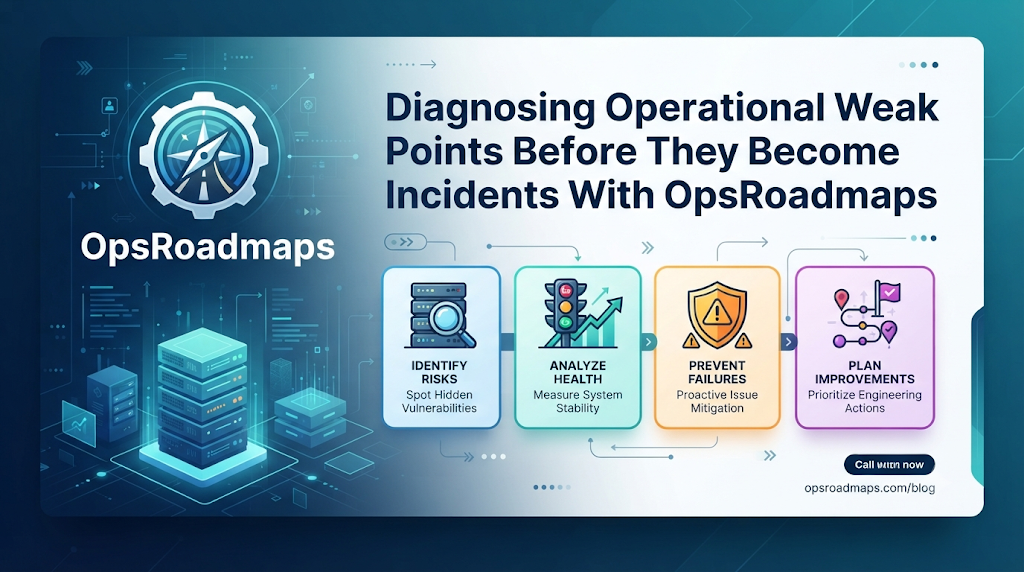
This article connects the two views. It first explains a careful way to investigate common production failures, including Kubernetes CrashLoopBackOff troubleshooting, and then shows how OpsRoadmaps helps teams trace repeated failures back to operational gaps and plan lasting fixes. OpsRoadmaps is an engineering operations assessment and improvement platform that helps organizations evaluate operational maturity, identify technical and organizational gaps, and build actionable improvement roadmaps.
Symptoms Teams See and What They Suggest
A symptom is a clue, not a diagnosis. These common symptoms and the practices they often point to can guide where to look first:
- A container restarts again and again: health checks that are too strict, a memory limit that is too low, missing configuration, or a dependency that cannot be reached.
- A node drops out or a workload moves unexpectedly: capacity planning, resource requests, or monitoring of node health.
- Messages pile up in a queue: consumer capacity, uneven message distribution, or a slow downstream system.
- A database becomes slow: long-running work, sessions waiting on each other, or missing visibility into usage.
- A cloud service fails after a change: weak change tracking, unclear ownership, or untested rollback steps.
If a symptom appears only once, a fix may be enough. If it returns, the practice behind it deserves a closer look.
Following a Careful Investigation Order
A steady order of work prevents guessing and reduces the risk of making things worse:
- Define the scope. Find out whether one instance or many are affected, and when the problem started.
- Collect evidence. Read status information, recent events, logs, and metrics before changing anything.
- Check recent changes. Many failures begin soon after a release, a setting change, or a dependency update.
- Form a simple hypothesis. State the most likely cause and what would prove it wrong.
- Test safely. Prefer actions that only read information. Test changes outside production when possible.
- Fix with a way back. Make one change at a time and keep a rollback ready.
- Record what happened. Write down the cause, the fix, and any follow-up work.
Steps that change or remove live resources can affect real users. The people who own the workload should approve them, and the possible impact should be understood first.
Applying the Order to Common Failures
Containers That Keep Restarting
Kubernetes CrashLoopBackOff troubleshooting follows the same order. The status means a container starts, fails, and is restarted with growing waits in between. The first step is to read the pod's recorded reason for stopping and its exit information, then read the logs from the previous run and the recent events.
The findings usually point in one of a few directions. A memory-related stop suggests the limit or the application's memory use. An application error points to code or configuration. Restarts tied to health checks suggest probe settings that do not match how long the application takes to start. Only after the cause is clear should limits, probes, or settings be changed.
Node Failures and Capacity Surprises
When a node fails, the key questions are how many workloads are affected, whether the cause is a shared resource such as memory or disk, and whether the rest of the cluster has enough room. Draining or isolating a node changes where workloads run, so it should be done with care and approval.
Message Backlogs and Consumer Lag
For Kafka consumer lag, look at the lag for each partition. If only one partition is behind, suspect one slow consumer or an uneven spread of message keys. If all partitions are behind, look at total consumer capacity or a slow system the consumers depend on. Changing read positions affects what the group processes, so the owning team must agree first.
Slow Databases and Cloud Outages
For PostgreSQL performance issues, start by understanding what the database is doing now: active work, sessions waiting on locks, and the number of connections. For AWS infrastructure incidents, confirm the provider's service status, review what changed recently, and check permissions and limits before assuming an application fault.
When Repeated Failures Point to Process
A single incident is solved. A repeating incident is a pattern, and patterns usually come from practices that are weak or missing. Three kinds of maturity review help here:
- A DevOps maturity assessment checks how changes are released, tested, and reversed.
- An incident management maturity model checks roles, response, communication, and learning after incidents.
- An observability maturity model checks whether the team can understand system behavior through logs, metrics, and traces, and whether alerts match real impact.
If restarts follow every release, the release process deserves attention. If incidents drag on because nobody knows who leads, the response practice is the gap. If problems are found by customers first, visibility is the issue.
How OpsRoadmaps Connects Findings to Plans
OpsRoadmaps combines structured self-assessments, explainable maturity scoring, prioritized findings, and executable roadmaps. It covers 42 engineering operations disciplines across nine domains, including DevOps, GitOps, DevSecOps, SRE, observability engineering, incident management, cloud operations, platform engineering, FinOps, MLOps, and LLMOps.
A free operational health scan is available without an account, and signed-in users can take more detailed production readiness and reliability assessments. Scoring follows published, versioned rules, so a team can see why it received a result. Recommendations are source-backed, and plans take dependencies into account so that the order of work follows what each task needs.
One limit matters. A self-assessment reflects what the team reports and the evidence it can show. It is not an independent audit, a certification, or proof of compliance. It also does not find the root cause of a single incident. It shows capability gaps that make incidents more likely, and it helps plan how to close them.
Prevention Through Checklists and Roadmaps
Each planning guide aims to prevent a certain kind of failure:
- A Kubernetes production readiness checklist helps prevent restart loops and unsafe rollouts by checking probes, resource settings, logging, access, and ownership.
- An SRE adoption roadmap helps teams agree on service goals so alerts reflect real customer impact.
- A DevSecOps implementation roadmap adds security checks into delivery in the right order.
- A platform engineering adoption roadmap turns repeated developer problems into shared, reliable tooling.
- A cloud cost optimization roadmap builds ownership and visibility so unexplained spending and forgotten resources are found sooner.
Documentation Habits That Speed Up Diagnosis
Investigations go faster when basic records exist before an incident. Useful habits include:
- Keeping a runbook for each important service, with owners and contacts.
- Recording how to roll back each type of change.
- Writing short notes after incidents with the cause, the fix, and follow-up actions.
- Reviewing runbooks after every release that changes behavior, so they stay accurate.
- Keeping a simple list of dependencies for each service.
A Hypothetical Review After Repeated Restarts
An internal billing service starts restarting in a loop after a configuration change. The team follows its investigation order, finds that a required setting was missing in one environment, and restores service. A month later a similar problem appears after another change.
Leadership asks for a wider review. The team runs a health scan and a deeper assessment of delivery, incident management, and observability. The ranked findings show that configuration changes have no standard review, rollback steps are unwritten, and alerts do not distinguish a restart loop from normal restarts. The plan puts the change review and rollback notes first, since they are quick and reduce risk. Better alerts follow, because they depend on agreed service goals. Each item has an owner and a date, and the team repeats the review after finishing the first group.
Questions Troubleshooters Often Ask About Process
How can I tell if a problem is technical or a process gap?
If the same type of problem keeps returning, or the fix depends on one person's memory, a process gap is likely.
Should we fix first or document first?
Restore service safely first, then record what happened while details are fresh.
Why do restarts often follow a configuration change?
A missing or wrong setting, a changed dependency, or settings that differ between environments can stop an application from starting properly.
How many people should join an investigation?
Enough to cover the affected systems, with one person leading. Too many voices can slow evidence gathering.
Can runbooks become outdated?
Yes. Review them after releases and incidents so the steps match the current system.
Does a health scan find the cause of a specific incident?
No. It shows capability gaps. Root cause analysis of a single incident still needs evidence from that incident.
When should an investigation be escalated?
When customer impact grows, when the owner of an affected system is unknown, or when the team lacks the access needed to continue safely.
How do decision guides help after an incident?
They help teams choose between tools using weighted criteria, such as which monitoring or infrastructure tool best fits their needs.
Closing Notes on Learning From Failure
Every failure carries information, but only teams that record it, repeat their reviews, and act on the findings turn that information into improvement. Careful investigation solves the problem in front of the team, and a structured assessment shows why similar problems keep appearing. OpsRoadmaps supports the second step with explainable scoring, ranked findings, runbooks, decision guides, and dependency-aware plans, and it is clear that its results describe reported practice and not an audit. When teams keep asking why a failure was possible instead of only how to stop it, their systems tend to become calmer, their responses faster, and their plans easier to trust.



Top comments (0)