
Introduction
Drones now do jobs that once needed ladders, helicopters, or whole teams on foot. That has pulled many kinds of people into the same subject. Some want a first drone. Some want to turn flying into a profession. Others only want a skilled person to do a task for them. Each group has to piece together answers from many places.
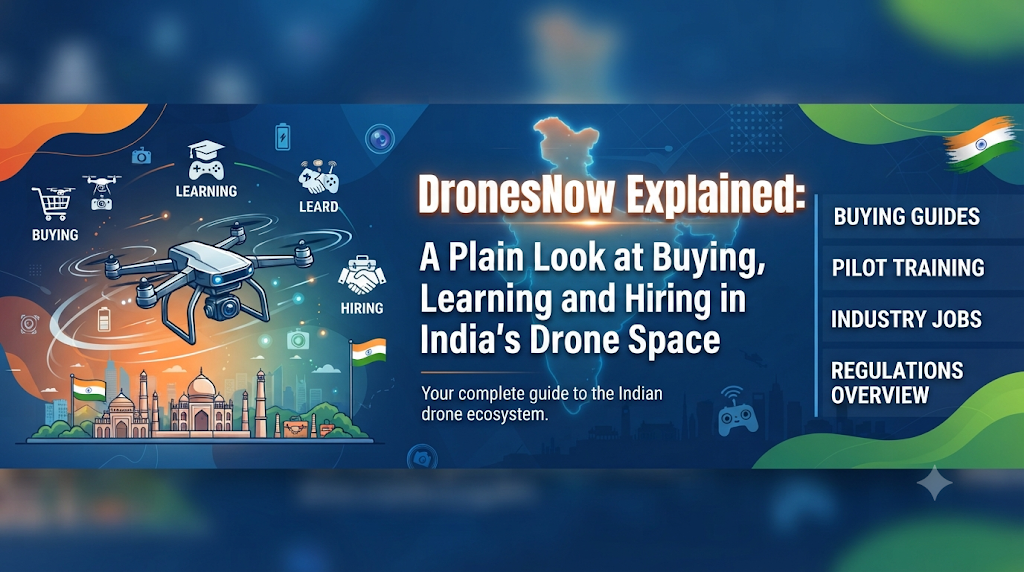
DronesNow is an India-focused platform that puts many of those answers side by side. This article, written for readers of Mozellosite, explains what the platform covers and how its areas relate to one another. You will see how people research drones in India, how they train, and how clients find help.
What Is DronesNow?
DronesNow is a drone discovery and ecosystem platform. It is made for people on every side of the drone world: buyers, pilots, training institutes, operators, enthusiasts, and businesses.
Its main areas are:
- A model database with detailed specifications
- Side-by-side model comparison
- Pilot profiles for finding professional operators
- Listings for training institutes and training partners
- A shopping section for drone-related products
- Blogs, videos, and forums
The information supplied for this article says visitors can compare more than 100 drone models. Buying guides for Indian readers are part of the platform too.
Nobody needs every part. One visitor may only read model pages, while another only wants to look at pilots.
Understanding Drones in India
Drones in India are no longer just flying cameras. They are used for film shoots, checking tall structures, measuring land, making maps, working in fields, and viewing places after an emergency. These jobs are quite different, so the machines and skills they need are different too.
Before making any decision, most people need answers to a few basic questions:
- What kinds of drones exist?
- What does each kind do well?
- What does a drone cost, and what does that cost cover?
- How does someone learn to fly for work?
- Who can be hired for a particular task?
The platform exists to keep these answers near each other.
Choosing a Drone: What to Read Before You Decide
A good choice starts with the task. A drone for filming a festival has little in common with one that sprays a field. Write down the job first, and many models drop off the list.
Then read the specifications. A specification is a fact about the drone, such as how long it flies, how far it goes, or how good its camera is. For spraying work, the weight it can carry also matters. Compare two or three models and the trade-offs show up. A drone with a strong camera may carry less. One built for heavy loads may be too much for a beginner.
Many people search for the best drones in India hoping for a single name. That name does not exist, because the right drone depends on the job, the pilot's skill, and the budget. A fair comparison gives a more honest answer than any ranking.
Price needs careful reading too. A drone price in India is only useful when you know what it includes. Buying guides that show cost beside features help with that.
If you plan to buy drones online India-wide, treat the shopping step as the last one. Research first, so you know what to look for when you reach the product page.
Becoming a Drone Operator: The Training Side
Flying for fun is easy to start. Flying for a client is not. A professional pilot needs safe habits, a clear method, and the discipline to follow the rules. That is why many future operators look for proper training.
Drone pilot training in India is a main interest for these learners. DronesNow lets them look up training partners and read about their options. Many then search for DGCA certified drone pilot training. DGCA is India's civil aviation regulator. Requirements can change, so always check the latest details with the relevant authority before you pay for a course.
Next comes the choice of school. Drone training institutes in India are many. The supplied figures give a sense of scale: as of February 2026, India had more than 39,000 DGCA-certified remote pilots and 244 approved training organisations. A list of institutes is a good starting point, and learners can narrow it by goal and location.
Hiring a Pilot: Who Does What
Many clients do not want to own a drone at all. They want the work done well. This is where certified drone pilots in India come in. DronesNow connects customers with pilots across these fields:
- Aerial cinematography: video of events, properties, and films from above
- Industrial inspection: close looks at structures that are risky to reach
- Surveying: measuring land and sites
- Mapping: building maps from aerial images
- Agriculture: help with field and crop work
- Emergency response: a quick view of affected areas
The fields call for different strengths. A cinematographer cares about smooth motion and framing. An inspector cares about fine detail and safety. Reading a pilot's area of work helps a client pick the right person.
What a Drone Service Actually Delivers
A drone service is more than a flight. The client receives a finished result: footage, a map, or an inspection record. Behind it sit a pilot, suitable equipment, and a method.
Drone services in India serve many kinds of clients. A builder may want regular views of a site. A team that looks after towers may want a close look without climbing. A media crew may need shots the ground cannot give. Since the needs differ, the equipment and pilot skills differ too.
The most useful thing a client can do is describe the result they want. Once that is clear, finding a suitable operator is far easier.
Drones on the Farm
Farming is one of the more specialised uses. Agricultural drone services India can cover several kinds of work, and licensed operators increasingly provide them:
- Crop spraying: the drone carries liquid and sprays along a planned path.
- Field mapping: the drone flies over a field and builds a map from its images.
- NDVI analysis: NDVI is a way to study plant health using images captured from a drone. It can help identify areas where crops may need attention.
- Monitoring: repeated flights show how a crop changes through the season.
- Precision agriculture: using field data so each part of a field gets what it needs, instead of treating everything the same.
Not every provider offers all of these. Some do spraying, others do mapping and monitoring. Results still depend on the crop, the land, the weather, and the operator.
One Ecosystem, Many Hands
Think of a relay race. A buyer reads and compares, then picks equipment. A trained pilot flies it. A training organisation prepared that pilot. A business or farm gives the pilot work. Blogs, videos, and forums cheer everyone along and answer questions.
If one runner stumbles, the others feel it. A good drone with an untrained pilot is risky. A skilled pilot with the wrong equipment may give weak results. A client with an unclear brief may struggle to find the right operator.
Seeing all these roles in one place makes the handovers easier to understand.
Five Steps to Use This Information
- Name your purpose. Are you buying, learning, hiring, or arranging a service?
- Look at suitable options. Read about the drones or service types that fit.
- Compare the details. Check specifications and price for drones, or what each operator covers for services.
- Check training and operator requirements if needed. For professional flying, confirm current official rules and training options.
- Decide from the real need. Pick what suits the task, not what is simply popular.
Common Mistakes
- Buying on price alone. A low price may leave out something you need. A high price may pay for features you will never use.
- Skipping the intended use. A filming drone is not automatically good at spraying or mapping.
- Not reading specifications. Flight time, camera, and carrying weight decide how useful a drone will be.
- Picking training without checking the fit. The course should match your goal and current requirements.
- Hiring before defining the project. A vague task makes it hard to judge any operator.
A Hypothetical Example
Picture an agriculture business in India that wants to follow crop health across its land during one season.
The owners begin by stating the goal: regular checks on plant health and a map of each field. They learn that for this task, camera quality matters more than carrying weight. They put a few models side by side and compare specifications.
Then they look at effort and cost. The work is seasonal, so hiring an agricultural drone service seems wiser than buying equipment. They read pilot information and look for operators with farm experience. After the first flights come field maps and plant-health images. The owners use these to decide which patches to walk and inspect themselves.
Quick Reference Table
| If you want to... | Look at this part of the ecosystem |
|---|---|
| Choose a drone | Models, specifications, and comparisons |
| Become an operator | Training institutes and learning content |
| Get a job done | Pilot profiles and professional services |
| Improve field work | Spraying, mapping, and monitoring services |
| Keep learning | Blogs, videos, and forums |
Frequently Asked Questions
Who is DronesNow meant for?
It serves buyers, pilots, training institutes, operators, enthusiasts, and businesses.
Why can't I just pick the most popular drone?
Popularity says little about your task. Match the drone to the job.
What should I compare between two models?
Flight time, range, camera, carrying weight where relevant, and operating features.
Does pricing tell me everything?
No. Always check what the price includes.
Is professional training different from hobby flying?
Yes. It prepares you for paid work, with safety and planning in mind.
Can rules for DGCA training change?
They can. Confirm the latest details with the relevant authority.
Can one pilot do every kind of job?
Not necessarily. Pilots have different areas of work, so check each profile.
What can drones do for a farm?
They can spray crops, map fields, track crop health, and support precision agriculture, depending on the provider.
Conclusion
The drone world works best when its parts are understood together. Discovery shows what is available, and comparison helps buyers choose. Training prepares new operators, and certified pilots carry out the work. Drone services spread that work across industries, and farming shows how specialised it can become.
DronesNow brings these areas into one place so readers can see how they connect. With careful research and a check of current official requirements, anyone can make clearer decisions about drones in India.



Top comments (0)