
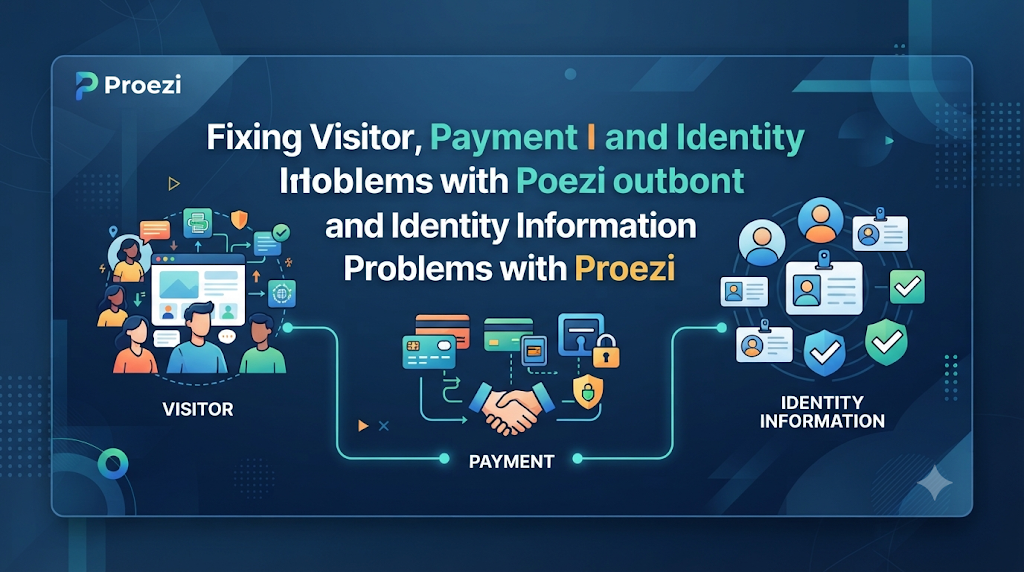
When a visitor arrives at the wrong gate, a customer pays into a closed account or a supplier receives an incorrect tax number, the cause is rarely carelessness alone. It is usually a defect in how information is stored and passed on. The same details live in many messages, each copy slightly different, with no single version to correct.
Viewed this way, shared business information can be handled like any other operational problem: observe the symptom, find the likely cause and apply a fix that prevents it from returning. Proezi is a web-based platform that supports this approach. It lets organizations publish digital visitor arrival instructions, payment details and business identity information as dedicated pages, shared through reusable links and QR codes. This article uses a troubleshooting framework to show where it helps and where it does not.
Treating Shared Information as One Source
The central idea is simple. Each important detail should exist in one maintained place, and every request should point to that place. This is often called a single source of truth.
Messages break this rule. Each one is a copy, and copies cannot be updated after they leave. A page that has a stable link and a QR code follows the rule. The content can change, while the address that people use stays the same. Most of the faults described below come from copies that drifted away from the original.
Common Arrival Faults and Their Causes
Arrival problems are the easiest to see, because they happen in front of staff. The most frequent ones look like this.
- Visitors reach the right address but the wrong entrance. The likely cause is directions that stop at the street address. The fix is a page that names the exact entrance, with a photograph and a landmark.
- Drivers cannot find parking or the gate. The cause is usually that parking and entrance directions for visitors were never written down. The fix is to describe where to park, which gate to use and what to say at security.
- Visitors enter the building but cannot find the room. The cause is missing detail about reception, lifts, floors and room numbers. The fix is step-by-step instructions from the door to the destination.
- Deliveries arrive at the front desk. The cause is that delivery crews were given the same route as guests. The fix is a separate delivery route with its own gate or loading area.
- Visitors who need step-free access are unsure of the route. The cause is that accessible routes were never published. The fix is a separate step-free route with clear notes.
- Instructions are right on Monday and wrong on Friday. The cause is a temporary change that was never communicated. The fix is a temporary notice on the page.
Proezi supports each of these remedies. Its instructions cover parking areas, entrances, gates, reception desks, lifts, floors and rooms. Routes can be published for drivers, pedestrians, taxis, deliveries and step-free visitors. Annotated photographs, map coordinates and entrance landmarks make steps recognizable, and an emergency contact button helps those who are still lost. This is the final stretch often called last mile navigation for businesses. For the outdoor journey, visitors can use Google Maps, Apple Maps or Waze, then follow the published steps.
Payment Information Faults and Practical Fixes
Payment problems are quieter, but they cost money or goodwill.
- A customer pays into an old account. The cause is an outdated copy of the details. The fix is a payment page that is updated when the account changes.
- Details are retyped incorrectly. The cause is manual copying. The fix is copyable fields.
- The business cannot tell what a payment was for. The cause is a missing reference. The fix is a payment-purpose reference on the page.
- Staff answer the same question daily. The cause is that there is no standard place to point to. The fix is one reusable link, or a printed sign.
A business that needs to share bank details with customers can publish bank transfer instructions, account holder names, account details, UPI information, PayPal details and supported international identifiers on a payment details page. A UPI QR code payment page can be printed for a counter or attached to an invoice.
One boundary is important. Proezi does not process, collect or transfer payments, and it is not a bank, wallet or gateway. The customer completes the payment in their own banking or payment application, so the business must still confirm receipt in its own accounts.
Identity Record Faults and Practical Fixes
Company records are often shared by hand, which invites mistakes.
- A registration number is mistyped. The fix is to publish it once, after checking it against an original document.
- Names differ between documents. The fix is to publish the registered business name exactly as it appears in official records.
- A partner asks for the same details again. The fix is a single identity page that can be shared with each new counterparty.
It helps to separate three kinds of checking. Format validation tests whether a number follows the expected structure. Checksum validation tests whether a supported number passes its mathematical rules. Official verification means confirming the record with the authorized government body. Proezi performs the first two on supported identifiers. It does not confirm ownership or registration status with any authority, and publishing a number does not prove that a company is legitimate. A business that wants to share business registration details online can use the page for convenience, while partners should still verify with the official registry.
How the Reusable Link Model Works
At a conceptual level, the model has few moving parts.
- A page is created for a specific purpose and given a stable link.
- A QR code of this kind normally stores a web address that opens the page, so scanning it is the same as following the link.
- Visitors open the page in an ordinary browser, with no app installation and no account.
- The page content can be edited, and later visitors see the new version.
- Directions that a visitor has opened before may remain available from the device for offline use.
- Customer-created pages are kept out of search indexing, so they are shared directly with chosen people.
This is why a printed sign need not be replaced when instructions change. The sign carries the address, and the page carries the details.
Testing a Page Before Release
A short test routine catches most defects.
- Ask someone who has never visited the site to follow the page without other help.
- Compare every detail against its original source, such as the signed account record or the registration document.
- Scan the QR code on more than one phone, at normal reading distance and in the lighting of the real location.
- Open the page on a small screen and check that photographs and steps are readable.
- Check that temporary notices display clearly.
- Confirm that the audience for each page is correct before sharing it.
Maintaining Pages After They Go Live
Release is the start of maintenance, not the end.
- Assign an owner to each page, so that changes have someone responsible.
- Set a review date and keep to it.
- Update details as soon as they change, and remove those that no longer apply.
- Keep a short record of what was changed and when, outside the page itself, so that mistakes can be traced.
- Review signs and codes at the physical location from time to time.
Boundaries Operators Should Keep in Mind
- A QR code opens a page. It does not provide live indoor positioning.
- The published instructions guide visitors, but they depend on the accuracy of the people who write them.
- Payment pages show information and do not confirm that money has arrived.
- Identity pages do not replace official verification.
- The platform's description makes no claims about encryption or security certifications, so organizations with strict requirements should assess them independently.
- The platform launched in September 2026 and is currently free during early access, so terms may change.
A Hypothetical Walkthrough of One Fault
Imagine a distribution warehouse whose delivery drivers keep stopping at the front office. The symptom is repeated calls from drivers and a queue at the gate. The likely cause is that every driver receives the same general address and no instructions for the loading area. The operator publishes a delivery route page with a photograph of the correct gate, the loading bay number and a contact button, and places a QR code at the road junction. It then tests the page with a driver who has never visited. After a few weeks, the operator reviews whether the calls have decreased, and adds a temporary notice when the gate is closed for maintenance.
Technical Questions Answered in Plain Terms
Does the QR code contain the instructions?
Normally, a QR code of this kind stores the web address of the page. The instructions live on the page, which is why they can be updated without reprinting.
Can instructions work without internet access?
Directions that were opened earlier may be available from the device, but a live connection is best for seeing recent notices.
How are business identifiers checked on entry?
Supported identifiers are tested for format and checksum. This does not confirm registration status with a government authority.
Do customer pages appear in search results?
No. Customer-created pages are deliberately kept out of search indexing.
Can the page support several languages?
Yes. Multilingual directions are supported.
Closing Notes for Careful Operators
Most information problems in a business are not mysteries. They have symptoms, causes and fixes, and many of them share one root: details stored as copies and not as a maintained source. Moving those details to dedicated pages is a modest change, but it removes a whole class of repeated faults, from the wrong gate to the outdated account. Proezi offers a way to do that for arrival instructions, payment information and company records, within clear limits. It shares information without handling payments or certifying anyone. The operators who benefit most will be those who test before release, keep an owner for each page and review regularly, treating accuracy as an ongoing task and not a one-time launch.



Top comments (0)