
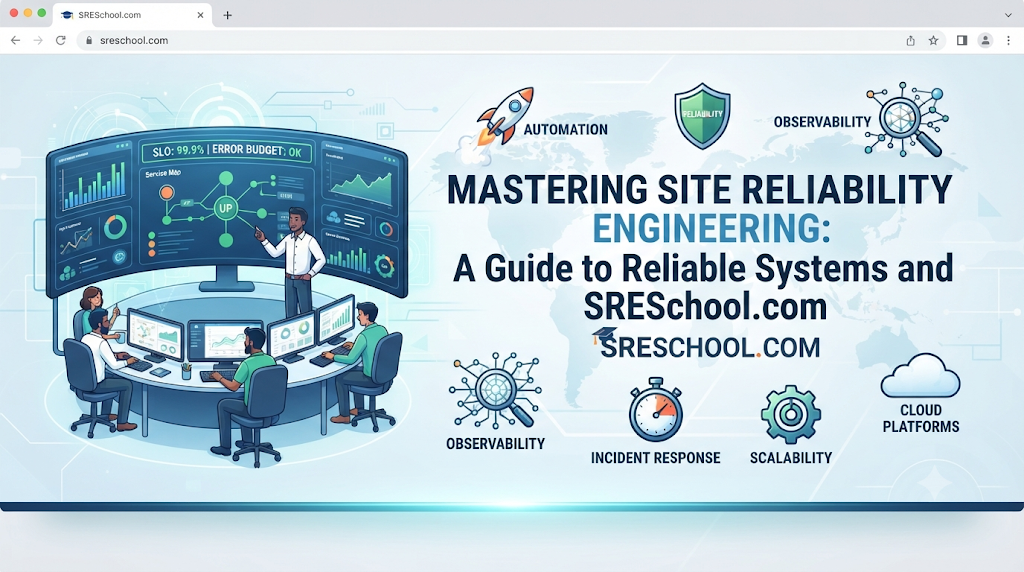
Modern software runs 24/7. When a digital service breaks, users notice right away. Fixing production problems after they happen is hard and stressful.
This is why Site Reliability Engineering exists. It connects software development with system operations. Platforms like SRESchool.com help engineers and companies learn how to build dependable systems.
This guide explains how reliability engineering works and why it matters.
What Is SRESchool.com?
SRESchool.com is a global learning platform focused on Site Reliability Engineering. It helps teams build scalable and stable software systems.
The platform offers:
- Learning resources: Guides on production systems, monitoring, and failure management.
- Reliability paths: Training on Service Level Objectives, error budgets, and system health.
- Professional services: Expert advice to help organizations improve their daily operations.
The goal is to design stability directly into your infrastructure rather than fixing problems later.
What Is Site Reliability Engineering?
Site Reliability Engineering applies software ideas to IT operations. Traditional teams use manual tasks to keep servers running. SRE teams write code and build automation to manage systems at scale.
Reliability means your service works correctly over time. Key goals include:
- Availability: Making sure users can access the system whenever they need it.
- Performance: Keeping response times fast.
- Scalability: Helping the system handle sudden traffic growth.
A Quick Example
Imagine an online shop during a huge sale. Millions of visitors arrive at once. Without automated scaling, the servers crash. An SRE approach detects the traffic surge, adds extra server power automatically, and keeps checkout running smoothly.
Why Reliability Matters
Modern software is complex. Applications use cloud servers and hundreds of small services that talk to each other.
When one small service fails, the whole app can break. Common issues include:
- Service dependencies: A slow database can freeze an entire website.
- Cloud complexity: Managing servers across multiple regions is difficult.
- Operational overload: Teams stuck doing manual chores have less time to fix root causes.
Planning for reliability helps companies prevent downtime and keep user trust.
Core Learning Areas in SRE
Mastering production engineering requires learning several key concepts.
SRE Training
Practical SRE Training teaches engineers how to measure system health, cut down manual work, and handle system failures smoothly.
SRE Certification
An SRE Certification proves that a professional understands monitoring, incident response, and automation. Certification is useful, but real-world production experience is still essential.
Site Reliability Engineering Course
A complete Site Reliability Engineering Course guides learners from basics to advanced design. It shows how developers and operators work together to keep large systems stable.
Certified Site Reliability Engineer
A Certified Site Reliability Engineer masters reliability measurement, postmortems, and infrastructure tools.
Organizational Reliability Services
Reliability is a team goal. Companies often look outside for expert help.
SRE Consulting
SRE Consulting lets experts review your current setup. Consultants check monitoring tools, review incident workflows, and help teams set realistic reliability goals.
SRE as a Service
SRE as a Service provides ongoing support. External experts help companies manage cloud servers, improve monitoring, and handle complex incidents over the long term.
Corporate SRE Training
Corporate SRE Training builds custom learning programs for entire engineering teams. It ensures everyone shares the same approach to system stability.
Core Reliability Concepts
SLIs, SLOs, and Error Budgets
Measuring reliability is simple with the right terms:
- SLI: A metric that measures system performance, such as error rates.
- SLO: The reliability goal set by your team, such as keeping response times under two hundred milliseconds.
- Error Budget: The amount of unreliability allowed within a set time. It balances fast software updates with system stability.
Monitoring vs. Observability
- Monitoring tells you when a system is broken using alerts.
- Observability helps you find out why it broke by checking logs and traces across your services.
Managing Incidents and Automation
Incident Management
When things fail, teams follow a clear path: detect the issue, assess the impact, fix the service, and review what happened to prevent future mistakes.
Automation and Toil Reduction
Toil is repetitive manual work that does not scale. SRE practices use automation to replace routine tasks. This frees up engineers to build better features.
Frequently Asked Questions
What is Site Reliability Engineering?
It is a discipline that applies software engineering to IT operations to create stable, scalable systems.
What is SRE Training?
It is structured learning focused on production systems, error budgets, and incident management.
What is an SRE Certification?
It is a formal credential that validates an individual's knowledge of reliability and monitoring tools.
What does an SRE course cover?
It covers reliability principles, SLOs, error budgets, monitoring, incident response, and automation.
What is the difference between an SLO and an SLA?
An SLO is an internal goal for your team. An SLA is a formal contract with customers that includes business rules.
What is an error budget?
It is the allowed amount of downtime for a service, balancing new feature releases with system stability.
How does SRE consulting help?
Consultants review your infrastructure and workflows to improve your operational maturity.
What is SRE as a Service?
It is ongoing external support for managing cloud infrastructure and production platforms.
Why is automation important in SRE?
Automation replaces repetitive manual tasks, reduces human error, and helps systems scale efficiently.
What skills do SREs need?
Key skills include troubleshooting, observability knowledge, scripting, and calm incident management.
Conclusion
Reliable software matters for every online business. When apps break, users leave and trust is lost. Site Reliability Engineering fixes this by using software tools to manage servers, stop manual work, and prevent crashes.
Tools like SRESchool.com offer the exact training, courses, and certifications you need to learn these skills. Whether you use individual study guides, expert consulting, or ongoing SRE as a Service support, teams can build strong and stable computer systems. By focusing on clear goals, safe error budgets, and smart automation, companies can launch new updates quickly while keeping their systems running smoothly.



Top comments (0)