
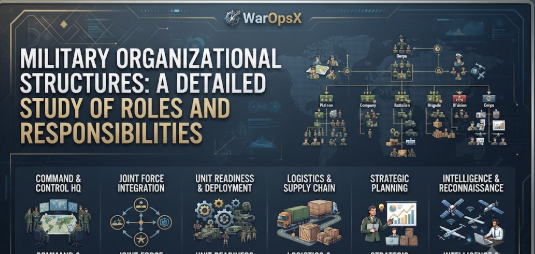
Understanding the complexities of modern defense systems, military organizations, and global security requires structured educational resources. As a specialized platform, WarOpsX serves as a knowledge destination for exploring these intricate domains. By breaking down high-level concepts ranging from strategy to technology, WarOpsX helps students, researchers, and professionals grasp how modern defense environments function.
What Is WarOpsX?
WarOpsX is an educational platform dedicated to exploring Defense Studies, Military Strategy, operational concepts, emerging technologies, and organizational frameworks. Rather than focusing on tactical combat instruction, the platform emphasizes high-level educational content designed to clarify how strategic objectives, leadership, logistics, information, and technology connect within complex defense structures.
The platform provides structured resources for students, policy learners, defense enthusiasts, and researchers seeking a deeper comprehension of how large-scale organizations operate. By presenting information in a clear and objective manner, WarOpsX aims to make complex defense topics accessible to anyone interested in strategic studies, military history, and security environments.
Why Is WarOpsX Relevant for Defense and Military Education?
Studying defense and military systems requires looking at how various operational components interact rather than viewing them in isolation. A strategic decision made at the highest level directly impacts logistics, organizational structure, and information management down the line.
WarOpsX provides a centralized educational resource that connects these diverse subjects. Understanding these relationships helps learners comprehend why large defense organizations require meticulous planning, robust logistics, advanced technology, and clear command structures to achieve their objectives.
Military Strategy
Military strategy forms the foundational layer of statecraft and defense planning. It involves the disciplined application of national or organizational power to achieve specific political or security objectives.
Good strategy connects high-level goals with available resources, balancing ends, ways, and means. It requires anticipating adversary reactions, understanding geographic realities, and accounting for economic capacity. The historical development of strategic thinking shows that while technology changes, fundamental principles regarding resource allocation, objective alignment, and risk management remain consistent. Studying strategy helps learners understand how long-term goals are translated into actionable plans.
Defense Studies
Defense Studies is an interdisciplinary academic field that goes far beyond the study of military equipment or combat tactics. It encompasses strategic analysis, military history, institutional organization, technology policy, logistics, and international security environments.
By examining these elements together, learners gain insight into how governments and organizations prepare for security challenges. Defense Studies encourages critical thinking about policy decisions, resource allocation, alliance structures, and the broader social and economic factors influencing defense organizations.
Military Operations
Military operations represent the practical execution of strategy through coordinated campaigns, deployments, and day-to-day activities. Understanding operations requires looking at planning, objective setting, coordination, and sustainment.
It is helpful to distinguish between strategic, operational, and tactical levels. While tactics involve specific engagements, operational art connects tactical actions to strategic goals. Successful operations depend heavily on organizational readiness, clear leadership, and seamless coordination across different units and branches.
Military Logistics
Logistics is often described as the backbone of any defense organization. Without effective supply chains, transportation, maintenance, and resource management, even the most brilliant strategy cannot succeed.
Military logistics involves moving personnel, equipment, fuel, food, and medical supplies across vast distances and maintaining them over time. Sustainment and infrastructure readiness dictate the limits of what an organization can achieve. Understanding logistics provides critical insight into the practical constraints and operational capabilities of defense systems.
Command and Control Systems
Command and Control (C2) refers to the exercise of authority and direction by a designated leader over assigned forces. C2 systems involve communication networks, coordination procedures, information management, and leadership structures designed to maintain situational awareness.
Effective command and control ensures that decision-makers receive timely information and that orders are communicated clearly across hierarchical levels. It bridges human leadership and technological infrastructure, enabling coordinated action in complex environments.
Defense Technology
Technology plays a major role in shaping modern defense environments. Defense technology encompasses artificial intelligence, autonomous systems, advanced sensors, secure communications, simulation tools, cyber capabilities, and data analysis platforms.
These technologies influence how information is gathered, how decisions are made, and how communication is maintained. However, technology alone does not guarantee success; it must be integrated effectively with human leadership, organizational structure, and operational doctrine to deliver meaningful value.
Military History
Military History provides an essential educational lens for understanding the evolution of defense systems, strategies, and technologies. By examining past campaigns, organizational reforms, and technological transitions, learners can identify recurring patterns and enduring challenges.
History demonstrates how institutions adapt to change, how leadership styles influence outcomes, and how strategic miscalculations occur. Studying historical examples helps build a contextual foundation for analyzing contemporary security challenges.
Military Organizational Structure
Military organizational structure defines the hierarchy, command relationships, units, and joint force arrangements that govern defense institutions. Structure dictates accountability, communication channels, and responsibility.
Hierarchical models help manage large groups of personnel and complex assets, while joint organizational structures enable different branches to work together cohesively. Understanding these frameworks explains how responsibility is distributed and how large organizations execute complex tasks.
Multidomain Operations
Modern defense environments increasingly emphasize Multidomain Operations, which involve the synchronized coordination of activities across land, maritime, air, space, cyber, and information domains.
Because adversaries can challenge security across multiple fronts simultaneously, defense organizations must coordinate their capabilities across all these environments. Understanding multidomain concepts helps learners see how different operational spheres interact and support one another.
Intelligence Surveillance and Reconnaissance
Intelligence Surveillance and Reconnaissance (ISR) refers to the coordinated collection, monitoring, analysis, and dissemination of information. ISR supports situational awareness and decision-making by providing leaders with accurate data about the operating environment.
Effective information management ensures that decision-makers can distinguish relevant data from noise, enabling informed planning and strategic foresight.
How These Defense Areas Connect
The various subjects covered by WarOpsX do not exist in isolation; they form an interconnected ecosystem.
For instance, Military Strategy sets the objectives that shape Military Operations. In turn, operations cannot succeed without Military Logistics to sustain them. Both operations and logistics rely heavily on Command and Control Systems to coordinate actions and manage information.
Furthermore, Defense Technology enhances information flow and operational capabilities, while Military Organizational Structure provides the framework through which all these elements are managed.
When viewed through the lens of Military History, learners can trace how strategic learning and institutional development have shaped modern defense concepts over time.
Key Elements Covered by WarOpsX
- Strategy: High-level planning and alignment of objectives with resources.
- Operations: Coordination and execution of campaigns and activities.
- Logistics: Supply chains, sustainment, and resource management.
- Command and Control: Leadership structures, communication, and decision support.
- Technology: AI, sensors, cyber capabilities, and communications systems.
- History: Examination of past campaigns, doctrines, and institutional changes.
- Organizational Structure: Hierarchies, units, and joint force arrangements.
- Multidomain Environments: Interaction between land, sea, air, space, and cyber domains.
- Intelligence and Information: Data collection, analysis, and situational awareness.
- Defense Studies: Interdisciplinary research and policy learning.
Benefits of Learning These Defense Concepts
Developing an understanding of defense and military concepts offers several educational benefits:
- Building familiarity with professional defense terminology.
- Gaining deeper insight into military history and institutional evolution.
- Understanding the relationship between strategic goals and operational realities.
- Comprehending the administrative and logistical requirements of large organizations.
- Recognizing the role of technology and information systems in modern environments.
- Connecting historical precedents with contemporary security developments.
Step-by-Step Approach to Studying Military and Defense Systems
Step 1: Start With Basic Terminology
Begin by learning common definitions and foundational vocabulary used in defense studies to ensure clear comprehension of subsequent topics.
Step 2: Understand Military Strategy
Examine how high-level objectives are established, how resources are balanced against goals, and why strategic planning is essential.
Step 3: Study Military Operations
Explore how strategic ideas translate into operational planning, coordination, and execution without focusing on tactical combat details.
Step 4: Learn About Military Organizational Structure
Understand the hierarchy, command relationships, and joint force models that structure defense institutions.
Step 5: Understand Military Logistics
Study the principles of supply chains, transportation, maintenance, and sustainment that keep large organizations functioning.
Step 6: Study Information and Command Systems
Examine how leadership, communication networks, and information management support effective decision-making.
Step 7: Examine Technology and Multidomain Environments
Explore how modern technologies and the interaction between land, sea, air, space, and cyber domains influence defense systems.
Step 8: Use Military History to Connect the Concepts
Review historical examples to understand how strategies, organizations, and technologies have evolved over time.
Common Mistakes When Studying Military and Defense Topics
- Studying technology without strategy: Assuming advanced equipment automatically ensures success without evaluating underlying strategic goals.
- Ignoring logistics: Overlooking the vital role of supply chains, maintenance, and sustainment in operational success.
- Treating history as a list of battles: Reducing historical study to dates and conflict outcomes rather than examining institutional and strategic lessons.
- Confusing strategy and tactics: Failing to distinguish between high-level planning and specific operational execution.
- Ignoring organizational structure: Overlooking how command relationships and hierarchies influence decision-making and communication.
- Treating information as separate from command: Viewing data collection in isolation from leadership and decision support processes.
- Assuming technology is a silver bullet: Overestimating the impact of technological tools while neglecting human leadership and training.
- Ignoring historical context: Applying modern assumptions to past eras without understanding the constraints of the time.
- Treating domains independently: Viewing land, sea, air, space, and cyber environments as completely separate rather than interconnected.
Practical Tips for Students and Researchers
- Start by mastering basic definitions before moving on to complex strategic frameworks.
- Compare historical examples to identify enduring patterns in leadership and organization.
- Study strategy and operations as interconnected subjects rather than separate topics.
- Learn how organizational hierarchies affect responsibility and communication.
- Pay close attention to logistical constraints when analyzing operational feasibility.
- Follow developments in defense technology and information systems objectively.
- Read academic and historical literature from multiple perspectives to maintain balance.
- Take structured notes on how different defense concepts influence one another.
Who Can Benefit from WarOpsX's Educational Content?
30.1 Students
Students pursuing political science, history, or international relations can use structured resources to build a solid foundation in defense concepts and terminology.
30.2 Researchers
Researchers can utilize clearly categorized subject areas to support academic inquiry, literature reviews, and strategic analysis.
30.3 Defense Studies Learners
Individuals focused on broadening their knowledge of defense studies can explore comprehensive breakdowns of strategy, logistics, and organizational models.
30.4 Policy Learners
Policy learners can gain insight into how strategic objectives, technology, and organizational structures intersect with governance and security planning.
30.5 Defense Technology Professionals
Technology specialists working in related fields can better understand the broader operational and strategic environments in which defense technologies operate.
30.6 Defense Enthusiasts and General Readers
General readers interested in military history, strategy, and modern defense topics can develop an informed, high-level understanding of these subjects.
First Professional Table: Major Educational Subject Areas
| Subject Area | What It Covers | Why It Matters | Related Areas |
|---|---|---|---|
| Military Strategy | High-level planning, resource allocation, and objective alignment | Connects national goals with actionable military plans | Defense Studies, Military History |
| Military Logistics | Supply chains, transportation, maintenance, and sustainment | Determines the practical limits of operational capability | Military Operations, Organizational Structure |
| Command and Control | Leadership structures, communication networks, and decision support | Ensures coordinated action and situational awareness | Defense Technology, Information Systems |
| Multidomain Operations | Coordination across land, sea, air, space, and cyber domains | Reflects the complex nature of modern security environments | Defense Technology, Military Strategy |
Real-World and Historical Context
Examining historical examples illustrates the critical importance of logistics and strategy. Throughout military history, campaigns have frequently turned on logistical capacity rather than tactical prowess alone. For example, during long campaigns in World War II, the ability to maintain supply lines across oceans dictated the pace and scale of operations.
Similarly, institutional reforms in military organizational structures—such as the establishment of joint command systems—demonstrate how administrative adaptation improves coordination between different branches. These historical lessons highlight why studying logistics, organization, and strategy together provides a complete picture of defense systems.
Modern Developments
In contemporary defense environments, rapid advancements in digital communication, data analytics, and autonomous systems are reshaping how information is processed and managed. Artificial intelligence and advanced sensors assist analysts in sorting through vast amounts of data to maintain situational awareness.
However, these modern tools operate within the same timeless frameworks of strategy, logistics, and command structure. Balancing technological innovation with sound organizational principles remains a central focus of modern defense studies.
Second Professional Table: Traditional and Modern Defense Concepts
| Defense Concept | Traditional Understanding | Modern Development | Key Learning Point |
|---|---|---|---|
| Command and Control | Paper maps, radio voice networks, and hierarchical briefings | Digital dashboards, AI-supported data feeds, and automated networks | Technology accelerates decision cycles but requires clear leadership |
| Logistics & Supply | Stockpiling physical inventory and manual transport tracking | Predictive analytics, automated inventory, and global supply visibility | Sustainment remains the ultimate constraint on operations |
| Surveillance | Human reconnaissance patrols and optical photography | Satellite constellations, persistent sensors, and cyber monitoring | Information volume increases the need for effective analysis |
Frequently Asked Questions
What does WarOpsX cover as an educational platform?
WarOpsX focuses on defense studies, military strategy, operational concepts, logistics, command systems, technology, history, and organizational structures. It provides structured educational resources designed to help readers understand how these complex elements connect within modern defense environments.
Why is military strategy important to study?
Military strategy provides the framework that aligns high-level objectives with available resources. Studying strategy helps learners understand how long-term goals are planned, how risks are managed, and how military power is applied purposefully.
What is the difference between strategy and operations?
Strategy deals with the overarching goals and the alignment of national or organizational power, while operations involve the planning and execution of campaigns and coordinated activities to achieve those strategic objectives.
Why is logistics considered the backbone of defense systems?
Logistics encompasses the supply chains, transportation, maintenance, and sustainment required to keep an organization functioning. Without adequate logistical support, strategic plans and operational movements cannot be sustained over time.
What role do Command and Control systems play?
Command and Control systems involve leadership, communication, and information management. They enable leaders to maintain situational awareness, issue directives, and coordinate units effectively across complex organizational structures.
How does defense technology influence modern organizations?
Defense technology—including artificial intelligence, sensors, and cyber capabilities—enhances data collection, communication, and decision-making. However, technology must be integrated with sound doctrine and human leadership to be effective.
What can we learn from military history?
Military history provides insights into how organizations, strategies, and technologies have evolved. It helps learners recognize recurring patterns, leadership dynamics, and the institutional challenges faced by defense systems over time.
What are Multidomain Operations?
Multidomain Operations refer to the synchronized coordination of activities across land, maritime, air, space, cyber, and information domains. This concept addresses the reality that modern security challenges cross multiple operational boundaries simultaneously.
Why is Intelligence Surveillance and Reconnaissance essential?
ISR involves collecting, monitoring, and analyzing information to support decision-making. Accurate information management gives leaders situational awareness, helping them navigate complex and uncertain operating environments.
Who is the target audience for WarOpsX?
WarOpsX is designed for students, researchers, policy learners, defense enthusiasts, and professionals who want to build a solid, educational understanding of military strategy, defense history, and modern security systems.
Conclusion
Exploring the intricacies of defense systems requires looking beyond isolated components and examining how strategy, operations, logistics, command structures, and technology connect. Platforms like WarOpsX offer valuable educational resources for understanding these interrelationships.
Whether examining the historical evolution of strategic thought, the complexities of military logistics, the structure of command organizations, or the role of modern defense technology, building a solid foundation in these subjects provides a clearer, more comprehensive view of how global security environments operate.



Top comments (0)