
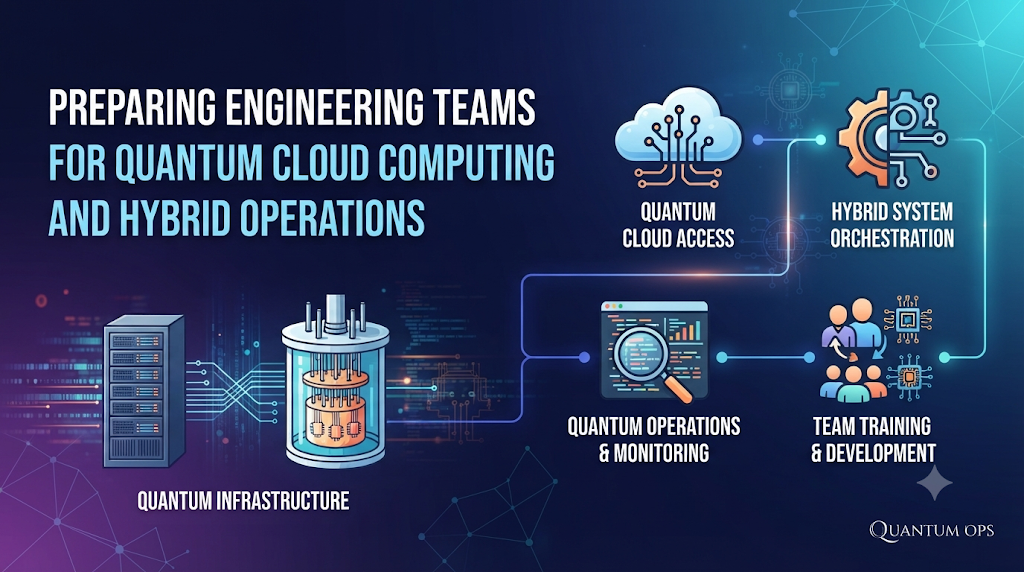
Enterprise IT infrastructure has evolved through distinct stages—from on-premises data centers to virtual machines, containers, and managed cloud platforms. Today, a new specialized layer is emerging alongside conventional cloud services: cloud-hosted quantum computing.
Rather than requiring organizations to build expensive cryogenic facilities, cloud providers now expose quantum processors and high-performance quantum simulators through standard APIs. For engineering leaders, developers, and system architects, the immediate challenge is not replacing existing servers, but learning how to integrate quantum workflows into modern cloud operations. Building that capability starts with structured quantum cloud computing training that connects quantum mechanics fundamentals to everyday software and infrastructure practices.
Understanding Where Quantum Computing Fits in Enterprise IT
A common misconception is that quantum computers will make classical servers obsolete. In reality, conventional CPUs and GPUs remain far better suited for databases, web applications, networking, and routine business logic.
Quantum processors are designed as specialized accelerators for mathematical problems where the number of possible combinations grows exponentially. Examples include:
- Molecular and Chemical Simulation: Modeling electron interactions to accelerate materials science and pharmaceutical research.
- Combinatorial Optimization: Evaluating complex routing, scheduling, and resource allocation problems in logistics and manufacturing.
- Financial Modeling: Running advanced Monte Carlo simulations for risk analysis and derivative pricing.
Because physical quantum hardware is sensitive to environmental noise and remains in an active research and early commercial phase, organizations access these systems through remote cloud environments. Managing them effectively requires engineering teams who understand both cloud governance and quantum software execution.
Foundational Quantum Concepts for Technical Professionals
Transitioning from classical software engineering to quantum application development requires learning a new computational model. Five core principles form the foundation of practical quantum programming:
- Qubits and Superposition: Unlike a classical bit, which holds a fixed value of 0 or 1, a quantum bit (qubit) can exist in a superposition—a mathematical combination of both states weighted by probability amplitudes. A qubit does not hold two separate classical bits at the same time; instead, it stays in a quantum state until measurement forces it to collapse into a single classical outcome of either 0 or 1.
- Entanglement: Entanglement creates a deep correlation between two or more qubits so that measuring one immediately informs the state of the other. Quantum algorithms rely on entanglement to link variables across a system in ways classical memory cannot easily replicate.
- Quantum Gates and Circuits: Developers manipulate qubits using quantum gates—reversible mathematical operations analogous to classical logic gates. Connecting gates in sequence forms a quantum circuit.
- Interference: Because quantum states behave like waves with positive and negative amplitudes, circuits are engineered so incorrect solution paths cancel each other out while valid solutions reinforce one another before measurement.
- Decoherence and Error Mitigation: Physical qubits lose their quantum properties within fractions of a second due to heat, electromagnetic interference, and hardware imperfections. Until large-scale fault-tolerant error correction matures, engineers use software-level error mitigation and keep circuits short.
Inside a Hybrid Quantum-Classical Architecture
Because current quantum processors are noisy and limited in qubit count, practical workloads split tasks between classical cloud servers and quantum processing units (QPUs). Mastering this architecture is the central focus of hybrid quantum classical computing training.
In a typical hybrid setup, classical and quantum systems operate in a tight feedback loop:
- Step 1: Data Encoding and Circuit Setup. A classical cloud instance preprocesses raw data and maps the problem onto a parameterized quantum circuit.
- Step 2: Quantum Execution. The classical orchestrator submits the circuit via a cloud API to a QPU or simulator. The backend executes the circuit hundreds or thousands of times to collect statistical measurement counts.
- Step 3: Classical Evaluation. The measurement distribution returns to the classical server, which computes a cost or energy score based on the problem objective.
- Step 4: Parameter Adjustment. A classical optimizer adjusts the circuit angles to improve the score and submits a new job. This cycle repeats until results converge.
Hybrid execution does not automatically deliver speedups over classical algorithms. Network latency, cloud job queues, and hardware error rates heavily influence overall performance, making careful benchmarking essential.
Comparing Quantum Software Frameworks and Cloud Platforms
Developers and cloud architects work with several open-source frameworks and managed cloud environments. Choosing the right stack depends on existing cloud infrastructure, hardware targets, and team skill sets.
| Technology | Category | Core Strengths | Primary Use Cases |
|---|---|---|---|
| AWS Braket | Managed Cloud Service | Single API connecting multiple hardware vendors alongside managed classical simulators and hybrid job orchestration | AWS Braket training, cloud engineers automating hybrid workflows on AWS |
| Qiskit | Open-Source Python SDK | Comprehensive circuit construction, transpilation tools, noise simulation, and native IBM Quantum integration | Qiskit programming course learners, algorithm prototyping, and gate-level optimization |
| IBM Quantum | Cloud Hardware & Runtime Platform | Direct access to superconducting quantum processors, Qiskit Runtime for low-latency loops, and hardware telemetry | Enterprise algorithm benchmarking and experimental circuit execution |
| Azure Quantum | Managed Cloud Service | Multi-vendor hardware access, resource estimation tools, and classical quantum-inspired optimization solvers | Organizations operating within Microsoft Azure cloud ecosystems |
| Microsoft QDK | Development Kit & Language (Q#) | Domain-specific quantum programming language (Q#), VS Code tooling, and fault-tolerant resource estimators | Software engineers evaluating long-term hardware resource requirements |
| Cirq | Open-Source Python Framework | Low-level control over gate scheduling, pulse timing, and physical qubit grid topology | Researchers tailoring circuits to specific hardware architectures |
Standard Development Lifecycle: From Laptop to QPU
Teams rarely run untested code directly on physical quantum processors. Instead, engineers follow a three-tier validation pipeline:
- Tier 1 — Local Functional Testing: Developers write circuits in Python (using Qiskit or Cirq) and run them on local statevector simulators to verify mathematical correctness with zero latency.
- Tier 2 — Noisy Cloud Simulation: Engineers move the workload to cloud-hosted simulators configured with realistic hardware noise models to evaluate how decoherence impacts accuracy.
- Tier 3 — Hardware Execution: After verifying circuit depth and error sensitivity, the team submits the job to a physical QPU queue, tracks execution metrics, and post-processes the resulting bitstrings.
Career Tracks and Organizational Readiness
Different roles within an IT department require distinct capabilities when preparing for quantum adoption:
- Software Engineers: Building skills in quantum computing for software engineers involves strengthening Python proficiency, reviewing linear algebra and probability, learning circuit design, and wrapping quantum API calls inside standard REST or microservice architectures.
- System Architects and Cloud Engineers: Pursuing a quantum computing architecture course mindset prepares infrastructure specialists to configure identity and access management (IAM), manage hybrid compute budgets, monitor API latency, and design resilient cloud orchestration pipelines.
- IT Managers and Technology Leaders: Focusing on quantum computing for IT managers helps decision-makers separate realistic near-term experiments from hype, select appropriate proof-of-concept problems, govern cloud spending, and plan workforce upskilling.
Practical Training and Advisory Support at QuantumOps School
For professionals seeking structured, operations-oriented guidance rather than purely theoretical lectures, QuantumOps School is a specialized quantum computing education, certification, and consulting platform focused on bridging the gap between quantum technologies and practical IT operations. Operating from India with online and classroom delivery options, the platform integrates quantum fundamentals with cloud infrastructure, quantum programming, hybrid computing, and operational governance.
To align learning with specific job functions, QuantumOps School outlines four QuantumOps certification and training tracks:
- QuantumOps Architect: Focuses on quantum hardware architectures, hybrid system blueprints, workload scheduling, and enterprise cloud integration.
- QuantumOps Engineer: Emphasizes hands-on programming and lab exercises across Qiskit, Cirq, Microsoft QDK, AWS Braket, IBM Quantum, and Azure Quantum, culminating in technical assessments and capstone projects.
- QuantumOps Manager: Concentrates on organizational readiness, project scoping, risk evaluation, cost control, and adoption strategy for technical managers.
- QuantumOps Professional: Introduces core principles including qubits, quantum gates, superposition, entanglement, error correction, and cloud quantum ecosystems.
(Note: When evaluating any **quantum computing certification course, learners should note that provider-issued credentials validate completion of specialized training curricula and labs, and differ from independently accredited university degrees or government-issued licenses.)
In addition to training, organizations assessing early pilot projects often look for external technical guidance. QuantumOps School advertises quantum computing consulting services and specialist freelance support covering quantum cloud integration, algorithm development, hybrid workload optimization, and cloud security across industries like finance, healthcare, pharmaceuticals, logistics, and research. Organizations engaging consulting support should frame initial work around feasibility testing and capability building rather than guaranteed commercial production deployment.
Actionable Steps for Starting a Quantum Pilot
Technology leaders looking to build practical quantum readiness without disrupting core operations can follow a measured approach:
- Audit High-Complexity Bottlenecks: Identify existing optimization, simulation, or sampling problems where classical algorithms struggle to scale.
- Prioritize Simulator-First Experimentation: Train engineering teams on open-source SDKs and classical cloud simulators to keep early experimentation costs predictable.
- Address Post-Quantum Cryptography Separately: Preparing networks for quantum-resistant encryption relies on updated classical cryptographic standards rather than quantum hardware. Treat cryptographic migration as a dedicated security initiative alongside—but separate from—quantum computing R&D.
- Track Learning Milestones: Evaluate early pilots based on architectural insights, benchmark data, and team skill development rather than immediate financial return.
Frequently Asked Questions (FAQs)
1. How much math is required to start quantum programming?
A working understanding of basic linear algebra (vectors, matrices, and tensor products) and probability theory is sufficient to start writing quantum circuits in Python. Most modern SDKs handle complex low-level matrix operations automatically.
2. Why is cloud access the standard model for quantum computing?
Physical quantum processors require extreme cooling, vacuum isolation, and specialized control electronics. Cloud platforms allow engineering teams to access multiple hardware architectures on demand without massive capital investment.
3. What makes hybrid quantum-classical workflows necessary today?
Current quantum hardware can only maintain coherent states for brief periods, limiting how many gates can run before noise corrupts the calculation. Hybrid workflows keep quantum circuits short by handling data preparation and optimization loops on classical servers.
4. How do AWS Braket and Azure Quantum differ from Qiskit and Cirq?
AWS Braket and Azure Quantum are cloud infrastructure services that manage hardware access, billing, security, and simulators. Qiskit and Cirq are open-source programming frameworks used to construct and optimize the quantum circuits that run on those cloud backends.
5. Should companies invest in physical QPU time right away?
No. Most development, debugging, and algorithm testing should happen on local and cloud-based simulators first. Physical QPU access is best reserved for final validation, noise benchmarking, and hardware-specific research.
6. How can IT managers evaluate if their organization is ready for quantum computing?
Readiness depends on having strong classical cloud engineering practices, Python-proficient developers, and well-defined computational bottlenecks in areas like optimization or molecular modeling.
7. What is the difference between QuantumOps School certifications and academic degrees?
QuantumOps School offers specialized professional training tracks and credentials (Architect, Engineer, Manager, and Professional) focused on applied cloud and operational skills, whereas university degrees represent formal academic qualifications accredited by educational authorities.
Summary of Key Takeaways
Integrating quantum computing into enterprise IT is an incremental engineering discipline rather than an overnight replacement for classical systems. By combining strong cloud architecture practices, simulator-driven software development, hybrid workflow design, and targeted professional training, technology teams can build durable skills today while preparing their infrastructure for future advancements in quantum hardware.



Top comments (0)