
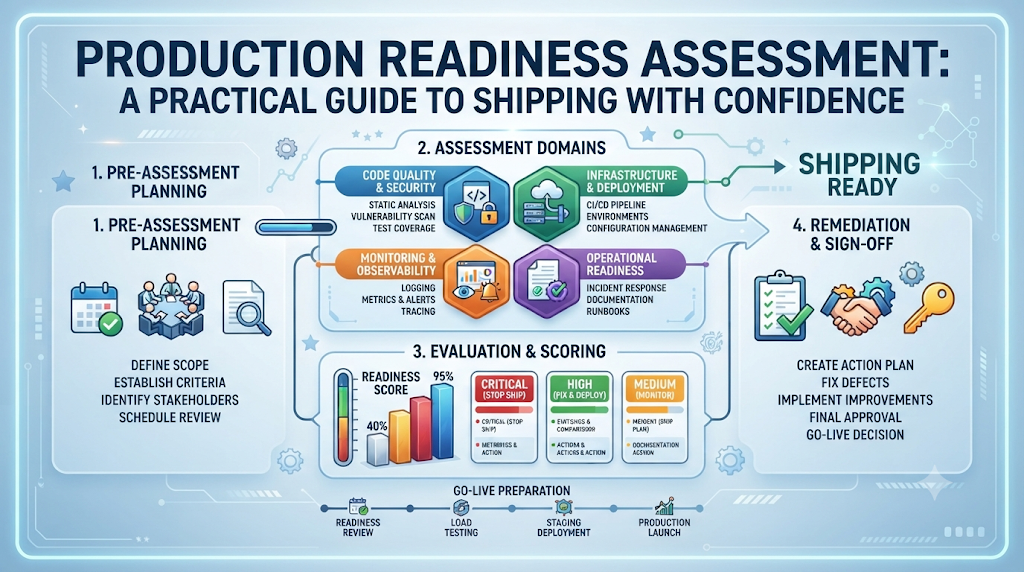
Shipping software is easy. Shipping software that stays reliable under real traffic, real failures, and real pressure is hard. A production readiness assessment is the structured step between “it works on my machine” and “it works for our users.” It asks a simple question: if this service goes live today, what will break first?
This guide explains what a production readiness assessment is, why it matters, and how engineering teams can run one without turning it into a bureaucratic checkbox exercise. It also connects the assessment to broader practices like DevOps maturity, Kubernetes readiness, and incident management—because production readiness never exists in isolation.
Understanding Production Readiness
Production readiness is the practice of checking whether a system, service, or workload is prepared to handle production conditions. That includes more than code correctness. It covers configuration, observability, failure handling, security, capacity, rollback plans, and the human processes around deployment.
A production readiness assessment is the formal or semi-formal review that scores these areas and surfaces gaps. It can happen before a first launch, before a major release, or as a periodic health check for services already running.
The output of a good assessment is not a pass/fail stamp. It is a prioritized list of risks with clear ownership. Some gaps are acceptable to defer—but only if someone writes down that decision explicitly. An unchecked box is a decision made by accident.
Why Teams Struggle with Readiness
Most production incidents do not come from exotic edge cases. They come from predictable gaps that were visible before launch: a missing resource limit, a probe that tests the wrong thing, a rollback that was never rehearsed, or a secret that lived in Git because moving it felt inconvenient.
Readiness work competes with feature work. It feels like slowing down. But the cost of a missed readiness check shows up later as an outage, a late-night rollback, or a postmortem that concludes “we knew about this risk.” A structured assessment makes the trade-off visible.
Core Components of a Readiness Assessment
A useful assessment covers several dimensions. The exact questions vary by organization, but the categories are consistent.
Reliability and Failure Handling
Does the service degrade gracefully? Are there redundant replicas across failure domains? What happens when a dependency is slow or unavailable? Reliability questions force teams to think about failure modes before users experience them.
Resource Management and Kubernetes Readiness
For teams running on Kubernetes, the Kubernetes production readiness checklist is a practical starting point. Key items include setting CPU and memory requests and limits, configuring liveness and readiness probes that test different behaviors, using PodDisruptionBudgets, and pinning container images by digest rather than :latest.
These are not theoretical concerns. Without requests, the scheduler places pods blindly. Without limits, one leaking container can take down a node. Mixing up liveness and readiness probes causes restart loops that turn a partial degradation into a full outage.
Observability and Debugging
Can the team tell what is happening inside the service without SSH-ing into a container? Readiness reviews should check whether logs, metrics, and traces are in place before launch—not added after the first incident. A useful readiness question is: “When something behaves oddly in production, how long does it take to find out why?” If the honest answer is “hours,” observability is not ready.
Security and Secrets
Are secrets managed by a proper secret store, or are they base64-encoded in a manifest? Is sensitive data encrypted at rest, including backups? These questions belong in a readiness review because security gaps are production risks, not just compliance items.
Rollback and Recovery
The most critical readiness control is often the least rehearsed: can the team roll back a bad release quickly and safely? A rollback procedure that exists only in documentation is not a control. It is a hope. A tested rollback path is worth more than a dozen optimistic checkboxes.
A Step-by-Step Approach to Running an Assessment
A readiness assessment does not need to be heavy. It needs to be honest and repeatable.
Step 1: Pick the scope and depth. A quick review for a small internal service might take 30 minutes. A deep audit for a customer-facing platform may take several sessions. Match the effort to the blast radius of failure.
Step 2: Use a structured checklist. Start from a known framework—whether that is an internal template, a public checklist, or a platform like OpsRoadmaps that scores answers against published criteria. The point is to avoid relying on memory and opinion alone.
Step 3: Answer with evidence, not optimism. For each control, ask what evidence exists. A backup is not “verified” because a cron job exists; it is verified because someone restored from it. An alert is not “configured” because a dashboard exists; it is configured because someone was paged by it.
Step 4: Score gaps and prioritize by risk. Not every gap is equal. A missing runbook for a low-traffic internal tool is different from an untested rollback for a payment service. Prioritize by impact and likelihood, not by how easy the fix is.
Step 5: Write the roadmap and assign owners. An assessment without follow-through is just a document. Each finding should have a next action and a person responsible. Some teams use a simple spreadsheet; others use a platform to track findings across services.
Step 6: Revisit on a schedule. Production readiness is not a one-time gate. Services change. Dependencies change. A review that was accurate six months ago may be stale today. Quarterly or release-based reassessment keeps it honest.
Connecting Readiness to Broader Engineering Maturity
A production readiness assessment is one piece of a larger picture. Teams that assess readiness repeatedly start to see patterns. The same gaps appear across services. Those patterns point to deeper maturity work.
DevOps and SRE Maturity
A DevOps maturity assessment or SRE adoption roadmap helps an organization understand whether its processes, tooling, and culture support reliable delivery at scale. Readiness reviews generate concrete evidence for those broader assessments. If three services all lack tested rollbacks, that is not a service-level problem—it is an organizational gap.
Incident Management Maturity
Readiness and incident response are connected. A service that is ready for production should have a clear path for escalation when things go wrong. An incident management maturity model can help teams evaluate whether they have the right on-call structure, communication channels, and postmortem practices in place.
Platform Engineering and DevSecOps
As organizations grow, platform engineering adoption and DevSecOps implementation become ways to make readiness easier by default. A platform team can provide golden paths—templates, CI/CD pipelines, and policy checks—that bake in production readiness controls so individual teams do not have to remember every item. For example, policy engines can reject deployments that lack probes or resource limits before they ever reach a cluster.
Benefits and Realistic Challenges
The benefits of a structured assessment are straightforward: fewer surprise incidents, faster debugging, clearer ownership, and a shared language for risk. Teams that assess readiness tend to have shorter rollbacks, more useful postmortems, and better conversations with leadership about technical debt.
The challenges are also real. Assessments can become box-ticking exercises if teams treat them as paperwork. They can miss context if the questions are too generic. And they require time from senior engineers who are often the busiest people on the team.
The way to avoid these traps is to keep the assessment honest and lightweight. Use it to surface decisions, not to assign blame. Celebrate teams that report gaps accurately—those are the teams that will fix them.
Common Mistakes to Avoid
Mistake 1: Treating readiness as a gate owned by one person. Readiness works best when the team that operates the service owns the answers. A central reviewer can help, but the team must feel responsible for the outcome.
Mistake 2: Checking boxes without evidence. “Yes, we have monitoring” is not an answer. “Yes, we have an alert on error rate that paged someone in the last 30 days” is an answer.
Mistake 3: Ignoring the human side. Probes and limits matter, but so do on-call rotations, escalation paths, and runbooks. A technically perfect deployment with no one trained to operate it is not ready.
Mistake 4: Assessing once and never again. A readiness review is a snapshot. Services drift. Dependencies change. Revisit.
A Realistic Example
Consider a team preparing to launch a new API service on Kubernetes. They run a production readiness assessment and find three gaps: no PodDisruptionBudget, a readiness probe that hits the same endpoint as the liveness probe, and a rollback process that exists only in a wiki page.
None of these are catastrophic on their own. But together they create a fragile service. A node drain during an upgrade could take down all replicas. A temporary dependency slowdown could trigger a restart loop because the liveness probe fails when the service is merely busy. And when a bad release goes out, the team has to figure out the rollback under pressure.
The team fixes the PDB and separates the probes before launch. They schedule a rollback rehearsal for the following week. The service launches without incident. Two months later, a bad configuration change causes errors. Because the rollback was rehearsed, the team reverts in minutes instead of hours. The assessment did not prevent the problem—it made the response faster and calmer.
Frequently Asked Questions
What is a production readiness assessment?
It is a structured review that checks whether a service, application, or workload is prepared for production traffic and failure conditions. It covers reliability, security, observability, rollback, and operational ownership.
How is a production readiness assessment different from testing?
Testing verifies that specific behaviors work as expected. A readiness assessment asks broader questions about whether the system can be operated safely: can we see what is wrong, can we recover, and do we know who is responsible.
How long does a readiness assessment take?
A lightweight review for a single service can take 30 to 60 minutes. A deeper audit with evidence review may take several hours across multiple sessions. The right depth depends on the service’s criticality.
Do we need special tools to run an assessment?
No. A checklist and a conversation can surface most gaps. Tools help with consistency, tracking, and scoring, but the core practice is honest questioning and follow-through.
What should we do if we find critical gaps before launch?
Either fix them or document a conscious decision to accept the risk with a mitigation plan. The worst outcome is pretending the gap does not exist.
Is production readiness only for Kubernetes?
No. The concepts apply to any production system. Kubernetes has specific controls—probes, resource limits, disruption budgets—but the broader principles of observability, rollback, and ownership apply everywhere.
How does readiness connect to SRE and DevOps maturity?
Readiness reviews produce evidence that feeds into broader maturity assessments. Repeated gaps across services indicate organizational issues that maturity work can address.
What is the most commonly missed readiness item?
Tested rollback. Many teams have a rollback process, but few rehearse it under realistic conditions. A rollback that has never been tested is not a control.
Can a readiness assessment be automated?
Parts of it can. Policy checks can enforce probes, resource limits, and image pinning. But human judgment—about ownership, escalation, and acceptable risk—cannot be fully automated.
How often should we reassess?
Before major launches, after significant architecture changes, and on a regular cadence for critical services. Quarterly is a reasonable default for customer-facing systems.
Conclusion
A production readiness assessment is not a hurdle to clear before shipping. It is a practice that helps teams ship with fewer surprises. The goal is not perfection—it is clarity. Know what risks you are taking, write them down, and decide which ones to fix first.
Start small. Pick one service. Run a structured review. Fix one gap. Then repeat. Over time, the assessment becomes less of a project and more of a habit—one that pays off every time a deployment goes smoothly or a rollback finishes in minutes instead of hours.



Top comments (0)