
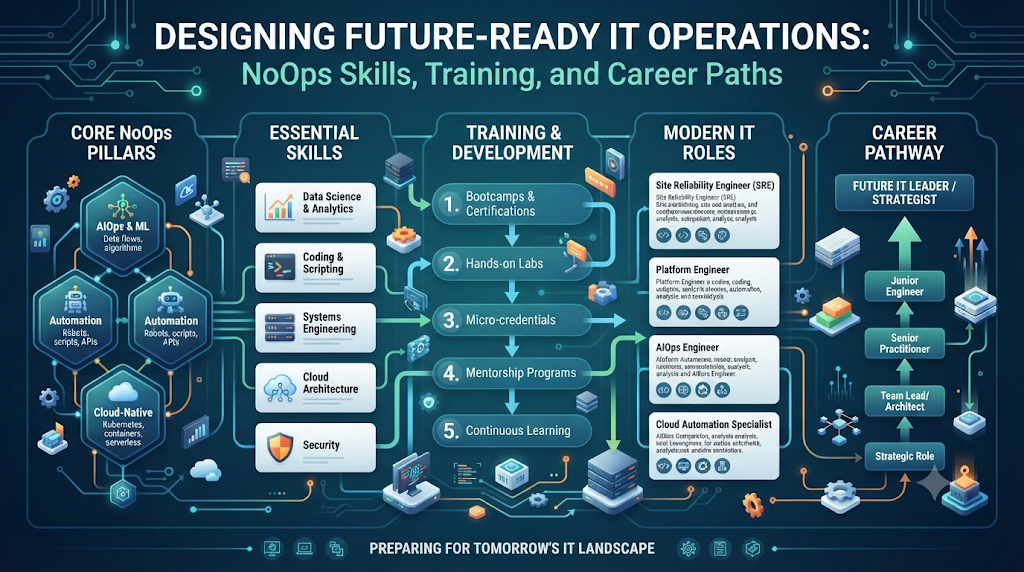
Introduction
Technology keeps changing how organizations deliver services. IT teams must support users across many platforms. They also manage security, system updates, and infrastructure. These duties can become difficult as services grow. Repeated manual tasks may take time from important work.
NoOps offers a practical way to improve these processes. It uses automation to manage suitable operational activities. Teams can create standard workflows and reduce repeated effort. They can also improve consistency across different environments.
However, automation needs proper planning and skilled people. Teams must review changes and protect important systems. They must also handle problems that need human judgment. Learning NoOps can help professionals understand these responsibilities. It can also help organizations prepare for modern IT demands.
1. Understanding NoOps and Its Main Principles
A common starting point is what is NoOps. NoOps is an approach that reduces manual operations work through automation. It uses software and managed services for suitable routine tasks.
These tasks may include resource setup and configuration. They may also include software releases and system monitoring. The aim is to make repeated activities easier to manage.
Understanding what is NoOps also means knowing its boundaries. It does not mean removing all operations staff. People still plan infrastructure and review system changes. They remain responsible for security and service quality.
For example, a team may create approved infrastructure templates. A workflow can use those templates to prepare an environment. Another process can check settings before a release. Staff can review the results and approve important changes.
The idea behind what is NoOps is not full independence from people. It is about choosing tasks that can follow clear rules. Complex problems still need skilled investigation. Human oversight remains part of responsible operations.
Organizations should begin by reviewing their daily work. They can list repeated tasks and identify common delays. Then they can decide which activities are suitable for automation.
2. How NoOps Supports Better IT Operations
Many IT teams manage several connected systems. They may support websites, mobile applications, and cloud services. Each service has its own needs and dependencies.
Manual work can make these duties harder. Staff may repeat the same setup steps. Different teams may use different configurations. Small errors can affect service quality.
NoOps encourages teams to define standard processes. They can reuse approved settings and workflows. They can also track changes through review systems.
Understanding what is NoOps helps teams find useful opportunities. They can separate predictable work from tasks requiring judgment. This makes automation decisions more practical.
NoOps can also help teams plan their time. Staff may spend less effort on repeated setup activities. They can focus on system improvement and service needs. Leaders can review whether resources support the right priorities.
Automation should still follow clear controls. Teams need testing, monitoring, and recovery plans. They should also know who owns each workflow. These steps help prevent small mistakes from becoming larger problems.
3. NoOps vs DevOps: Understanding Their Roles
The comparison NoOps vs DevOps helps explain two related ways of working. DevOps encourages development and operations teams to work together. It supports shared responsibility across software delivery.
NoOps focuses on reducing routine manual operations. It uses automation for suitable tasks and processes. People still guide systems and manage unusual events.
The main difference in NoOps vs DevOps is the area of focus. DevOps highlights teamwork and delivery practices. NoOps highlights automation of repeatable operational work.
These approaches do not need to compete. Teams can use DevOps practices for collaboration. They can also automate suitable infrastructure tasks. This may help improve consistency across the delivery process.
When reviewing NoOps vs DevOps, consider your current work. Look at how teams build and release software. Identify tasks that require personal decisions. Then find repeated tasks with clear instructions.
| Option | What It Covers | Who It Helps |
|---|---|---|
| DevOps | Collaboration across development and operations | Teams improving software delivery |
| NoOps | Automation of suitable operational tasks | Teams reducing repeated manual work |
| Combined approach | Shared delivery with automated processes | Organizations with varied IT needs |
The right choice depends on the organization. Some teams need stronger cooperation between departments. Others may have many stable tasks ready for automation. A combined approach may suit both needs.
4. Choosing NoOps Automation Tools Carefully
NoOps automation tools help teams complete repeatable technical tasks. They can support infrastructure setup and system configuration. They may also manage software delivery and monitoring.
Infrastructure as code is one useful practice. It means describing infrastructure through files. Teams can review these files before applying changes.
Configuration tools help maintain consistent system settings. CI/CD tools support software building and release steps. Container platforms package applications with their required parts. Orchestration tools help manage container workloads.
When comparing NoOps automation tools, begin with a clear problem. Decide which task needs improvement. Then review products that support the required work.
Security should guide every tool decision. Check how permissions are assigned. Review whether changes can be tracked. Make sure sensitive actions have proper controls.
The best NoOps automation tools should fit the existing environment. A complicated product may create extra maintenance work. Teams should avoid buying tools without a clear need. Small tests can reveal whether a tool is suitable.
5. Building Knowledge Through NoOps Certification
A NoOps certification can provide a structured learning goal. It may help professionals study important concepts. It can also help learners review their knowledge.
Before selecting a NoOps certification, examine the syllabus. Check the subjects and practical learning activities. Make sure the content matches your experience.
A useful study plan should include cloud foundations. It should also cover infrastructure as code and monitoring. Security and software delivery are important subjects too.
A NoOps certification should support practical learning. It cannot replace experience with real systems. Learners should build test environments and document their work.
People considering a NoOps certification should check current provider information. Review the learning requirements and assessment details. Do not assume every certificate has equal recognition.
6. Preparing for NoOps Engineer Certification
A NoOps engineer certification may suit people in technical roles. It can support learning about cloud infrastructure and automation. It may also cover monitoring and deployment practices.
Engineers need to understand how services connect. They should know how configuration changes affect applications. They must also understand access controls and security.
Preparing for a NoOps engineer certification needs practical effort. Learners can create a small test environment. They can deploy an application and review its settings. They can then add monitoring checks.
A NoOps engineer certification becomes more useful with project work. Learners should explain their technical choices. They should also record how they test changes.
Engineers must understand when automation needs human review. Some failures cannot be handled through known workflows. Staff should know when to stop a process. They must also know when to investigate further.
7. Developing System Design Skills
NoOps architect training helps professionals plan automated IT environments. Architects decide how services and infrastructure connect. They also consider security and future maintenance.
A suitable NoOps architect training path should cover cloud design. It should explain infrastructure as code and service architecture. Learners should also study monitoring and recovery planning.
Architects must understand the purpose of each service. They should know who will use the system. They must also consider data needs and access rules.
Good NoOps architect training includes design exercises. Learners can prepare a simple architecture diagram. They can show how services exchange information. They should also identify security boundaries.
People exploring NoOps architect training should compare design options. Managed services may reduce maintenance duties. Custom systems may provide greater control. Each option brings different responsibilities.
8. Leadership Development Through NoOps Manager Certification
A NoOps manager certification may interest IT team leaders. Managers need to understand automation plans and team duties. They must also connect technical work with service goals.
A NoOps manager certification can provide a learning structure. It may cover operational planning and change management. It can also help managers study risk and ownership.
Leaders should involve technical staff in planning. Staff can explain system limits and possible problems. Managers should assign clear owners to important workflows.
Preparing for a NoOps manager certification also involves communication skills. Leaders must explain why processes are changing. They should set review steps and escalation rules.
A NoOps manager certification does not replace workplace experience. Managers still need to guide people and manage priorities. They should review whether changes support service goals.
9. Selecting a NoOps Training Course
A NoOps training course can give learners an organized study path. It should explain basic ideas before advanced subjects. Clear examples can make technical topics easier.
A useful NoOps training course should include practical exercises. Learners may work with cloud platforms and configuration files. They may also practice deployment and monitoring.
Before choosing a NoOps training course, review the topic list. Check whether it covers security and infrastructure. Make sure the lessons match your current skills.
A course should explain why each tool matters. Learners need to understand the problems tools solve. They should also learn about limits and risks.
A NoOps training course can support professional growth. However, learning should continue after the lessons finish. Projects help turn new knowledge into practical ability.
10. When Organizations Need NoOps Consulting Services
Some organizations need help reviewing their IT processes. NoOps consulting services may support this work. They can help teams examine current operations and automation needs.
Before selecting NoOps consulting services, define the project scope. List the systems that need attention. Agree on access rules and responsibilities.
NoOpsSchool.com advertises consulting areas for this field. These include operational assessments and automation strategy. The platform also lists cloud-native modernization and infrastructure provisioning.
Its advertised areas include CI/CD implementation. It also lists AIOps integration and security automation. Organizations should confirm current service details before making plans.
Useful NoOps consulting services should explain each recommendation. Teams should understand how changes will be tested. They should also know who will approve important decisions.
When comparing NoOps consulting services, ask about knowledge transfer. Internal staff need to understand new workflows. They should be able to maintain systems after the project ends.
11. Finding and Hiring NoOps Freelancers
Some projects need skills that internal teams do not have. Organizations may choose to hire NoOps freelancers for specific work. This can provide focused support for a defined task.
Before you hire NoOps freelancers, explain the project clearly. List the systems and expected deliverables. Describe security requirements and access limits.
Review each candidate's relevant experience. Ask about tools and similar technical projects. Discuss how they test changes and record their work.
When you hire NoOps freelancers, agree on ownership. Decide who approves system changes. Keep credentials and permissions under proper control.
Organizations that hire NoOps freelancers should begin with a clear scope. Review the work before adding more tasks. Clear communication can prevent confusion.
NoOpsSchool.com advertises freelancer access in selected areas. These include Terraform, Kubernetes, cloud platforms, automated monitoring, and self-healing systems. Check current availability and suitability before making plans.
12. Common Mistakes to Avoid During Adoption
NoOps needs clear goals and careful controls. Teams should avoid these common mistakes:
- Automating unclear tasks: Define each process before creating a workflow.
- Ignoring access security: Give tools only the permissions they need.
- Choosing tools without purpose: Start with a specific operational problem.
- Skipping testing: Check workflows before using them widely.
- Removing human review: Keep approval for sensitive changes.
- Neglecting monitoring: Check whether automated tasks work correctly.
- Expecting perfect recovery: Some incidents need human investigation.
- Forgetting documentation: Record settings, owners, and recovery steps.
- Changing every system at once: Begin with a small and safe task.
- Ignoring staff development: Give teams time to learn new methods.
13. Fictional Example: SilverLine Community Learning Exchange
SilverLine is a fictional online learning exchange. Local groups use it to share lessons and learning resources. Volunteers manage content through its digital platform.
The small IT team handled several routine tasks manually. Staff prepared test environments with separate instructions. They also checked service status across different systems.
The team reviewed its repeated duties. It found that some setup steps used the same settings. Staff created shared templates for those tasks. They also introduced checks before software releases.
Monitoring tools began collecting service information. Alerts helped staff notice unusual activity. The team documented which alerts needed human review.
People remained responsible for important decisions. Volunteers still reviewed learning materials. IT staff managed security and access changes. Automation supported routine tasks without replacing human judgment.
SilverLine shows why a gradual approach matters. Teams should understand each task before automating it. They should also keep clear ownership and review steps.
14. How NoOpsSchool Supports Learning and Development
NoOpsSchool.com is an IT education, certification, and consulting platform. It focuses on NoOps, cloud infrastructure automation, and modern software delivery.
The platform advertises learning tracks for several professional roles. These include NoOps Engineers, NoOps Architects, NoOps Managers, and NoOps Professionals.
Its listed topics include infrastructure as code and cloud-native computing. It also lists Kubernetes, Docker, and Terraform. Other subjects include GitOps and CI/CD.
The platform also lists serverless architecture and observability. AI-powered operations is another advertised topic. These subjects help learners explore modern IT practices.
People asking what is NoOps can use these subjects as a starting point. They should connect each topic with practical tasks. Understanding a tool's purpose matters as much as learning its name.
NoOpsSchool.com advertises hands-on labs and real-world automation scenarios. Its listed areas include self-healing infrastructure and automated incident response. Learners should review current information before choosing a path.
Professionals considering a NoOps certification can review the advertised learning tracks. Those exploring NoOps engineer certification can examine technical subjects. Learners interested in NoOps architect training can review system design topics.
The platform advertises a learning track for managers. This may interest people exploring NoOps manager certification. Learners can also review the advertised NoOps training course information.
Organizations can review the platform's advertised NoOps consulting services. These include operational assessments and automation strategy. Its listed areas also cover cloud modernization and security automation.
The platform advertises freelancer access in selected skill areas. Organizations planning to hire NoOps freelancers should check current skills and availability. They should also define the project requirements.
15. Creating a Personal NoOps Development Plan
A learning plan should reflect your role and experience. Beginners can start with cloud and infrastructure basics. Experienced professionals may focus on design or automation.
First, understand what is NoOps and its purpose. Learn which tasks can follow clear rules. Also study where human review remains necessary.
Next, compare NoOps vs DevOps in your workplace. Review team responsibilities and release processes. Identify tasks that may benefit from automation.
Then explore suitable NoOps automation tools. Test one tool against a real need. Review its security and maintenance requirements.
You can choose a NoOps training course or NoOps certification for structured study. Build small projects as you learn. Record what works and what needs improvement.
Technical learners may explore NoOps engineer certification. Professionals interested in system design can consider NoOps architect training. Team leaders may study NoOps manager certification.
Organizations planning larger changes may seek NoOps consulting services. Teams with a focused skills gap may hire NoOps freelancers. In both cases, define responsibilities and protect system access.
Frequently Asked Questions
- Can NoOps help teams that support customer-facing applications?
Yes. Teams can automate suitable setup, deployment, and monitoring tasks. They must still review application health and protect customer data. Human staff should handle unusual incidents and important decisions. The approach works best when processes have clear rules and owners.
- What should an organization review before starting NoOps adoption?
Review current systems, repeated tasks, security controls, and staff skills. Identify processes that follow stable steps. Check which activities require human approval. This review helps organizations choose a suitable starting point without changing too much at once.
- How can someone decide whether NoOps certification matches their goals?
Start by reviewing your current role and learning needs. A NoOps certification may suit someone seeking structured study. Compare its topics with your skill gaps. Also consider practical projects that can help you apply the knowledge.
- What skills should a learner practice for NoOps engineer certification?
Practice cloud resource setup, configuration, and deployment. Learn to read system logs and monitor service health. Review access permissions and test changes safely. A NoOps engineer certification study plan should include practical work, not only reading.
- How does NoOps architect training relate to infrastructure planning?
NoOps architect training helps professionals consider how services connect. It can support learning about cloud design, security, and maintenance. Architects should practice explaining their choices. They must also consider how teams will monitor and support the finished system.
- What leadership abilities matter for NoOps manager certification?
Managers need planning, communication, and risk awareness. A NoOps manager certification may support learning in these areas. Leaders should also understand team capacity and system ownership. They must ensure that automated work remains visible and accountable.
- Can a NoOps training course be useful for experienced IT staff?
Yes. Experienced staff may use a NoOps training course to organize their learning. They can focus on unfamiliar tools or modern infrastructure practices. Review the course outline first. Choose subjects that support your current responsibilities or future goals.
- How should businesses compare NoOps consulting services providers?
Review the proposed scope, relevant experience, and working methods. Ask how recommendations will be tested and documented. NoOps consulting services should fit the organization's needs. Teams should also agree on access rules and knowledge transfer before work begins.
- What makes NoOps automation tools suitable for a growing business?
Suitable tools should support current systems and likely future needs. Review security, compatibility, maintenance, and ease of use. NoOps automation tools should solve defined problems without adding needless complexity. Testing with a small workflow can help reveal whether they fit.
- How can organizations manage risks when they hire NoOps freelancers?
Before you hire NoOps freelancers, define access permissions and approval rules. Use controlled accounts and keep records of changes. Require clear documentation and testing. Internal staff should retain ownership of important systems and review all sensitive work.
Final Thoughts
NoOps offers a practical way to improve routine IT work. It helps teams make repeated processes more consistent. It can also create more time for service improvement.
However, technology cannot replace careful human decisions. Teams must protect systems and review important changes. They must also prepare for problems that need investigation.
Start with one clear operational task. Test a suitable workflow in a safe environment. Keep documentation and ownership in place. Expand only after careful review.
Professionals can build their knowledge through study and practice. NoOpsSchool advertises learning tracks and consulting areas. Review its current information before selecting a suitable option.



Top comments (0)