
Introduction
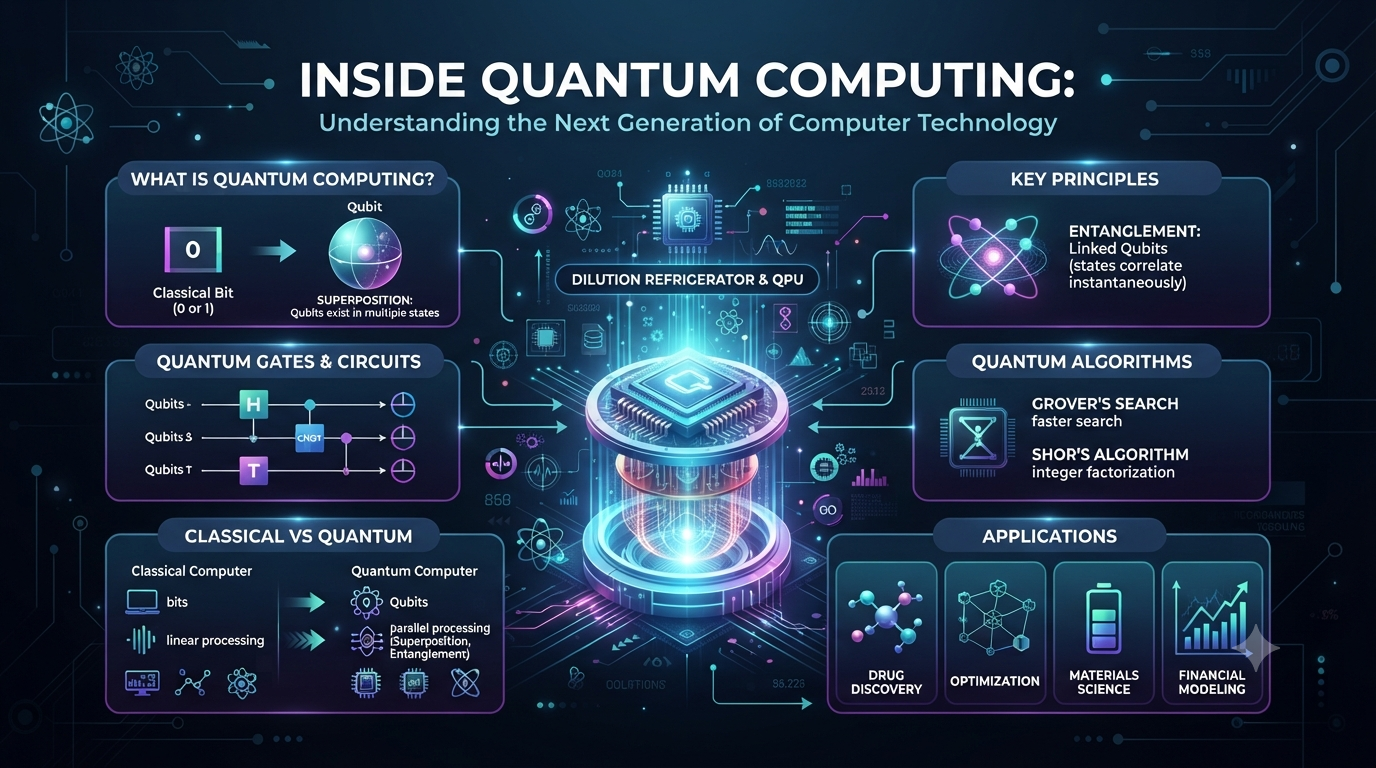
Technology keeps changing the way people work and solve problems. Computers help us manage information, perform research, and complete daily tasks. Most computers use classical systems that process information through bits.
Quantum computing introduces a different way to handle information. It uses principles from quantum physics to perform specialised calculations. Researchers are exploring its potential in science, chemistry, materials, and cybersecurity.
For readers interested in quantum computing for beginners, learning the basic concepts is the best place to start. Understanding what is a qubit explains the main building block of a quantum computer. Exploring quantum computing vs classical computing also shows why these systems work differently.
Quantum technology is still developing. It cannot replace ordinary computers for every activity. However, it may become useful for selected problems that are difficult to study with traditional methods.
The Core Ideas That Make Quantum Computing Different
Quantum computing uses quantum physics to process information. Instead of ordinary bits, it uses quantum bits called qubits.
Classical bits store either zero or one. Qubits can exist in combinations of possible states before measurement. This behaviour allows quantum programs to use special operations.
Three important ideas explain how quantum systems work.
- Superposition: A qubit can exist in a combination of possible states before measurement.
- Entanglement: Two or more qubits can have linked quantum states.
- Interference: Quantum states can combine to strengthen or reduce possible outcomes.
These principles work together inside quantum circuits. They help researchers design algorithms for specialised tasks.
A good introduction to quantum computing for beginners should explain these principles before moving to programming. They also provide the foundation for understanding what is a qubit.
The difference between quantum computing vs classical computing becomes clearer when we examine how each system stores information and performs operations.
Qubits and the Nature of Quantum Information
What is a qubit?
A qubit is the basic unit of quantum information. It is different from a classical bit because it can exist in a combination of zero and one states before measurement.
For anyone asking what is a qubit, imagine a spinning coin. While it spins, it has not settled on heads or tails. Once it stops, you see one result.
This is only an analogy. A real qubit follows the rules of quantum physics and does not behave exactly like a coin.
When a qubit is measured, the system produces a classical result. The measurement also changes the quantum state.
Physical systems used to build qubits
Researchers use different technologies to create and control qubits. Common approaches include:
- Superconducting circuits: Electrical circuits designed to show quantum behaviour.
- Trapped ions: Charged atoms held and controlled using electromagnetic fields.
- Photons: Particles of light used to carry quantum information.
- Neutral atoms: Individual atoms controlled through carefully designed systems.
- Semiconductor systems: Small structures built using materials found in electronic devices.
Each approach has different benefits. Researchers continue to improve stability, control, and reliability.
Superposition and entanglement
Superposition allows a qubit to exist in a combination of possible states before measurement. Quantum programs use this property to perform carefully planned operations.
Entanglement creates strong relationships between quantum states. Measuring one part can reveal information about another part. However, entanglement cannot be used to send messages faster than light.
Understanding what is a qubit helps beginners explore these ideas. It also makes quantum computing for beginners easier to follow.
Quantum Computing vs Classical Computing: Understanding the Difference
Classical and quantum computers use different methods to process information. Classical systems use bits and logic gates. Quantum systems use qubits and quantum gates.
How classical computers process information
Classical computers use electronic circuits to follow instructions. They support common activities such as:
- Running mobile applications
- Managing business records
- Browsing websites
- Editing documents
- Playing videos
- Processing online payments
Classical computers are reliable and suitable for most daily tasks.
How quantum computers process information
Quantum computers prepare qubits and apply controlled operations. These operations change the quantum state. The system then measures the qubits and produces classical results.
The comparison of quantum computing vs classical computing depends on the problem. Quantum systems may help with selected calculations, while classical computers remain more practical for most everyday work.
| Comparison Area | Classical Computers | Quantum Computers |
|---|---|---|
| Information unit | Bit | Qubit |
| Information states | Zero or one | Combinations of quantum states before measurement |
| Operations | Classical logic gates | Quantum gates |
| Output | Classical data | Classical results after measurement |
| Common uses | Daily computing and business software | Specialised research and calculations |
| Main challenges | Processing limits and energy needs | Noise, decoherence, and error correction |
The idea of quantum computing vs classical computing is not about choosing one technology for everything. Both systems may work together in future computing environments.
For quantum computing for beginners, remember that quantum computers do not automatically test every answer and select the correct one. Their possible advantage depends on the algorithm and the problem.
Exploring Quantum Circuits Through Simple Examples
Quantum circuits provide a visual way to understand quantum programs. They show how qubits move through different operations.
A quantum circuits tutorial usually begins with a small circuit. The circuit prepares a qubit, applies a gate, and measures the result.
Preparing the initial state
A quantum program begins by setting the starting state of its qubits. This gives the circuit a clear starting point.
Applying operations
The program applies quantum gates in a planned order. Each gate changes the state of one or more qubits.
Measuring the qubits
Measurement produces classical results. These results help programmers study the circuit's behaviour.
Reviewing the output
A quantum program may need repeated runs. Researchers examine the results to identify patterns and evaluate performance.
A beginner-friendly quantum circuits tutorial helps learners understand the order of operations. It also shows how different gates work together.
A larger quantum circuits tutorial may include several qubits. Such examples can demonstrate superposition, entanglement, and interference.
Quantum simulators allow learners to practise circuits without using physical quantum hardware. This makes them useful for anyone studying quantum computing for beginners.
Quantum Gates and Their Role in Quantum Programs
Quantum gates are operations that change quantum states. They form the basic building blocks of quantum circuits.
Learning quantum gates explained helps beginners understand how quantum programs perform calculations.
Pauli-X gate
The Pauli-X gate flips the basic state of a qubit. It performs a role similar to a NOT operation when applied to the basic zero and one states.
Hadamard gate
The Hadamard gate creates an equal superposition from a basic zero or one state. It is often used when preparing qubits for further operations.
Pauli-Z gate
The Pauli-Z gate changes the phase of a quantum state. Phase changes can affect how quantum states combine later in a circuit.
CNOT gate
The controlled-NOT gate uses one qubit to control another. It flips the target qubit when the control qubit has the required state.
This gate can also help create entanglement between qubits.
| Gate Name | Main Action | Common Role |
|---|---|---|
| Pauli-X | Flips the basic qubit state | Changing a qubit's basic state |
| Hadamard | Creates superposition | Preparing quantum states |
| Pauli-Z | Changes phase | Controlling interference |
| CNOT | Controls the target qubit using another qubit | Creating entanglement |
These examples make quantum gates explained easier to understand. Each gate has a specific role, and the order of operations can affect the final result.
When practising a quantum circuits tutorial, learners can identify each gate and follow its effect. This makes quantum gates explained more useful than simply memorising names.
Quantum Algorithms and the Problems They Explore
Quantum algorithms are special instructions designed for quantum computers. They use quantum operations to address selected problems.
The topic of quantum computing algorithms explained includes several important methods.
Grover's search algorithm
Grover's algorithm searches an unstructured collection of possibilities. It can reduce the number of queries needed compared with a classical search method in the standard theoretical setting.
Shor's algorithm
Shor's algorithm focuses on factoring large integers. It could threaten some public-key encryption systems if a sufficiently powerful fault-tolerant quantum computer becomes available.
Quantum simulation
Quantum simulation uses quantum computers to study quantum systems. Researchers explore it to understand molecules, chemical reactions, and advanced materials.
A useful guide to quantum computing algorithms explained should explain the purpose of each method. Not every algorithm provides an advantage over classical computing.
Learning quantum computing algorithms explained also requires understanding measurement. A quantum program may need repeated runs to collect useful results.
Comparing quantum algorithms with classical methods helps learners understand where quantum technology may provide value.
Shor's Algorithm and Its Importance for Encryption
Shor's algorithm is one of the best-known quantum algorithms. It is designed to factor large integers efficiently on a sufficiently powerful fault-tolerant quantum computer.
This matters because some public-key encryption methods depend on the difficulty of factoring large numbers.
Understanding its security impact
Encryption protects sensitive information across many digital services. Online banking, private communication, business systems, and government records depend on secure methods.
A sufficiently advanced quantum computer running Shor's algorithm could threaten some widely used public-key security systems.
For readers searching for Shor's algorithm explained, the main point is its possible effect on digital security.
Can today's quantum computers break common encryption?
Current quantum computers cannot break commonly used large public-key keys at practical scale. They still face major hardware and error-correction challenges.
The topic Shor's algorithm explained helps researchers understand possible future risks. It does not mean that today's quantum devices can easily break modern encryption.
Studying quantum computing algorithms explained also shows why Shor's work matters beyond scientific research.
Post-Quantum Cryptography and Future Data Protection
Post-quantum cryptography focuses on security methods designed to resist attacks from both classical and quantum computers.
A guide to post-quantum cryptography explained should make one point clear: these methods do not need quantum computers. They can run on ordinary computers and other digital devices.
Why security methods need to change
Some existing public-key systems could become vulnerable to powerful future quantum computers. Security researchers are developing new methods to reduce this risk.
Post-quantum cryptography may help protect:
- Financial information
- Government records
- Private communication
- Healthcare data
- Business documents
- Long-term digital records
Post-quantum cryptography and quantum key distribution
These terms describe different approaches.
- Post-quantum cryptography uses mathematical methods designed to resist quantum attacks.
- Quantum key distribution uses quantum communication principles to help establish shared secret keys.
A clear explanation of post-quantum cryptography explained should keep these approaches separate.
Organisations may need to review their current security systems and prepare for future changes. Understanding post-quantum cryptography explained helps readers see why cybersecurity planning matters.
People studying Shor's algorithm explained should also explore post-quantum cryptography explained. Together, these subjects show the possible security risk and the methods being developed to address it.
Real-World Applications of Quantum Computing
Quantum computing is still developing. Many proposed uses remain in research, but several fields are exploring its potential.
Chemistry and medicine research
Quantum computers may help researchers study molecular behaviour. This could support research into chemical reactions, drug discovery, and new treatments.
Materials science
Researchers are exploring quantum systems to study materials at the atomic level. This work may support research into batteries, electronic components, and advanced materials.
Supply chain management
Some supply chain problems involve many possible choices. Researchers are exploring quantum methods for selected scheduling and optimisation problems.
Financial research
Researchers are testing possible uses in risk analysis, portfolio research, and financial optimisation. These applications still need careful comparison with classical methods.
Artificial intelligence
Scientists are exploring connections between quantum computing and machine learning. Practical advantages remain uncertain, and many ideas are still experimental.
The phrase real-world applications of quantum computing includes both current research and possible future uses. It does not mean that every proposed application is already successful.
Understanding real-world applications of quantum computing requires separating research results from commercial claims. This helps readers form realistic expectations.
How to Learn Quantum Computing Without Feeling Overwhelmed
Learning quantum computing becomes easier when you follow a clear path. You do not need to understand every advanced concept at the beginning.
Begin with programming
Python is a useful language for beginners. It helps learners understand basic programming ideas and build simple applications.
Study the basic quantum concepts
Learn about qubits, superposition, entanglement, measurement, and interference. These ideas form the foundation of quantum programming.
Explore common quantum gates
Study how different gates change quantum states. Start with small circuit examples before moving to larger programs.
Practise with quantum simulators
Tools such as Qiskit and Cirq can help learners create and test quantum circuits. Their simulators allow practice without access to physical quantum machines.
Explore beginner algorithms
After understanding circuits and gates, explore Grover's algorithm, Shor's algorithm, and quantum simulation.
A useful plan for how to learn quantum computing includes both reading and practical work. Small experiments help explain how quantum programs behave.
People asking how to learn quantum computing can begin by creating simple circuits. They can then test different gates and study the measurement results.
Another important part of how to learn quantum computing is comparing quantum methods with classical approaches. This builds a realistic understanding of the technology.
Technical Challenges That Still Need Attention
Quantum computers have exciting potential, but several challenges remain.
Hardware noise
Qubits can be affected by unwanted interactions with their surroundings. These disturbances can create errors during calculations.
Decoherence
Quantum states can lose their useful properties over time. This process is known as decoherence.
Quantum error correction
Quantum error correction aims to protect quantum information. It often requires many physical qubits to support a more reliable logical qubit.
Building larger machines
Creating larger and more stable quantum computers is difficult. Researchers continue to improve qubit control, connections, and hardware designs.
Limited practical advantages
Quantum computers are not suitable for every task. Each proposed use needs careful testing against strong classical methods.
These challenges are important for anyone studying quantum computing for beginners. They explain why quantum technology is still developing.
Preparing for the Next Stage of Computing
Quantum computing brings together physics, computer science, and engineering. Its progress depends on better hardware, improved algorithms, and reliable error correction.
A clear quantum circuits tutorial helps learners understand how quantum programs operate. Studying quantum gates explained makes it easier to follow the role of each operation.
Learning quantum computing algorithms explained introduces methods that researchers use for specialised problems. Exploring Shor's algorithm explained also shows the connection between quantum technology and cybersecurity.
The need for post-quantum cryptography explained will remain important as organisations prepare their security systems for future risks.
Research into real-world applications of quantum computing may create new opportunities in science and industry. However, practical benefits must be tested before making strong claims.
For learners interested in how to learn quantum computing, steady practice is the best approach. Start with basic ideas, use simulators, and gradually explore advanced topics.
Frequently Asked Questions
1. Can quantum computers operate in normal office environments?
Many current quantum computers need carefully controlled environments. Some systems require extremely low temperatures or protection from outside disturbances. Their operating needs depend on the hardware design.
2. Are quantum computers useful for video games?
Ordinary computers and graphics processors are better suited to current video games. Quantum computing focuses on specialised calculations rather than everyday gaming activities.
3. Can quantum computers store personal photographs?
Quantum computers are not designed to replace normal storage devices. Traditional computers and storage systems remain practical for saving photographs, documents, and videos.
4. Do quantum computers always produce the same result?
Not always. Quantum measurements can produce different results across separate runs. Repeating an experiment helps researchers study the output and identify useful patterns.
5. Can a beginner use quantum programming tools?
Yes. Beginners can explore quantum programming through tools such as Qiskit and Cirq. Simulators make it possible to practise without owning quantum hardware.
6. Does quantum computing require advanced physics knowledge?
Advanced physics helps with deeper research, but beginners can start with simple explanations. Basic programming and an understanding of core quantum ideas provide a useful foundation.
7. Can quantum computers replace cloud computing services?
No. Cloud services support many everyday computing needs. Quantum machines may become available through cloud platforms for selected research and specialised calculations.
8. Why are quantum computers difficult to maintain?
Qubits are sensitive to environmental disturbances. Researchers must carefully control their hardware and reduce errors to keep quantum information stable.
9. Can quantum computing improve weather forecasting?
Researchers may explore quantum methods for selected scientific calculations. However, there is no general evidence that current quantum computers provide better weather forecasts than established classical systems.
10. Will quantum computing create new technology careers?
The field may create opportunities in quantum software, hardware engineering, research, cybersecurity, and related areas. These roles often require knowledge of programming, physics, mathematics, or engineering.
Conclusion
Quantum computing introduces a different way to process information. It uses qubits, quantum gates, circuits, and specialised algorithms to explore selected complex problems.
Learning quantum computing for beginners starts with understanding what is a qubit and how quantum states behave. Exploring quantum computing vs classical computing, quantum circuits tutorial, and quantum gates explained builds a strong foundation.
Studying quantum computing algorithms explained introduces methods such as Grover's and Shor's algorithms. Learning Shor's algorithm explained also shows the importance of post-quantum cryptography explained for future digital security.
Research into real-world applications of quantum computing continues across science and technology. Although major challenges remain, the field offers new areas for discovery.
Anyone interested in how to learn quantum computing can begin with basic programming, simple circuits, and practical experiments. A steady learning approach makes this advanced subject easier to understand.




Top comments (0)