
Introduction
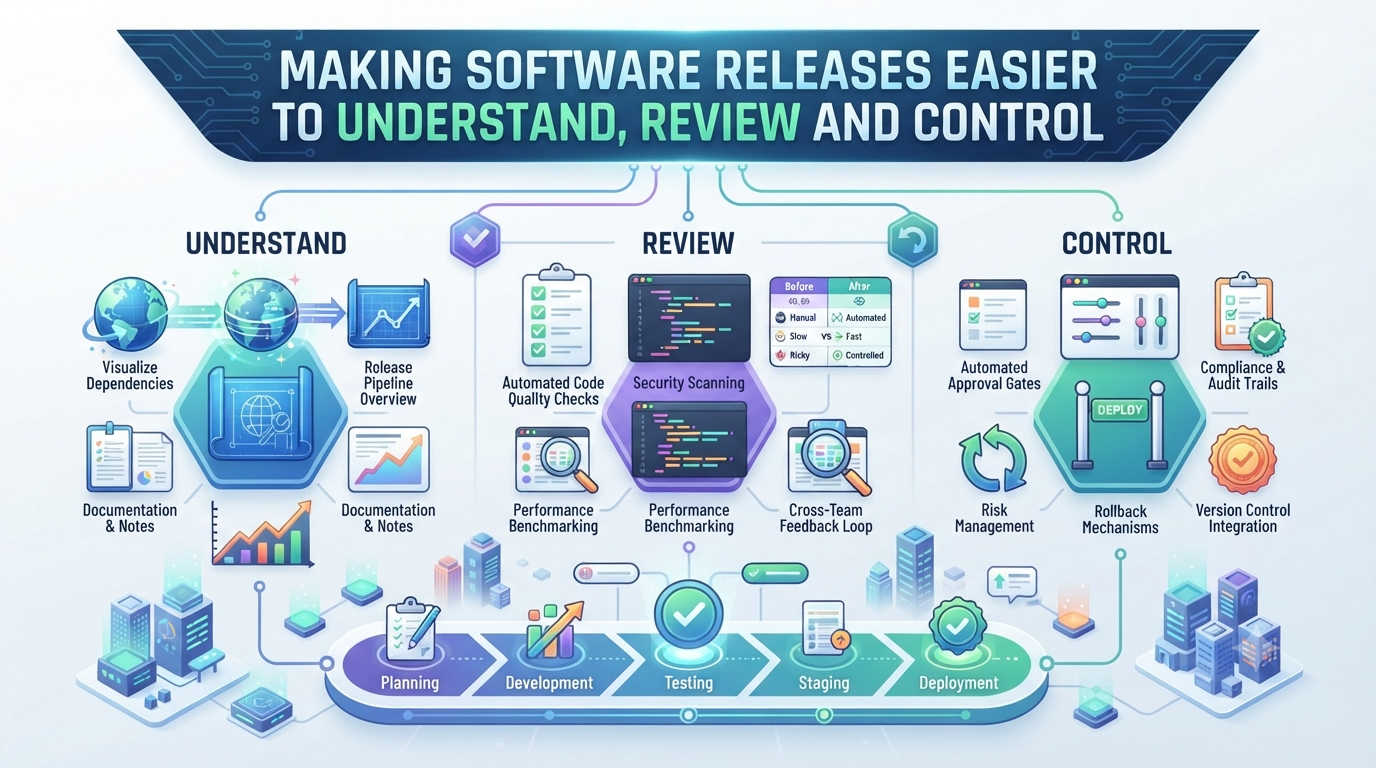
A software release involves more than moving code into production. Teams plan work, review changes, run builds, create packages and deploy services. Each step creates useful information. However, that information often stays in different systems.
This makes it hard to understand what a release contains. Teams may see completed tasks but lack proof of what reached production. They may also struggle to explain delays, missing approvals or unexpected changes.
A software release tracking tool helps bring these details into a clearer view. It connects release activity and gives teams a shared record. Reloqui focuses on this need through release intelligence. It brings together evidence from engineering and delivery systems. This helps teams understand release status with greater confidence.
Why Release Information Needs Better Organisation
Software teams work across many tools. Product teams record planned work in issue trackers. Developers manage code changes in repositories. Build systems create packages, while deployment tools record production activity.
These systems each show part of the process. Yet they may not provide one complete release picture.
For example, a task may appear complete in a project tracker. Its related code may still be waiting for review. A build may exist, but the team may not know whether it contains the expected changes.
A software release tracking tool can connect these records. It helps teams compare planned work with code activity and deployment evidence. This makes release information easier to review.
Without connected records, teams may face several problems:
- Release details spread across many systems.
- Unclear links between tasks and code changes.
- Missing evidence during release reviews.
- Different teams sharing different status updates.
- Manual work when preparing release summaries.
- Limited visibility into late changes.
- Difficult checks during audits or investigations.
The goal is not to replace existing engineering tools. It is to make their information easier to understand together.
Understanding a Release Intelligence Platform
A release intelligence platform brings evidence from different delivery stages into one connected view. It helps teams understand how planned work relates to merged code, builds, artifacts and deployments.
This is different from viewing a simple deployment list. A deployment list may show when a service was updated. A release intelligence platform can also help explain which changes were expected and what evidence supports the release record.
For example, a team may plan three changes for a product update. The repository may show that two related code changes were merged. Build records may confirm that a package was created. Deployment records may show which environment received it.
The team can review these details together. It can also identify missing or uncertain links.
Reloqui.com uses evidence reconciliation to connect release information. Its records can include tracked issues, merged pull requests, builds, artifacts and deployments.
A release intelligence platform is useful when teams need more than a basic status label. It supports clearer reviews by showing the evidence behind release information.
Building a Useful Software Release Audit Trail
An audit trail records important events and the evidence connected to them. It helps teams understand what changed, when it changed and how the change moved through the delivery process.
A software release audit trail can connect a planned issue with its code change, build and deployment record. This creates a clearer history of the release.
Consider a service update that includes a security setting change. The team may need to identify the related task, code review and deployment. A connected software release audit trail makes these records easier to follow.
Good release records should support several activities:
- Reviewing the changes included in a release.
- Checking links between tasks and merged code.
- Understanding build and deployment history.
- Finding evidence for approval decisions.
- Investigating unexpected release behaviour.
- Preserving a clear record for later review.
Reloqui.com can create stored release records from available evidence. It also supports frozen release snapshots. These help preserve a view of the evidence associated with a particular release.
A software release audit trail does not prove that software is free from defects. It helps explain the recorded delivery activity. Teams must still use testing, security checks and other quality controls.
Making Release Communication Easier
Release communication often takes time. Engineers understand technical changes, but other teams may need simpler explanations. Product teams may focus on customer impact. Operations teams may need service details. Compliance teams may need supporting records.
An automated release notes generator can reduce the effort of preparing release summaries. It uses available release information to help create organised notes.
However, useful release notes need more than a list of merged changes. They should explain the purpose and relevance of each change. They should also avoid presenting uncertain information as confirmed fact.
An automated release notes generator can support different communication needs when it uses reliable source records.
For example:
- Executives may need a short summary of release progress.
- Engineers may need technical change details.
- Operations teams may need deployment information.
- Product teams may need feature-related updates.
- Compliance teams may need traceable evidence.
Reloqui.com supports five audience-focused release narratives. These cover executive, engineering, operations, product and compliance needs. Each narrative can be traced back to its source information.
An automated release notes generator should make communication clearer, not hide missing evidence. Teams should review the output before sharing it.
Checking Release Readiness Before Deployment
A release can look complete while important evidence remains missing. Some changes may lack clear issue links. A build may not match the expected release. Deployment details may also be incomplete.
Release readiness assessment software helps teams review whether the required release information is available. It can support checks before a release moves forward.
A useful readiness review may consider:
- Whether planned work has clear records.
- Whether relevant code changes are linked.
- Whether build information is available.
- Whether deployment evidence matches the release.
- Whether required approvals are recorded.
- Whether late changes affect the release picture.
Release readiness assessment software should help teams identify gaps. It should not make safety claims based on a single score.
Reloqui.com uses confidence scoring to show the strength of available evidence. Its approach is deterministic-first and heuristic-second. It also shows signals that can raise or lower confidence.
This helps reviewers understand why a release record has a particular confidence level. However, confidence is a guide to evidence strength. It is not a guarantee of software quality or safety.
With release readiness assessment software, teams can make better-informed reviews by checking both the result and its supporting evidence.
Creating a Clear Release Approval Process
Release approval should have clear rules. Teams need to know who can approve a release and what conditions must be met.
Release approval workflow software helps organise these decisions. It can connect approval steps with release records and policy requirements.
For example, an organisation may require a reviewer to approve a release before publishing. It may also set a minimum confidence threshold. If the evidence falls below that threshold, the release may need another review.
A useful release approval workflow software process can support:
- Defined approval requirements.
- Required sign-off from responsible people.
- Evidence checks before publishing.
- Clear records of approval decisions.
- Review when new information changes release confidence.
Reloqui.com supports policy gates that can block publishing when confidence falls below a configured threshold. It can also require sign-off and suspend approvals when late evidence lowers the confidence score.
This matters because release information can change after an initial review. An approval should not remain trusted if important new evidence changes the release record.
Release approval workflow software helps make decisions easier to review. It does not replace human responsibility for release decisions.
Connecting Work Through GitHub Jira Release Tracking
Development work often starts in a planning system and continues in a code repository. Teams need to connect these records to understand how a planned change becomes part of a release.
GitHub Jira release tracking helps connect issue information with repository activity. It can show how planned work relates to pull requests and merged changes.
For example, a project issue may describe a new account setting. A developer creates a pull request for the change. After review, the code is merged. Linking these records helps reviewers understand the relationship between the planned task and the code activity.
A good GitHub Jira release tracking process should help teams:
- Connect work items with code changes.
- Review whether planned work has related pull requests.
- Find changes that lack clear issue links.
- Understand which work appears in a release.
- Investigate differences between plans and completed work.
GitHub Jira release tracking is most useful when teams maintain clear links and consistent records. Poor issue references can make matching difficult.
Reloqui.com reconciles tracked issues with merged pull requests and other release evidence. This can help teams build a more explainable record from their existing delivery activity.
Seeing Delivery Activity in One CI/CD View
Continuous integration and continuous delivery systems create many useful records. They may show build results, package creation and deployment events. Yet teams can still struggle to connect these details with the work planned for a release.
A CI/CD deployment tracking dashboard brings important delivery information into a shared view. It can help teams review build and deployment activity without checking every system separately.
For example, a team may have a successful build but no confirmed production deployment. A dashboard that shows both records can help prevent confusion between build completion and release completion.
A useful CI/CD deployment tracking dashboard should make it easier to review:
- Build records linked to a release.
- Available artifact information.
- Deployment activity across environments.
- Differences between expected and recorded changes.
- Missing delivery evidence.
A CI/CD deployment tracking dashboard should not treat every successful build as proof of a completed release. Build and deployment events represent different stages.
Reloqui.com connects build, artifact and deployment evidence with other release records. This gives teams a broader view of delivery activity.
Improving Software Release Change Traceability
Traceability means being able to follow a change through its related records. It helps teams understand where a change started and how it moved through delivery.
Software release change traceability connects planned work, code changes and release evidence. It helps reviewers follow the path from an original requirement to the deployed result.
For instance, a change to a customer notification service may affect another service that depends on it. A dependency graph can help teams see these relationships and understand possible impact areas.
Strong software release change traceability supports:
- Following changes from planning to deployment.
- Identifying related services and dependencies.
- Reviewing upstream and downstream effects.
- Explaining release contents to different teams.
- Investigating unexpected changes.
- Preserving useful evidence for future reviews.
Reloqui.com includes a catalogue and dependency graph for products, services, environments and related dependencies. This can help teams understand how changes connect across their systems.
Software release change traceability is especially useful in complex environments. It gives teams a clearer way to investigate change relationships instead of relying on scattered notes.
Choosing Self-Hosted Release Management Software
Some organisations prefer to keep software and operational data within their own infrastructure. They may have internal security rules, data handling needs or deployment policies.
Self-hosted release management software gives these organisations an option to run release management capabilities in an environment they control.
Before selecting self-hosted release management software, teams should review:
- Deployment and infrastructure requirements.
- Data storage and access controls.
- Connector support for existing systems.
- Maintenance and upgrade responsibilities.
- Monitoring and operational needs.
- Internal support and ownership.
Self-hosting does not remove the need for good processes. Teams still need clear release policies and reliable source records.
Reloqui.com offers a self-managed deployment option with its full feature set. It also provides a managed enterprise option with dedicated infrastructure and support.
The right self-hosted release management software should fit the organisation's operating model. It should also work with the tools already used by engineering teams.
Comparing Common Release Management Needs
Different teams need different capabilities. The table below shows how common requirements relate to release management work.
| Need | What to Look For | Who It Helps |
|---|---|---|
| Release visibility | Connected issues, code, builds and deployment records | Engineering and product teams |
| Audit history | Traceable evidence and preserved release snapshots | Compliance and engineering teams |
| Release communication | Audience-focused summaries linked to source records | Product and leadership teams |
| Readiness review | Evidence gaps and understandable confidence signals | Release managers |
| Approval control | Policy rules, sign-off and approval history | Engineering leaders |
| Delivery monitoring | Build, artifact and deployment information | Operations teams |
| Change impact | Service relationships and dependency details | Architects and engineers |
| Deployment ownership | Self-managed or managed operating options | Platform and infrastructure teams |
Common Mistakes That Make Releases Harder to Manage
Even a well-designed process can fail when teams use incomplete records or unclear rules. These mistakes can reduce the value of release information.
- Treating a completed task as a deployed change: A task can be closed before its code reaches production.
- Relying only on deployment status: Deployment records do not explain every change included in a release.
- Ignoring missing links: Unconnected issues and pull requests make reviews harder.
- Writing notes by hand without evidence: Manual summaries can miss important changes or include unclear details.
- Using confidence as a quality guarantee: Evidence strength does not prove that software is safe or defect-free.
- Approving releases without clear rules: Unclear approval conditions can create inconsistent decisions.
- Overlooking late evidence: New information may change the release record after an earlier review.
- Ignoring service dependencies: A change can affect services beyond the one being updated.
- Assuming every connector provides identical data: Different systems may record different details and levels of evidence.
- Expecting one platform to replace every engineering tool: Release intelligence should connect existing tools, not replace testing, source control or CI/CD systems.
A Fictional Example: Managing a Learning Portal Release
Consider a fictional company that operates an online learning portal. Its team plans a release with three changes: a new course search feature, an updated login flow and a notification setting.
The product team records the work in its issue tracker. Developers create and merge the related code changes. The build system creates an artifact, and the deployment system records the environments where it runs.
At first, the release manager checks each system separately. This takes time and makes it hard to confirm whether all planned changes are included.
The team then uses a software release tracking tool to bring the available records together. Its release intelligence platform view helps reviewers compare planned work with code, build and deployment evidence.
A software release audit trail gives the team a clearer history. An automated release notes generator helps prepare summaries for different readers. The team also uses release readiness assessment software to review missing evidence.
If a new record changes the confidence level, release approval workflow software can support another review. GitHub Jira release tracking helps connect tasks with merged changes, while a CI/CD deployment tracking dashboard shows delivery activity.
The team can also use software release change traceability to inspect related services. If the organisation needs internal deployment control, self-hosted release management software may suit its operating needs.
This example is fictional. It explains a possible process, not a customer result or performance claim.
How Reloqui.com Supports Release Intelligence
Reloqui.com is designed to help engineering organisations understand release evidence across their delivery systems. It brings together information from planning, code, builds, artifacts and deployments.
Its capabilities include:
- Evidence reconciliation: Connects tracked issues, merged pull requests, builds, artifacts and deployments.
- Confidence scoring: Shows signals that affect trust in a release record.
- Approval policies: Supports confidence thresholds, sign-off and approval suspension when late evidence changes the score.
- Audience-focused narratives: Provides separate release views for executive, engineering, operations, product and compliance readers.
- Dependency visibility: Models products, services, environments and upstream or downstream relationships.
- Release snapshots: Supports frozen records that preserve a release view.
- System connections: Supports connectors across source control, issue tracking, CI/CD, registries, infrastructure and incident systems.
- Deployment choices: Offers self-managed and managed enterprise options.
Reloqui.com is not a replacement for source control, issue tracking, CI/CD, testing or security tools. It connects evidence from these systems to make release information easier to explain.
Teams should assess its connectors, evidence coverage and operating options against their own requirements.
FAQs
1. What does a software release tracking tool help teams manage?
A software release tracking tool helps teams organise release information from different delivery stages. It can connect planned work, code changes, builds and deployments. This gives reviewers a clearer view of release contents and helps them identify missing or unclear records before sharing a release update.
2. How is a release intelligence platform different from a deployment tracker?
A deployment tracker mainly records deployment activity. A release intelligence platform connects deployment information with other evidence, such as planned issues, merged code and build records. This broader view helps teams explain what a release contains and understand how its recorded changes relate to the original work.
3. Why is a software release audit trail important?
A software release audit trail helps teams follow the history of release activity. It can connect tasks, code changes, builds and deployments. These records support reviews, investigations and internal checks. They also make it easier to explain which evidence supported a release decision.
4. Can an automated release notes generator create useful notes for different teams?
Yes, when it uses relevant and reliable release evidence. An automated release notes generator can help organise technical changes into summaries for different readers. Engineering, product, operations and leadership teams may need different levels of detail. Human review remains important before notes are shared.
5. Does release readiness assessment software guarantee a safe release?
No. Release readiness assessment software can help teams review available evidence and identify gaps. It cannot guarantee that software has no defects or security risks. Teams still need suitable testing, security reviews and operational checks. A readiness score should support human judgement, not replace it.
6. What should release approval workflow software include?
Release approval workflow software should support clear approval rules, required sign-offs and a record of decisions. It should also help teams respond when new evidence changes a release assessment. These features make approval processes easier to review and help prevent unclear release decisions.
7. How does GitHub Jira release tracking improve release reviews?
GitHub Jira release tracking connects planned work in Jira with code activity in GitHub. Reviewers can follow the relationship between an issue and its related pull request. This makes it easier to understand which planned changes have corresponding code records and where links may be missing.
8. What information belongs in a CI/CD deployment tracking dashboard?
A CI/CD deployment tracking dashboard can show build records, artifact details and deployment events. It should help teams distinguish between a successful build and a completed deployment. Connecting this information with release records gives reviewers a clearer understanding of delivery progress.
9. How does software release change traceability help with dependencies?
Software release change traceability helps teams follow changes and their relationships with other services. Dependency information can show which upstream or downstream systems may be affected. This supports impact reviews and investigations, especially when a release involves several connected applications or services.
10. When should an organisation consider self-hosted release management software?
An organisation may consider self-hosted release management software when it needs to operate release tools within its own infrastructure. It should review data handling, deployment needs, maintenance work and connector support first. The option should fit its internal policies and available operational resources.
Final Thoughts
Reliable release management depends on clear records and useful evidence. Teams need to understand how planned work becomes code, builds and deployed changes. They also need approval rules and release notes that different readers can understand.
A connected process can reduce confusion between delivery stages. It can also make reviews easier to explain and repeat. Reloqui.com brings release evidence together and helps teams examine the strength of their records. Its confidence signals, approval controls and dependency views support more informed release discussions. However, teams must still maintain their testing, security and deployment practices. Good release intelligence works best when it strengthens the tools and processes an organisation already uses.



Top comments (0)