
Introduction
Harvest brings joy, but selling brings stress. A farmer may carry his crop to the market and hear a rate far below his hope. Then he has little choice but to accept it. Often the problem is not the crop. It is missing market knowledge. Clear farming information in Hindi can fix this gap. MAHTO is a Hindi-first rural knowledge platform. It explains farming, government schemes, livestock, mandi prices, and village business in easy words. It is not a government website. In this blog, we look at smart selling. We also cover scheme papers, credit, crops, animals, and side income. Read on, and plan your next sale with a calm mind.
What Does a Mandi Price Mean?
A mandi is a wholesale market where farmers sell crops to traders. The mandi price is the rate paid for a fixed weight of your produce on that day. It is not the same as the price you see in a shop. Shop rates include transport, storage, and the seller's margin. Mandi rates change often, sometimes within a day. They also differ by crop quality and by market town. So one number never tells the whole story. Always ask what grade and moisture level the rate applies to.
Why This Matters for Farmers and Villages
Selling well can add more to your income than any extra irrigation. A small rise in the rate means more cash on every quintal. Poor timing can erase weeks of hard work. Families who watch the market make calmer choices. They know when to sell and when to wait. They also bargain with more confidence. When a village shares market news, everyone gains. Young members can read rates on phones and tell elders. Together, they avoid hasty sales at weak rates.
Farming Information in Hindi: Why Simple Language Helps
Market reports often use short forms and difficult terms. Words like arrivals, modal rate, and grade can confuse a new reader. Farming information in Hindi explains each one in daily speech. Arrivals simply means how much produce reached the market. Modal rate means the rate most sellers got. Once a farmer knows such words, a price chart becomes useful. He can compare days and markets with ease. Clear language also protects against rumours. Still, check a rate with more than one source before acting on it.
Government Schemes for Farmers
Some government schemes for farmers connect to the market. For a few crops, the government announces support prices and runs purchase centres. Rules, crops, and dates differ by state. Other programmes help with storage, transport, or farmer groups. Ask your block office or mandi office what applies to you this season. You may need registration before the sale. MAHTO.IN explains scheme basics, documents, and common mistakes in simple steps. Use such guides to prepare. The official office gives the final answer.
PM Kisan eKYC Explained Simply
Selling a crop gives you cash once a year. Scheme support can fill the gaps between sales. So keep PM Kisan eKYC in order. This is an online identity check linked to the scheme. It helps confirm that support reaches the right person. Look at your status on the official portal now. Make sure your name, bank account, and mobile number match your papers. A common service centre can help if the online steps fail. Steps can change over time, so follow the official portal. Never share an OTP.
Kisan Credit Card: What Farmers Should Know
Many farmers sell in a hurry because a loan is due. The Kisan Credit Card can ease this pressure when used with care. It offers bank credit for farm costs. Ask your bank about the limit, interest, and repayment schedule. Plan the due date for a time after your expected sale. That way, you are not forced to sell at a weak rate. Keep ID, address proof, and land papers ready. Borrow only what your crop needs. Rules vary, so confirm current terms with your bank.
How to Check Mandi Prices
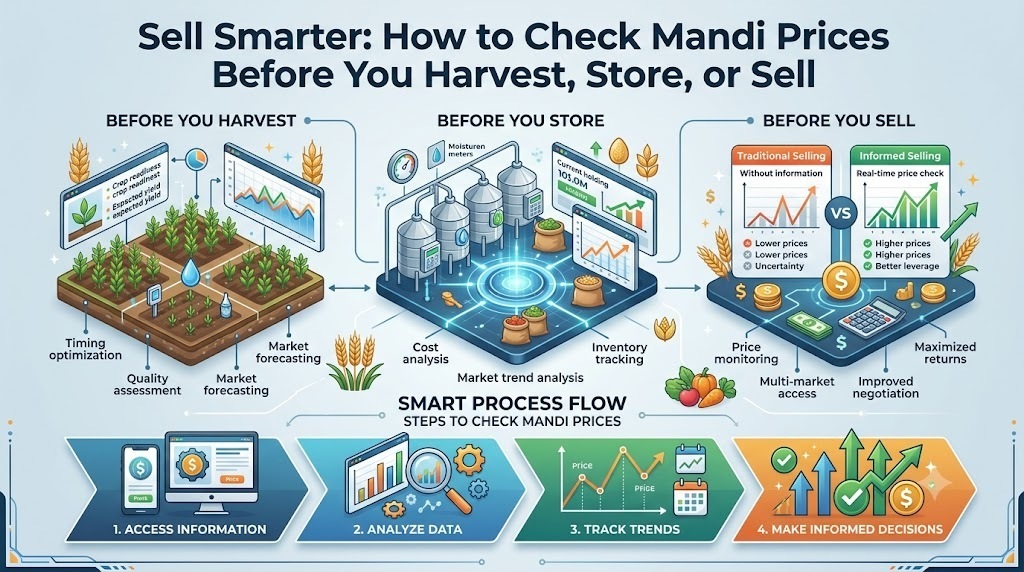
Now the main topic. Here is how to check mandi prices step by step. First, open the official market portals run by the government. Second, look at farm apps that show daily rates. Third, visit the notice board at your nearest mandi. Fourth, call two or three trusted traders. Fifth, compare the rates for the same crop and grade. Sixth, write each rate in a notebook for several days. A trend matters more than one day's number. Also add transport and unloading costs. Then you can see your true return.
How to Grow Paddy
Good market returns start in the field. When you learn how to grow paddy with care, grain quality improves. Better quality often means better offers. Prepare level land so water spreads evenly. Choose a variety that your area and buyers prefer. Raise healthy seedlings, and transplant them on time. Control weeds early. Ask local experts before using sprays or fertilizer. Harvest when grains turn golden. Dry the grain well, because high moisture can lower the rate. Clean it before you take it to the market.
How to Start Organic Farming
Some farmers look for niche buyers instead of the usual mandi. If you want to learn how to start organic farming, begin with one plot. Test the soil, then build it with compost and green manure. Use natural pest control and keep clear notes. Direct sales to nearby families or shops may work for some crops. Ask buyers what they want before you grow. Do not assume a higher rate without proof. Learn label rules before using the word organic. Ask a farmer group about local demand.
How to Start Goat Farming
Animals can give income between crop sales. If you plan how to start goat farming, study the animal market first. Visit nearby animal fairs and ask about rates by age and weight. Prepare a dry shed and clean water. Start with a few healthy animals from trusted sellers. Keep feed costs in your notebook. A local veterinarian should guide vaccines and treatment. Do not treat sick animals yourself. Sell only when animals reach a good condition. Avoid panic sales during festivals or shortages.
Livestock Farming Information
Reliable livestock farming information shows how animal income differs from crop income. Dairy gives money in small amounts each day. Poultry sells in short cycles. Fish ponds pay after months of care. Each has costs for feed, health care, and transport. Vaccination protects animals from many common diseases, and a veterinarian sets the plan. Balanced feed improves growth and milk output. Choose the animal that fits your space and daily time. Master one type, then think about another.
Village Business Ideas
Market knowledge can inspire useful village business ideas. A grain cleaning and grading unit helps farmers earn better rates. A small cold or dry storage room may hold produce for later sale. A transport pooling service can cut carriage costs. Some groups run a rate-sharing board or phone group for local traders. Others pack and sell farm produce directly. Start small and test demand. Count your own time as a cost. No idea guarantees profit.
Table: Farming and Rural Income Options at a Glance
| Option | What It Involves | Who It Helps |
|---|---|---|
| How to check mandi prices | Comparing portals, boards, and trader rates | Farmers ready to sell |
| PM Kisan eKYC | Online identity check for scheme records | Families getting support |
| Kisan Credit Card | Bank credit with a repayment plan after sale | Farmers short of seasonal cash |
| How to grow paddy | Better grain quality for better offers | Farmers with irrigated land |
| How to start organic farming | Direct buyers and careful records | Farmers testing niche markets |
| How to start goat farming | Studying animal market rates before buying | Families with fodder and time |
| Livestock farming information | Comparing daily, short, and long income cycles | Families choosing animals |
| Village business ideas | Grading, storage, transport pooling | Youth, women, small groups |
Common Mistakes Farmers Make
- Selling on the first day of heavy arrivals. Rates often dip then.
- Looking at only one market. Compare at least two or three.
- Forgetting transport cost. A higher rate far away may not pay.
- Selling damp grain. Moisture can reduce the offer.
- Never learning how to check mandi prices from more than one source.
- Taking a Kisan Credit Card loan with a due date right after harvest. Plan a buffer.
- Leaving PM Kisan eKYC incomplete. Support may pause.
- Trusting forwarded messages on government schemes for farmers. Check official notices.
- Skipping receipts. You may need proof of sale later.
- Storing produce without pest checks. Losses can exceed any rate gain.
A Simple Example
This is a fictional example. A family grows paddy on a small farm. A few weeks before harvest, they read market guides on MAHTO.IN. They start a notebook and note rates from the portal, a trader, and a neighbour. They also ask the mandi office about purchase centres. At harvest, they dry and clean the grain. Then they compare offers over several days. They also check whether storage space is safe. In the slack season, they discuss a small goat shed. Each plan is checked with a local office before they act.
How MAHTO Can Help
MAHTO helps farm families make informed choices. Its crop pages cover seasons, irrigation, soil testing, fertilizer, pest control, and calendars. They include how to grow paddy and how to start organic farming. Scheme pages explain PM-Kisan, PM Fasal Bima Yojana, Kisan Credit Card, and Soil Health Card. They share eligibility, benefits, documents, and common errors. Livestock pages offer livestock farming information on dairy, poultry, fish, goats, and feed. Business pages share village business ideas with simple planning notes. The aim is farming information in Hindi that is easy to follow. MAHTO.IN is not an official portal. It cannot promise income, subsidy, or loan approval.
Frequently Asked Questions About Mandi Rates and Smart Selling
How does farming information in Hindi help me read market reports?
It explains terms like arrivals and grade in daily words. You can then compare rates with confidence. Family members can help each other. Still, check every rate with a second source. Prices change quickly and differ by market.Do government schemes for farmers include support at the market?
Some crops may have support prices or purchase centres. Rules differ by state and season. Ask your mandi office or block office what is open now. You may need to register first. Never pay a stranger to promise a sale.Can PM Kisan eKYC problems affect my cash flow?
They can pause scheme support, which may leave a gap before sale. Check your status on the official portal. Match your name, bank details, and mobile number. Visit a common service centre if needed. Follow current official steps.How can a Kisan Credit Card help me avoid a hurried sale?
It may give crop-cost credit so you are not short of cash. Set your repayment date after your planned sale. Ask your bank about interest and charges. Borrow only what you need. Approval is up to the bank.How to check mandi prices if I cannot visit the market?
Use official market portals and farm apps. Call trusted traders. Ask a neighbour who visits the mandi. Write down rates for several days. Compare, and subtract transport cost. Do not decide on a single forwarded message.How to grow paddy so that I get better offers?
Focus on clean seed, steady water, and timely weeding. Harvest at the right stage and dry grain well. Remove stones and dust before sale. Follow local advice for sprays and fertilizer. Buyers often pay better for even, dry grain.How to start organic farming if I want to find direct buyers?
Begin with one plot and keep notes. Talk to nearby shops and families about demand. Ask what crops they want. Test a small lot first. Learn label rules before using the word organic. Do not assume a higher price.How to start goat farming and judge the animal market?
Visit local animal markets and note rates by age and weight. Prepare a dry shed and clean water. Start with a few animals. Meet a veterinarian before buying. Sell when animals are healthy and well fed.Where can I find livestock farming information on selling animals or milk?
Ask your district veterinary office and local dairy or poultry groups. Farm training centres also help. Platforms like MAHTO.IN share plain-language guides. Compare buyer offers. Ask a veterinarian before treating any illness.Does MAHTO offer village business ideas linked to markets?
Yes, MAHTO shares village business ideas such as grading, packing, and storage. It is a Hindi-first learning platform, not a government site. It cannot promise income. Try each idea on a small scale first.
Final Thoughts
Smart selling starts before harvest. Learn how to check mandi prices from several sources, and track them in a notebook. Plan your loan dates so you are never forced to sell cheap. Keep PM Kisan eKYC complete, and ask your bank about a Kisan Credit Card with care. Improve crop quality through steps like how to grow paddy well. Try how to start organic farming or how to start goat farming on a small scale. Use farming information in Hindi, clear livestock farming information, and practical village business ideas to guide your plan. Confirm government schemes for farmers on official sources. MAHTO.IN will keep sharing simple guides for rural families.



Top comments (0)