
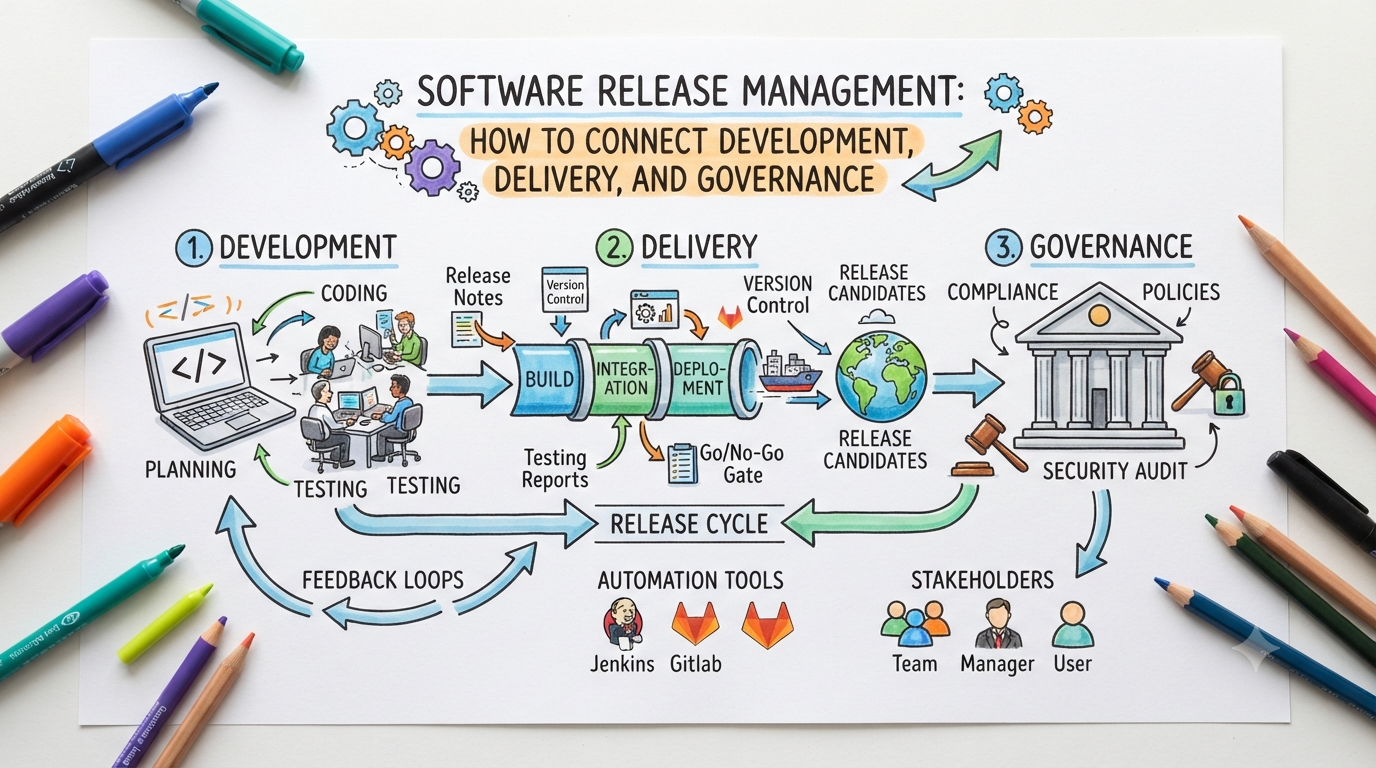
Introduction
Shipping software involves many decisions. Teams must decide what belongs in a release, confirm that developers completed the planned work, check build and deployment records, and make sure the right people approve publication.
These decisions become difficult when information sits across separate engineering tools. A release manager may need to check source control, project tasks, CI/CD pipelines, artifact records, and deployment history. Without clear connections, even a routine release can require repeated manual checks.
A structured release process gives teams a better way to manage this work. A release intelligence platform connects relevant engineering information and helps reviewers understand how changes move through the delivery process.
Reloqui supports this process with an 11-stage release reconciliation engine, evidence classification, release confidence signals, governance controls, release comparisons, and audience-specific documentation. Let's explore how these capabilities fit into the everyday work of software release management.
1. Plan the Release Around Clear Delivery Goals
A release should begin with a clear understanding of what the team wants to deliver. Developers may work on new features, bug fixes, infrastructure updates, and technical improvements at the same time. The release owner needs to identify which changes belong in the planned version.
Start by defining the release scope.
- Identify the target release version or Git tag.
- List the planned features and fixes.
- Connect work items with the relevant development changes.
- Identify changes that need additional review.
- Confirm which teams contribute to the release.
A software release tracking tool helps organize this information and gives teams a better view of release contents.
Reloqui helps teams reconcile information from connected engineering systems. Its 11-stage release reconciliation engine collects and classifies evidence to support a structured review of release activity.
This gives release owners a clearer starting point. They can investigate what the release contains before moving toward build checks, approvals, and publication.
2. Bring Development and Project Records Into One View
Development work creates information in several places. A developer may complete a task in Jira, submit code through GitHub, and merge a pull request after review. Another team may use GitLab, Bitbucket, Azure DevOps, or Linear.
The challenge is understanding how these records relate to each other.
For example, a project board may show a task as complete, but the release reviewer may still need to confirm that the corresponding code change entered the intended version.
Reloqui's connector ecosystem includes 12 connector types. Its described integrations cover GitHub, GitLab, Bitbucket, Azure DevOps, Jira, Linear, CI/CD systems, artifact registries, Terraform, and incident-related integrations.
Teams working with GitHub Jira release tracking can use connected engineering information to review the relationship between development activity and project work.
This approach supports software release change traceability. It helps reviewers understand how planned work connects to code changes and release records without replacing the systems teams already use.
3. Confirm That the Release Contains the Intended Changes
Once teams connect their development records, they need to check whether the actual release matches the plan.
A release may contain an unexpected change. A planned fix may not appear in the expected version. A pull request may lack a clear relationship with a work item.
These situations do not always indicate a serious problem, but reviewers should understand them before publication.
A practical scope review should ask:
- Do the release records match the planned version?
- Can reviewers identify the changes included in the release?
- Are important pull requests linked to the expected work?
- Does any change appear outside the intended scope?
- Can the team explain missing or unexpected records?
Reloqui collects and classifies evidence to help teams examine these relationships. Its reconciliation process gives reviewers a structured way to investigate release contents.
This review can also support better communication. Developers and release managers can discuss specific records rather than relying on different versions of a release list.
4. Check Build Results, Artifacts, and Deployment Records
A release does not become ready simply because developers have merged the code. Teams also need to review the delivery evidence.
Build systems show whether the relevant build completed successfully. Artifact registries help teams check whether expected outputs are available. Deployment systems provide records of delivery activity.
These records answer different questions, so teams should review them together.
| Delivery area | What the team should verify |
|---|---|
| Build results | Did the relevant builds complete successfully? |
| Artifacts | Are the expected release artifacts available? |
| Deployment | Can reviewers find evidence of deployment? |
| Version details | Do Git tags identify the expected release? |
| Change links | Do pull requests connect to the release records? |
| Exceptions | Do unusual or missing records need investigation? |
A CI/CD deployment tracking dashboard can make delivery information easier to review. It can help teams see important build and deployment details without repeatedly switching between tools.
Reloqui considers successful builds, artifact availability, and deployment evidence among its release confidence signals. It uses information from connected CI/CD systems and artifact registries as part of its reconciliation process.
Teams should still consult their original engineering systems when they need detailed logs or technical investigation.
5. Investigate Missing Links and Unusual Git Activity
Release records do not always follow an ideal path. A change may lack a linked pull request. A commit may not connect to the expected work item. Force-push activity may affect the history reviewers need to understand.
These details can make a release harder to verify.
Reloqui considers orphaned changes and force-push activity as part of its release confidence signals. Along with Git tags, linked pull requests, successful builds, artifact availability, and deployment evidence, these signals help reviewers understand the available release information.
The platform's confidence scoring can highlight areas that deserve attention. However, teams should not treat a confidence score as a final quality decision.
A high score does not guarantee that a release has no defects. A lower score does not automatically mean that a release must stop. Reviewers need to investigate the underlying evidence and apply their engineering judgment.
6. Compare Versions to Understand Release Changes
A release owner often needs to explain how one version differs from another. This becomes important when a team changes scope during development or prepares several releases close together.
Release comparison can help teams examine:
- Changes added to the newer version.
- Changes that appeared in an earlier version.
- Differences in release contents.
- Unexpected additions or omissions.
- Potential effects on connected components.
Reloqui supports release comparison and impact analysis. These capabilities help teams examine release differences and understand how changes affect the wider delivery picture.
This information can support planning, technical review, and release communication. It can also help teams investigate questions that arise after publication.
7. Use Release Confidence as a Review Aid
Teams need a repeatable way to assess whether they have enough information to proceed.
Release readiness assessment software can support this process by organizing relevant release evidence and helping reviewers identify areas that need attention.
Reloqui uses its confidence signals to help teams examine the available release evidence. Reviewers can consider source history, build results, artifact availability, deployment records, orphaned changes, and force-push activity.
A useful readiness review should also consider factors beyond the available release records:
- Have the required tests passed?
- Have security checks taken place?
- Do operational teams understand the deployment plan?
- Are known issues documented?
- Have relevant stakeholders reviewed the release?
- Does the release meet internal publishing requirements?
The platform can help organize release information, but the organization must define its own readiness criteria. Teams should use confidence signals as supporting information, not as a substitute for testing or final approval.
8. Define Who Can Approve and Publish a Release
Release approval requires clear responsibility. Without an agreed process, teams may not know who can approve a version or which checks must happen before publication.
Release approval workflow software helps organizations define these steps and manage release governance.
Reloqui supports approval workflows, publishing policies, and freeze windows.
Organizations can use these capabilities to structure their release process. For example, they may require a technical review before publication or restrict changes during a defined freeze window.
A good approval process should answer three questions:
- Who reviews the release?
- What evidence must reviewers consider?
- Who can authorize publication?
Clear rules help developers, release managers, and operations teams understand their responsibilities. They also make it easier to review how the organization handled a release decision.
9. Keep a Consistent Record of Release History
Teams may need to revisit a release months after publication. They might investigate an incident, compare versions, or explain why a particular change entered production.
A software release audit trail helps preserve and review information about release activity. It can support internal investigations and governance reviews by making relevant history easier to examine.
Reloqui supports immutable snapshots as part of its release governance capabilities. These snapshots help preserve release information at a particular point in the process.
Organizations should define their own policies for record access, retention, and protection. An audit trail can support accountability, but it does not automatically satisfy every compliance requirement.
A consistent record gives future reviewers a stronger starting point than scattered messages or personal notes.
10. Prepare Release Information for Technical and Business Teams
Different readers need different explanations of the same release.
Developers may want details about code changes and linked work items. Operations teams may need information about deployment activity. Managers may want to understand the main improvements and their expected impact.
An automated release notes generator can help reduce the time teams spend preparing release documentation. However, automatic content should never go straight to publication without review.
Reloqui supports audience-specific release documentation. Teams can use this capability to prepare information for different readers while keeping it connected to the release evidence.
Before publishing release notes, reviewers should confirm that:
- Every listed change belongs to the release.
- Descriptions match the delivered functionality.
- Unfinished work does not appear as completed.
- Technical details remain accurate.
- Readers can understand the main changes.
Clear documentation helps teams explain releases without forcing every reader to interpret raw engineering records.
11. Check Service Relationships Before Deployment
Software changes can affect connected applications, shared services, and infrastructure. A release that looks small at the code level may still influence another component.
Teams should therefore consider dependencies before publication.
Reloqui supports service catalogs and dependency graphs. These capabilities help teams examine relationships between services and consider the wider impact of release changes.
Its described connector ecosystem also includes Terraform and incident-related integrations.
This information can help reviewers identify which services may need attention. It can also support conversations between development and operations teams when a change affects shared components.
Dependency information should guide investigation, not replace technical testing. Teams still need to verify how their systems behave under the planned release.
12. Select the Right Deployment and Hosting Arrangement
The way an organization hosts its release management platform can affect its daily operations. Teams should consider infrastructure responsibilities, maintenance, support, and recovery requirements.
Reloqui offers two options.
Free self-hosted option: Organizations can use the complete feature set while managing the platform within their own environment.
Managed enterprise option: This option includes dedicated infrastructure, SLA and service-level commitments, operational support, backups, and disaster recovery.
Teams evaluating self-hosted release management software should consider who will manage infrastructure, maintenance, backups, access, and recovery. They should also check how the approach fits their internal security and operational policies.
Organizations that prefer dedicated infrastructure and operational support may consider the managed enterprise option. The choice should reflect actual team requirements and responsibilities.
13. Test the Release Workflow Before Adoption
A platform should make release work clearer, not introduce unnecessary complexity. Teams should test how it handles realistic engineering situations before making it part of daily operations.
Reloqui provides a no-login guided demo with synthetic release evidence. Teams can use this demo to explore how release information appears and how reviewers can examine it.
They can also review the technical documentation and REST API to understand the available technical capabilities.
During evaluation, consider these practical questions:
- Can the team understand the release contents?
- Can reviewers investigate missing evidence?
- Can they compare versions?
- Does the platform support the required governance process?
- Can different audiences use the release documentation?
- Does the hosting model fit internal operations?
Include developers, release managers, and operations staff in the evaluation. Their feedback can reveal workflow requirements that a feature checklist may miss.
14. Improve the Next Release With Lessons From the Last One
A release process should improve as teams learn from their work.
After publication, reviewers can examine where the process slowed down. They may find missing links, unclear approval ownership, unavailable artifacts, or documentation that required repeated corrections.
Teams can turn these findings into practical improvements.
For example, developers may need a clearer process for linking pull requests to work items. Release owners may need better rules for handling exceptions. Operations teams may need more consistent deployment records.
Reloqui's release evidence, comparisons, governance capabilities, and documentation can support these reviews.
The goal is not to create more paperwork. It is to identify recurring problems and make the next release easier to understand, verify, and manage.
Frequently Asked Questions
1. What is software release management?
Software release management covers the planning, review, approval, documentation, and delivery of software changes. It helps teams coordinate development and operations activities before and after publication.
2. How does a release intelligence platform help engineering teams?
It connects relevant information from engineering systems and helps teams review release contents, evidence, changes, and governance. This can reduce manual investigation and make release decisions easier to explain.
3. Which evidence does Reloqui use for release confidence?
Reloqui considers Git tags, linked pull requests, successful builds, artifact availability, deployment evidence, orphaned changes, and force-push activity. These signals support review but do not guarantee software quality.
4. Can Reloqui connect source control with project management tools?
Yes. Its described integrations include GitHub, GitLab, Bitbucket, Azure DevOps, Jira, and Linear, along with CI/CD systems, artifact registries, Terraform, and incident-related integrations.
5. Does Reloqui support release approval workflows?
Yes. Reloqui supports approval workflows, publishing policies, freeze windows, and immutable snapshots as part of its release governance capabilities.
6. Can Reloqui help create release documentation?
Yes. Reloqui supports audience-specific release documentation. Teams should review the content to ensure that it accurately describes the changes included in each release.
7. Is Reloqui available as self-hosted software?
Yes. Reloqui offers a free self-hosted option with the complete feature set. It also offers a managed enterprise option with dedicated infrastructure, service-level commitments, operational support, backups, and disaster recovery.
8. How can an organization evaluate Reloqui?
Teams can explore the no-login guided demo with synthetic release evidence. They can also review the technical documentation and REST API to understand the platform's technical options.
Final Thoughts
Managing a software release requires more than checking whether code has reached production. Teams need to understand the planned scope, connect development records, review build and deployment evidence, manage approvals, and preserve useful release history.
A connected process makes these activities easier to follow. It also helps teams investigate exceptions, explain changes, and improve their delivery practices over time.
Reloqui supports this approach with release reconciliation, evidence classification, confidence signals, release comparisons, governance controls, service catalogs, dependency graphs, and audience-specific documentation.
When teams can understand the evidence behind each release, they can make clearer decisions and build a more consistent delivery process.



Top comments (0)