
Introduction
QuantumOps School: Learn Quantum Computing Through Practical Skills and Real Projects
Quantum computing sounds like a subject from science fiction. However, it is slowly becoming part of modern technology. Many people now want to understand how quantum computers work.
But learning quantum computing can feel difficult. Beginners often face complex maths, new terms, and unfamiliar tools. They may also wonder where to start.
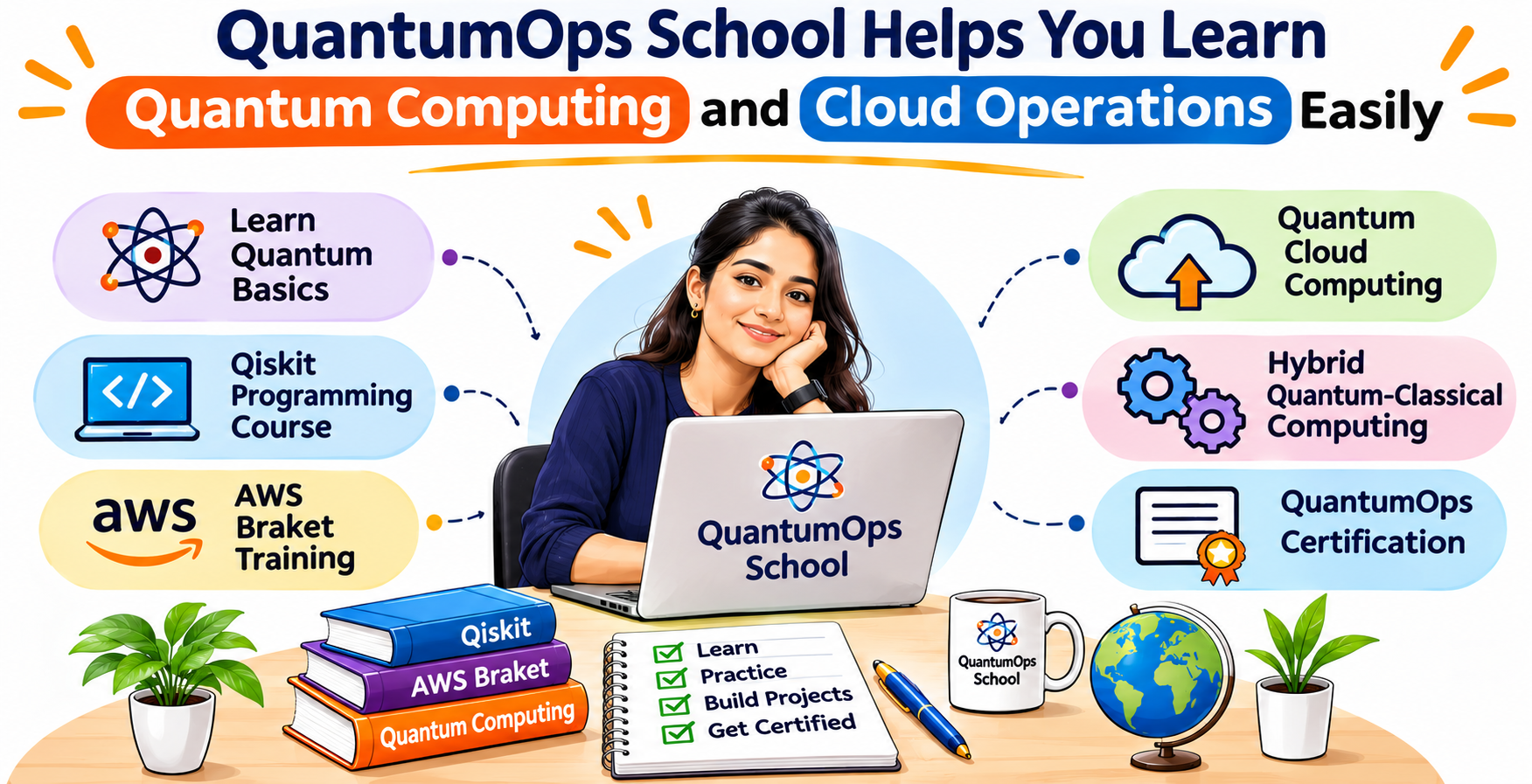
QuantumOps School helps learners explore quantum computing through training, practical exercises, and guided learning. It connects quantum theory with cloud technology, programming, and real-world problems.
This guide takes a different approach. Instead of focusing only on courses, it explores how learners can build useful quantum computing skills step by step.
1. Why Quantum Computing Is Becoming Important
Traditional computers use bits. A bit stores either zero or one. Computers use these bits to process information and complete tasks.
Quantum computers use qubits. A qubit can behave differently from a normal bit. It can use quantum states to support new ways of solving certain problems.
This does not mean quantum computers replace normal computers. Both technologies will work together for many years.
Quantum computing may help researchers study complex problems. These problems can involve chemistry, materials, finance, medicine, and scientific research.
For example, scientists may use quantum systems to study how molecules behave. This could help them explore new medicines or materials.
However, quantum computing still faces many challenges. Hardware remains difficult to build and control. Many systems also need special environments.
Therefore, learning quantum computing today means preparing for an emerging technology. It also means understanding its strengths and limits.
2. Start With Problems, Not Complex Theory
Many learners begin with difficult mathematical formulas. This can make quantum computing feel confusing.
A better approach starts with simple questions.
- What makes a quantum computer different?
- Which problems may benefit from quantum methods?
- Why do researchers use qubits?
- How can quantum systems work with normal computers?
These questions help learners understand the purpose of quantum technology.
Next, learners can explore basic ideas such as superposition and entanglement.
Superposition allows a quantum system to exist in a combination of states. Measurement produces a result that follows quantum rules.
Entanglement creates a special connection between quantum systems. Their states can become linked in ways that classical physics cannot explain.
Learners do not need to master every mathematical detail immediately. They can first understand the concepts through simple examples and simulations.
QuantumOps School can help learners build this foundation before moving into advanced topics.
3. The Learning Journey: From Curiosity to Practical Skills
Quantum computing learning should follow a clear path. Learners can build knowledge gradually instead of studying everything at once.
Step One: Understand the Basics
Start with classical computing concepts. Learn how computers store information and perform calculations.
Then explore quantum concepts. Study qubits, quantum states, gates, measurement, and quantum circuits.
Step Two: Explore Quantum Circuits
A quantum circuit shows how quantum operations work together.
Learners can create simple circuits. They can also test how different gates change quantum states.
This gives them a visual way to understand quantum operations.
Step Three: Learn Quantum Programming
Programming helps learners move beyond theory.
They can write small programs and test them using simulators. This creates a practical learning experience.
Step Four: Use Quantum Cloud Platforms
Cloud platforms provide access to quantum tools. Learners can explore quantum computing without building their own hardware.
They can study how quantum jobs run. They can also compare simulator results with real quantum devices.
Step Five: Build Small Projects
Projects help learners connect ideas. They can create simple experiments and explain their results.
This approach makes quantum computing easier to understand and remember.
4. Quantum Programming: Turning Ideas Into Experiments
Quantum programming helps learners test quantum concepts.
Instead of only reading about a quantum gate, learners can create a circuit and observe its results.
For example, a beginner can create a circuit with one qubit. They can apply a gate and measure the result.
Next, they can add more gates. They can study how each operation changes the circuit.
Qiskit programming course learning can help students explore quantum circuits using Python.
Qiskit is a popular framework for quantum programming. It allows learners to create circuits, run simulations, and explore quantum algorithms.
Learners can begin with small experiments.
- Create a basic quantum circuit.
- Apply a Hadamard gate.
- Add a measurement operation.
- Run the circuit on a simulator.
- Observe the results.
- Change the circuit and compare outcomes.
These exercises teach practical skills through experimentation.
Learners can also explore Cirq and Microsoft Quantum Development Kit. Each tool offers different ways to create and test quantum programs.
5. Cloud Platforms Make Quantum Learning Easier
Quantum hardware is expensive and difficult to maintain. Most learners cannot access a physical quantum computer at home.
Cloud platforms solve part of this problem.
They allow users to explore quantum tools through online services. Learners can create circuits and submit jobs to supported systems.
AWS Braket training can introduce learners to quantum computing through cloud-based tools.
AWS Braket provides access to quantum simulators and supported quantum hardware providers. It also helps learners explore hybrid quantum-classical workflows.
A hybrid workflow combines classical computing with quantum computing.
For example, a classical computer may prepare data. A quantum system may perform a specific calculation. The classical computer then processes the result.
This approach is important because many quantum applications will work alongside normal computers.
Learners can explore:
- Quantum circuit development
- Quantum simulators
- Cloud-based quantum jobs
- Quantum hardware access
- Hybrid computing workflows
- Experiment tracking
Cloud learning also helps software engineers understand how quantum systems may fit into modern technology environments.
6. Practical Projects That Build Confidence
Projects provide a better learning experience than theory alone.
A learner can start with simple experiments. Then they can gradually explore more advanced problems.
Project One: Quantum Coin Experiment
Create a circuit that behaves like a quantum coin.
Use a quantum gate to create a balanced state. Then measure the qubit.
Run the experiment several times. Compare the results.
This project introduces quantum states and measurement.
Project Two: Quantum Entanglement Demo
Create a circuit with two qubits.
Apply gates that create an entangled state. Then measure both qubits.
Study the relationship between their results.
This project helps learners understand entanglement through practical observation.
Project Three: Quantum Circuit Comparison
Create two different circuits.
Run both circuits using a simulator. Compare their outputs.
Then change the gates and observe the results.
This project teaches learners how circuit design affects quantum experiments.
Project Four: Cloud Quantum Experiment
Use a cloud platform to submit a small quantum job.
Compare the simulator result with the hardware result.
Learners may notice differences caused by noise and hardware limits.
This project helps them understand the challenges of real quantum systems.
7. Quantum Computing for Software Engineers
Software engineers already understand programming and problem-solving.
These skills provide a useful starting point for quantum computing.
However, quantum programming requires a different mindset. Developers must think about quantum states, gates, measurement, and probability.
They also need to understand which problems may benefit from quantum methods.
A quantum computer cannot solve every programming problem faster. It works best with specific types of tasks.
Software engineers can begin by learning Python. They can then explore quantum libraries and circuit design.
Quantum computing for software engineers can include:
- Quantum programming basics
- Quantum algorithms
- Circuit development
- Quantum simulators
- Cloud quantum platforms
- Hybrid application design
This knowledge may help developers explore new technology areas.
It can also support research, innovation, and future technical projects.
8. Understanding Quantum Hardware and Architecture
Quantum software is only one part of the technology.
Quantum hardware creates and controls qubits. Different systems use different technologies.
Some quantum computers use superconducting circuits. Others use trapped ions or different physical methods.
Each approach has strengths and challenges.
Quantum systems also need careful control. Small environmental changes can affect quantum states.
Learners should explore how hardware works.
They can study:
- Qubit design
- Quantum gates
- Control systems
- Quantum measurement
- Error correction
- Hardware limitations
A quantum computing architecture course can help learners understand how software and hardware connect.
This knowledge is useful for engineers who want to work with quantum systems.
It also helps IT professionals understand the technology behind quantum cloud services.
9. Building Skills for Quantum Cloud Computing
Cloud computing and quantum computing are becoming connected.
Cloud platforms help users access quantum systems. They also provide tools for managing experiments.
Learners need to understand both technologies.
Quantum cloud computing training can cover cloud access, quantum jobs, simulators, programming tools, and hybrid workflows.
These skills may help professionals explore new technology projects.
Cloud engineers can study how quantum services connect with existing cloud systems.
Developers can learn how to create quantum experiments.
Architects can explore how quantum workloads may fit into larger systems.
IT managers can study the business value and limitations of quantum computing.
This creates different learning paths for different professional roles.
10. Quantum Computing for IT Managers
IT managers do not always need to write quantum programs.
However, they should understand the technology and its possible business impact.
Quantum computing may support future research and advanced problem-solving.
Managers need to know what quantum computing can do. They should also understand what it cannot do today.
A practical learning path can include:
- Quantum computing fundamentals
- Business use cases
- Technology limitations
- Cloud quantum services
- Hybrid computing
- Security considerations
- Team skill development
Quantum computing for IT managers focuses on technology awareness and planning.
Managers can use this knowledge to evaluate projects. They can also prepare teams for future technology changes.
11. When Businesses Should Explore Quantum Computing
Businesses should not adopt quantum computing simply because it is new.
They should first identify a problem that may benefit from quantum methods.
Some possible areas include optimization, scientific research, material discovery, and complex simulations.
However, many applications remain under research.
Businesses should begin with small experiments. They can work with researchers, developers, and technology experts.
Quantum computing consulting services may help organizations explore possible use cases.
Consulting teams can support research, strategy, algorithm development, and hybrid computing experiments.
The goal should be practical learning.
Businesses should avoid expecting immediate results from every quantum project.
12. Learning Quantum Computing Through Certification
Certification can provide a clear learning path.
It may also help learners show their knowledge to employers or project teams.
However, a certificate alone does not prove practical ability.
Learners should build projects and understand the concepts behind their work.
A quantum computing certification course may cover several important areas.
These include quantum fundamentals, programming, cloud tools, algorithms, and architecture.
A structured course can help learners move from basic concepts to practical exercises.
QuantumOps certification programs may offer learning tracks for different professional goals.
Learners should choose a path that matches their current skills and career plans.
13. Choosing the Right Quantum Learning Path
Different learners have different goals.
A developer may want to learn quantum programming.
A cloud engineer may want to explore quantum cloud services.
An architect may want to study quantum systems and infrastructure.
A manager may want to understand business use cases.
Therefore, learners should choose their training based on their interests.
They should also consider their current technical skills.
A beginner may need more time with programming and mathematics.
An experienced developer may move faster into quantum circuits and algorithms.
The right learning path should include theory, practical work, and clear feedback.
14. The Challenges Learners Should Expect
Quantum computing is an emerging field.
Learners may face difficult concepts. They may also need to learn new tools and programming methods.
Some quantum systems produce noisy results. Hardware access may also be limited.
These challenges should not discourage learners.
They should create realistic expectations.
Learners can focus on small goals. They can complete simple projects before exploring advanced topics.
They can also use simulators to practice without hardware access.
Learning becomes easier when learners build knowledge step by step.
Frequently Asked Questions
What is QuantumOps School?
QuantumOps School provides quantum computing training, certification, and consulting. It helps learners explore quantum technology and practical skills.
Can beginners learn quantum computing?
Yes. Beginners can start with basic computing concepts. They can then explore qubits, quantum gates, and simple circuits.
Do I need advanced mathematics?
Advanced mathematics can help with deeper topics. However, beginners can start with simple concepts and visual experiments.
What is Qiskit used for?
Qiskit helps users create quantum circuits and run quantum experiments. It supports quantum programming and simulation.
What is AWS Braket?
AWS Braket is a cloud service for quantum computing. It provides access to simulators and supported quantum hardware.
Can software engineers learn quantum computing?
Yes. Software engineers can use their programming skills as a starting point. They can learn quantum concepts and quantum programming tools.
What is hybrid quantum-classical computing?
Hybrid computing combines classical computers with quantum systems. Each system performs tasks suited to its strengths.
Is quantum computing ready for every business?
No. Quantum computing remains an emerging technology. Businesses should explore suitable problems through small experiments.
Final Thoughts
Quantum computing is a new field with exciting possibilities.
But learning it does not require understanding everything at once.
Learners can start with basic concepts. They can explore circuits, programming, cloud tools, and practical projects.
The best learning approach combines theory with experimentation.
QuantumOps School can help learners explore quantum computing through structured training, hands-on practice, and different learning paths.



Top comments (0)