
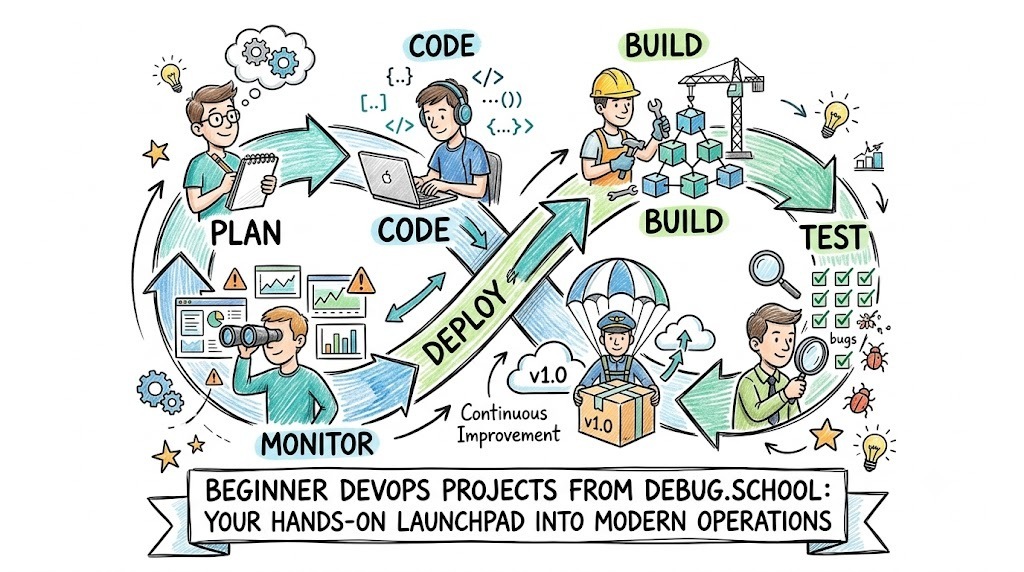
Stepping into the world of DevOps can often feel like trying to drink from a firehose. The sheer volume of tools, the constant buzz about automation, and the cultural shift it represents can be overwhelming for anyone just starting out. You might be asking yourself, "Where do I even begin?" The answer, as with most complex skills, lies in getting your hands dirty with practical work. This is where structured, beginner-friendly projects become your most valuable asset. At debug.school , the focus is on bridging the gap between theoretical knowledge and real-world application through carefully crafted projects that demystify the field. This blog is designed to be your guide, walking you through the fundamentals of DevOps and providing a clear path forward.
Instead of drowning in theory, you need a launchpad that lets you build something tangible. This approach aligns perfectly with the "learn by doing" philosophy that has become a cornerstone of effective technical education . By starting with manageable projects, you gain immediate, practical experience with the essential tools and concepts. This builds the confidence needed to tackle more complex challenges down the line. We'll explore everything from setting up a simple web server and containerizing your first application to building a basic CI/CD pipeline, all while ensuring you grasp the why behind each step.
This isn't just a list of projects; it's a roadmap to a new way of thinking. The journey to becoming proficient in this area requires a shift in mindset, embracing automation and collaboration. The resources and project ideas you'll find at platforms like this are crucial for that transition. They provide a safe, guided environment to experiment, fail, and learn—an essential process for any aspiring engineer. So, let's dive into the core concepts and get you started on your journey to mastering the tools and practices that power modern software delivery.
Key Operational Concepts You Must Know
Before we dive into the projects, it's important to get a handle on a few foundational concepts. These are the building blocks of any modern operations environment. Think of them as the grammar rules of a new language you're about to speak.
Infrastructure as Code (IaC): This is the practice of managing and provisioning your infrastructure (servers, networks, databases) through machine-readable definition files, rather than physical hardware configuration or interactive configuration tools . Instead of manually clicking around a cloud console to set up a server, you write code that defines what that server should look like. This code is then version-controlled, reviewed, and executed to create the environment. This ensures consistency, repeatability, and eliminates the "it works on my machine" problem. Tools like Terraform and AWS CloudFormation are prime examples of this concept in action .
Continuous Integration (CI): CI is a development practice where developers integrate code into a shared repository frequently, ideally several times a day . This triggers an automated build and testing process. The goal is to find and address bugs more quickly, improve software quality, and reduce the time it takes to validate and release new software updates. Services like Jenkins and GitHub Actions are the engines that power this pipeline .
Continuous Delivery (CD): This goes a step further than CI. Continuous Delivery ensures that code is always in a deployable state, even if you don't deploy it immediately. It's about automating the entire software release process up to the point of deployment . Every change that passes the CI stage is automatically built, tested, and prepared for release to production. This makes deployments a routine, low-risk event.
Containerization: Containerization involves packaging your application and all its dependencies (libraries, frameworks, configurations) into a single, executable unit called a container . This ensures the application runs quickly and reliably from one computing environment to another. Docker is the industry-standard tool that makes this possible, allowing you to create and manage these isolated environments.
Orchestration: Once you have multiple containers running, managing them manually becomes a nightmare. This is where orchestration tools come in. Kubernetes is the leading platform for automating the deployment, scaling, and management of containerized applications . It acts as a control plane, ensuring your containers are healthy, can communicate with each other, and can scale up or down based on demand.
Platform Implementation vs. Culture — What's the Real Difference?
This is a common point of confusion. People often conflate the tools we use with the philosophy behind them. Understanding this distinction is critical for anyone looking to truly succeed in this field.
Platform Implementation is the technical side. It's the tangible setup: the Jenkins server you install, the Kubernetes cluster you provision, the Docker daemon running on your machine, and the Terraform scripts you write to spin up AWS resources. Implementation is about the "how." It's the focus on selecting the right toolchain, configuring it correctly, and ensuring it functions as intended. A successful implementation means your CI/CD pipeline is green, your monitoring dashboards are showing metrics, and your application is live .
Culture, on the other hand, is the "who" and the "why." It's a shift in mindset and operational philosophy. This is a collaborative approach where development and operations teams are no longer siloed . It's about breaking down the "throw it over the wall" mentality and fostering a culture where everyone shares responsibility for the application's success. The "You build it, you run it" model is a perfect example of this cultural shift .
The real difference lies in the outcome. You can perfectly implement a CI/CD pipeline, but without a culture of collaboration, feedback, and continuous learning, it won't deliver its full value. The platform provides the vehicle, but the culture is the fuel. To succeed, you need both.
Real-World Use Cases of Modern Operations
Modern operational practices are not just for tech giants. They are transforming how organizations of all sizes build and deliver value. Let's look at a few common scenarios where these practices shine.
Automated Deployments for E-commerce: Consider an online retailer. During peak sales seasons like Black Friday, their traffic surges. Without automation, a manual scaling process would be slow and error-prone. Using IaC with Terraform, they can automatically provision more servers. Paired with a CI/CD pipeline, their team can deploy last-minute updates or rollbacks without needing a team of engineers to be on standby . This ensures a seamless shopping experience for customers and high availability.
Microservices Management at SaaS Companies: A Software-as-a-Service (SaaS) company might run dozens of microservices, each responsible for a single function like user authentication or payment processing. Managing these independently is complex. Kubernetes provides the orchestration needed to handle these services. It can ensure each service is healthy, discoverable, and can communicate securely. If a service crashes, Kubernetes automatically restarts it, minimizing downtime and manual intervention .
Streaming Services and Content Delivery: Think about a streaming platform like Netflix. They rely heavily on a robust operational model to ensure millions of users can stream content without buffering. They use advanced monitoring (like Prometheus and Grafana) to track the performance of their systems and use chaos engineering (like injecting random failures) to test their resilience and identify weak points before they cause widespread outages .
Banks and Financial Institutions: In the banking sector, security and reliability are paramount. They use DevSecOps practices to integrate security into every stage of the pipeline. They might use tools like SonarQube for static application security testing (SAST) and Trivy for container vulnerability scanning . This ensures that any code shipped to production is free from critical vulnerabilities and meets compliance standards.
Common Mistakes in Operations Engineering
Even seasoned engineers can fall into common traps. Being aware of these pitfalls can save you a great deal of headache down the road.
Underestimating the Power of Observability: Many beginners focus on setting up the application but skimp on monitoring and logging. A common mistake is only setting up basic infrastructure metrics (CPU, memory) without any application-level telemetry. Without proper observability, you are flying blind. When something goes wrong, you lack the data needed to troubleshoot effectively.
Ignoring Network Security: A frequently overlooked aspect is proper network configuration. This includes setting up security groups or firewalls to restrict traffic. For example, leaving a database server open to the public internet is a critical vulnerability. Another common error is failing to secure internal service-to-service communication.
Misunderstanding Kubernetes Resources: When deploying applications on Kubernetes, beginners often forget to set resource requests and limits. Without these, a single container can consume all the available memory or CPU on a node, starving other pods and potentially causing a cascade of failures. This is a classic error that can be easily avoided by setting appropriate values .
Not Planning for Rollbacks: A successful deployment strategy isn't just about pushing code; it's about having a fail-safe plan. Many teams forget to have a solid rollback strategy in place. If a deployment fails, the ability to quickly revert to a previous stable version is critical. Failure to plan for this can lead to extended outages.
Overcomplicating the Initial Setup: Starting with a large, complex system from day one is a recipe for disaster. A common mistake is trying to deploy a full-scale microservices architecture with Kubernetes and service meshes before grasping the fundamentals. The recommended approach is to start small, master the basic concepts with a simple project, and then gradually add complexity .
How to Become an Operations Expert — Career Roadmap
Becoming an expert in this domain isn't about overnight success; it's a journey of continuous learning and application. Here's a structured roadmap to guide your career path.
Phase 1: The Foundation (0-1 year). Your primary goal is to build a solid foundation. Start by learning Linux fundamentals. Master the command line, understand file permissions, and learn basic scripting. Next, set up a simple web server (e.g., Apache or Nginx) on a virtual machine . Then, learn to automate this setup using a configuration management tool like Ansible. Finally, get comfortable with Git. Create an account on GitHub and practice branching and merging.
Phase 2: Mastering Core Technologies (1-2 years). This is where you start specializing. Dive deep into containerization by learning Docker. Build a custom image for an application you write and run it. Move on to orchestration by learning Kubernetes. Deploy your containerized application onto a cluster. Then, learn to build a CI/CD pipeline. Start with a simple Jenkins pipeline to automate the building, testing, and deployment of your application . This is a great project to add to your portfolio.
Phase 3: Specialization and Scaling (2-4 years). At this stage, you should focus on cloud platforms. Get certified in a major cloud provider (AWS, Azure, GCP). Start integrating security into your pipelines. Learn about infrastructure as code (IaC) with Terraform or CloudFormation. Practice with a multi-stage deployment project (Dev → Test → Prod) . This demonstrates an understanding of the full lifecycle and scalability.
Phase 4: Leadership and Architecture (4+ years). The final phase is about moving from an individual contributor to a leader. Focus on Site Reliability Engineering (SRE) principles. Learn how to build resilient systems and manage incidents effectively. You'll also mentor junior engineers and design large-scale architectures. Your role expands from solving technical problems to guiding the technical and cultural transformation of the organization . This journey often starts with the structured, hands-on projects found on educational platforms.
FAQ Section
What is the best first DevOps project for an absolute beginner?
The best first project is to automate the deployment of a static website to a cloud provider like AWS S3. This project introduces you to key concepts like Git for version control, infrastructure as code (IaC) in a simple way, and cloud deployment without the complexity of managing servers. It provides a quick win and a solid foundation.
How important is knowing Linux for a career in this field?
It is absolutely essential. Linux is the operating system of choice for the vast majority of servers and cloud environments. You will need to be comfortable with the command line to navigate the filesystem, manage processes, write scripts, and configure various tools. It's the first skill you should focus on.
Do I need to learn to code to become an Operations Engineer?
While you don't need to be a software developer, scripting and basic coding skills are a must. You will need to write scripts in languages like Bash or Python to automate tasks. You'll also need to understand application code enough to debug issues and optimize its performance in a production environment.
What is the difference between CI and CD?
CI (Continuous Integration) focuses on automatically integrating code changes and running tests to catch bugs early. CD (Continuous Delivery) takes it a step further by ensuring that this integrated and tested code is always in a deployable state. Think of CI as the "building and testing" phase and CD as "preparing for release."
What is a "pipeline" in DevOps?
A pipeline is an automated process that represents the path software takes from code commit to production. It includes stages like building the code, running tests, packaging it, deploying it to a staging environment, and finally releasing it to production. It's the heart of the automation that DevOps promises.
Final Summary
Starting your DevOps journey can feel like a daunting task, but the path is clearer than you might think. By focusing on beginner-friendly projects, you can demystify the tools and concepts that drive modern software delivery. The key is to start with a strong foundation in concepts like Linux and scripting. From there, progress through the fundamentals of Infrastructure as Code, Containerization, and Orchestration.
Remember, it's not just about learning to use a specific tool. It's about understanding the philosophy and culture of shared responsibility and continuous improvement. The platform implementation is the vehicle, but the culture is the fuel that drives success. Use resources like debug.school to get your hands dirty with practical labs and projects, such as setting up a CI/CD pipeline or containerizing an application. This approach helps you build a strong portfolio and makes you a more confident and capable engineer.



Top comments (0)