
Why DevOps Leadership Has Become Critical
DevOps no longer succeeds through automation alone. Organizations now expect leaders to guide delivery reliability, reduce operational risk, coordinate security, and control cloud costs. These expectations reshape DevOps roles into ownership-driven positions.
This guide explores how leadership-oriented DevOps learning supports that shift. It speaks to engineers advancing toward management roles and managers already accountable for delivery outcomes.
The content stays practical and grounded in production realities rather than theoretical models.
Automation Without Leadership Creates Limits
Teams often improve release speed yet struggle with outages, misalignment, and missed commitments. Leadership gaps usually create these issues, not missing tools.
Structured DevOps leadership education helps managers design clear operating models, define responsibilities, and track meaningful signals. Leaders learn to guide behavior and outcomes instead of reacting to recurring problems.
This approach allows organizations to scale DevOps confidently without sacrificing reliability or trust.
Who Should Invest in This Capability
Senior engineers preparing to lead teams gain clarity on decision-making and accountability. Engineering managers responsible for CI/CD platforms, cloud infrastructure, or shared services benefit from structured delivery governance.
Platform owners and reliability managers who coordinate across teams often face conflicts that technical solutions cannot resolve. Leadership learning equips them to align priorities and expectations.
Professionals working in distributed and global delivery environments benefit strongly from the emphasis on communication clarity and measurable outcomes.
Why This Learning Pays Off Long Term
Technology changes faster than organizational behavior. Teams will always face incidents, dependency issues, release pressure, and cost constraints.
This certification focuses on those enduring challenges. It strengthens a leader’s ability to interpret delivery metrics, manage risk, and align engineering work with business goals.
By developing judgment instead of tool expertise, professionals build careers that survive technology shifts.
Program Structure and Learning Style
The program operates through Certified DevOps Manager Certification
and runs under DevOpsSchool
Scenario-based learning replaces traditional theory-heavy examinations. Participants demonstrate how they prioritize work, resolve incidents, and handle trade-offs.
This design fits professionals who already manage real systems, teams, and delivery pressure.
Learning Progression Based on Scope
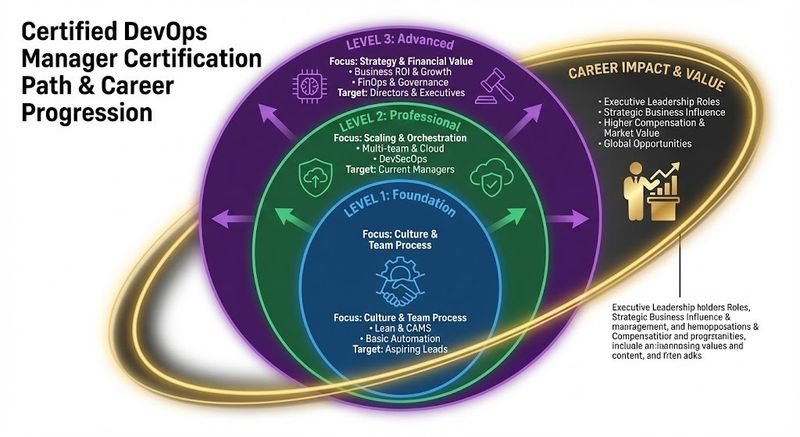
The learning path grows with responsibility instead of technical depth. Early learning establishes leadership perspective and shared DevOps understanding.
Mid-stage learning focuses on cross-team coordination, visibility into flow, and reliability ownership.
Advanced learning addresses enterprise transformation, compliance alignment, financial transparency, and value measurement. Each stage expands influence rather than narrowing focus.
Certification Levels Overview
Track Level Intended Audience Experience Needed Focus Areas Order Reference
DevOps Leadership Foundation New managers, senior engineers DevOps exposure Culture, metrics, flow Step 1 Certified DevOps Manager
DevOps Leadership Professional Engineering managers Team ownership Scaling, reliability Step 2 Certified DevOps Manager
DevOps Leadership Advanced Senior leaders Multi-team accountability Strategy, governance Step 3 Certified DevOps Manager Foundation Stage: Leadership Readiness
Purpose
This stage builds awareness of how leadership actions shape DevOps performance and team health.
Who benefits
Senior contributors preparing for management and newly appointed managers.
Capabilities developed
Collaboration frameworks
Flow and reliability metrics
Workflow visibility
Practical outcomes
Define useful DevOps KPIs
Review pipelines from a leadership standpoint
Improve coordination across teams
Preparation strategy
Spend two weeks revisiting DevOps fundamentals. Observe real workflows during the next month. Apply insights directly to daily responsibilities over sixty days.
Common missteps
Concentrating too heavily on tools
Overlooking human dynamics
Next steps
Progress to the professional stage
Explore reliability leadership
Strengthen management fundamentals
Professional Stage: Managing Delivery at Scale
Purpose
This stage validates the ability to coordinate DevOps delivery across teams and platforms with consistent results.
Who benefits
Engineering managers, platform leads, and senior reliability engineers with production responsibility.
Capabilities developed
Cross-team alignment
Incident leadership
Reliability ownership
Practical outcomes
Design scalable DevOps operating models
Lead effective incident reviews
Connect delivery metrics to business objectives
Preparation strategy
Revisit leadership principles in the first two weeks. Study scaling patterns within one month. Analyze incident data and delivery trends over the following sixty days.
Common missteps
Treating DevOps as a silo
Ignoring organizational constraints
Next steps
Advance to the advanced stage
Add FinOps or cost governance expertise
Develop program management skills
Advanced Stage: Enterprise-Level Influence
Purpose
This stage confirms the ability to lead DevOps initiatives across large organizations.
Who benefits
Senior managers, directors, and transformation leaders.
Capabilities developed
Strategic governance
Compliance and risk alignment
Organizational change leadership
Practical outcomes
Drive company-wide DevOps adoption
Integrate finance and security into delivery decisions
Measure business impact at scale
Preparation strategy
Study strategic models for two weeks. Review enterprise cases over one month. Map learning to organizational priorities over sixty days.
Common missteps
Applying frameworks without adaptation
Underestimating cultural resistance
Next steps
Focus on continuous improvement leadership
Expand into AIOps or automation strategy
Prepare for executive technology roles
Post-Certification Direction Options
DevOps leadership
Own delivery flow, platform stability, and accountability.
DevSecOps leadership
Align security expectations with release velocity.
SRE leadership
Manage availability targets, incidents, and error budgets.
AIOps and MLOps leadership
Guide intelligent automation and operational analytics.
DataOps leadership
Oversee data pipeline reliability and speed.
FinOps leadership
Control cloud spending and financial accountability.
Role-Based Guidance
Role Recommended Level
DevOps Engineer Foundation
SRE Professional
Platform Engineer Professional
Cloud Engineer Foundation
Security Engineer Foundation
Data Engineer Foundation
FinOps Practitioner Professional
Engineering Manager Professional to Advanced
Career Momentum After Certification
Expand responsibility
Advance within DevOps leadership to manage broader delivery programs.
Broaden influence
Add reliability, financial, or automation leadership capabilities.
Lead at scale
Transition into senior technology leadership and organizational design roles.
Training and Support Landscape
DevOpsSchool delivers leadership-driven DevOps programs.
Cotocus supports enterprise DevOps transformation.
Scmgalaxy blends process insight with leadership learning.
BestDevOps prepares engineers for management responsibility.
devsecopsschool.com focuses on security-aligned leadership.
sreschool.com builds reliability ownership capability.
aiopsschool.com develops intelligent operations leadership.
dataopsschool.com strengthens data delivery management skills.
finopsschool.com develops cloud financial governance expertise.
Final Takeaway
This certification supports professionals who already shape delivery outcomes and now own people, platforms, and decisions. It builds judgment, alignment, and leadership discipline instead of replacing technical expertise.
For careers centered on accountability, scale, and sustainable impact, it delivers long-term value.



Top comments (0)