
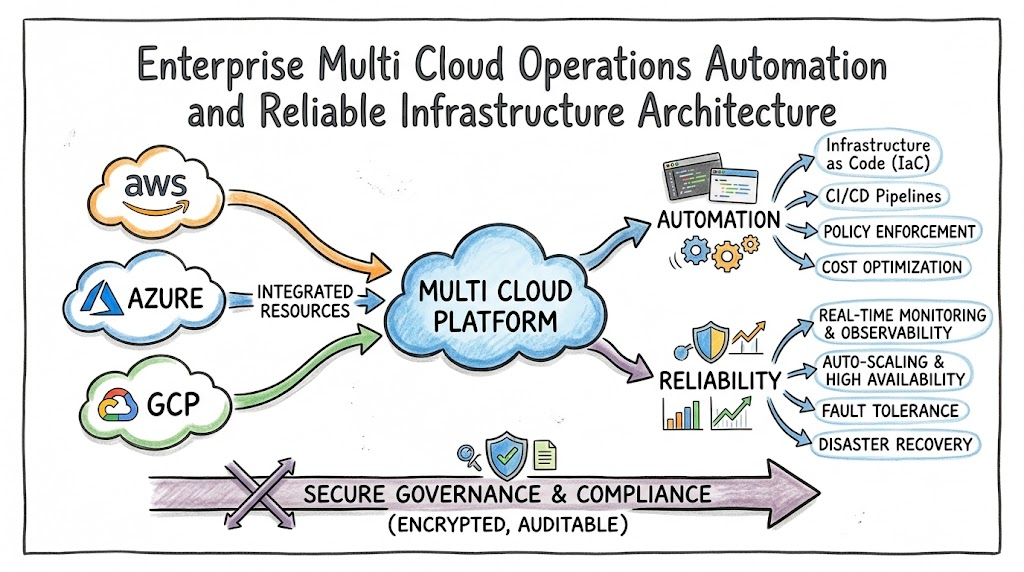
Introduction
Deploying resilient enterprise platforms requires continuous discipline, standard operational protocols, and forward-looking systems engineering. Technology executives increasingly invest in automated workflows to guarantee dependable software delivery without frustrating service outages. Because complex computing environments scale rapidly, engineering teams must replace disorganized system administration with predictable operating standards.
Furthermore, forward-thinking organizations build durable production platforms by combining continuous delivery pipelines, unified telemetry, and proactive operational governance. This comprehensive guide delivers practical deployment workflows, real-world architecture examples, actionable management strategies, and proven operational blueprints to help your team run modern systems with total confidence.
What Is Cloud Operations?
Cloud operations, frequently termed CloudOps, defines the routine administration, fine-tuning, and systematic optimization of cloud infrastructure assets and enterprise workloads. In daily production environments, this operational discipline unifies automated continuous deployment, site reliability engineering principles, and proactive systems architecture into a responsive delivery pipeline.
In addition, CloudOps ensures that distributed software systems consistently satisfy rigorous enterprise security requirements, latency targets, and high availability metrics. Platform operations teams establish measurable service level objectives to govern multi-region infrastructure availability effectively.
| Core Operational Area | Traditional Data Center IT | Next-Generation CloudOps Model |
|---|---|---|
| Resource Provisioning | Manual Ticket Queues (Slow) | Declarative GitOps Deployments (Instant) |
| System Visibility | Static Host Dashboards | Unified High-Cardinality Observability |
| Incident Resolution | Reactive Manual Triage | Automated Runbooks and Self-Healing Nodes |
| Environment State | High Risk of Configuration Drift | Immutable Code and Declarative Blueprints |
- Continuous Platform Governance: Establishing uniform security baselines, identity policies, and regulatory compliance standards across dynamic container clusters.
- Performance Engineering: Eliminating latency bottlenecks through dynamic horizontal container autoscaling policies.
- Lifecycle Management: Running zero-downtime rolling software updates alongside automated rollback triggers for production workloads.
Understanding Cloud Operations Management
Successful cloud operations management coordinates strategic engineering leadership, specialized technical talent, and enterprise automation toolsets. Specifically, this discipline creates predictable management protocols across complex serverless topologies, distributed microservices, and high-volume database tiers.
Furthermore, empirical enterprise studies demonstrate that mature operational practices eliminate more than 40 percent of unexpected production outages across large-scale distributed setups.
+-----------------------------------------------------------------------------------+
|                        THE RE-ACT OPERATIONAL FRAMEWORK                           |
+-----------------------------------------------------------------------------------+
|  [R] Resource Governance  --> Standardized tag policies & access guardrails       |
|  [E] Elastic Observability --> Unified logging, distributed traces & metrics       |
|  [A] Automated Remediation --> Trigger-based runbooks & self-healing nodes        |
|  [C] Continuous Security   --> Automated image scanning & policy-as-code          |
|  [T] Total Cost Control    --> Proactive right-sizing & waste elimination         |
+-----------------------------------------------------------------------------------+
During a major peak shopping event, a global retail platform faced severe performance slowdowns during unpredicted consumer traffic surges. By executing the structured RE-ACT operational framework, the platform team quickly eradicated provisioning bottlenecks and restored complete system stability.
The Role of Cloud Infrastructure Management
Cloud infrastructure management concentrates directly on provisioning, configuring, securing, and maintaining core virtual compute instances, network links, and cloud storage tiers. When platform engineers curate clean infrastructure state definitions, internal software developers build and release software features much faster.
Moreover, proactive hardware capacity planning prevents sudden resource exhaustion during unexpected platform traffic spikes.
- Compute Orchestration: Automating Kubernetes node pool expansion, managed cluster updates, and spot instance lifecycle policies.
- Software-Defined Networking: Enforcing zero-trust network policies, encrypted VPC peering links, and scalable ingress load balancers.
- Data Layer Protection: Scheduling automated database snapshots, multi-region replication routines, and cryptographic key rotation.
Why Cloud Automation Matters
Manual system configuration repeatedly introduces catastrophic human mistakes, untracked configuration drift, and costly operational delays. Consequently, end-to-end automation serves as the primary backbone of dependable cloud platform engineering.
By removing manual terminal commands, platform teams execute repeatable tasks across thousands of cloud servers within seconds.
- Configure Pipeline Triggers: Connect automated webhooks directly to your central Git version control repositories.
- Execute Automated Policy Checks: Validate declarative deployment blueprints against internal security rules before building resources.
- Ship Immutable Workloads: Roll out validated container images across staging and production clusters without manual intervention.
- Validate Platform Health: Trigger automated synthetic checks to confirm flawless service performance before routing live traffic.
Cloud Infrastructure Automation and Infrastructure as Code
Infrastructure as Code allows engineering teams to model, validate, and provision physical and virtual infrastructure through declarative code repositories. This approach eliminates configuration drift and guarantees identical environments across every application tier.
Additionally, version-controlled architecture definitions generate clear, auditable change records for strict regulatory compliance.
- Declarative Infrastructure State: Managing entire network topologies through clean, versioned code definitions.
- Automated Validation: Running syntax checks and policy validations directly inside continuous delivery pipelines.
- Deterministic Provisioning: Ensuring identical runtime environments across local staging, quality assurance, and production clusters.
The Importance of Cloud Monitoring
Proactive cloud monitoring provides constant visibility into core server health, memory pressure, and storage throughput. However, basic infrastructure checks alone cannot protect modern distributed applications against unexpected failures.
Platform teams must gather granular operational telemetry around the clock to detect performance anomalies before they impact end users.
- Infrastructure Health Signals: Tracking compute saturation, storage latency, and memory utilization trends.
- Application Performance Indices: Inspecting API response distributions, transaction error spikes, and total request volume.
- Operational Golden Signals: Measuring overall latency, request throughput, error distribution, and node saturation.
From Monitoring to Observability
Traditional monitoring alerts engineers when a service fails, whereas advanced observability uncovers precisely why the unexpected breakdown occurred. Thus, analyzing distributed request traces alongside structured log data allows engineers to pinpoint root causes rapidly.
Deep observability equips platform teams to investigate isolated errors across thousands of microservices seamlessly.
| Operational Focus | Traditional Cloud Monitoring | Modern Deep Observability |
|---|---|---|
| Telemetry Objective | Tracking Predefined Metric Thresholds | Investigating Novel System Outages |
| Telemetry Composition | Aggregate Counters and Basic Logs | Correlated Metrics, Structured Logs, and Traces |
| Root-Cause Velocity | Slow Manual Investigation | Instant Trace and Context Isolation |
| System Scope | Isolated Host-Level Uptime | End-to-End User Transaction Workflows |
- Distributed Request Tracing: Tracking user requests across decoupled microservices and event queues.
- Structured Log Aggregation: Centralizing contextual application logs to accelerate root-cause investigations.
- High-Cardinality Metrics: Analyzing performance trends by customer identifier, geographic location, and tenant tags.
Cloud Operations Best Practices
Adopting validated platform practices protects enterprise architectures from catastrophic downtime and runaway infrastructure expenses. Proactive governance guarantees stable scaling while safeguarding engineering budgets.
- Zero-Trust Security Controls: Apply the principle of least privilege and enforce short-lived credentials across all operational roles.
- Continuous Resilience Drills: Execute regular chaos engineering experiments to discover hidden single points of failure.
- Granular Cost Governance: Assign distinct cost-allocation tags to every resource to eliminate idle virtual machines immediately.
Managing AWS, Azure and GCP Environments
Each major cloud vendor utilizes distinct APIs, resource hierarchies, and access control engines. Thus, modern platform engineers must master these unique characteristics to maintain operational parity across every environment.
- Amazon Web Services: Architect reliable environments using AWS Organizations, custom IAM policies, and CloudWatch metrics.
- Microsoft Azure: Enforce unified enterprise governance through Azure Management Groups, Azure Policy definitions, and Log Analytics.
- Google Cloud Platform: Maintain strict security boundaries using GCP Projects, Service Account hierarchies, and Cloud Operations tooling.
What Is Multi Cloud Management
Multi cloud management encompasses the orchestration, security, and governance of workloads spanning two or more cloud service providers. Although this strategy prevents vendor lock-in, it also introduces operational friction and complex network perimeters.
Teams must deploy vendor-neutral management frameworks to maintain uniform security guardrails everywhere.
+-----------------------------------------------------------------------------------+
|                        HYBRID MULTI-CLOUD CONTROL PLANE                           |
+-----------------------------------------------------------------------------------+
|  [ Unified Platform Engineering Layer: CI/CD, GitOps & Security Policies ]       |
+-------------------------+-------------------------------+-------------------------+
|      AWS Regions        |         Azure Regions         |       GCP Regions       |
|  - EKS Clusters         |  - AKS Clusters               |  - GKE Clusters         |
|  - VPC Peering          |  - ExpressRoute Networks      |  - Cloud Interconnect   |
|  - S3 Data Lakes        |  - Blob Storage               |  - BigQuery Analytics   |
+-------------------------+-------------------------------+-------------------------+
- Standardized Runtime Layers: Deploying identical Kubernetes manifests across every cloud vendor cluster.
- Unified Policy Enforcement: Executing policy-as-code validations universally before deploying resources to any cloud.
- Centralized Identity Federation: Integrating single-sign-on access control across all vendor management consoles.
Building a More Reliable Cloud Environment
Achieving platform stability requires strong cultural habits alongside modern operational toolsets. Site reliability engineers prioritize automated recovery over manual patching whenever production outages occur.
Additionally, hosting blameless post-incident retrospectives turns unexpected failures into powerful opportunities for architectural improvement.
- Error Budget Management: Balancing rapid feature delivery against defined platform reliability limits.
- Automated Self-Healing: Configuring health probes that immediately terminate and replace failing container instances.
- Proactive Resilience Testing: Injecting network latency into testing environments to harden downstream dependencies.
How CloudOpsNow Can Help
Mastering complex infrastructure requires deep technical knowledge, practical architectural blueprints, and actionable advice. Here is where CloudOpsNow delivers immense value for engineering teams and platform architects.
CloudOpsNow curates expert engineering guides, comprehensive system blueprints, hands-on tutorials, and real-world implementation case studies. Whether your team needs to adopt Infrastructure as Code, configure multi-region Kubernetes clusters, or optimize cloud expenditure across AWS, Azure, and GCP, CloudOpsNow delivers the field-tested guidance you need.
Frequently Asked Questions About CloudOpsNow
- Which core mission defines CloudOpsNow? CloudOpsNow provides comprehensive technical articles, practical architectures, and hands-on guides for modern cloud operations.
- Who benefits most from the CloudOpsNow knowledge base? DevOps engineers, Site Reliability Engineers, cloud architects, system administrators, and technology managers scaling cloud platforms.
- Does CloudOpsNow address multi-cloud design patterns? Yes, the platform offers practical deployment guides and operational models covering AWS, Microsoft Azure, and GCP.
- How does CloudOpsNow advance automation practices? The platform shares detailed tutorials on Infrastructure as Code, GitOps workflows, automated testing, and self-healing systems.
- Can junior engineers follow the tutorials on CloudOpsNow? Yes, the educational content bridges foundational administration principles and advanced enterprise architectures.
- Does CloudOpsNow highlight security and governance strategies? Yes, the guides emphasize zero-trust architecture, automated policy verification, and enterprise compliance routines.
- How regularly do authors update the platform content? Platform architects consistently refresh tutorials and documentation to align with emerging cloud standards.
- Can operations teams use CloudOpsNow for incident response blueprints? Yes, the site provides real-world troubleshooting guides and operational runbooks for complex microservices.
- Does CloudOpsNow cover observability and telemetry pipelines? Yes, it delivers deep dives into distributed tracing, structured logging frameworks, and alerting best practices.
- Do the tutorials on CloudOpsNow solve enterprise scale challenges? Yes, every guide features production-tested designs suitable for large-scale enterprise environments.
Final Thoughts
Sustaining resilient infrastructure demands proactive platform governance, comprehensive automation pipelines, and multi-layered observability. Adopting structured operational models empowers your team to eliminate manual configuration drift and reduce expensive platform downtime.
By uniting declarative infrastructure, automated testing, and site reliability engineering principles, modern organizations build scalable digital platforms that deliver enduring operational excellence.



Top comments (0)