
Introduction
DevSecOps Certified Professional (DSOCP)
is designed for engineers and technical leaders who want to embed security directly into modern software delivery without slowing velocity. This guide is written for professionals working across DevOps, cloud-native platforms, and large distributed systems where security failures translate into business risk. As organizations accelerate release cycles, security ownership is shifting toward engineering teams rather than isolated security units. This guide explains where the certification fits within real-world careers and helps professionals choose an informed, long-term learning direction. The program is delivered and supported by DevOpsSchool
.
What is the DevSecOps Certified Professional (DSOCP)?
DevSecOps Certified Professional (DSOCP) represents a practical approach to building secure software delivery pipelines. It focuses on integrating security checks, controls, and governance into everyday engineering workflows. Instead of treating security as a final audit step, it promotes continuous validation throughout development and operations. The certification emphasizes production realism, operational trade-offs, and automation-driven security practices aligned with modern platforms.
Who Should Pursue DevSecOps Certified Professional (DSOCP)?
DevSecOps Certified Professional (DSOCP) is suited for DevOps engineers, SREs, platform engineers, and cloud professionals responsible for delivering reliable systems. Security engineers who work closely with engineering teams also gain strong value from understanding delivery constraints. Engineering managers benefit by learning how security decisions impact speed, stability, and risk exposure. The certification is relevant for global roles and particularly valuable in India’s enterprise, SaaS, and regulated sectors.
Why DevSecOps Certified Professional (DSOCP) is Valuable in 2026 and Beyond
As systems become more distributed, security risks multiply across pipelines, infrastructure, and runtime environments. DevSecOps Certified Professional (DSOCP) remains relevant because it teaches enduring principles rather than tool-specific skills. Organizations seek professionals who can balance speed, compliance, and resilience simultaneously. The certification offers strong return on effort by improving long-term career durability and decision-making confidence.
DevSecOps Certified Professional (DSOCP) Certification Overview
The DevSecOps Certified Professional (DSOCP) program is delivered via the official course and hosted on DevOpsSchool. The certification structure emphasizes applied learning and scenario-based evaluation. Assessments focus on judgment, workflow design, and production awareness rather than memorization. The program is owned and maintained within a controlled ecosystem to ensure consistency and relevance.
DevSecOps Certified Professional (DSOCP) Certification Tracks & Levels
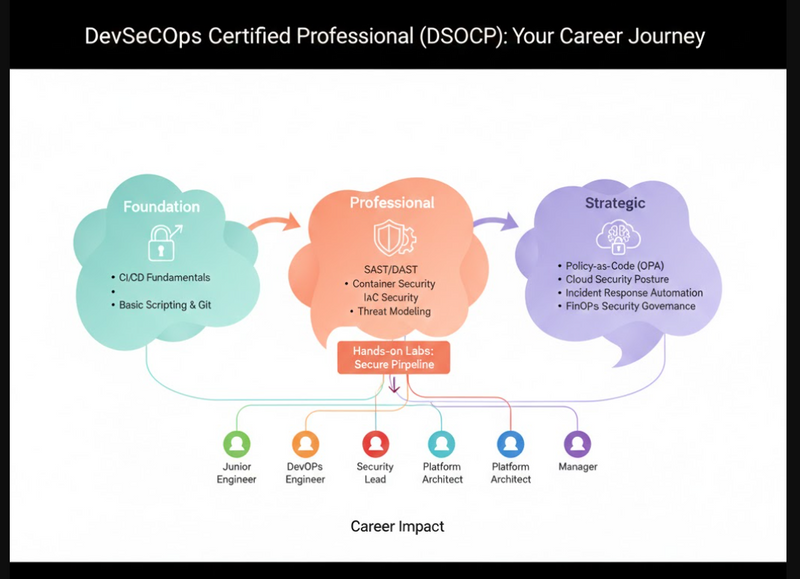
The certification follows a progressive structure spanning foundation, professional, and advanced levels. Early stages establish secure delivery fundamentals and shared responsibility models. Professional levels focus on enforcing security across pipelines, infrastructure, and cloud platforms. Advanced stages address architecture, governance automation, and organization-wide security strategy. Each level maps clearly to career progression.
Complete DevSecOps Certified Professional (DSOCP) Certification Table
Track Level Who it’s for Prerequisites Skills Covered Recommended Order Official Link
DevSecOps Foundation Early-career engineers DevOps basics Secure pipelines, scanning 1 DSOCP
DevSecOps Professional Working practitioners CI/CD experience Policy automation, secrets 2 DSOCP
DevSecOps Advanced Senior engineers Cloud security exposure Governance, architecture 3 DSOCP
Detailed Guide for Each DevSecOps Certified Professional (DSOCP) Certification
DevSecOps Certified Professional (DSOCP) – Foundation
What it is
This level validates understanding of embedding security into daily DevOps workflows. It builds shared awareness between development, operations, and security disciplines.
Who should take it
Junior to mid-level engineers working with CI/CD, automation, or cloud platforms.
Skills you’ll gain
Pipeline security integration
Dependency and code analysis
Secure configuration practices
Real-world projects you should be able to do
Add security checks to CI pipelines
Identify basic vulnerabilities before release
Preparation plan
7–14 days for concepts, 30 days for labs, 60 days for applied confidence.
Common mistakes
Focusing only on tools instead of understanding workflow impact.
Best next certification after this
Same-track: Professional level
Cross-track: SRE fundamentals
Leadership: Secure delivery basics
DevSecOps Certified Professional (DSOCP) – Professional
What it is
This level confirms the ability to secure real production systems and pipelines.
Who should take it
DevOps engineers, SREs, and platform engineers handling live workloads.
Skills you’ll gain
Secrets lifecycle management
Policy enforcement automation
Container and cloud security
Real-world projects you should be able to do
Secure Kubernetes delivery workflows
Enforce compliance via automation
Preparation plan
Two weeks review, one month practice, two months real system exposure.
Common mistakes
Ignoring operational risk and incident scenarios.
Best next certification after this
Same-track: Advanced level
Cross-track: Cloud security
Leadership: Risk ownership
DevSecOps Certified Professional (DSOCP) – Advanced
What it is
This level focuses on secure architecture and enterprise governance.
Who should take it
Senior engineers, architects, and technical leaders.
Skills you’ll gain
Threat modeling
Compliance automation
Secure platform design
Real-world projects you should be able to do
Architect secure multi-team platforms
Align engineering with regulatory needs
Preparation plan
One month of design study and two months of applied architecture work.
Common mistakes
Treating security as documentation instead of automation.
Best next certification after this
Same-track specialization
Cross-track FinOps or DataOps
Leadership engineering management
Choose Your Learning Path
DevOps Path
This path fits engineers integrating security into automation and delivery pipelines. It supports growth toward senior contributor roles. The focus remains on practical ownership.
DevSecOps Path
Ideal for professionals specializing in secure delivery practices. It emphasizes early risk detection and continuous validation. This path supports security leadership within engineering teams.
SRE Path
SREs apply reliability thinking to security controls. This path strengthens incident response and resilience. It aligns availability with protection.
AIOps / MLOps Path
Automation and intelligence add new attack surfaces. This path builds secure data and model delivery awareness. It suits engineers working with advanced platforms.
DataOps Path
Data pipelines require trust and control. This path integrates governance with performance. It benefits analytics and platform teams.
FinOps Path
Security impacts cost through misconfigurations and abuse. This path balances risk with financial discipline. It supports cloud accountability.
Role → Recommended DevSecOps Certified Professional (DSOCP) Certifications
Role Recommended Certifications
DevOps Engineer Foundation → Professional
SRE Professional
Platform Engineer Professional → Advanced
Cloud Engineer Foundation → Professional
Security Engineer Professional
Data Engineer Foundation
FinOps Practitioner Foundation
Engineering Manager Advanced
Next Certifications to Take After DevSecOps Certified Professional (DSOCP)
Same Track Progression
Deep specialization builds authority in secure delivery and governance.
Cross-Track Expansion
Expanding into SRE, DataOps, or FinOps broadens technical impact.
Leadership & Management Track
This supports transition into platform ownership and strategic roles.
Training & Certification Support Providers for DevSecOps Certified Professional (DSOCP)
DevOpsSchool provides structured, hands-on programs aligned with enterprise environments. Cotocus focuses on applied scenarios and practical validation. Scmgalaxy emphasizes workflow understanding and automation discipline. BestDevOps delivers modern engineering perspective across tooling and practice. devsecopsschool.com concentrates on security-first delivery. sreschool.com aligns reliability with protection. aiopsschool.com integrates automation with operational safety. dataopsschool.com supports governed data platforms. finopsschool.com balances cost control with risk management.
Frequently Asked Questions (General – 12 Questions)
Is DevSecOps Certified Professional (DSOCP) beginner friendly?
DevSecOps Certified Professional (DSOCP) is not designed for absolute beginners with no DevOps exposure. It assumes basic familiarity with CI/CD, cloud platforms, and software delivery concepts. However, engineers early in their DevOps journey can still succeed with focused preparation. The certification emphasizes understanding workflows rather than deep security theory.How much time is needed to prepare effectively?
Most working professionals can prepare for DevSecOps Certified Professional (DSOCP) within 30 to 60 days. Those with prior DevOps experience may require less time, especially for foundation concepts. Preparation time depends on hands-on practice rather than reading alone. Consistent daily study is more effective than intensive short bursts.Does it require prior security experience?
Formal security experience is not mandatory for DevSecOps Certified Professional (DSOCP). The certification focuses on practical security integration rather than specialist security roles. Familiarity with common vulnerabilities and basic cloud security concepts is helpful. The learning process itself builds the required security mindset.How practical is the assessment?
The assessment approach for DevSecOps Certified Professional (DSOCP) is strongly practice-oriented. Questions test decision-making, workflow design, and real operational scenarios. It avoids excessive theoretical questions disconnected from daily engineering work. This makes the certification more aligned with production environments.Is it relevant across cloud providers?
Yes, DevSecOps Certified Professional (DSOCP) is cloud-agnostic by design. It focuses on principles that apply across AWS, Azure, GCP, and private clouds. The emphasis is on automation, policy enforcement, and secure pipelines. This ensures long-term relevance regardless of platform preference.Does it help with career switching?
DevSecOps Certified Professional (DSOCP) helps DevOps engineers transition into security-focused roles smoothly. It also enables security professionals to move closer to delivery teams. For career switchers, it acts as a structured bridge rather than a complete restart. Real value comes when combined with hands-on project work.How long does the certification remain valuable?
The value of DevSecOps Certified Professional (DSOCP) lasts several years because it is principle-driven. Since it avoids tool dependency, skills remain applicable even as technology evolves. Continuous practice ensures relevance beyond the certification itself. It supports long-term career stability.What roles benefit the most?
DevOps engineers, SREs, cloud engineers, and platform engineers benefit the most. Security engineers working with automation also gain practical delivery insight. Engineering managers benefit by understanding risk ownership. The certification adapts well to multiple roles.Is it suitable for managers?
Yes, DevSecOps Certified Professional (DSOCP) is suitable for engineering managers and technical leaders. It helps them evaluate secure delivery trade-offs without deep hands-on execution. Managers gain clarity on governance, compliance, and risk management. This improves decision quality and team guidance.How does it compare to tool-specific certifications?
Unlike tool-specific certifications, DevSecOps Certified Professional (DSOCP) focuses on engineering behavior and architecture. Tool certifications may expire in relevance as platforms change. DSOCP skills transfer across tools and organizations. This makes it a stronger long-term investment.Can it be pursued alongside a full-time job?
Yes, DevSecOps Certified Professional (DSOCP) is designed for working professionals. The modular structure supports steady learning without disrupting work schedules. A daily commitment of one to two hours is usually sufficient. Hands-on practice can align with real job tasks.Does it support long-term career growth?
The certification supports progression from individual contributor to technical leader. It builds confidence in owning production systems securely. Over time, it strengthens architectural and governance skills. This supports promotions and broader responsibility.
FAQs on DevSecOps Certified Professional (DSOCP)
What makes DevSecOps Certified Professional (DSOCP) different from DevOps certifications?
DevSecOps Certified Professional (DSOCP) embeds security directly into delivery workflows rather than treating it as an add-on. It focuses on shared responsibility across teams. This makes it more aligned with enterprise expectations.Is coding required for the certification?
Basic scripting and configuration understanding is helpful but heavy coding is not mandatory. The certification emphasizes automation concepts rather than language mastery. Practical pipeline logic is more important than syntax depth.Does the certification focus more on tools or processes?
The primary focus is on processes and engineering decisions. Tools are used only as examples to explain workflows. This approach improves adaptability across environments.Will this certification help in compliance-heavy industries?
Yes, DevSecOps Certified Professional (DSOCP) is valuable in regulated sectors. It addresses continuous compliance and audit readiness. Engineers learn to automate controls instead of relying on manual checks.Is hands-on experience mandatory before attempting the exam?
Hands-on experience is strongly recommended but not strictly mandatory. Candidates without practice often struggle with scenario-based questions. Even small lab environments significantly improve readiness.Can security professionals benefit without DevOps experience?
Security professionals gain value by understanding delivery pipelines and automation. Some DevOps fundamentals may need extra preparation. The certification helps security teams collaborate better with engineers.How does DSOCP help in large enterprise environments?
It teaches scalable security models rather than individual fixes. This is critical for large teams and distributed systems. Enterprises benefit from consistent, automated control patterns.Is DevSecOps Certified Professional (DSOCP) worth the effort compared to self-learning?
Self-learning is valuable, but the certification provides structure and validation. It reduces blind spots and confirms practical understanding. For professionals seeking recognition, it adds credibility.
Final Thoughts: Is DevSecOps Certified Professional (DSOCP) Worth It?
DevSecOps Certified Professional (DSOCP) is worth pursuing for professionals who want lasting relevance rather than quick titles. It rewards disciplined learning and real-world application. Engineers gain confidence in owning secure systems. Managers gain clarity in balancing speed and risk. For those committed to modern engineering responsibility, it is a solid long-term investment.



Top comments (0)