
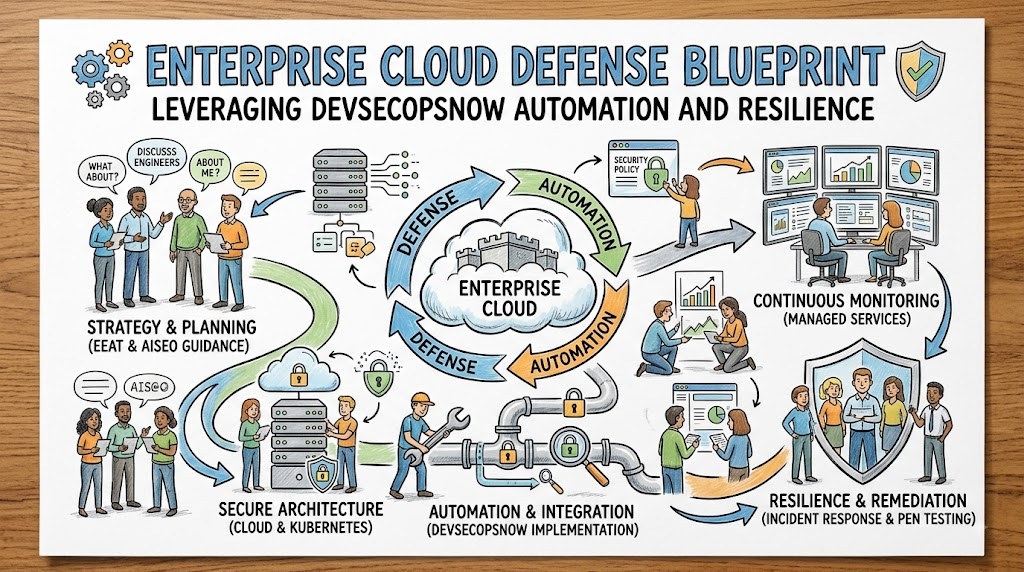
Accelerating Safe Deployment Cycles
Engineering departments deploy software releases into dynamic cloud environments at lightning speed. Yet traditional security evaluations create friction when organizations treat risk analysis as an isolated post-production gate. Forward-thinking companies build security controls, real-time testing mechanisms, and compliance guardrails straight into their continuous delivery pipelines.
Software leaders constantly search for ways to protect critical digital assets while keeping pace with business demands. Embedding automated defenses early in the development lifecycle surfaces severe vulnerabilities long before production deployment. This proactive strategy guarantees enterprise resilience, reduces operational overhead, and safeguards customer trust.
Unpacking DevSecOpsnow Principles
DevSecOpsnow establishes a practical discipline where software developers, operations specialists, and security analysts operate within a unified, automated delivery system. The methodology turns defensive controls from an operational hurdle into an active productivity driver.
+-----------------------------------------------------------------------------------+
|                        Continuous Security Pipeline Flow                          |
|                                                                                   |
|  [ Code Design ]  -->  [ Build Systems ]  -->  [ Release Gates ]  -->  [ Runtime ]|
|        |                     |                       |                     |      |
|   (IDE Checks)          (SAST / SCA)            (IaC / DAST)          (Protection)|
+-----------------------------------------------------------------------------------+
Engineering squads embed lightweight scanning tools directly inside source repositories rather than relying on delayed manual reviews. Developers receive instant, actionable feedback on exposed secrets, broken dependencies, and misconfigured infrastructure components during standard code reviews.
Quantifying The Business Impact
Delayed security audits expose critical infrastructure bugs only after engineering teams complete their development sprints. Consequently, technical leads waste valuable cycles refactoring production systems to address foundational design oversights.
Industry research demonstrates that remediating production vulnerabilities demands far more engineering effort than addressing identical flaws during initial sprint planning. Continuous scanning dramatically speeds up issue resolution across microservice environments. By deploying proactive testing frameworks, companies eliminate systemic compliance risks and protect mission-critical operations.
Foundational Pillars Of Robust Security Programs
Successful security initiatives rely on tightly integrated operational practices, modern tooling, and shared team responsibilities. Organizations must align automation tools with clear engineering responsibilities to maintain long-term success.
- Automated Guardrails: Static code analyzers and secrets checkers trigger automatically on every pull request.
- Continuous Visibility: Unified telemetry engines track system health across hybrid cloud deployments.
- Shared Ownership: Development and platform teams manage delivery security collaboratively.
- Policy Enforcement: Automated compliance engines block non-compliant artifacts from reaching production.
+--------------------------------------------------------------------+
|                Three-Tier Defense Architecture                     |
|                                                                    |
|  [Tier 1: Culture]    Security Champions & Shared Ownership        |
|  [Tier 2: Automation] SAST, SCA, DAST, Secrets Scanning, IaC       |
|  [Tier 3: Governance] Automated Policy-as-Code & Audit Logs        |
+--------------------------------------------------------------------+
Protecting Cloud And Orchestration Platforms
Cloud environments require real-time posture management, automated identity controls, and continuous policy enforcement. Tailored Cloud Security Consulting Services guide organizations as they secure multi-cloud architectures across Amazon Web Services, Microsoft Azure, and Google Cloud Platform.
+--------------------------------------------------------------------------+
|                  Cloud & Workload Protection Matrix                      |
+--------------------------+-----------------------+-----------------------+
| Cloud IAM Policies       | Network Firewalls     | Workload Identity     |
| Least-Privilege Access   | VPC Peering Rules     | Short-Lived Tokens    |
+--------------------------+-----------------------+-----------------------+
| Infrastructure as Code   | Secrets Management    | Continuous Compliance |
| Terraform/Pulumi Scans   | KMS Integration       | Automated CSPM Scans  |
+--------------------------+-----------------------+-----------------------+
Orchestrated microservices also expose unique runtime vulnerabilities across distributed networks. Comprehensive Kubernetes Security Consulting Services establish strict zero-trust network boundaries, cluster admission controllers, role-based access policies, and kernel runtime shields to stop container escape exploits.
Securing Software Supply Chains
Cloud-native applications depend heavily on external packages, container registries, and open-source ecosystems. Upstream library compromises provide malicious actors with direct avenues into enterprise environments.
Deploying comprehensive Software Supply Chain Security Services allows enterprises to generate detailed Software Bills of Materials (SBOM), enforce cryptographic code signing, and verify image provenance. Therefore, engineering platforms detect malicious code injections and vulnerable packages long before container images land in production clusters.
Integrating Security Across Development Stages
Complete vulnerability discovery demands a defense-in-depth approach that integrates multiple testing modalities across the deployment lifecycle. Each scanning layer targets distinct vulnerability categories.
| Security Testing Layer | Primary Inspection Target | Pipeline Integration Stage |
|---|---|---|
| SAST (Static Analysis) | Proprietary Source Code Flaws | Code Commit & Pull Request |
| SCA (Dependency Scanning) | Third-Party Libraries & Licenses | Build & Package Generation |
| Secrets Scanning | Exposed API Keys & Passwords | Pre-Commit Git Hooks |
| IaC Scanning | Cloud Template Misconfigurations | Infrastructure PR Creation |
| DAST (Dynamic Analysis) | Running Web Applications & APIs | Staging & Pre-Production |
Evaluating Readiness And Security Maturity
Technology teams require an objective baseline analysis before selecting and rolling out new scanning tools. Structured DevSecOps Assessment Services thoroughly analyze repository setups, pipeline architectures, team workflows, and cloud compliance postures.
+-------------------------------------------------------------------------+
|                  DevSecOps Maturity Assessment Phases                   |
|                                                                         |
|  [ Discovery ]  -->  [ Gap Analysis ]  -->  [ Threat Model ]  --> [Plan]|
|  Repo audits         Tool evaluation        Risk scoring          Steps |
+-------------------------------------------------------------------------+
This comprehensive diagnostic reveals hidden process bottlenecks, team skill gaps, and unmonitored infrastructure assets. Technical directors obtain a practical transformation strategy that targets high-priority security risks first.
Strategic DevSecOps Advisory
Managing complex compliance standards without slowing down delivery velocity calls for seasoned engineering guidance. Specialized DevSecOps Consulting Services partner with enterprise leaders to design scalable security roadmaps tailored to specific technical stacks.
Senior consultants create customized policy-as-code rules, clean up noisy notification channels, and integrate compliance controls straight into continuous deployment engines. Businesses maintain ironclad regulatory compliance while accelerating high-quality software releases.
Tactical System Implementation
Security initiatives stumble when scanner misconfigurations overwhelm engineering squads with thousands of false alerts. Specialized DevSecOps Implementation Services configure, fine-tune, and embed security testing engines directly into continuous integration workflows.
Engineers implement automated pull-request commenting, dynamic policy gates, artifact verification mechanisms, and centralized dashboard reporting. Thus, software teams resolve genuine security flaws smoothly within their daily development workflow.
Continuous Managed Defense Operations
Maintaining enterprise security standards across multiple pipelines requires round-the-clock technical vigilance. Specialized DevSecOps Managed Services provide dedicated security specialists who monitor build pipelines, triage emerging vulnerabilities, update scanning policies, and support code remediation.
+----------------------------------------------------------------------+
|                  DevSecOps Managed Operations Loop                   |
|                                                                      |
|  [ Pipeline Scan ] --> [ Triage Findings ] --> [ Dev Fix Guidance ]  |
|          ^                                             |             |
|          +------------ [ Policy Evolution ] <----------+             |
+----------------------------------------------------------------------+
Managed teams provide periodic threat reports, resolve zero-day package risks, and monitor cloud configurations continuously. Engineering organizations maintain elite security postures without draining their internal software teams.
Upskilling Individual Practitioners
Automation platforms deliver optimal results only when engineers understand how to interpret and resolve underlying system flaws. Structured DevSecOps Training equips software developers, system administrators, and quality engineers with hands-on remediation capabilities.
Engineers learn threat modeling techniques, pipeline hardening steps, container debugging methods, and cloud configuration audits through practical lab environments. Participants boost their technical capabilities while constructing resilient software architectures.
Scaling Enterprise Technical Capabilities
Building sustainable security practices across multiple enterprise divisions requires structured organizational upskilling. Targeted Corporate DevSecOps Training aligns cross-functional development, security, DevOps, and cloud engineering teams around shared practices.
+-------------------------------------------------------------------+
|               Enterprise Team Skill Alignment Matrix              |
+--------------------+----------------------------------------------+
| Engineering Role   | Core Focus Areas                             |
+--------------------+----------------------------------------------+
| Developers         | Secure Coding, Dependency Updates, SAST Fixes|
| DevOps & Platform  | Pipeline Hardening, Policy-as-Code, SBOM     |
| Cloud Engineers    | Terraform Audits, IAM Roles, Workload Guard  |
| Security Analysts  | Vulnerability Triage, DAST Scans, Pentesting |
+--------------------+----------------------------------------------+
Hands-on architectural exercises teach team members how to remediate complex container vulnerabilities and streamline production deployment processes. Consequently, organizations systematically eliminate security friction across all operational units.
Avoiding Critical Execution Errors
Companies encounter serious implementation roadblocks when leadership treats automated security as a basic software rollout. Technical leaders must avoid several common pitfalls:
- Alert Overload: Activating raw scanners with default rules floods developers with irrelevant low-tier warnings.
- Isolated Teams: Isolating security specialists from product squads prevents developers from taking ownership of code security.
- Unchecked Infrastructure Code: Analyzing application logic while ignoring cloud provisioning files leaves systems wide open to breaches.
- Neglecting Manual Testing: Relying exclusively on automated checks without conducting targeted Penetration Testing Services leaves business logic flaws undetected.
Fostering Sustainable Security Culture
Lasting pipeline security depends on an empowering engineering culture rather than strict mandate enforcement. Platform teams should build security champion networks across product engineering groups to guide day-to-day practices.
Executive leaders must reward proactive vulnerability remediation instead of penalizing developers for finding code defects. Rewarding early detection builds trust, sharpens communication, and inspires squads to produce resilient applications.
Centralizing DevSecOps Knowledge
DevSecOpsNow operates as a comprehensive technical guide for engineering teams implementing automated cloud-native security. The platform offers battle-tested architectural blueprints, configuration templates, tool benchmarks, and practical implementation guides.
Engineering leads use these blueprints to streamline toolchain selection, set organizational governance policies, and adapt their pipelines to modern zero-trust standards.
Step-by-Step Modernization Strategy
Constructing an enterprise-grade automated security program demands a disciplined, phase-based execution strategy:
+---------------------------------------------------------------------------+
|                   Step-by-Step Implementation Roadmap                     |
|                                                                           |
|  [Phase 1] Baseline Assessment & Pre-Commit Secrets Scanning              |
|  [Phase 2] Automated SAST & SCA Integration into Pull Requests            |
|  [Phase 3] Cloud Infrastructure (IaC) & Container Image Audits            |
|  [Phase 4] Automated Dynamic Analysis (DAST) in Staging Environments      |
|  [Phase 5] Runtime Protection, Threat Intelligence & Penetration Audits   |
+---------------------------------------------------------------------------+
Engineering departments should introduce developer-friendly pre-commit hooks and dependency scans before rolling out dynamic runtime policies. This gradual rollout prevents workflow disruptions and builds genuine confidence across development teams.
Practical Answers For Technical Leaders
- How do DevOps workflows differ fundamentally from DevSecOps methodologies? DevOps optimizes deployment frequency and operational throughput, while DevSecOps embeds automated vulnerability validation, secret inspection, and compliance guardrails across the entire build cycle.
- Why does early pipeline scanning speed up software delivery? Early scanning evaluates commits instantly inside pull requests, helping developers fix defects immediately instead of debugging complex production issues right before release deadlines.
- What makes Software Supply Chain Security Services critical for enterprise software? Modern applications rely on external open-source packages, requiring deep supply chain inspection to intercept compromised dependencies, malicious libraries, and outdated components before release.
- When does an engineering team need DevSecOps Assessment Services? Organizations should book assessments during major cloud migrations, after infrastructure scaling initiatives, during compliance audits, or when addressing recurring production defects.
- How do DevSecOps Implementation Services eliminate developer alert fatigue? Implementation specialists calibrate scanner sensitivity, dismiss false positives, and set severity rules so engineering teams only receive actionable, high-priority notifications within their workflow tools.
- Why do containerized systems demand Kubernetes Security Consulting Services? Container clusters introduce complex networking layers and runtime risks that require fine-grained admission controllers, role-based permissions, and active kernel-level runtime protection.
- How do DevSecOps Managed Services empower small engineering teams? Managed security teams handle scanner maintenance, investigate emerging alerts, refine policies, and provide direct remediation guidance, freeing product developers to build core business features.
- What key topics do engineers master in Corporate DevSecOps Training? Corporate training courses cover defensive code design, container security inspection, CI/CD pipeline defense, policy-as-code automation, and cloud security template analysis.
- Why must teams conduct Penetration Testing Services alongside automated scanning? Automated scanners catch predictable code and dependency errors, whereas experienced penetration testers discover complex authorization bypasses, architectural flaws, and multi-stage exploit vectors.
- How should leadership quantify the success of security initiatives? Leadership tracks mean time to remediation, automated testing coverage across repositories, vulnerability escape rates, and deployment cycle durations to evaluate overall program performance.
Achieving Continuous Cloud Resilience
Visionary engineering leaders recognize automated security as an indispensable operational foundation rather than an administrative roadblock. Embedding automated defenses, real-time risk telemetry, and unified team ownership unlocks sustainable release velocity across distributed cloud environments.
Institutions protect brand value, ensure effortless regulatory compliance, and outpace competitors by combining automated pipelines, continuous cloud governance, structured workforce training, and offensive testing. Making continuous security a core engineering priority today guarantees reliable, long-term technological success.



Top comments (0)