
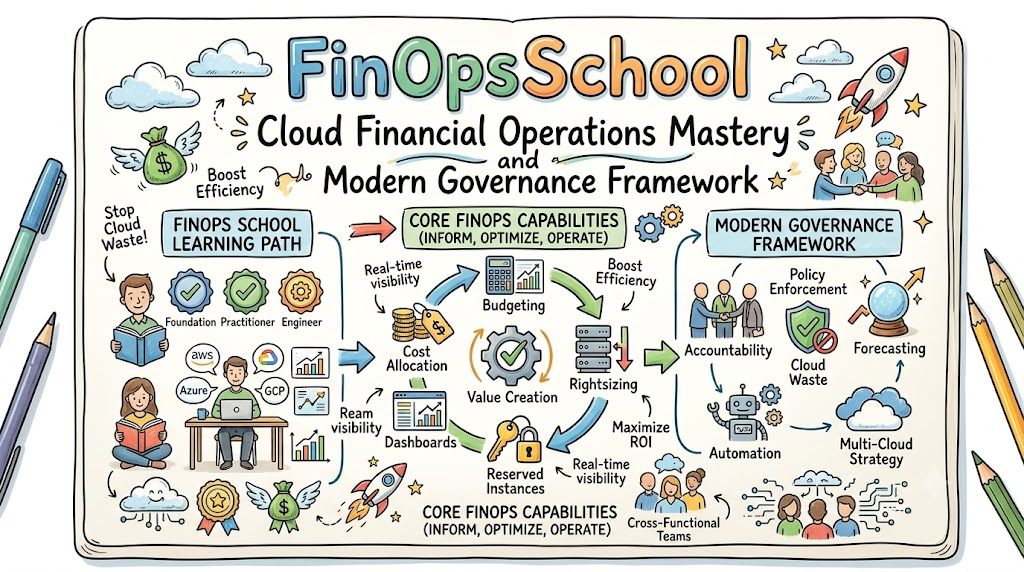
Breaking Down Cloud Financial Friction
Unchecked cloud provisioning burns corporate capital at an unsustainable pace across modern software teams. Distributed development units launch computing assets continuously without tracking the downstream commercial impact. Consequently, finance departments receive volatile, unpredicted monthly invoices that squeeze operating margins.
Through FinOpsSchool, technology and business teams discover collaborative methodologies to manage variable cloud expenditures effectively. The platform unites rapid engineering execution with deep fiscal analysis, converting chaotic cloud bills into strategic growth drivers.
Organizations build transparent financial accountability directly into continuous integration and continuous deployment pipelines. This cultural transformation safeguards corporate capital, eliminates idle resources, and accelerates product delivery across modern enterprises.
Core Operational Principles of Cloud Financial Governance
Traditional static IT procurement models fail inside elastic, on-demand cloud computing environments. FinOps introduces an agile operating model where developers, system architects, finance analysts, and procurement officers make shared, data-driven spending choices.
Rather than viewing infrastructure bills as fixed overhead, cross-functional teams analyze spending through unit economic indicators. Engineers measure infrastructure expenses against customer transactions, active user counts, and platform revenue.
This shared visibility enables technical squads to build resilient systems while respecting strict financial boundaries. As a result, businesses innovate rapidly without experiencing unexpected budgetary overruns.
Iterative Lifecycle Framework for Cloud Maturity
+-----------------------------------------------------------------------------+
|                     CONTINUOUS VALUE GENERATION CYCLE                       |
|                                                                             |
|   [ 1. INFORM ]              [ 2. OPTIMIZE ]             [ 3. OPERATE ]     |
|   Map Granular Spend         Eliminate Waste &           Automate Real-Time |
|   Through Tags & Showback    Secure Discount Rates       Governance Policies|
+-----------------------------------------------------------------------------+
Achieving high financial maturity requires continuous execution across three interconnected phases:
- Inform Phase: Implement consistent tagging taxonomies and allocation models to give stakeholders clear visibility into department-level spending trends.
- Optimize Phase: Downsize overprovisioned instances, delete orphaned storage volumes, and purchase long-term commitment discount plans.
- Operate Phase: Establish automated policy guardrails that continuously track system performance against business goals and budget thresholds.
Value-Driven Optimization Strategies
Effective financial governance prioritizes total business value over crude, across-the-board budget cuts. Slashing cloud resources without architectural analysis degrades application reliability, slows response times, and disrupts end-user satisfaction.
Healthy governance strategies encourage higher cloud investments when those expenditures directly expand top-line business revenue. Engineers deliberately scale infrastructure footprints to support high-margin digital products and services.
Teams reinvest discovered savings into continuous innovation, research, and rapid software experimentation. This mindset turns cloud spending into an active revenue driver rather than an uncontrolled operational expense.
Technical Remediation Tactics for Engineering Teams
Engineering teams achieve substantial cost reductions by systematically eliminating architectural waste across production and staging environments:
| Optimization Vector | Engineering Action | Operational Impact |
|---|---|---|
| Compute Rightsizing | Adjust virtual machine allocations to reflect real-world CPU and memory usage | Cuts monthly computing expenses by up to 35% |
| Commitment Structuring | Procure multi-year Savings Plans and Reserved Instances for steady-state workloads | Unlocks provider discount rates up to 72% |
| Storage Lifecycle Rules | Automatically transfer aged objects to low-cost archival storage classes | Lowers long-term storage expenditures significantly |
| Idle Resource Purging | Terminate unattached disk volumes, unassociated IP addresses, and obsolete snapshots | Eliminates pure infrastructure waste instantly |
Multi-Cloud Governance Across AWS, Azure, and Google Cloud
Modern enterprises operate workloads across multiple hyper-scale platforms, producing complex, fragmented billing datasets. Technical teams must navigate the distinct billing engines, discount structures, and governance tools native to each cloud ecosystem.
- Amazon Web Services: Teams utilize AWS Cost Explorer and Compute Optimizer while managing Savings Plans and Spot Instances.
- Microsoft Azure: Engineers analyze Cost Management metrics and Azure Advisor alerts while configuring Azure Savings Plans.
- Google Cloud Platform: Administrators review Cloud Billing Reports and Active Assist insights to purchase Flexible Committed Use Discounts.
Consolidating billing telemetry across these environments gives leadership a single, reliable source of financial truth.
Professional Career Paths and Educational Tracks
Building professional cloud financial management capabilities unlocks strategic enterprise leadership opportunities. Taking structured FinOps Training prepares individuals to translate complex billing telemetry into high-impact business decisions.
Professionals who earn an industry-recognized FinOps Certification prove their ability to safeguard operational margins while supporting rapid software delivery. Organizations actively recruit certified talent because these specialists resolve urgent enterprise waste issues.
Completing targeted FinOps Certification Training gives practitioners the exact methods needed to lead organizational transformation. Furthermore, comprehensive FinOps Course curricula help specialists balance technical engineering requirements with rigorous accounting practices.
+-----------------------------------------------------------------------------+
|                     TARGETED PROFESSIONAL LEARNING TRACKS                   |
|                                                                             |
|  [Foundations Track]        [Technical Track]        [Enterprise Track]     |
|  * FinOps Practitioner      * FinOps Engineer        * Corporate FinOps     |
|  * Showback Frameworks      * Kubernetes Telemetry   * Team-Wide Alignment  |
+-----------------------------------------------------------------------------+
- FinOps Practitioner Training: Equips analysts, procurement managers, and operations leaders with foundational lifecycle principles, showback frameworks, and unit economics.
- FinOps Engineer Training: Prepares DevOps and platform architects to build automated rightsizing routines, enforce Infrastructure as Code policies, and track containerized workloads.
- Corporate FinOps Training: Aligns distributed development squads, platform engineers, and finance departments under one shared operating framework.
- Cloud Cost Optimization Training: Trains technical specialists to spot architectural waste, configure autoscaling groups safely, and eliminate network data transfer bottlenecks.
- FinOps Online Training & FinOps Training in India: Delivers flexible, mentor-led virtual instruction designed for distributed enterprise teams worldwide.
Embedding Cost Accountability into DevOps Pipelines
Accountability expands rapidly when engineering squads see the financial impact of their pull requests in real time. Developers make purchasing decisions whenever they deploy infrastructure code, configure load balancers, or spin up test databases.
Interactive dashboards provide development squads with instant feedback on their spending trends. Teams correlate infrastructure costs with business metrics like daily active users, checkout volume, and search requests.
Management reinforces these behaviors by celebrating teams that build cost-effective architectures without sacrificing speed. Continuous visibility turns resource management into a standard engineering metric alongside latency and uptime.
Real-Time Anomaly Detection and Tool Ecosystems
Unexpected traffic surges, recursive script loops, and unmonitored autoscaling events can double a monthly cloud bill within hours. Relying on end-of-month invoice reconciliations guarantees massive financial waste.
Modern enterprises deploy automated anomaly detection platforms that spot abnormal spending spikes instantly. These engines analyze historical usage trends, filter out standard seasonal traffic, and send immediate alerts into team chat channels.
+-----------------------------------------------------------------------------+
|                     SPECIALIZED FINOPS TOOL ECOSYSTEM                       |
|                                                                             |
|  [Native Consoles]        [Multi-Cloud Analytics]  [Container Costing]      |
|  * AWS Cost Explorer      * CloudZero              * Kubecost               |
|  * Azure Cost Management  * Apptio Cloudability    * OpenCost               |
|  * GCP Billing Console    * Spot by NetApp         * Cast AI                |
+-----------------------------------------------------------------------------+
Integrating specialized software into CI/CD pipelines ensures technical squads monitor containerized namespaces and shared cluster expenses with complete precision.
Governing High-Throughput Artificial Intelligence Workloads
Artificial intelligence applications introduce massive compute requirements, dedicated GPU clusters, and high data ingestion costs. Training foundational models and managing high-throughput inference endpoints quickly cause massive budget overruns.
Cloud practitioners build custom management frameworks designed specifically for complex AI deployments. Engineers track cost-per-inference metrics, schedule model fine-tuning jobs during off-peak hours, and optimize GPU utilization through dynamic batching.
These governance practices ensure companies invest in modern artificial intelligence capabilities without eroding operating profit margins. Proactive financial controls protect corporate budgets while supporting technical innovation.
Essential Competencies for Modern Practitioners
Thriving in cloud financial operations demands a balanced mix of data analysis, infrastructure engineering, and corporate communication:
- Data Engineering: Query complex billing datasets using SQL, Python, and modern business intelligence tools.
- System Architecture: Understand container orchestration, serverless microservices, distributed storage, and networking layers.
- Financial Modeling: Master operational expenditures, capital depreciation, amortization, and enterprise budgeting cycles.
- Cross-Team Leadership: Translate complex infrastructure constraints into clear business trade-offs for executive stakeholders.
Frequently Asked Questions About FinOpsSchool
- How does the FinOpsSchool instructional roadmap build hands-on competency?
The curriculum delivers comprehensive instruction covering multi-cloud cost visibility, commitment planning, tagging taxonomies, anomaly alerts, Kubernetes container accounting, and collaborative culture frameworks.
- Which professional roles secure the greatest strategic benefit from these training tracks?
Cloud architects, DevOps specialists, finance analysts, technology procurement officers, platform engineers, and enterprise technology directors gain actionable, high-impact career skills.
- Does the program examine distinct architectures across AWS, Azure, and Google Cloud?
Yes, students analyze native billing interfaces, discount structures, and governance tooling across all major cloud providers throughout the practical coursework.
- Do participants work directly with real-world enterprise billing datasets?
Yes, the educational modules use hands-on labs and enterprise billing simulations to prepare students for actual workplace cost management scenarios.
- Why does structured cost governance improve day-to-day software development?
It provides engineers with immediate spending visibility, automates capacity rightsizing, optimizes containerized workloads, and prevents accidental budgetary overruns.
- Can learners clearly differentiate practitioner modules from technical engineering courses?
Practitioner modules focus on governance processes, lifecycle phases, and cross-departmental alignment, while engineering modules focus heavily on code-driven automation, policy enforcement, and infrastructure tuning.
- Are dedicated training packages available for internal corporate teams?
Yes, customized corporate programs address specific internal infrastructure stacks, billing workflows, and unique multi-cloud architectural challenges.
- Where does close collaboration between engineering units and corporate finance teams create value?
Dynamic cloud environments generate variable expenses with every deployment, requiring continuous coordination between technical releases, procurement strategies, and organizational budgets.
- Which software solutions and analytical frameworks do students evaluate during sessions?
Participants gain deep exposure to native cloud cost consoles, open-source Prometheus exporters, and enterprise tools like Kubecost, Apptio Cloudability, and CloudZero.
- In what ways does this expertise accelerate an individual's career trajectory?
Demonstrating proven cost governance skills positions practitioners for high-visibility leadership roles that connect engineering delivery directly to executive business strategy.
Accelerating Long-Term Organizational Growth
Operating cloud architectures without disciplined governance invites unnecessary financial waste and compromises business agility. Organizations that establish clear cost visibility transform unpredictable infrastructure bills into high-performing commercial investments.
Engineers and business leaders who master collaborative operational models secure massive competitive advantages for their companies. Developing these interdisciplinary capabilities establishes your reputation as a forward-thinking technologist who drives enterprise innovation while protecting corporate profit margins.



Top comments (0)