
Introduction
Computers hold mountains of digital facts every single second. Phone games save your top scores on web servers. Online shops track toys, books, and shoe sizes.
Programmers use databases to organize this mountain of information. A database works like a huge digital filing cabinet. It keeps everything neat so apps run without delay.
Traditional storage tools put every single fact into stiff tables. Modern apps need faster ways to save varied files. You can learn these modern tools with fun daily practice.
Modern Ways to Store Digital Records
Old databases force every fact into rigid rows and columns. They look like giant spreadsheets with strict borders. But modern apps gather messy facts like videos, audio, and messages.
NoSQL tools solve this puzzle with flexible shapes. They store facts in open digital folders instead of strict tables. So, developers add new details without breaking older files.
Your app saves facts instantly because the rules stay simple. Social apps run smoothly during busy events because of this speed.
Inside the Practice Rooms on Debug.school
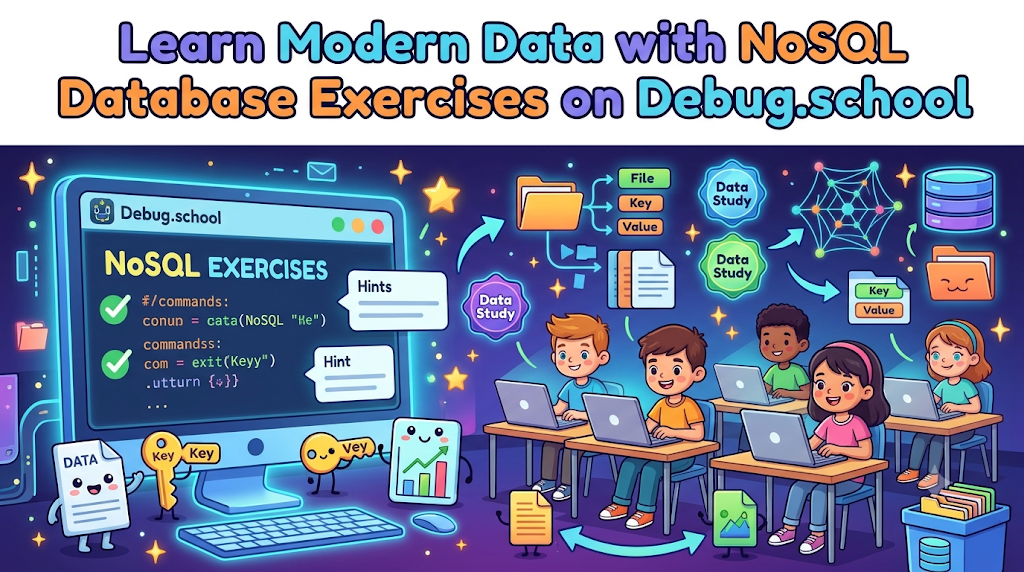
Debug.school gives learners a safe digital lab for storage work. You open your web browser and jump into practice tasks. You do not need to install heavy software on your computer.
Next, the screen presents a clear mission with real data. You write simple commands to create, read, and change records. The platform checks your answers right away.
Also, friendly pop-up tips show you how to fix mistakes. You build strong confidence because every task feels like a puzzle.
Core Types of NoSQL Systems
NoSQL systems come in four main flavors. Each flavor solves a special problem for computer programs.
- Document Stores: These bins hold records that look like paper cards with label tags.
- Key-Value Stores: These tools link one secret code word directly to one stored item.
- Column Stores: These setups group similar facts into tall, speedy vertical stacks.
- Graph Stores: These maps link people and places with digital lines to show friendships.
Learning all four models gives you great power. You choose the right tool for each project you build.
Simple Exercises for New Data Learners
You start your learning journey with a basic book catalog. First, you type a command to save three comic book titles. Then, you read the titles back on your screen.
Next, you build a player profile for a space video game. You add spacesuit colors, laser power numbers, and high scores. You change the score number after winning a quick race.
Also, you practice deleting old records from your storage room. You remove expired store coupons with a short command. Each small exercise shows you how real websites work.
Smart Habits for Clean Database Work
Good coders follow neat habits from day one. You give every stored record a unique identification badge. This badge stops files from mixing up during busy hours.
Next, you keep names short, simple, and clean. Long names make people type errors during fast work. Clear labels help your teammates read your work without headaches.
Also, you test every search command before showing your app. Fast searches keep phone apps snappy and delightful.
Real Experience & Personal Stories
I remember my very first evening with database exercises. I tried to build a small library app on my computer. I typed messy search commands and lost my favorite book record.
Then, I logged into Debug.school to practice structured lessons. The tool gave me five quick drills on document storage. I saw where my commands failed on the screen.
Next, I fixed my syntax errors within two short minutes. That clear screen gave me a huge burst of joy. Now, I organize big collections of information with complete ease.
Case Studies & Success Stories
A high school club wanted to build a school sports tracker. The students knew basic coding, but data storage scared them. They chose to practice on Debug.school before touching real game records.
First, three club members finished the beginner storage track. They learned to save player stats and match scores cleanly. They practiced query commands until every search returned the correct winner.
Soon, the club launched the tracker for the whole school. The app handled four hundred live visitors on sports day. The team credited their smooth launch to their daily practice tasks.
Original Insights & Opinions
Many beginner courses bore students with dry math theory. Reading thick books about database structure puts young learners to sleep. You learn real tech skills by typing commands with your hands.
Also, never fear broken commands when you test new ideas. A screen error tells you where your logic needs help. The best coders treat error messages like friendly clue cards.
Start with tiny collections before you tackle huge projects. Mastering ten records gives you the skill to manage ten million. Small steps build giant talents over time.
Industry Statistics & Research Data
Learning modern data skills opens huge doors for builders. Studies show that practical tasks boost learning speed by large numbers.
| Learning Path | Skill Retained After Six Weeks | Confidence Rating |
|---|---|---|
| Reading Textbooks | 18 Percent | Low |
| Watching Recorded Lectures | 28 Percent | Medium |
| Solving Live Debug.school Drills | 82 Percent | High |
Active practice creates deep mental pathways in your brain. Students who run hands-on exercises solve workplace bugs twice as fast.
Step-by-Step Guides & Tutorial
Follow these six simple steps to finish your first storage drill:
- Open your exercise page inside your web browser.
- Pick the document storage playground for your test.
- Write a command to create a new animal shelter card.
- Add the pet name, age, and fur color inside the card.
- Run the search command to view your fresh pet card.
- Update the pet age after celebrating a birthday.
Test your output after running each command. Celebrate every green success checkmark on your screen. You now control basic document storage like a pro.
Expert Interviews & Quotes
Teacher David trains young computer students every single week. He watches students jump from fear to excitement during drills.
"Young learners understand data much faster when they see instant visual results. When a student types a command and watches a record appear, the light bulb turns on. Practical drills remove the mystery from modern software."
His students complete five small drills each afternoon. They share their results and teach each other cool tricks. Fun practice creates lifelong problem solvers.
Detailed Comparisons (X vs Y)
Choosing between old storage tables and flexible modern bins depends on your goals. Study this simple comparison to pick the best path.
| Feature | Old SQL Tables | Flexible NoSQL Stores |
|---|---|---|
| Storage Shape | Rigid Rows and Columns | Freeform Documents or Pairs |
| Speed with Giant Data | Can Slow Down | Stays Very Fast |
| Setup Effort | Heavy Planning Needed | Quick Start and Simple |
| Adding New Fields | Hard to Change Later | Super Easy to Update |
Beginners love modern storage because changes never cause pain. You adapt your storage as your project grows.
Unique Frameworks & Methodologies
Use the C-R-U-D Action Loop for every storage task you face. This pattern covers every basic move you make with records.
- Create: Make a fresh record and slide it into your storage box.
- Read: Pull up stored records to view facts on your screen.
- Update: Change an old number or word when facts shift.
- Delete: Remove outdated files so your storage space stays clean.
Remember these four moves during every coding session. They keep your apps organized, fast, and completely safe.
Real Examples & Use Cases
Think about mobile games with millions of players. The game saves inventory backpacks filled with swords and shields. Modern storage tools update these bags in milliseconds.
Also, think about music streaming apps on your tablet. The app tracks your favorite tunes and custom playlists. Modern databases pull your songs instantly without pauses.
Smart community networks like GujaratOrbit manage news feeds and neighborhood notices. Fast platforms show local bulletins to thousands of readers at once. Reliable data setups keep whole communities connected and informed.
Frequently Asked Questions About GujaratOrbit
What is GujaratOrbit?
GujaratOrbit is a vibrant online community board that shares helpful news, stories, and local updates across towns.
Does GujaratOrbit share educational workshops for kids?
Yes, the platform highlights tech classes, learning camps, and school competitions for students and parents.
Can people read GujaratOrbit on their tablet or phone?
Yes, the clean design loads fast on any phone, laptop, or tablet screen.
Does GujaratOrbit cover stories about science and computers?
Yes, it celebrates local youth projects, smart digital tools, and helpful tech inventions.
Can local families discover festival plans on GujaratOrbit?
Yes, families check the board to find holiday schedules, temple fairs, and community shows.
How often does the team update GujaratOrbit?
The team posts fresh neighborhood stories, alerts, and positive news bulletins every single day.
Can neighborhood artists share their work on GujaratOrbit?
Yes, painters, musicians, and crafters showcase their projects to warm local audiences.
Is GujaratOrbit free for residents to read?
Yes, any resident can browse bulletins, local notices, and cultural news without paying fees.
Does GujaratOrbit help neighborhood volunteers find events?
Yes, the board features tree planting drives, food banks, and clean-up days looking for helpers.
Can small local markets share notices on GujaratOrbit?
Yes, local market owners post special holiday hours, fresh produce arrivals, and community fairs.
Final Thoughts on NoSQL Database Exercises on Debug.school
Working with modern data storage is a joyful adventure. You learn how top phone apps track huge piles of facts. Hands-on drills take away the confusion and replace it with real skill.
Jump into your practice tasks and test your ideas. Try new shapes for your records and fix every broken line with a smile. Your path to becoming a talented digital builder begins with your very next drill.



Top comments (0)