
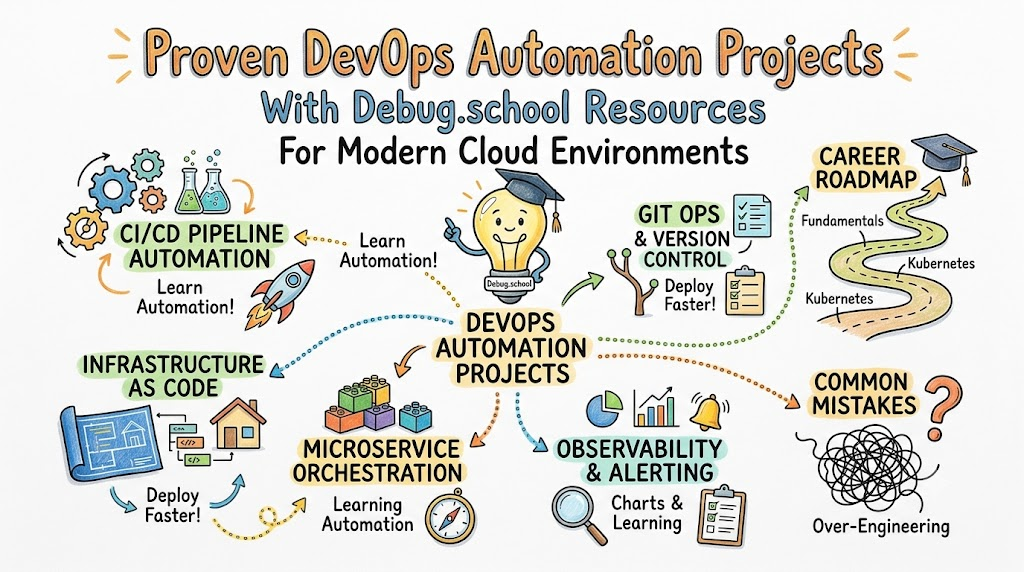
Modern software delivery demands speed, precision, and repeatable processes across distributed cloud environments. When development teams ship software manually, human error introduces unexpected downtime and security vulnerabilities. Engineers eliminate these deployment bottlenecks by mastering automation pipelines, infrastructure scripting, and container orchestration. To build these vital engineering capabilities, practitioners explore curated project workflows and architectural blueprints available at debug.school. This specialized platform simplifies complex deployment architectures by transforming advanced systems engineering into structured, hands-on automation projects. Consequently, developers rapidly develop the practical skills necessary to design, deploy, and maintain robust infrastructure systems.
Continuous Integration and Delivery Pipeline Automation
Automated continuous integration and delivery pipelines form the core circulatory system of modern software engineering. When developers push code to a shared repository, automated pipelines immediately compile, test, and package the application. This rapid validation process guarantees that software bugs surface within minutes rather than weeks.
Furthermore, automated continuous delivery mechanisms deploy validated application artifacts directly into staging or production servers without manual intervention. By removing manual file transfers and manual server restarts, teams eliminate human error from the release cycle entirely.
Ultimately, building end-to-end continuous integration pipelines gives engineers direct experience with automated build triggers, testing suites, and artifact registries. This foundational skill enables teams to release high-quality software updates rapidly and consistently.
Infrastructure as Code Provisioning With Declarative Tools
Managing cloud servers through manual web dashboards creates configuration drift and untracked infrastructure changes. Infrastructure as code solves this problem by defining networks, virtual servers, and storage buckets entirely through version-controlled configuration files.
Additionally, declarative automation engines analyze these configuration files, calculate execution plans, and provision identical environments across multiple cloud providers. This automated provisioning ensures that development, staging, and production environments remain completely synchronized.
Therefore, completing infrastructure provisioning projects teaches engineers how to manage scalable cloud resources safely. Mastering declarative configuration empowers operations teams to reconstruct entire production data centers within minutes.
Containerized Microservice Orchestration and Scaling
Containerization packages application code alongside its exact runtime dependencies, ensuring uniform behavior across every operating environment. When teams migrate complex monolithic applications to distributed microservices, managing individual container instances manually becomes impossible.
Moreover, container orchestration engines automate container scheduling, load balancing, health monitoring, and self-healing across server clusters. When a container crashes unexpectedly, the orchestrator immediately launches a replacement instance to maintain high availability.
As a result, hands-on orchestration projects teach engineers how to manage service discovery, ingress traffic routing, and rolling application updates. These operational capabilities ensure uninterrupted user access during major system upgrades.
Centralized Observability and Automated Alerting Systems
Engineering teams cannot manage or repair infrastructure systems that lack comprehensive runtime visibility. Modern observability pipelines collect real-time metrics, structured logs, and distributed traces from every server and container.
Similarly, automated alerting engines analyze these incoming telemetry streams against defined operational thresholds. When system memory spikes or network error rates surge, automated alerts notify on-call engineers before end users experience disruptions.
Consequently, building centralized observability projects enables engineers to visualize application bottlenecks and diagnose system crashes swiftly. Full system observability transforms reactive troubleshooting into proactive performance tuning.
Key Operational Concepts You Must Know
Idempotency and State Management
Idempotency ensures that executing an automation script multiple times produces the exact same final system state without unintended side effects. In distributed environments, network blips and transient server errors frequently cause automated deployment tasks to retry unexpectedly.
Furthermore, non-idempotent scripts often create duplicate configuration entries, corrupt file systems, or launch unnecessary server instances during retries. Robust automation frameworks maintain explicit state tracking to evaluate existing configurations before applying modifications.
Consequently, mastering state management and idempotent execution patterns prevents configuration drift and protects system integrity. Reliable automation scripts always verify current states before applying necessary infrastructure adjustments.
GitOps and Declarative Version Control
GitOps establishes a single source of truth for both application software and cloud infrastructure by leveraging version control repositories. Under this operational model, engineers declare the entire desired state of a production system inside Git.
Additionally, automated synchronization agents continuously compare the live infrastructure against the declared repository configuration. If someone makes an unauthorized manual change directly on a server, the agent automatically reverts the system back to the declared baseline.
Thus, implementing GitOps principles enhances security auditing, simplifies rollback procedures, and standardizes collaboration across development teams. Every infrastructure modification leaves an immutable, auditable trail within version control history.
Immutable Infrastructure Architecture
Traditional server management treats physical and virtual machines as mutable servers that undergo continuous in-place patching and updates. Over time, these cumulative manual modifications create unique server configurations that are nearly impossible to replicate.
Conversely, immutable infrastructure architecture dictates that servers remain completely unchanged after initial provisioning. When a software update or security patch arrives, the automated pipeline builds and deploys brand-new server images, subsequently decommissioning the obsolete instances.
Ultimately, immutable architecture eliminates configuration drift and ensures absolute consistency across all hosting tiers. Testing completely immutable artifacts in staging environments guarantees identical performance when deploying to live production systems.
Automated Testing and Verification Gates
Deploying software updates rapidly requires absolute confidence in the stability of your automated delivery pipelines. Verification gates incorporate unit tests, integration suites, static code analysis, and automated security scans into every deployment stage.
Moreover, modern pipelines implement canary deployment strategies that route a tiny percentage of user traffic to newly deployed instances. Automated monitoring scripts track error rates in real time, automatically rolling back the release if anomalies emerge.
Therefore, rigorous automated verification gates protect production systems from critical regressions and security vulnerabilities. Establishing automated quality checkpoints empowers engineering teams to ship updates with speed and confidence.
Platform Implementation vs. Culture — What's the Real Difference?
The Technology Trap in Automation
Many enterprises mistakenly assume that adopting modern continuous delivery tools and container orchestration platforms automatically guarantees operational efficiency. This narrow tool-centric mindset leads teams to deploy complex technical software suites without addressing underlying organizational workflows.
Consequently, engineering teams encounter excessive operational friction, as poorly designed manual approval processes simply migrate into automated platforms. When organizations focus exclusively on tooling while ignoring deployment bottlenecks, release frequencies remain sluggish.
Therefore, technology platforms merely provide the mechanical execution engines for software delivery. Achieving genuine operational excellence requires teams to streamline their underlying workflows before automating them with software.
Cultivating an Agile Engineering Culture
A high-performing automation culture prioritizes psychological safety, shared system ownership, and continuous incremental improvement. In this collaborative environment, developers and operations professionals share equal responsibility for code quality, system uptime, and deployment success.
Additionally, a healthy operational culture embraces post-incident reviews that examine systemic process flaws rather than assigning personal blame. This constructive mindset encourages engineers to experiment boldly, automate repetitive manual toil, and share technical knowledge openly.
When technical automation platforms combine with a supportive, collaborative culture, organizational velocity accelerates dramatically. Teams release resilient software continuously while maintaining high developer morale and system reliability.
| Dimension | Platform Implementation | Culture & Mindset |
|---|---|---|
| Core Focus | Deploying orchestration engines, configuring CI/CD runners, and writing scripts. | Fostering shared responsibility, blameless learning, and rapid feedback loops. |
| Primary Metric | Tool uptime, pipeline execution speed, and successful build completion rates. | Mean time to recovery, deployment frequency, and overall change failure rates. |
| Failure Mode | Produces complex, unmaintained pipeline configurations and heavy tool sprawl. | Creates operational silos, developer friction, and reluctance to automate tasks. |
| Strategic Value | Provides the mechanical automation capabilities required for rapid software releases. | Sustains long-term continuous improvement and high organizational agility. |
Real-World Use Cases of Modern Operations
High-Volume Retail E-Commerce Platforms
Global retail platforms experience dramatic traffic fluctuations during major promotional sales events and holiday shopping seasons. Automation engineers implement elastic auto-scaling policies that dynamically launch additional container clusters based on incoming traffic demand.
Simultaneously, automated continuous deployment pipelines deliver hotfixes and feature updates without interrupting active customer checkout sessions. This seamless operational scaling prevents website crashes and maximizes revenue during peak shopping periods.
- Primary Objective: Deliver zero-downtime scaling and continuous feature releases during massive traffic spikes.
- Core Mechanisms: Dynamic cluster auto-scaling, blue-green deployments, and distributed cache automation.
- Key Challenge: Maintaining transactional database consistency while scaling computational microservices horizontally.
Regulated Banking and Fintech Systems
Financial transaction networks require continuous automated compliance auditing, strict access isolation, and zero deployment downtime. DevOps teams deploy automated security scanning tools that inspect every container image for known vulnerabilities before deployment.
Furthermore, immutable deployment pipelines automatically generate audit logs and verify cryptographic signatures on every application package. This automated governance guarantees strict compliance with global banking security standards.
- Primary Objective: Ensure continuous regulatory compliance and absolute security across payment processing pipelines.
- Core Mechanisms: Automated vulnerability scanning, cryptographic image signing, and immutable audit logging.
- Key Challenge: Balancing stringent regulatory approval gates with rapid software deployment requirements.
Global Media and Content Streaming Networks
Online video streaming services distribute petabytes of encrypted digital content across globally distributed edge caching networks. Infrastructure automation pipelines provision, configure, and monitor edge delivery nodes worldwide using declarative configuration templates.
Additionally, automated canary releases deploy video transcoding algorithm updates to regional edge nodes incrementally. Automated monitoring engines immediately halt rollouts if video buffering metrics degrade in any geographic zone.
- Primary Objective: Maintain ultra-low latency video streaming and instant global content delivery.
- Core Mechanisms: Edge infrastructure provisioning, canary deployment validation, and real-time metric tracking.
- Key Challenge: Coordinating synchronized software updates across thousands of geographically dispersed edge locations.
Common Mistakes in Operations Engineering
Over-Engineering Automation Pipelines
A common trap for novice engineers is creating overly complex automation pipelines for simple applications that need basic setups. Developers frequently chain together dozens of disparate cloud services and obscure plugins when a simple shell script would suffice.
Consequently, these bloated pipelines become extremely brittle, failing frequently due to minor external network timeouts or dependency changes. The engineering team then spends more time troubleshooting their build pipelines than writing production code.
Therefore, simplicity and transparency should always guide the design of continuous delivery workflows. Build straightforward, easily maintainable automation pipelines before gradually adding advanced capabilities as project requirements grow.
Storing Sensitive Secrets Inside Code Repositories
Hardcoding database passwords, private API keys, and cloud credentials directly inside version-controlled code repositories represents a catastrophic security vulnerability. Even inside private repositories, hardcoded secrets remain accessible to unauthorized users and automated scanning bots.
Moreover, removing an exposed secret from Git history requires rewriting commit logs and rotating all compromised keys immediately. Operations teams must utilize dedicated secret management services and inject credentials dynamically at runtime.
Ultimately, keeping secrets isolated from application codebases protects corporate data assets from accidental public exposure. Automated repository scanners should immediately block any commit containing plain-text credential patterns.
Operating Without Centralized Log Aggregation
Relying on manual server logins to inspect scattered log files during a live production outage severely delays incident remediation. When distributed container clusters run across multiple machines, tracking down error logs on individual nodes is virtually impossible.
Furthermore, ephemeral containers delete their local log files permanently whenever an instance crashes or restarts. Without centralized log shipping, vital forensic evidence disappears instantly during critical failure events.
As a result, engineers must implement centralized log shippers that stream telemetry data to an indexed, searchable repository. Centralized logging ensures immediate visibility into system errors and accelerates root-cause investigation during outages.
How to Become an Operations Expert — Career Roadmap
Step 1: System Foundations and Scripting
Begin your engineering roadmap by establishing an exceptionally strong foundation in Linux administration, networking fundamentals, and automation scripting. You must become completely fluent in command-line navigation, file permission models, process management, and core networking protocols.
- Core Focus: Master Linux command-line tools, understand TCP/IP networking, and write automation scripts using Python or Bash.
- Skill Application: Build custom command-line utilities to parse server log files and automate user account provisioning.
- Target Milestone: Gain the ability to configure, secure, and troubleshoot remote Linux servers comfortably over SSH.
Step 2: Containerization and CI/CD Pipelines
Transition into modern application delivery by mastering containerization tools and automated continuous integration workflows. Learn how to write optimized Dockerfiles that produce lightweight, secure container images for diverse programming runtimes.
- Core Focus: Build automated continuous integration pipelines, run automated test suites, and manage container registries.
- Skill Application: Construct an automated pipeline that builds, tests, and publishes container images upon every Git commit.
- Target Milestone: Deploy fully automated delivery pipelines that push tested applications directly to staging environments.
Step 3: Infrastructure as Code and Orchestration
Elevate your skillset by mastering declarative infrastructure provisioning and production container orchestration platforms. Study how to write modular infrastructure templates and manage large-scale container workloads across distributed server clusters.
- Core Focus: Learn declarative infrastructure tools, configure ingress controllers, and manage Kubernetes container clusters.
- Skill Application: Provision complete virtual cloud networks and deploy scalable microservice applications across Kubernetes nodes.
- Target Milestone: Architect self-healing cluster environments featuring automated load balancing and zero-downtime rolling updates.
Step 4: Enterprise Observability and SRE Practices
Complete your professional progression by mastering enterprise observability, automated security scanning, and Site Reliability Engineering principles. Learn to define Service Level Objectives, build comprehensive telemetry dashboards, and coordinate complex incident response playbooks.
- Core Focus: Implement distributed tracing, configure centralized metric monitoring, and manage enterprise secret stores.
- Skill Application: Build comprehensive monitoring dashboards and automate incident alerting pipelines using Prometheus and Grafana.
- Target Milestone: Lead simulated disaster recovery operations and architect resilient, multi-cloud automated platforms.
FAQ Section
- What is the most important programming language for DevOps automation? Python remains the primary programming language for automation scripts, cloud API integrations, and data processing utilities. Additionally, learning Go provides significant advantages, as modern infrastructure tools like Docker and Kubernetes are built using Go.
- How does Infrastructure as Code prevent configuration drift? Infrastructure as Code defines your entire cloud environment through version-controlled configuration templates. Automated engines continuously compare your live cloud resources against these templates, automatically correcting any manual, out-of-band modifications.
- What is the difference between continuous delivery and continuous deployment? Continuous delivery automatically builds, tests, and prepares code releases for production, requiring a final manual approval click before deployment. Continuous deployment automates the entire process end-to-end, pushing every passing code commit directly to live users.
- Why is containerization preferred over traditional virtual machines? Containers share the host operating system kernel, making them significantly lighter, faster to start, and less resource-intensive than virtual machines. This efficiency allows developers to run dozens of isolated microservices on a single server without unnecessary overhead.
- Can beginners start practicing DevOps projects without paid cloud accounts? Yes, beginners can practice container orchestration, pipeline automation, and server configuration locally using free virtualization tools and lightweight containers. Many educational platforms also provide sandboxed cloud environments designed specifically for safe practical learning.
Final Summary
Achieving fluency in modern infrastructure automation requires moving beyond abstract theory and diving directly into hands-on project engineering. Building continuous delivery pipelines, writing declarative infrastructure templates, and orchestrating container workloads helps developers gain practical systems intuition. Educational resources like debug.school provide the structured project guides, curated learning paths, and technical frameworks necessary to master these complex skills efficiently. Remember that sustainable success stems from prioritizing simplicity, enforcing strict security hygiene, and fostering an open, collaborative engineering culture. By continuously building, refining, and automating real-world infrastructure systems, you will build the foundational expertise needed to manage resilient cloud architectures.



Top comments (0)