
Introduction
Site Reliability Engineering Certified Professional (SRECP) is designed for engineers who want to build, operate, and scale highly reliable systems in real production environments. It sits at the intersection of DevOps, cloud-native platforms, automation, and modern observability practices.
This guide is created for working professionals who want clarity before investing time and money into certification. Whether you are a software engineer, DevOps practitioner, SRE, or engineering manager, this guide explains what SRECP truly validates.
Reliability is now a board-level concern. Downtime affects revenue, customer trust, and brand reputation. As organizations move to distributed architectures and multi-cloud environments, SRE skills are no longer optional.
This guide helps you understand the program structure, difficulty level, preparation strategy, and how Site Reliability Engineering Certified Professional (SRECP) fits into your long-term career path.
What is the Site Reliability Engineering Certified Professional (SRECP)?
Site Reliability Engineering Certified Professional (SRECP) represents validated capability in designing, operating, and improving production systems using SRE principles.
It focuses on real-world reliability engineering rather than academic theory. The certification emphasizes availability, scalability, observability, automation, incident management, and continuous improvement.
SRECP aligns with modern engineering practices such as infrastructure as code, CI/CD pipelines, error budgets, SLO-driven engineering, and automation-first operations.
Unlike generic cloud certifications, Site Reliability Engineering Certified Professional (SRECP) tests whether you can apply reliability engineering discipline in live systems.
Who Should Pursue Site Reliability Engineering Certified Professional (SRECP)?
Working software engineers who are involved in deployment, monitoring, or production support can greatly benefit from this certification.
DevOps engineers transitioning into reliability-focused roles will find the structured SRE methodology extremely valuable.
Cloud engineers, platform engineers, and infrastructure engineers aiming to move into higher-responsibility production environments should strongly consider it.
Engineering managers and tech leads responsible for uptime, SLAs, and operational excellence also gain strategic understanding from Site Reliability Engineering Certified Professional (SRECP), especially in India’s fast-growing SaaS ecosystem and global cloud enterprises.
Why Site Reliability Engineering Certified Professional (SRECP) is Valuable in 2026 and Beyond
The demand for reliability professionals continues to grow as distributed systems become more complex. Modern applications span Kubernetes, microservices, cloud-native infrastructure, and hybrid environments.
Tools change every year. But principles like SLOs, SLIs, error budgets, incident response discipline, and observability remain stable. Site Reliability Engineering Certified Professional (SRECP) focuses on these durable concepts.
Enterprises are increasingly building dedicated SRE teams instead of relying solely on traditional operations. That shift makes reliability credentials strategically valuable.
From a return-on-investment perspective, the certification helps you move into higher compensation roles with ownership of mission-critical systems.
Site Reliability Engineering Certified Professional (SRECP) Certification Overview
The program is delivered via
Site Reliability Engineering Certified Professional (SRECP) is structured to validate practical production knowledge, not just conceptual understanding. The assessment typically evaluates architecture thinking, operational trade-offs, and automation skills.
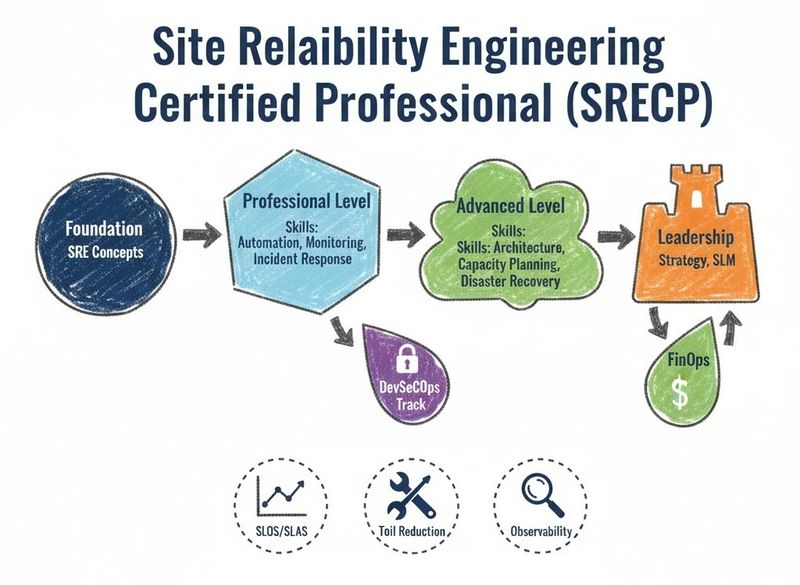
The certification is organized into structured levels to help professionals progress from foundation understanding to advanced enterprise reliability engineering.
Ownership remains aligned with structured DevOps and SRE-focused learning methodology to ensure industry relevance.
Site Reliability Engineering Certified Professional (SRECP) Certification Tracks & Levels
The certification pathway is typically structured into Foundation, Professional, and Advanced levels.
Foundation level focuses on core SRE principles, monitoring basics, reliability theory, and production culture practices.
Professional level moves into deeper hands-on capabilities such as observability tooling, incident management design, and SLA/SLO modeling.
Advanced levels may include specialization tracks aligned to DevOps, cloud reliability, performance engineering, and reliability architecture leadership roles.
These levels align closely with career progression from engineer to senior engineer, staff engineer, and reliability architect.
Complete Site Reliability Engineering Certified Professional (SRECP) Certification Table
Track Level Who it’s for Prerequisites Skills Covered Recommended Order
Core SRE Foundation Beginners, DevOps engineers Basic Linux & Cloud knowledge SRE principles, SLIs/SLOs, monitoring basics 1
Core SRE Professional Mid-level engineers Foundation knowledge Observability, automation, incident response 2
Reliability Architecture Advanced Senior engineers, architects Professional level Scalability design, resilience patterns, reliability modeling 3
Detailed Guide for Each Site Reliability Engineering Certified Professional (SRECP) Certification
Site Reliability Engineering Certified Professional (SRECP) – Foundation
What it is
This level validates understanding of SRE principles, reliability culture, and monitoring fundamentals. It confirms you understand why SRE exists and how reliability engineering differs from traditional operations.
Who should take it
Junior engineers, DevOps professionals transitioning to SRE, and cloud engineers entering production reliability roles.
Skills you’ll gain
Understanding of SLIs, SLOs, and error budgets
Monitoring and alerting fundamentals
Incident response basics
Reliability-focused automation principles
Real-world projects you should be able to do
Define SLOs for an application
Implement monitoring dashboards
Design incident response workflow
Create basic automation for operational tasks
Preparation plan
7–14 days: Review SRE concepts and monitoring tools.
30 days: Implement SLOs in a lab setup.
60 days: Operate a small production-like system and track reliability metrics.
Common mistakes
Over-focusing on tools instead of principles
Ignoring error budget philosophy
Treating SRE like traditional system administration
Best next certification after this
Same-track option: Site Reliability Engineering Certified Professional (SRECP) – Professional
Cross-track option: DevOps-focused certification
Leadership option: Reliability governance or engineering management program
Site Reliability Engineering Certified Professional (SRECP) – Professional
What it is
This level validates applied reliability engineering in real production settings. It emphasizes automation, observability, scalability, and incident management maturity.
Who should take it
Mid-level engineers managing production systems and SRE team members responsible for uptime and stability.
Skills you’ll gain
Advanced observability practices
Capacity planning strategies
Blameless postmortem design
Automation at scale
Real-world projects you should be able to do
Build full observability stack
Design multi-region reliability strategy
Create incident simulation processes
Reduce toil through automation
Preparation plan
7–14 days: Review observability patterns.
30 days: Implement automation improvements.
60 days: Lead reliability improvement initiative.
Common mistakes
Neglecting cultural aspects of SRE
Underestimating toil reduction metrics
Treating alerts as monitoring
Best next certification after this
Same-track option: Advanced Reliability Architecture
Cross-track option: Cloud-native architecture certification
Leadership option: Engineering leadership certification
Choose Your Learning Path
DevOps Path
Start with foundation-level Site Reliability Engineering Certified Professional (SRECP) to understand reliability alignment within CI/CD pipelines. Move to professional level to integrate automation and observability in delivery workflows.
DevSecOps Path
Reliability intersects with security via incident management and system hardening. Combine Site Reliability Engineering Certified Professional (SRECP) with secure system design certifications to become production-ready.
SRE Path
Follow the full track from foundation to advanced. Focus on system resilience, capacity management, and production ownership.
AIOps / MLOps Path
Add monitoring automation and anomaly detection capabilities. Reliability thinking strengthens ML deployment governance.
DataOps Path
Use reliability frameworks to ensure pipeline stability and data integrity. SLO-based thinking improves data platform uptime.
FinOps Path
Apply reliability metrics to cost efficiency. Balanced resource usage improves financial governance.
Role → Recommended Site Reliability Engineering Certified Professional (SRECP) Certifications
Role Recommended Certifications
DevOps Engineer Foundation → Professional
SRE Foundation → Professional → Advanced
Platform Engineer Professional
Cloud Engineer Foundation → Professional
Security Engineer Foundation + DevSecOps track
Data Engineer Foundation
FinOps Practitioner Foundation
Engineering Manager Professional + Leadership track
Next Certifications to Take After Site Reliability Engineering Certified Professional (SRECP)
Same Track Progression
Deepen specialization with advanced reliability architecture certification focusing on scale and distributed systems.
Cross-Track Expansion
Expand toward cloud architecture, DevSecOps, or FinOps to broaden professional profile.
Leadership & Management Track
Transition into reliability governance, technical program leadership, or platform strategy roles.
Training & Certification Support Providers for Site Reliability Engineering Certified Professional (SRECP)
DevOpsSchool
[DevOpsSchool](https://www.devopsschool.com/
) provides structured, instructor-led programs with real project exposure and mentoring support. The focus is hands-on implementation and production-oriented labs. Trainers typically come from working industry backgrounds.
Cotocus
Cotocus emphasizes enterprise consulting and practical transformation strategies. It aligns certification learning with real digital transformation goals.
Scmgalaxy
Scmgalaxy offers foundational DevOps and SCM knowledge which complements reliability engineering learning paths.
BestDevOps
BestDevOps provides comparison-driven educational material and industry-focused certification preparation insights.
devsecopsschool.com
This platform integrates secure engineering principles into DevOps and reliability workflows.
sreschool.com
Sreschool.com concentrates specifically on SRE-focused learning paths including automation and reliability governance.
aiopsschool.com
Aiopsschool.com blends automation intelligence with operational reliability frameworks.
dataopsschool.com
Dataopsschool.com emphasizes data pipeline stability and governance through structured learning.
finopsschool.com
Finopsschool.com focuses on cost optimization strategies aligned with operational reliability.
Frequently Asked Questions (General – 12 Questions)
Is Site Reliability Engineering Certified Professional (SRECP) difficult?
It is moderately challenging and requires practical understanding of production systems.
How long does preparation take?
Typically 30–60 days for working professionals.
Are there prerequisites?
Basic Linux, cloud, and scripting knowledge is recommended.
Is it useful for beginners?
Yes, especially at foundation level.
Does it require coding?
Basic scripting knowledge is beneficial.
Is it globally recognized?
It is industry-aligned and relevant across global markets.
Does it focus on tools?
Principles are prioritized over specific tools.
Is hands-on experience necessary?
Strongly recommended for best results.
Does it help salary growth?
Reliability roles typically offer higher compensation.
Can managers benefit?
Yes, especially those managing uptime and SLAs.
Is renewal required?
Depends on program structure.
Does it replace cloud certifications?
No, it complements them.
FAQs on Site Reliability Engineering Certified Professional (SRECP)
How is Site Reliability Engineering Certified Professional (SRECP) different from DevOps certifications?
Site Reliability Engineering Certified Professional (SRECP) focuses more deeply on reliability theory, uptime models, and system resilience rather than deployment pipelines alone.
Does Site Reliability Engineering Certified Professional (SRECP) require Kubernetes knowledge?
Basic understanding helps, but the program emphasizes reliability concepts beyond any single platform.
Can this certification help transition from support engineer to SRE?
Yes. It provides structured understanding needed for production ownership roles.
Is SRECP relevant outside cloud environments?
Yes. Reliability practices apply to on-prem, hybrid, and distributed systems.
What salary range can SRE professionals expect?
Varies by region, but generally higher than traditional operations roles.
Is automation mandatory?
Automation is central to SRE philosophy, so strong automation understanding is expected.
How practical is the certification?
It is structured around applied reliability engineering scenarios.
Can it help in leadership roles?
Yes. Understanding reliability improves strategic planning and operational governance.
Final Thoughts: Is Site Reliability Engineering Certified Professional (SRECP) Worth It?
If you are serious about owning production systems and not just deploying code, Site Reliability Engineering Certified Professional (SRECP) is a meaningful investment.
It teaches disciplined thinking around availability, scalability, and operational excellence. These principles stay relevant even when tools evolve.
For engineers aiming at senior technical roles, reliability expertise often becomes a career differentiator.
Approach it not just as a certificate, but as a structured path toward engineering maturity and production accountability.



Top comments (0)