
Introduction
AiOps Certified Professional (AIOCP) is a practical certification designed for engineers who want to apply artificial intelligence techniques to IT operations and production systems. It focuses on real monitoring data, real incidents, and automation scenarios instead of textbook-only theory.
The program is delivered through the official course page:
AiOps Certified Professional (AIOCP)
The certification is hosted by DevOpsschool, a platform known for hands-on DevOps and SRE-oriented training.
This guide is written for working professionals who want clarity before investing time and money. It explains scope, career value, difficulty level, and how AiOps Certified Professional (AIOCP) fits into modern DevOps, SRE, and platform engineering careers.
If you are building reliability systems, managing large-scale infrastructure, or working on observability and automation, this guide will help you decide whether AiOps Certified Professional (AIOCP) aligns with your goals.
What is the AiOps Certified Professional (AIOCP)?
AiOps Certified Professional (AIOCP) validates practical knowledge in applying machine learning and analytics to IT operations. It focuses on reducing alert fatigue, improving incident response, and enabling predictive insights from logs, metrics, and traces.
The certification exists because traditional monitoring is no longer enough. Enterprises now operate distributed systems across cloud, containers, microservices, and hybrid environments. Manual troubleshooting does not scale.
AiOps Certified Professional (AIOCP) brings together observability, automation, ML-driven pattern detection, anomaly recognition, and root cause correlation. It connects DevOps, SRE, and data engineering workflows.
Instead of generic ML learning, this certification emphasizes production monitoring pipelines, event correlation models, noise reduction techniques, and operational intelligence systems.
Who Should Pursue AiOps Certified Professional (AIOCP)?
This certification is ideal for DevOps engineers managing large infrastructure setups. If you are handling alerts, incidents, or capacity planning, AiOps Certified Professional (AIOCP) adds strong automation depth to your profile.
SRE professionals benefit significantly. It strengthens your skills in incident pattern detection, reliability engineering analytics, and predictive failure analysis.
Cloud engineers working in AWS, Azure, or GCP environments can use AiOps Certified Professional (AIOCP) to improve observability and automated recovery models.
Engineering managers and platform leads in India and globally will find this certification valuable when building scalable operations teams that rely on intelligent monitoring systems.
Both beginners and experienced engineers can pursue it. Beginners gain structured clarity. Experienced professionals formalize and sharpen their operational knowledge.
Why AiOps Certified Professional (AIOCP) is Valuable in 2026 and Beyond
Enterprise systems are increasingly autonomous. AI-driven observability is becoming standard across production platforms.
AiOps Certified Professional (AIOCP) prepares professionals for a future where operations teams must analyze patterns rather than manually inspect logs.
Tooling will continue to change. However, principles of anomaly detection, data ingestion pipelines, signal processing, and automation logic remain consistent. This certification teaches those fundamentals.
From a return-on-investment perspective, AiOps Certified Professional (AIOCP) enhances your ability to reduce downtime, increase SLA compliance, and improve MTTR—skills organizations value highly.
In 2026 and beyond, companies expect engineers to automate operational intelligence. This certification positions you ahead of that demand curve.
AiOps Certified Professional (AIOCP) Certification Overview
AiOps Certified Professional (AIOCP) is delivered via the official program page and hosted on DevOpsschool. The structure is designed around real-world operations challenges.
The certification assesses applied knowledge instead of rote memorization. Candidates are expected to understand alert engineering, ML basics for ops, and predictive monitoring.
The ownership structure ensures the content remains aligned with DevOps and SRE industry practices. The focus is on operational maturity rather than academic ML research.
The evaluation typically covers applied concepts, scenario-based analysis, and architecture-level understanding.
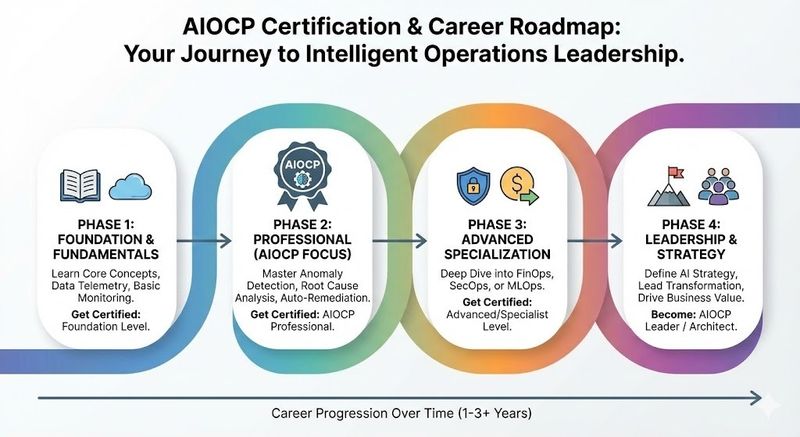
AiOps Certified Professional (AIOCP) Certification Tracks & Levels
AiOps Certified Professional (AIOCP) can be understood in structured levels:
Foundation Level
Covers AIOps fundamentals, monitoring evolution, data pipelines, anomaly detection basics, and incident workflows.
Professional Level
Focuses on model application, event correlation design, automation pipelines, and cross-platform observability integration.
Advanced Level
Emphasizes predictive scaling, self-healing systems, advanced ML integrations, and enterprise-wide AIOps strategies.
These levels align with career progression from engineer → senior engineer → architect or principal engineer.
Complete AiOps Certified Professional (AIOCP) Certification Table
Track Level Who it’s for Prerequisites Skills Covered Recommended Order
Core AIOps Foundation DevOps beginners, SRE juniors Basic Linux & cloud Monitoring basics, anomaly detection intro 1
Core AIOps Professional DevOps/SRE with 2+ yrs experience Monitoring tools experience Event correlation, ML for ops, alert reduction 2
Enterprise AIOps Advanced Architects & senior engineers Distributed system knowledge Predictive automation, self-healing systems 3
Cross-Track AIOps + MLOps ML/Data engineers Python & ML basics Operational ML pipelines After Foundation
Strategy Track AIOps Leadership Managers Production experience AIOps roadmap design After Professional
Detailed Guide for Each AiOps Certified Professional (AIOCP) Certification
AiOps Certified Professional (AIOCP) – Foundation
What it is
Validates fundamental understanding of AIOps concepts, observability layers, and anomaly detection basics.
Who should take it
Junior DevOps engineers, support engineers, early-career SRE professionals.
Skills you’ll gain
Monitoring ecosystem overview
Alert lifecycle management
Basic anomaly detection
Log and metrics correlation
Real-world projects you should be able to do
Configure intelligent alert thresholds
Reduce duplicate alerts
Create basic log analytics rules
Preparation plan
7–14 days: Review monitoring fundamentals.
30 days: Hands-on practice in lab environments.
60 days: Implement small internal demo projects.
Common mistakes
Ignoring fundamentals of metrics
Over-focusing on tools
Neglecting incident workflow concepts
Best next certification after this
Same-track: Professional level
Cross-track: MLOps certification
Leadership: SRE management track
AiOps Certified Professional (AIOCP) – Professional
What it is
Validates applied operational intelligence skills using real-world system data.
Who should take it
DevOps and SRE professionals with hands-on monitoring experience.
Skills you’ll gain
Event correlation modeling
Noise reduction algorithms
Incident clustering
Automated remediation design
Real-world projects you should be able to do
Build alert grouping logic
Design automated scaling triggers
Improve MTTR analytics dashboards
Preparation plan
7–14 days: Architecture review.
30 days: Implement use-case driven PoCs.
60 days: Deploy full operational workflow.
Common mistakes
Skipping data preprocessing
Relying fully on vendor defaults
Ignoring false positive tuning
Best next certification after this
Same-track: Advanced level
Cross-track: DataOps track
Leadership: Platform engineering leadership
AiOps Certified Professional (AIOCP) – Advanced
What it is
Demonstrates expertise in predictive monitoring and intelligent infrastructure automation.
Who should take it
Senior engineers, reliability architects, platform leads.
Skills you’ll gain
Predictive capacity planning
Self-healing pipeline design
Advanced ML integration
Enterprise automation governance
Real-world projects you should be able to do
Design predictive auto-scaling
Build self-remediation pipelines
Architect enterprise observability ecosystems
Preparation plan
7–14 days: Deep concept review.
30 days: Enterprise architecture simulations.
60 days: Real environment experimentation.
Common mistakes
Overengineering solutions
Ignoring security layers
Incomplete validation testing
Best next certification after this
Same-track: Enterprise AI architecture
Cross-track: FinOps optimization track
Leadership: Engineering management programs
Choose Your Learning Path
DevOps Path
Start with Foundation, then move to Professional. Focus on automation and alert optimization. Add Advanced for architectural depth.
DevSecOps Path
Combine Foundation with security monitoring integrations. Extend into automated compliance checks.
SRE Path
Professional level is critical. Add Advanced for predictive reliability modeling.
AIOps / MLOps Path
Start Foundation, integrate ML pipeline knowledge, then move to Professional and Advanced.
DataOps Path
Foundation helps understand ingestion pipelines. Combine with data engineering certification.
FinOps Path
Pair AIOps with cost anomaly detection techniques and predictive spend analytics.
Role → Recommended AiOps Certified Professional (AIOCP) Certifications
Role Recommended Certifications
DevOps Engineer Foundation → Professional
SRE Professional → Advanced
Platform Engineer Professional
Cloud Engineer Foundation → Professional
Security Engineer Foundation
Data Engineer Foundation + Cross-Track
FinOps Practitioner Foundation + Analytics Focus
Engineering Manager Professional + Leadership
Next Certifications to Take After AiOps Certified Professional (AIOCP)
Same Track Progression
Deepen specialization in advanced predictive automation and enterprise AI infrastructure.
Cross-Track Expansion
Move into DataOps or MLOps to combine analytics pipelines with operational intelligence.
Leadership & Management Track
Transition toward reliability strategy planning and digital transformation leadership.
Training & Certification Support Providers for AiOps Certified Professional (AIOCP)
DevOpsSchool
DevOpsSchool provides instructor-led training focused on production use cases. Their programs emphasize real deployment challenges rather than abstract theory. Sessions typically include monitoring tools, automation scripting, and architecture discussions. Mentors come from active DevOps and SRE backgrounds. The curriculum is aligned with enterprise-scale systems, making it suitable for professionals managing large infrastructures. It is ideal for those who prefer guided, structured learning with live interaction.
Cotocus
Cotocus focuses on enterprise DevOps consulting and hands-on implementation support. Their training methodology blends advisory insights with practical execution. Candidates benefit from scenario-based workshops. The approach is more aligned with organizations modernizing legacy systems. It suits professionals seeking applied transformation knowledge rather than only certification preparation.
Scmgalaxy
Scmgalaxy provides foundational and intermediate DevOps and AIOps courses. The programs are structured for gradual progression. Training content is typically modular and accessible to working professionals. It works well for individuals starting their automation or operational intelligence journey.
BestDevOps
BestDevOps delivers certification-oriented sessions with structured lab exercises. The focus is exam readiness combined with hands-on demos. The curriculum is usually aligned to industry trends. It fits professionals wanting a mix of structured content and applied practice.
devsecopsschool.com
This platform concentrates on security-oriented automation and operational monitoring. It works best for candidates integrating DevSecOps workflows into AIOps models. It strengthens security signal correlation capabilities.
sreschool.com
Designed specifically for reliability engineers, this platform dives deep into SLIs, SLOs, and incident analytics. It complements AIOps certification for those targeting SRE roles.
aiopsschool.com
Focused purely on AIOps topics, this platform covers monitoring analytics and ML-driven operational intelligence. It supports engineers building AI-integrated infrastructure systems.
dataopsschool.com
Ideal for professionals handling data ingestion and pipeline orchestration. It aligns well with the data-centric side of AIOps implementation.
finopsschool.com
Suitable for professionals combining infrastructure analytics with financial optimization strategies. It connects operational insight with cost governance.
Frequently Asked Questions (General)
Is AiOps Certified Professional (AIOCP) difficult?
It requires conceptual clarity and operational exposure but is manageable with practice.
How long does preparation take?
Typically 30–60 days for working professionals.
Are prerequisites mandatory?
Basic Linux, cloud, and monitoring knowledge is strongly recommended.
Is coding required?
Basic scripting knowledge is helpful but not advanced ML coding.
Is it suitable for beginners?
Yes, starting with the Foundation level.
Does it help outside India?
Yes, AIOps demand is global.
Is hands-on practice necessary?
Absolutely. Theory alone is insufficient.
Is it tool-specific?
No. It focuses on concepts applicable across tools.
Does it improve salary prospects?
It improves skill depth, which often supports career growth.
Can managers take it?
Yes, especially Professional level.
Is ML knowledge mandatory?
Only foundational understanding is required.
Is this future-proof?
Yes, operational intelligence demand continues to grow.
FAQs on AiOps Certified Professional (AIOCP)
Does AiOps Certified Professional (AIOCP) cover real production scenarios?
Yes, the focus is production-focused operational intelligence.
Is this certification research-heavy?
No, it emphasizes application over academic depth.
Can it reduce alert fatigue in real systems?
Yes, if implemented correctly.
Does it include predictive scaling concepts?
Advanced level covers such use cases.
Is it suitable for hybrid cloud engineers?
Yes, especially Professional and Advanced levels.
Can non-DevOps engineers take it?
Yes, with some operational background.
Is it useful for automation architects?
Very much so, especially Advanced level.
Does it replace traditional monitoring certifications?
No, it complements them with intelligence layers.
Final Thoughts: Is AiOps Certified Professional (AIOCP) Worth It?
If you are serious about operating large-scale systems intelligently, AiOps Certified Professional (AIOCP) is worth considering.
It does not replace hands-on experience. Instead, it structures and formalizes what strong engineers already practice.
For beginners, it creates a clear roadmap. For experienced professionals, it deepens reliability and automation expertise.
Choose it if you want to move beyond reactive monitoring and start building predictive, automated operations systems.



Top comments (0)