
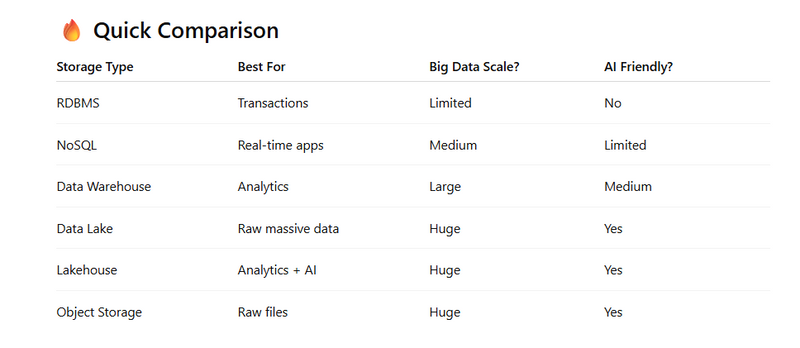
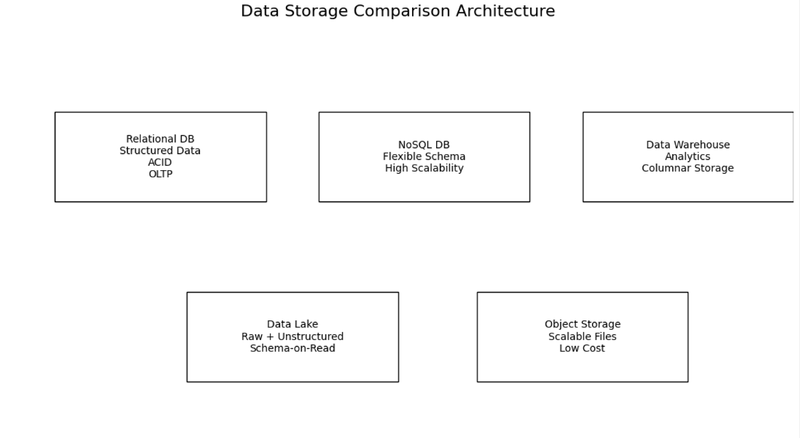
Traditional Relational Databases (RDBMS)
NoSQL Databases
Data Warehouse
Data Lake (Object Storage Based)
Lakehouse (Hybrid Model)
File Storage Systems
Distributed Key-Value Storage
Search Storage
Object Storage (Base Layer of Data Lake)
Objective and MCQ question on storage system
Traditional Relational Databases (RDBMS)
Examples:
MySQL

PostgreSQL

Oracle

SQL Server
Best for:
Transactional systems

Banking

User management

Orders / bookings
Limitation:
Not ideal for TB–PB scale analytics
Expensive to scale
2️⃣ NoSQL Databases
Examples:
MongoDB

Cassandra

DynamoDB

Couchbase
Best for:
Flexible schema

High-speed writes

Real-time applications

Large-scale web apps
Still not ideal for large analytics or storing images/videos in huge scale.
3️⃣ Data Warehouse
Examples:
Snowflake

Amazon Redshift

Google BigQuery

Azure Synapse
Best for:
Business analytics

SQL reporting

Structured data only
More expensive than Data Lake but optimized for analytics queries.
4️⃣ Data Lake (Object Storage Based)
Examples:
AWS S3

Azure Data Lake

Google Cloud Storage
Best for:
Huge raw data

Unstructured data

AI/ML workloads
Cheap storage
5️⃣ Lakehouse (Hybrid Model)
Examples:
Databricks Delta Lake

Apache Iceberg

Apache Hudi
Combines:
Data Lake flexibility
Data Warehouse reliability (ACID transactions)
Modern architecture.
6️⃣ File Storage Systems
Examples:
Hadoop HDFS

NAS (Network Attached Storage)

Local file systems
Older big data systems used HDFS before cloud object storage.
7️⃣ Distributed Key-Value Storage
Examples:
Redis (in-memory)

RocksDB

etcd
Best for:
Fast caching

Session storage
Not for long-term big data storage
8️⃣ Search Storage
Examples:
Elasticsearch

OpenSearch
Best for:
Log analytics

Search indexing

Text-heavy workloads
9️⃣ Object Storage (Base Layer of Data Lake)
Examples:
AWS S3

Azure Blob

Google Cloud Storage
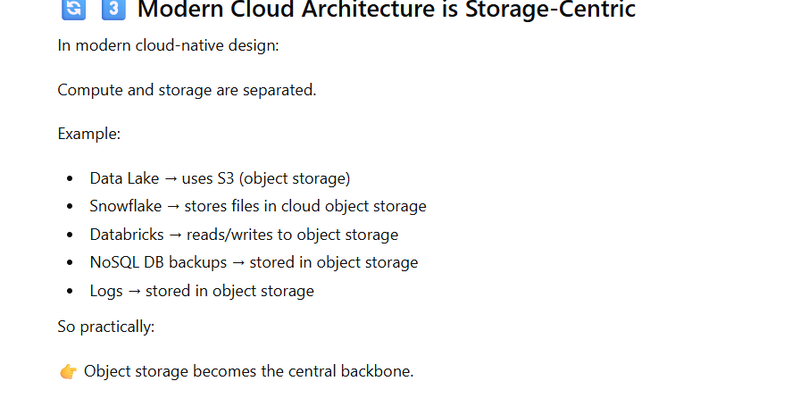
This is what actually stores data in Data Lakes.
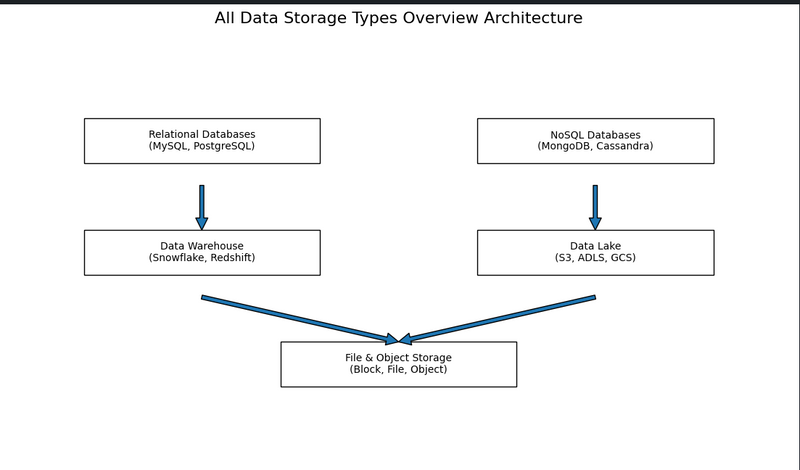
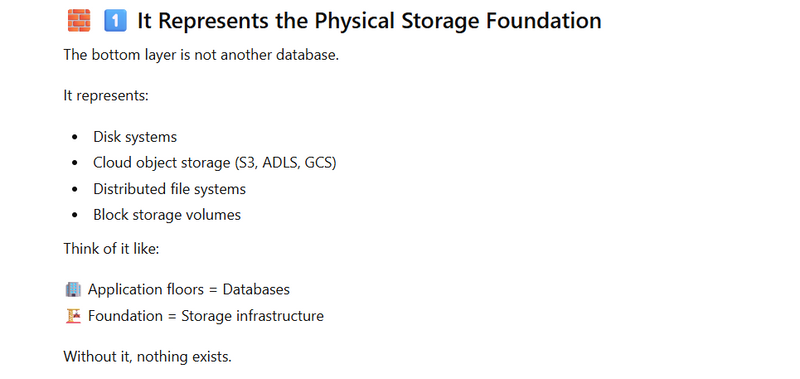
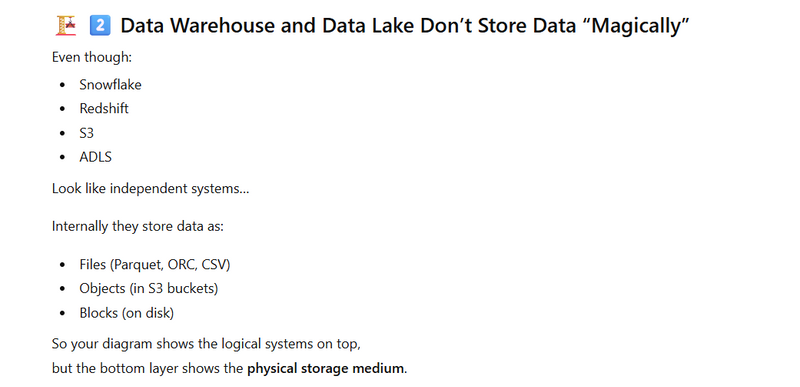
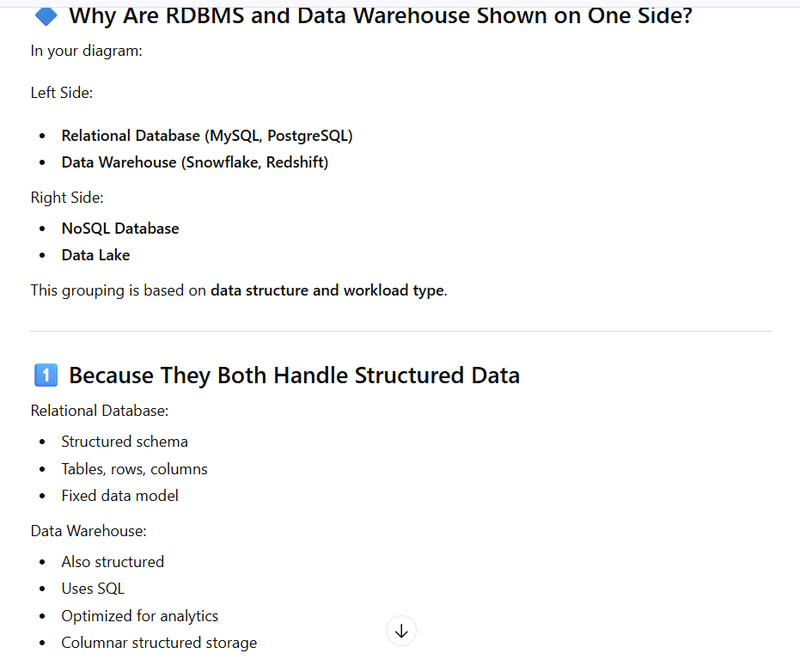
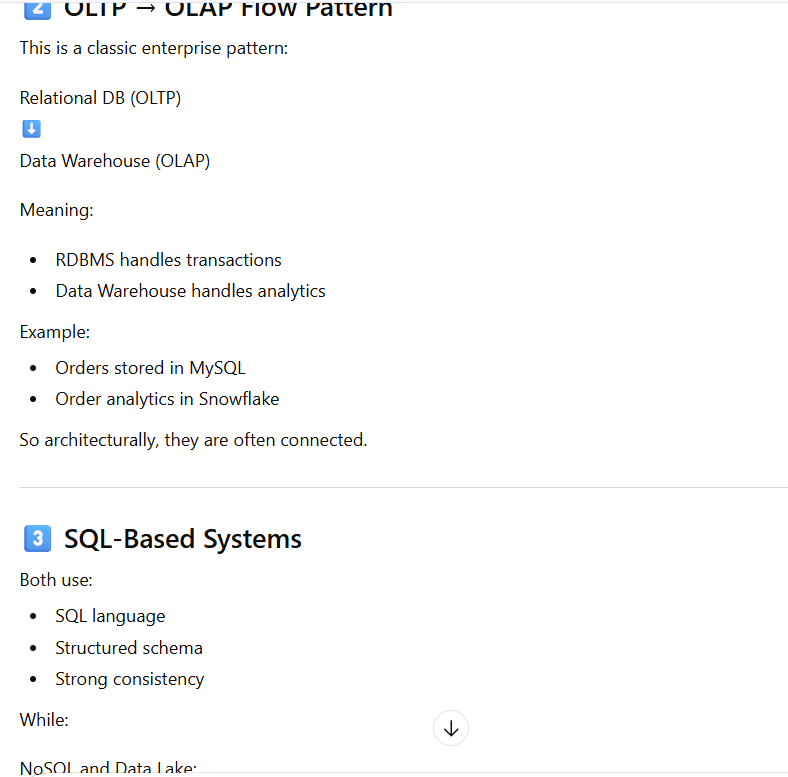
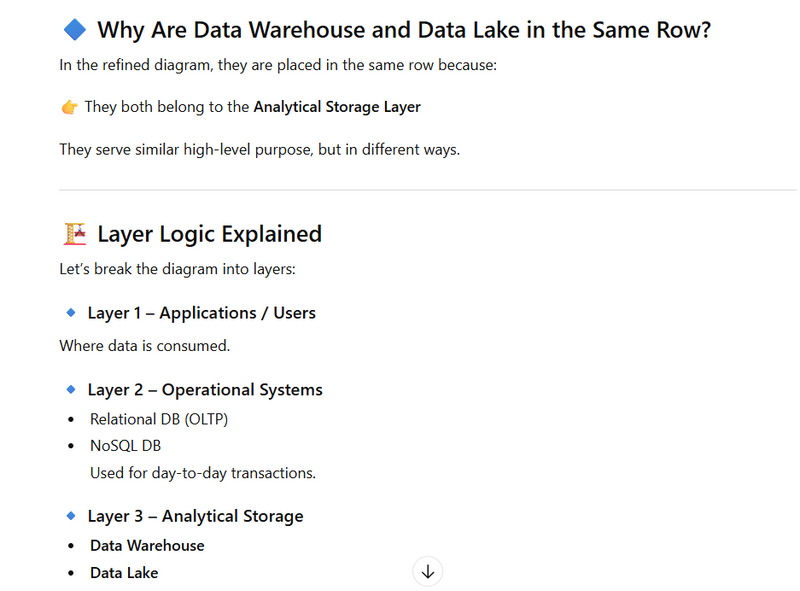
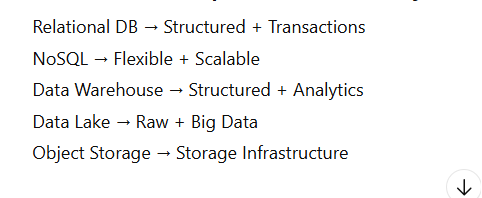
Why Is Everything Going to “File & Object Storage” at the Bottom?
Because almost all modern storage systems are physically built on top of file/object storage infrastructure.
Objective and MCQ question on storage system
What is the primary purpose of a Data Lake?
A) Run transactional queries
B) Store structured data only
C) Store large volumes of raw data
D) Replace application database
✅ Answer: C
2️⃣ Which storage is best for transactional systems?
A) Data Lake
B) RDBMS
C) Hadoop
D) Object Storage
✅ Answer: B
3️⃣ AWS S3 is an example of:
A) Data Warehouse
B) NoSQL Database
C) Object Storage
D) Relational Database
✅ Answer: C
4️⃣ Which system is optimized for SQL-based analytics?
A) MongoDB
B) Snowflake
C) Redis
D) Cassandra
✅ Answer: B
5️⃣ Data Warehouse mainly stores:
A) Unstructured data
B) Structured data
C) Video files
D) System logs
✅ Answer: B
6️⃣ Which storage supports schema-on-read?
A) RDBMS
B) Data Warehouse
C) Data Lake
D) Redis
✅ Answer: C
7️⃣ Which is best for caching and fast access?
A) Data Lake
B) Redis
C) S3
D) Redshift
✅ Answer: B
8️⃣ Apache Hadoop HDFS is:
A) Object Storage
B) Distributed File System
C) SQL Database
D) Data Warehouse
✅ Answer: B
9️⃣ Which format is commonly used in Data Lakes?
A) MP3
B) DOCX
C) Parquet
D) EXE
✅ Answer: C
🔟** Which system is best for handling petabyte-scale raw data?**
A) MySQL
B) PostgreSQL
C) Data Lake
D) SQLite
✅ Answer: C
1️⃣1️⃣ What does Lakehouse combine?
A) RDBMS + NoSQL
B) Data Lake + Data Warehouse
C) Redis + MongoDB
D) HDFS + MySQL
✅ Answer: B
1️⃣2️⃣ MongoDB is a:
A) Relational Database
B) NoSQL Database
C) Data Warehouse
D) Object Storage
✅ Answer: B
1️⃣3️⃣ Which storage is best for storing images and videos at scale?
A) SQL Server
B) Object Storage
C) Redis
D) Oracle
✅ Answer: B
1️⃣4️⃣ Which storage type supports ACID transactions natively?
A) Data Lake
B) RDBMS
C) S3
D) HDFS
✅ Answer: B
1️⃣5️⃣ Snowflake is primarily used for:
A) Web hosting
B) Analytics and reporting
C) Caching
D) Video streaming
✅ Answer: B
1️⃣6️⃣ Which storage is most suitable for log analysis and search?
A) Elasticsearch
B) MySQL
C) Cassandra
D) S3
✅ Answer: A
1️⃣7️⃣ What is the key advantage of Object Storage?
A) High transaction speed
B) Horizontal scalability
C) Strict schema enforcement
D) Fixed size limit
✅ Answer: B
1️⃣8️⃣ Which database is best for flexible schema and high write speed?
A) Oracle
B) PostgreSQL
C) MongoDB
D) Redshift
✅ Answer: C
1️⃣9️⃣ Data Warehouse differs from Data Lake because:
A) Warehouse stores raw unstructured data
B) Warehouse supports schema-on-read
C) Warehouse stores structured processed data
D) Warehouse cannot scale
✅ Answer: C
2️⃣0️⃣ Which architecture separates storage and compute?
A) Traditional RDBMS
B) Data Lake Architecture
C) Redis Cache
D) Local File System
✅ Answer: B
Which storage type is most suitable for storing large training datasets for AI?
A) Redis
B) Relational Database
C) Data Lake (Object Storage)
D) Local File System
✅ Answer: C
2️⃣ Why is Object Storage preferred for AI workloads?
A) It enforces strict schema
B) It scales horizontally and stores large unstructured data
C) It supports only SQL queries
D) It has low latency for transactions
✅ Answer: B
3️⃣ Which file format is most efficient for AI analytics in Data Lakes?
A) TXT
B) CSV
C) Parquet
D) DOC
✅ Answer: C
4️⃣ AI feature stores are mainly built on top of:
A) Caching systems
B) Data Lake or Lakehouse
C) Local storage
D) Redis only
✅ Answer: B
5️⃣ Which storage is best suited for real-time AI feature retrieval?
A) Object Storage
B) Redis / Low-latency database
C) HDFS
D) Cold archive storage
✅ Answer: B
6️⃣ In AI architecture, the Bronze/Silver/Gold layers are typically implemented in:
A) RDBMS
B) Hadoop MapReduce
C) Data Lake / Lakehouse
D) FTP Server
✅ Answer: C
7️⃣ Which storage system is most suitable for storing images and videos for computer vision models?
A) MySQL
B) MongoDB
C) Object Storage (S3/ADLS)
D) Oracle
✅ Answer: C
8️⃣ Why are columnar formats (Parquet/ORC) preferred in AI pipelines?
A) They increase CPU usage
B) They reduce storage and improve query speed
C) They prevent compression
D) They require manual indexing
✅ Answer: B
9️⃣ Which architecture separates storage from compute, making it ideal for AI workloads?
A) Traditional on-prem database
B) Monolithic server
C) Cloud Data Lake architecture
D) Desktop storage
✅ Answer: C
🔟 Which storage is typically used to store trained ML models?
A) Object Storage or Model Registry
B) Relational Database only
C) Redis cache
D) Local temporary folder
✅ Answer: A



Top comments (0)