
Create one git hub repository
give production path
git clone repository
Also install system dependencies in Linux server
which tesseract
Install python
Use Python 3.12 safely (venv)
To see live logs:
Give Permission
Step1:Create one git hub repository
step2:give production path
GCP_CREDENTIALS_JSON = "/opt/lampp/htdocs/motoshare.jp/motoshare-web/gcp-service.json"
step3: git clone repository
git clone git@github.com:Motosharein/motoshare_flask.git
Also install system dependencies in Linux server
sudo apt-get update
sudo apt-get install -y tesseract-ocr libtesseract-dev
Check binary path:
which tesseract
Should return:
/usr/bin/tesseract
Install python
specific version
sudo apt update
sudo apt install python3-pip -y
Check python version
python3 --version
apt install python3.12-venv
Use Python 3.12 safely (venv)
# Check 3.12 exists
which python3.12 || sudo apt install -y python3.12 python3.12-venv

# Create venv with 3.12
cd /opt/lampp/htdocs/motoshare_flask
python3.12 -m venv venv
source venv/bin/activate

# Verify you're inside the venv
which python
python --version

# Install deps inside the venv
pip install --upgrade pip
pip install -r requirements.txt


pip install gunicorn

# 4A) run with gunicorn (recommended)
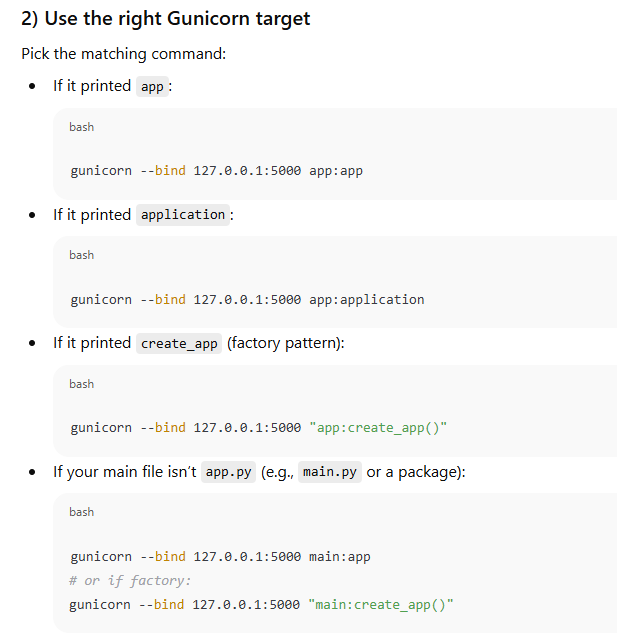
gunicorn --bind 127.0.0.1:5000 "app:create_app()"
sudo apt install -y libgl1 libglib2.0-0 libsm6 libxext6 libxrender1
Notes
See what your module actually exposes
Run this in your project folder:
cd /opt/lampp/htdocs/motoshare.jp/motoshare_flask
source venv/bin/activate
python -c "import app; print('attrs:', [a for a in dir(app) if a in ('app','application','create_app')])"
Virtual host setup
http_vhost
<VirtualHost *:80>
    ServerName motoshare.jp
    ServerAlias www.motoshare.jp
    DocumentRoot "/opt/lampp/htdocs/motoshare.jp/motoshare-web/public"

    # ...your existing Directory + Alias blocks...

    # --- Proxy /image/* to Flask on localhost:5000 ---
    ProxyRequests Off
    ProxyPreserveHost On

    # Put these BEFORE any other ProxyPass lines; keep trailing slashes
    ProxyPass        /image/ http://127.0.0.1:5000/image/
    ProxyPassReverse /image/ http://127.0.0.1:5000/image/

    # No X-Forwarded-Prefix or Location rewrites (prevents double prefix)
    ProxyTimeout 120
    Timeout 120
</VirtualHost>
httpd-ssl.conf
<VirtualHost *:443>
    ServerName motoshare.jp
    ServerAlias www.motoshare.jp
    DocumentRoot "/opt/lampp/htdocs/motoshare.jp/motoshare-web/public"

    SSLEngine On
    SSLCertificateFile      "/opt/lampp/etc/certs/motoshare.jp/motoshare.jp.cer"
    SSLCertificateKeyFile   "/opt/lampp/etc/certs/motoshare.jp/motoshare.jp.key"
    SSLCACertificateFile    "/opt/lampp/etc/certs/motoshare.jp/fullchain.cer"

    # ...your existing Directory + Alias blocks...

    # --- Proxy /image/* to Flask on localhost:5000 ---
    ProxyRequests Off
    ProxyPreserveHost On
    ProxyPass        /image/ http://127.0.0.1:5000/image/
    ProxyPassReverse /image/ http://127.0.0.1:5000/image/
    ProxyTimeout 120
    Timeout 120
</VirtualHost>
Run it directly in your Ubuntu server terminal (SSH or local):
# paths you already use
APP_DIR=/opt/lampp/htdocs/motoshare.jp/motoshare_flask
VENV=$APP_DIR/venv

# write the unit file
sudo bash -c 'cat >/etc/systemd/system/motoshare-flask.service' <<EOF
[Unit]
Description=MotoShare Flask (Gunicorn)
After=network-online.target
Wants=network-online.target

[Service]
User=www-data
Group=www-data
WorkingDirectory=$APP_DIR

Environment=FLASK_ENV=production
Environment=UPLOAD_FOLDER=$APP_DIR/uploads
Environment=GOOGLE_APPLICATION_CREDENTIALS=/opt/lampp/htdocs/motoshare-web/gcp-service.json
Environment=TESSERACT_CMD=/usr/bin/tesseract
Environment=SECRET_KEY=change-me-to-a-strong-secret

ExecStart=$VENV/bin/gunicorn --workers 2 --bind 127.0.0.1:5000 "app:create_app()"
Restart=always

[Install]
WantedBy=multi-user.target
EOF
After creating the file, run:
sudo systemctl daemon-reload
sudo systemctl enable motoshare-flask
sudo systemctl start motoshare-flask
sudo systemctl status motoshare-flask --no-pager
To see live logs:
sudo journalctl -u motoshare-flask -f
Give Permission
sudo chown -R www-data:www-data /opt/lampp/htdocs/motoshare.jp/motoshare_flask/uploads

# keep it secure but writable: setgid bit so new files inherit the group
sudo chmod 2775 /opt/lampp/htdocs/motoshare.jp/motoshare_flask/uploads
# if you want to be extra sure:
sudo find /opt/lampp/htdocs/motoshare.jp/motoshare_flask/uploads -type d -exec chmod 2775 {} \;
sudo find /opt/lampp/htdocs/motoshare.jp/motoshare_flask/uploads -type f -exec chmod 664 {} \;
In env
IMAGE_API_BASE=https://motoshare.jp
IMAGE_API_TIMEOUT=20
GOOGLE_APPLICATION_CREDENTIALS=/opt/lampp/htdocs/motoshare-web/gcp-service.json
In services.php
 'image' => [
        // use public domain (HTTPS) in production
        'base_url' => env('IMAGE_API_BASE', 'https://motoshare.jp'),
        'timeout'  => env('IMAGE_API_TIMEOUT', 30),
        // keep the exact Flask route path
        'qr_path'  => env('IMAGE_API_QR_PATH', '/image/qr/scan'),
    ],
finally check:
https://motoshare.jp/image/hello
===========================================================
if my route
C:\IMAGE_VERIFICATION\views_init_.py
Case A — Only /image
Flask
# C:\IMAGE_VERIFICATION\views\__init__.py
from .image_views import image_bp

def register_blueprints(app):
    app.register_blueprint(image_bp, url_prefix="/image")
Apache vhost (works exactly as you wrote)
<VirtualHost *:80>
    ServerName motoshare.jp
    ServerAlias www.motoshare.jp
    DocumentRoot "/opt/lampp/htdocs/motoshare.jp/motoshare-web/public"

    ProxyRequests Off
    ProxyPreserveHost On

    ProxyPass        /image/ http://127.0.0.1:5000/image/
    ProxyPassReverse /image/ http://127.0.0.1:5000/image/

    ProxyTimeout 120
    Timeout 120
</VirtualHost>
Case B — /image and /machinelearning
Flask
# in __init__.py
from .image_views import image_bp

def register_blueprints(app):
    app.register_blueprint(image_bp, url_prefix="/image")
    app.register_blueprint(image_bp, url_prefix="/machinelearning")  # ensure spelling
Note: If Flask complains about registering the same blueprint twice, create a second blueprint instance with a different name:
from flask import Blueprint
from .image_views import image_bp as _image_bp

image_bp_ml = Blueprint("image_bp_ml", __name__)
image_bp_ml.deferred_functions = _image_bp.deferred_functions  # reuse routes/handlers

def register_blueprints(app):
    app.register_blueprint(_image_bp, url_prefix="/image")
    app.register_blueprint(image_bp_ml, url_prefix="/machinelearning")
Apache vhost
<VirtualHost *:80>
    ServerName motoshare.jp
    ServerAlias www.motoshare.jp
    DocumentRoot "/opt/lampp/htdocs/motoshare.jp/motoshare-web/public"

    ProxyRequests Off
    ProxyPreserveHost On

    # /image/*
    ProxyPass        /image/ http://127.0.0.1:5000/image/
    ProxyPassReverse /image/ http://127.0.0.1:5000/image/

    # /machinelearning/*
    ProxyPass        /machinelearning/ http://127.0.0.1:5000/machinelearning/
    ProxyPassReverse /machinelearning/ http://127.0.0.1:5000/machinelearning/

    ProxyTimeout 120
    Timeout 120
</VirtualHost>



Top comments (0)