
How Rust Replaces if / switch with match
In Rust, match is the primary decision-making tool. It doesn’t just replace switch; it covers many if/else patterns too, while adding safety and expressiveness that Java/Python don’t have.
Think of it like this:
match = if + switch + destructuring + safety checks
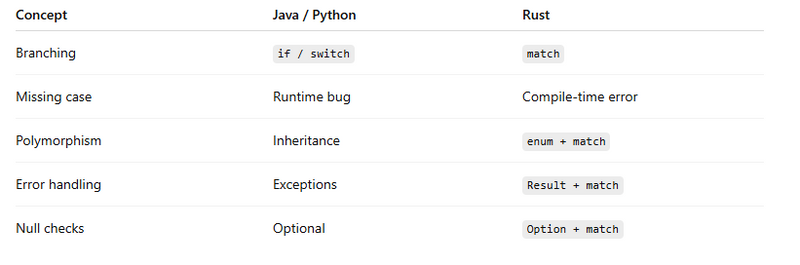
Rust replaces most if / switch logic with match because match is safer, more expressive, and compiler-checked.
Once you start using match, you’ll notice:
fewer bugs

clearer logic

zero “forgotten case” errors
Replacing switch (value-based branching)
Java switch
int day = 2;

switch (day) {
    case 1 -> System.out.println("Monday");
    case 2 -> System.out.println("Tuesday");
    default -> System.out.println("Other");
}

Rust match (same idea, safer)
fn main() {
    let day = 2;

    match day {
        1 => println!("Monday"),
        2 => println!("Tuesday"),
        _ => println!("Other"),
    }
}
Output
Tuesday
✔ Similar to switch
✔ _ is like default
✔ Compiler checks coverage
2️⃣
Replacing if / else if / else
Java / Python style
int x = -5;

if (x > 0) {
    System.out.println("Positive");
} else if (x < 0) {
    System.out.println("Negative");
} else {
    System.out.println("Zero");
}
Rust using match with guards
fn main() {
    let x = -5;

    match x {
        n if n > 0 => println!("Positive"),
        n if n < 0 => println!("Negative"),
        _ => println!("Zero"),
    }
}
Output
Negative
✔ Replaces chained if-else
✔ More readable when cases grow
3️⃣
Replacing null checks (Option + match)
Java
String name = null;

if (name != null) {
    System.out.println(name);
} else {
    System.out.println("No name");
}
Rust (no null)
fn main() {
    let name: Option<String> = Some("Ashwani".to_string());

    match name {
        Some(n) => println!("{}", n),
        None => println!("No name"),
    }
}
Output
Ashwani
✔ No NullPointerException
✔ Missing case is a compile-time error
4️⃣
Replacing polymorphic if instanceof chains
Java (runtime checks)
if (obj instanceof Integer i) {
    System.out.println(i);
} else if (obj instanceof String s) {
    System.out.println(s);
}
Rust (enum + match)
enum Value {
    Int(i32),
    Text(String),
}

fn main() {
    let v = Value::Text("hello".to_string());

    match v {
        Value::Int(i) => println!("{}", i),
        Value::Text(s) => println!("{}", s),
    }
}
Output
hello
✔ No casting
✔ No runtime type errors
✔ Exhaustive handling
5️⃣
Replacing error handling (Result + match)
Java (exceptions)
try {
    readFile();
} catch (Exception e) {
    System.out.println("Error");
}
Rust (errors are values)
fn read_file(ok: bool) -> Result<String, String> {
    if ok {
        Ok("File content".to_string())
    } else {
        Err("Read failed".to_string())
    }
}

fn main() {
    match read_file(true) {
        Ok(data) => println!("{}", data),
        Err(err) => println!("Error: {}", err),
    }
}
Output
File content
✔ No hidden control flow
✔ Errors must be handled
6️⃣
Why Rust prefers match over if / switch
🔥 Key advantages
Exhaustive checking
→ Compiler forces you to handle all cases
Destructuring built-in
→ Pull data out of enums/structs safely
One construct for many patterns
→ Values, ranges, enums, guards, errors
No runtime surprises
7️⃣
When to use if in Rust (yes, it still exists)
Rust still uses if when:
Only two simple branches
No pattern matching needed
if x > 10 {
    println!("Big");
} else {
    println!("Small");
}



Top comments (0)