
Numeric Literals
Boolean and Character Literals
String Literals
Arithmetic Operators
Comparison Operators
Logical Operators
Bitwise Operators
Assignment Operators
Programming example on literals
Programming example on Alias
Numeric Literals
fn main() {
    let a = 10;          // integer literal
    let b = 3.14;        // floating-point literal
    let c = 1_000_000;   // underscore for readability
    let d = 0xff;        // hexadecimal literal
    let e = 0b1010;      // binary literal

    println!("{}", a);
    println!("{}", b);
    println!("{}", c);
    println!("{}", d);
    println!("{}", e);
}
✅ Output
10
3.14
1000000
255
10
Boolean and Character Literals
fn main() {
    let is_active = true;
    let is_admin = false;
    let grade = 'A';

    println!("{}", is_active);
    println!("{}", is_admin);
    println!("{}", grade);
}
✅ Output
true
false
A
String Literals
fn main() {
    let name = "Ashwani";
    let message = "Welcome to Rust!";

    println!("{}", name);
    println!("{}", message);
}
✅ Output
Ashwani
Welcome to Rust!
Arithmetic Operators
fn main() {
    let a = 10;
    let b = 3;

    println!("{}", a + b); // addition
    println!("{}", a - b); // subtraction
    println!("{}", a * b); // multiplication
    println!("{}", a / b); // division
    println!("{}", a % b); // modulus
}
✅ Output
13
7
30
3
1
Comparison Operators
fn main() {
    let x = 10;
    let y = 20;

    println!("{}", x == y);
    println!("{}", x != y);
    println!("{}", x < y);
    println!("{}", x > y);
    println!("{}", x <= y);
    println!("{}", x >= y);
}
✅ Output
false
true
true
false
true
false
Logical Operators
fn main() {
    let a = true;
    let b = false;

    println!("{}", a && b);
    println!("{}", a || b);
    println!("{}", !a);
}
✅ Output
false
true
false
Bitwise Operators
fn main() {
    let x = 5;  // 0101
    let y = 3;  // 0011

    println!("{}", x & y); // AND
    println!("{}", x | y); // OR
    println!("{}", x ^ y); // XOR
    println!("{}", x << 1); // Left shift
    println!("{}", x >> 1); // Right shift
}
✅ Output
1
7
6
10
2
Assignment Operators
fn main() {
    let mut x = 10;

    x += 5;
    println!("{}", x);

    x *= 2;
    println!("{}", x);

    x -= 4;
    println!("{}", x);
}
✅ Output
15
30
26
Combined Literal + Operator Example
fn main() {
    let radius = 7.0;
    let pi = 3.14159;

    let area = pi * radius * radius;
    println!("Area = {:.2}", area);
}
✅ Output
Area = 153.94
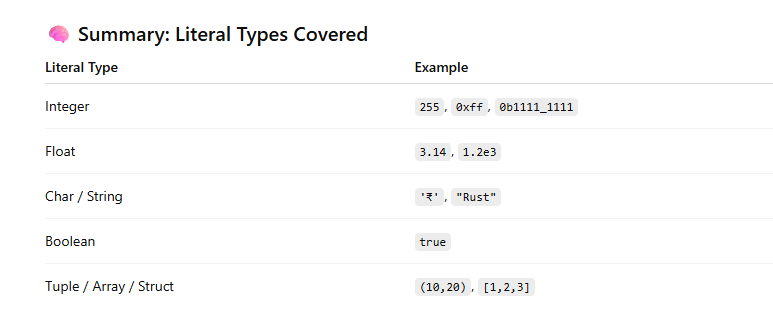
Programming example on literals
Integer literals (decimal, hex, binary, underscore)
fn main() {
    let decimal = 255;
    let hex = 0xff;
    let binary = 0b1111_1111;

    println!("decimal = {}", decimal);
    println!("hex = {}", hex);
    println!("binary = {}", binary);
}
Output
decimal = 255
hex = 255
binary = 255
2️⃣ Floating-point literals
fn main() {
    let pi = 3.14159;
    let scientific = 1.2e3;

    println!("pi = {}", pi);
    println!("scientific = {}", scientific);
}
Output
pi = 3.14159
scientific = 1200
3️⃣ Character and string literals
fn main() {
    let ch = '₹';
    let text = "Rust Language";

    println!("character = {}", ch);
    println!("string = {}", text);
}
Output
character = ₹
string = Rust Language
4️⃣ Boolean and tuple literals
fn main() {
    let flag = true;
    let point = (10, 20);

    println!("flag = {}", flag);
    println!("point = {:?}", point);
}
Output
flag = true
point = (10, 20)
5️⃣ Array and struct literals
struct User {
    name: &'static str,
    active: bool,
}

fn main() {
    let nums = [1, 2, 3, 4];
    let user = User {
        name: "Ashwani",
        active: true,
    };

    println!("nums = {:?}", nums);
    println!("user = {} active={}", user.name, user.active);
}
Output
nums = [1, 2, 3, 4]
user = Ashwani active=true
Programming example on Alias
Immutable aliasing (multiple read-only references)
fn main() {
    let x = 10;

    let r1 = &x;
    let r2 = &x; // allowed: multiple immutable references

    println!("r1 = {}", r1);
    println!("r2 = {}", r2);
}
Output
r1 = 10
r2 = 10
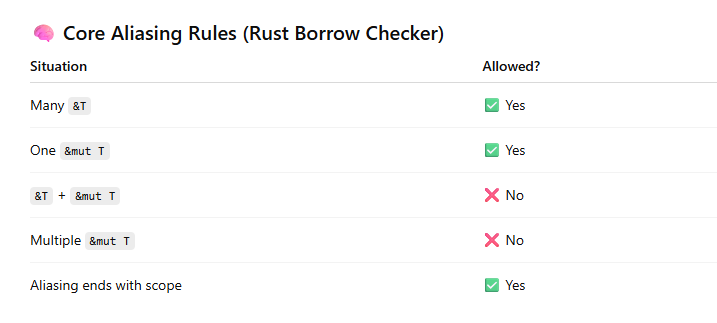
🔑 Rule
✅ Many immutable references (&T) are allowed at the same time.
2️⃣ Mutable aliasing (only ONE mutable reference)
fn main() {
    let mut x = 5;

    let r = &mut x; // only one mutable reference allowed
    *r += 10;

    println!("x = {}", x);
}
Output
x = 15
🔑 Rule
✅ Only one mutable reference (&mut T) at a time.
3️⃣ ❌ Invalid aliasing (mutable + immutable together)
fn main() {
    let mut x = 20;

    let r1 = &x;
    // let r2 = &mut x; // ❌ compile-time error

    println!("r1 = {}", r1);
}
Output
r1 = 20
❌ Why error if uncommented?
Rust forbids:
&x and &mut x at the same time
🔑 Rule

❌ You cannot mix mutable and immutable references.
4️⃣ Aliasing ends when scope ends
fn main() {
    let mut x = 100;

    {
        let r = &x; // immutable alias
        println!("inner r = {}", r);
    } // r goes out of scope here

    let m = &mut x; // now allowed
    *m += 50;

    println!("x = {}", x);
}
Output
inner r = 100
x = 150
🔑 Key Insight
Aliasing rules are scope-based.
5️⃣ Aliasing with slices (shared view of data)
fn main() {
    let data = [1, 2, 3, 4];

    let s1 = &data[0..2];
    let s2 = &data[1..4]; // overlapping immutable slices allowed

    println!("s1 = {:?}", s1);
    println!("s2 = {:?}", s2);
}
Output
s1 = [1, 2]
s2 = [2, 3, 4]
🔑 Rule
✅ Multiple immutable slice aliases are allowed.



Top comments (0)