
Why Rust Data Types Stand Out in Backend Development
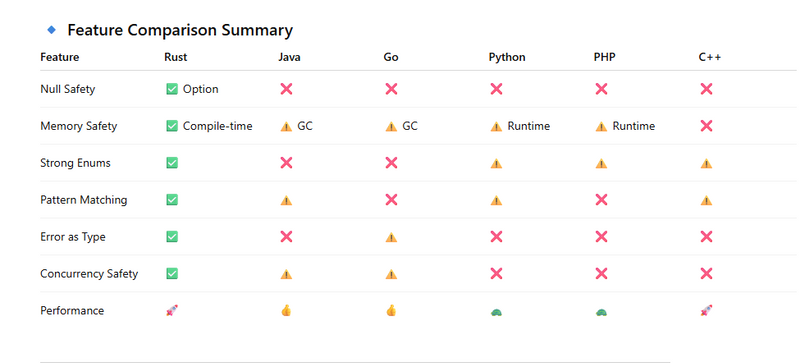
Memory Safety Without Garbage Collection
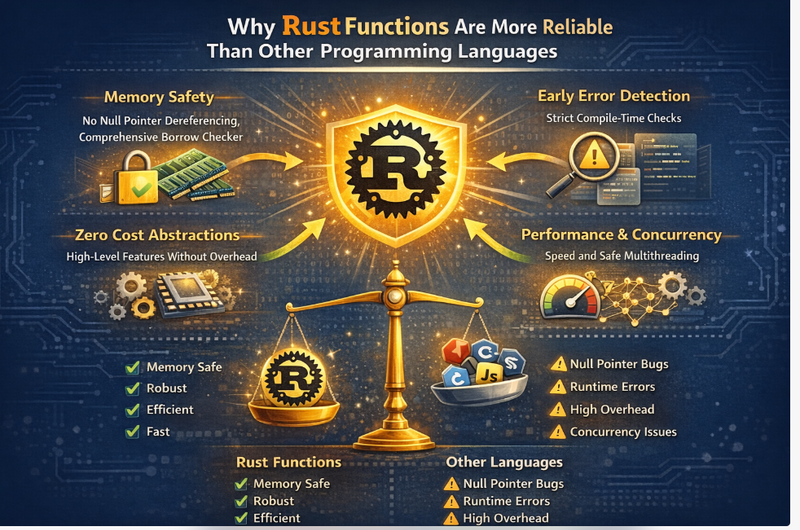
What Rust does better
Rust enforces ownership, borrowing, and lifetimes through its type system.
Prevents:
Null pointer dereference
Dangling references
Use-after-free
Double free
Other languages
Java, Go → rely on GC (runtime overhead)
C/C++ → manual memory management (error-prone)
PHP, Python → runtime memory safety, slower
👉 Rust catches memory bugs at compile time, not in production.
No Null Values by Default (Option)
Rust
let username: Option<String> = None;


Forces developers to handle absence explicitly
Eliminates NullPointerExceptions entirely
Other languages
Java, PHP, JS → null causes frequent runtime crashes

Go → uses zero values (often ambiguous)
👉 Rust makes “missing data” explicit and safe
3️⃣
Strong Static Typing (Zero Implicit Conversions)
Rust
let x: i32 = 10;
// let y: i64 = x; ❌ compile error
let y: i64 = x as i64; // explicit
Benefits
Prevents hidden bugs

Makes data flow predictable

Improves long-term maintainability
Other languages
JavaScript, PHP → weak/dynamic typing

Java → some implicit conversions

Python → runtime typing errors
👉 Rust forces clarity and correctness
4️⃣
Algebraic Data Types (Enums Are Powerful)
Rust enums are far more expressive than enums in most languages.
enum ApiResponse {
    Success(String),
    NotFound,
    Error { code: u16, message: String },
}
Advantages
Can store data
Pattern matching enforces exhaustive handling
Ideal for APIs, state machines, errors
Other languages
Java enum → constants only

PHP enum → limited

Go → no enums (uses constants)
👉 Rust enums model real backend states cleanly
5️⃣
Pattern Matching (Compile-Time Exhaustiveness)
match response {
    ApiResponse::Success(data) => println!("{}", data),
    ApiResponse::NotFound => println!("404"),
    ApiResponse::Error { code, message } => println!("{} {}", code, message),
}
Rust guarantees
All cases must be handled

No silent fall-through bugs

Other languages

Java switch → missing cases compile fine

PHP/JS → runtime surprises
👉 Backend logic becomes bulletproof
6️⃣
Error Handling as a Type (Result)
fn fetch_user() -> Result<User, DbError> {
    // ...
}
Benefits
Errors are part of function signatures

Impossible to “forget” handling errors

Encourages recoverable vs fatal distinction
Other languages
Java → exceptions (hidden control flow)

PHP → mixed error styles

Go → error returns but not enforced by type system
👉 Rust errors are explicit, predictable, and safe
7️⃣
Immutable by Default
let count = 10;
// count += 1; ❌ not allowed
let mut count = 10; // explicit mutability
Why it matters
Prevents accidental state changes

Safer concurrency

Easier reasoning in backend services
Other languages
Java, PHP → mutable by default

Python → mutable collections cause bugs
👉 Rust reduces state-related bugs
8️⃣
Zero-Cost Abstractions
Rust’s advanced types don’t slow your backend.
Generics

Traits

Enums
Pattern matching
👉 Compiled to machine code with no runtime penalty
Other languages

Java → runtime polymorphism

Python → heavy runtime overhead
9️⃣ Fearless Concurrency via Type System
use std::thread;

let data = vec![1, 2, 3];
thread::spawn(move || {
    println!("{:?}", data);
});
Rust guarantees
No data races

Thread safety enforced at compile time
Other languages
Java → synchronized blocks

Go → race conditions possible

PHP → mostly single-threaded
👉 Rust is ideal for high-performance backend systems



Top comments (0)