
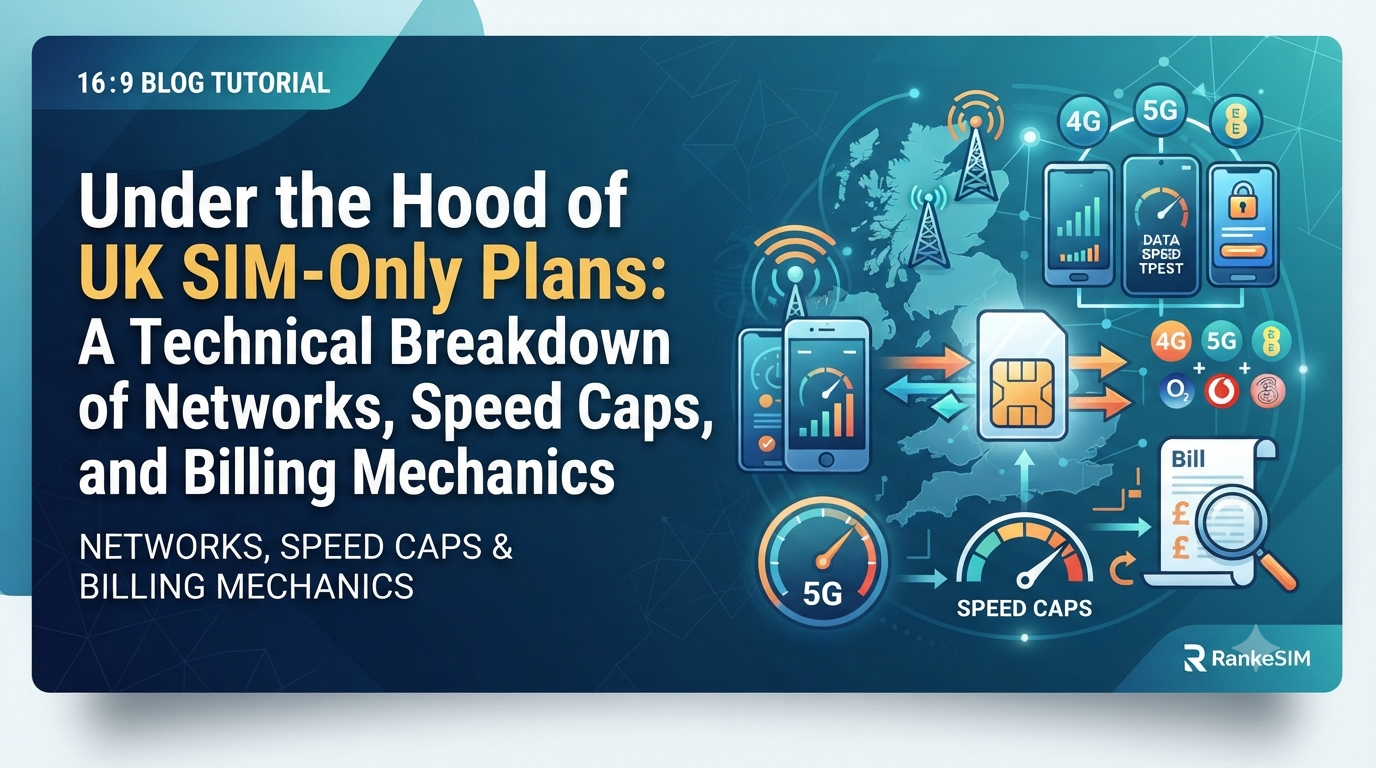
Selecting a mobile plan in Britain looks deceptively simple on a comparison banner: pick a data allowance, check the monthly price, and order a SIM. Beneath the surface, however, two UK tariffs both priced at £10 a month can operate on completely different technical and billing architectures. One provisions an instant eSIM on a 30-day rolling cycle with uncapped 5G throughput and inclusive European roaming. Another binds you to a 24-month contract, injects a mandatory £2.50 monthly rate increase every April, throttles peak download speeds, and meters roaming by the day.
When you compare SIM only deals UK providers advertise, treating every gigabyte as identical leads to avoidable bottlenecks and unexpected costs. Evaluating a tariff properly means inspecting the underlying radio network, QoS (Quality of Service) restrictions, contract math, and provisioning standards before switching.
Network Architecture: MNOs vs Wholesale MVNOs
All cellular traffic in the UK terminates on one of four physical radio access networks: EE, O2, Vodafone, or Three (with Vodafone and Three operating under the merged VodafoneThree entity while maintaining separate consumer brands). These four Mobile Network Operators (MNOs) hold the spectrum licenses, deploy the base stations, and manage core network routing.
Roughly two dozen Mobile Virtual Network Operators (MVNOs)—including giffgaff, SMARTY, Lebara, Voxi, iD Mobile, Tesco Mobile, Sky Mobile, spusu, and 1pMobile—lease wholesale access from those four MNOs rather than building their own radio infrastructure:
- EE infrastructure: Hosts 1pMobile, spusu, Lyca Mobile, and Utility Warehouse, providing broad rural 4G coverage and high-capacity urban 5G without direct-operator contract lock-ins.
- O2 infrastructure: Supports giffgaff, Tesco Mobile, and Sky Mobile, offering strong indoor signal penetration across residential areas.
- Vodafone infrastructure: Carries Voxi, Lebara, Talkmobile, and Asda Mobile, frequently pairing competitive rolling data bundles with international calling options.
- Three infrastructure: Underpins iD Mobile, SMARTY, and Honest Mobile, typically delivering large data buckets and strong urban 5G bandwidth at entry-level prices.
Because an MVNO shares the physical mast footprint of its host MNO, geographic coverage is identical. However, wholesale interconnect agreements define important technical boundaries. Some virtual operators enforce maximum 5G throughput caps, omit IMS services such as Wi-Fi Calling or VoLTE on specific handset firmware, or assign lower traffic priority during peak cell congestion. Verifying host reception in your postcode alongside supported IMS features ensures you do not trade away call reliability for a lower monthly bill.
Right-Sizing Bandwidth and Inspecting Unlimited Tiers
Promotional banners heavily push 60GB, 100GB, and unlimited plans, yet Ofcom reporting indicates average UK mobile consumption hovers around 10GB per user each month. Checking three months of historical cellular usage in your device settings provides a far more accurate baseline than marketing estimates.
Developers, students, and remote workers who spend most of their week on fixed-line Wi-Fi generally consume under 5GB monthly for messaging, maps, authentication apps, and light browsing—making low-cost rolling tiers around £4 to £6 or traditional pay as you go SIM deals UK operators maintain for minimal usage far more economical. Commuters who stream audio, browse social feeds, and watch video on the move typically sit within the 10GB to 30GB window, where MVNO competition keeps monthly rates between £6 and £10.
If you tether a laptop regularly or use cellular data as a primary connection, scrutinizing unlimited data SIM only deals UK networks sell requires checking three technical constraints:
- Throughput throttling by tier: Several UK MNOs segment unlimited tariffs by bandwidth ceiling rather than data volume—capping lower-tier unlimited plans at 2Mbps, 10Mbps, or 100Mbps while reserving full unthrottled 5G speeds for premium tiers.
- Fair usage thresholds: Acceptable use policies commonly trigger review around 600GB to 650GB per month to distinguish personal mobile consumption from commercial server or fixed-broadband replacement traffic.
- Tethering and CPE restrictions: While UK rules allow personal smartphone hotspot sharing on standard plans, certain operators place separate caps on tethered data within unlimited packages or block the SIM from operating inside dedicated 4G/5G customer-premises routers.
Modeling Effective Monthly Cost Under Ofcom Rules
Under Ofcom regulations enforced since January 2025, UK telecom providers can no longer tie mid-contract price increases to variable inflation percentages. Instead, any scheduled annual increase must be stated upfront at the point of sale in exact pounds and pence, alongside the effective date.
On low-cost SIM-only tariffs, flat annual hikes—commonly £1.50 to £2.50 per month each April—significantly alter the total cost of ownership. A 24-month contract starting at £10 per month with a £2.50 April rise increases to £12.50 in year two and £15.00 if the term spans a second April, pushing the true monthly average substantially above the headline figure. Short-term introductory discounts, such as half-price billing for the first three months, distort comparisons in the same manner.
Most 30-day rolling MVNOs eliminate this variable by committing to zero mid-contract price rises, leaving you free to port out with one month’s notice if pricing changes.
Provisioning, Roaming Caps, and Commitment Trade-Offs
Three remaining specifications determine how cleanly a UK SIM-only plan integrates into your setup:
- SIM vs eSIM plans: Comparing SIM vs eSIM plans comes down to provisioning speed and dual-SIM flexibility rather than tariff pricing. Modern Apple, Samsung, and Google handsets support embedded SIMs, enabling instant cryptographic profile download via QR code without waiting for physical mail. Dual-SIM devices can also keep a primary UK line active on an eSIM while running a secondary work number or local travel data plan abroad. Most UK MNOs and a growing number of MVNOs—including giffgaff, SMARTY, iD Mobile, Voxi, and spusu—support eSIM activation, though a few budget operators still distribute physical cards exclusively.
- EU and international roaming limits: Since mandatory EU roaming protections ended, policies diverge sharply. O2 includes EU roaming up to a 25GB fair-use limit across its standard plans, whereas EE, Vodafone, and Three generally charge daily European roaming fees unless you select a higher-tier package. Several MVNOs—such as iD Mobile, Lebara, and SMARTY—retain inclusive EU roaming up to fair-use caps between 12GB and 30GB, while others cap inclusive roaming at 5GB or less.
- Contract length and credit checks: One-month rolling plans typically require no hard credit check and carry zero early termination fees, making them practical for international students, newcomers to the UK, and anyone wanting month-to-month flexibility. Twelve- and 24-month contracts require credit checks and exit fees, though direct MNOs occasionally bundle multi-SIM household discounts or subscription perks.
Auditing Plan Data With Evidence-Based Tools
Because UK operators frequently revise promotional data boosts, April price schedules, and roaming fair-use caps, static comparison lists rapidly drift out of sync with live terms. Promotional summaries often foreground an introductory rate while omitting speed caps, hotspot rules, or post-April pricing.
Using an independent, evidence-based research platform such as RankeSIM allows buyers to inspect UK mobile plans against verifiable data rather than sponsored placements. RankeSIM calculates effective monthly costs alongside headline prices, distinguishes MNOs from MVNOs, confirms physical SIM and eSIM support, and displays last-checked timestamps backed by official provider documentation. Where specifications like hotspot caps or speed tiers are not publicly confirmed, RankeSIM leaves those fields explicitly flagged as unverified rather than assuming features are included.
Porting a number in the UK takes one working day under Ofcom’s Text-to-Switch system—text PAC to 65075 to retain an existing number or STAC to 75075 to cancel without porting. Before initiating a switch, verify local host mast reception at your home and workspace, confirm your handset is unlocked, and calculate the full post-April cost across your expected ownership window. A methodical check upfront ensures predictable throughput, transparent billing, and zero wasted spend.



Top comments (0)