
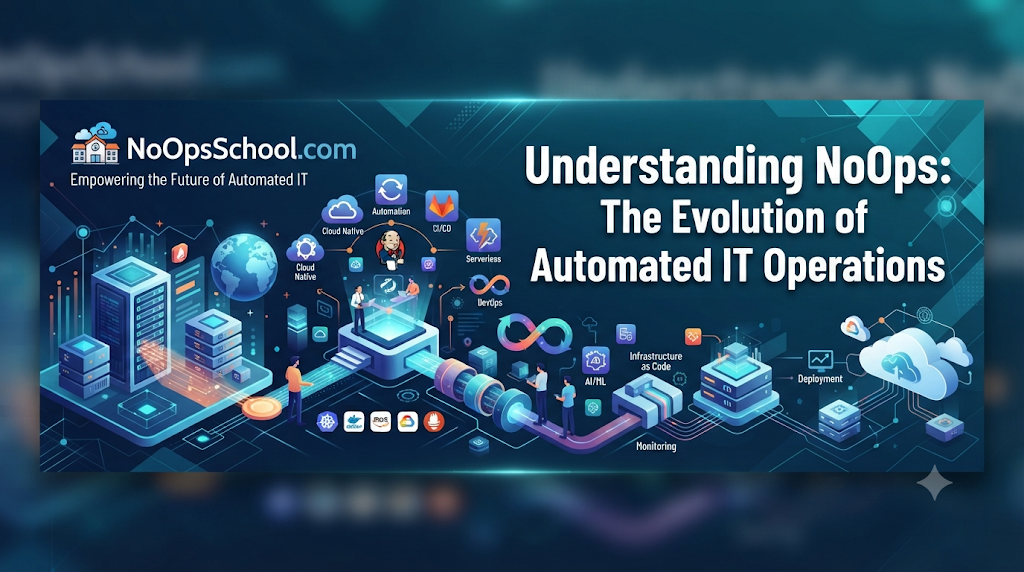
Modern software development is moving faster than ever. Organizations are deploying applications across cloud platforms, managing distributed systems, and responding to changing business requirements through continuous software releases. While these advancements improve agility, they also introduce operational complexity. Infrastructure provisioning, application deployment, configuration management, monitoring, and incident response require considerable engineering effort.
Traditional IT operations often depend on repetitive manual activities. As infrastructure expands, these activities can slow down development teams, increase the possibility of human error, and make consistent service delivery more difficult.
This is where NoOps enters the conversation. NoOps focuses on automating routine operational responsibilities through cloud-native technologies, infrastructure as code, self-service platforms, and intelligent monitoring. The objective is to create environments where applications and infrastructure can operate with minimal manual intervention.
Platforms such as NoOpsSchool.com focus on helping professionals and organizations understand this evolving approach through specialized education, certifications, technical training, consulting, and access to freelance expertise.
1. The Operational Challenge Behind Modern Software Delivery
Modern applications rarely operate on a single server. They depend on cloud infrastructure, databases, APIs, containers, networking components, and external services. Each component introduces operational requirements that engineering teams must manage.
Consider an organization running an e-commerce platform. During normal business hours, its infrastructure handles predictable traffic. However, during seasonal sales, traffic can increase dramatically. The organization must provision additional resources, maintain application performance, monitor database health, and ensure that transactions remain secure.
When these responsibilities depend heavily on manual intervention, several problems can emerge:
- Slow infrastructure provisioning: Teams spend time manually configuring servers and environments.
- Deployment inconsistencies: Differences between development, testing, and production environments create unexpected failures.
- Operational bottlenecks: Developers depend on operations teams for routine infrastructure changes.
- Limited scalability: Manual processes make it difficult to respond quickly to changing workloads.
- Human errors: Repetitive configuration activities increase the possibility of mistakes.
- Monitoring challenges: Large environments generate more operational data than teams can efficiently review manually.
These challenges encourage organizations to move toward automated operating models that improve consistency and reduce unnecessary operational effort.
2. Understanding the NoOps Philosophy
The question of what is NoOps becomes important when discussing the future of cloud-native engineering.
NoOps, short for No Operations, is an approach in which routine IT operations are increasingly automated through platforms, workflows, and intelligent systems. Instead of depending on engineers to manually perform every infrastructure-related activity, organizations create automated environments that handle predictable operational tasks.
NoOps does not mean eliminating operations teams or removing engineering responsibility. It means reducing the amount of manual operational work required to build, deploy, scale, and maintain applications.
Core Principles of NoOps
Automation First: Repetitive tasks such as infrastructure provisioning, configuration management, testing, and deployment are handled through automated workflows.
Self-Service Infrastructure: Developers can request approved infrastructure resources through standardized platforms without waiting for every change to be manually processed.
Standardized Environments: Reusable configurations and infrastructure templates help maintain consistency across development, testing, and production.
Continuous Delivery: Automated pipelines support frequent and reliable software releases.
Intelligent Monitoring: Monitoring and observability systems identify unusual behaviour and support automated responses to predefined conditions.
Reduced Manual Dependencies: Teams spend less time handling routine operational requests and more time improving architecture, security, and application quality.
The central idea is to make infrastructure and operations more predictable, repeatable, and accessible.
3. NoOps and DevOps: Two Approaches With Different Priorities
The discussion around NoOps vs DevOps sometimes creates confusion because both approaches emphasize automation and collaboration.
DevOps combines development and operations practices to improve communication, software delivery, reliability, and continuous improvement. It encourages shared responsibility throughout the software lifecycle.
NoOps takes automation further by attempting to make routine operational activities largely self-service and platform-driven.
Understanding the Differences
| Area | DevOps | NoOps |
|---|---|---|
| Primary focus | Collaboration and delivery improvement | Operational automation |
| Infrastructure | Automated and managed collaboratively | Highly standardized and automated |
| Deployment | CI/CD pipelines | Extensive deployment automation |
| Operations | Shared team responsibility | Minimal routine manual intervention |
| Monitoring | Continuous monitoring and response | Intelligent monitoring and automated responses |
| Human involvement | Active operational collaboration | Focus on exceptions, governance, and improvement |
For example, a DevOps team might use infrastructure automation to provision cloud resources and then manage deployment workflows collaboratively.
A NoOps-oriented organization may build a self-service platform where developers select approved infrastructure configurations, deploy applications, and access monitoring information through automated systems.
These approaches are not competitors. NoOps builds on many practices established through DevOps, particularly automation, collaboration, continuous delivery, and infrastructure as code.
4. Inside a NoOps Environment: The Technologies Working Together
A successful NoOps environment depends on multiple technologies working together. No single tool can automate an entire operating environment.
Infrastructure as Code
Infrastructure as Code (IaC) allows teams to define infrastructure through machine-readable configuration files. Tools such as Terraform help provision and manage cloud resources consistently.
Instead of manually creating virtual machines, networks, and storage resources, engineers define the desired infrastructure and use automation to implement it.
Cloud-Native Architecture
Cloud-native applications are designed to take advantage of scalable infrastructure, distributed services, automation, and managed cloud capabilities.
Managed databases, cloud storage, container services, and serverless platforms reduce the amount of underlying infrastructure that organizations need to maintain directly.
Containers and Kubernetes
Docker provides containerization capabilities that package applications with their dependencies.
Kubernetes manages containerized workloads through scheduling, scaling, service discovery, and recovery mechanisms. These capabilities support standardized application deployment across different environments.
CI/CD Automation
Continuous Integration and Continuous Delivery pipelines automate software building, testing, validation, and deployment.
This reduces repetitive release activities and helps development teams deliver application changes more consistently.
GitOps Workflows
GitOps uses Git repositories as a source of truth for infrastructure and application configuration.
Changes are reviewed, version-controlled, and applied through automated reconciliation processes. This improves traceability and helps teams understand how environments evolve.
Serverless Computing
Serverless platforms allow organizations to execute application logic without directly managing the underlying server infrastructure.
Cloud providers handle much of the infrastructure provisioning and scaling, allowing development teams to concentrate on application functionality.
Observability and AI-Assisted Operations
Observability combines metrics, logs, and traces to provide visibility into application and infrastructure behaviour.
AI-assisted operations can help identify unusual patterns, correlate alerts, summarize incidents, and recommend corrective actions. However, automated recommendations should be validated before high-impact changes are implemented.
Together, these technologies create the foundation for increasingly automated IT operations.
5. From Manual Intervention to Automated Infrastructure
The practical value of NoOps becomes clearer when examining everyday operational activities.
Imagine a development team preparing to release a new application feature.
In a traditional environment, engineers might manually provision infrastructure, configure application dependencies, deploy software, check server health, and adjust resources when traffic increases.
In an automated environment, these activities can follow predefined workflows.
- Infrastructure provisioning: IaC templates automatically create approved cloud resources.
- Application deployment: CI/CD pipelines build, test, and release application versions.
- Configuration management: Standardized configurations maintain consistency between environments.
- Automatic scaling: Platform policies adjust resources based on workload requirements.
- Monitoring: Observability tools continuously evaluate application health.
- Routine recovery: Automated processes restart unhealthy components or replace failed instances when appropriate.
However, automation must be supported by testing, security policies, access controls, and recovery procedures.
For example, automatically restarting a failed service may restore availability, but it does not necessarily resolve the underlying database or application problem. Engineers must still investigate recurring failures and improve system design.
6. Choosing the Right Automation Tools for NoOps
Selecting suitable NoOps automation tools requires understanding the operational problems an organization wants to solve.
Different categories of tools address different parts of the infrastructure lifecycle.
| Technology Category | Examples | Primary Purpose |
|---|---|---|
| Infrastructure provisioning | Terraform, OpenTofu | Automated infrastructure creation |
| Containerization | Docker | Application packaging |
| Container orchestration | Kubernetes | Container deployment and management |
| Configuration management | Ansible | Configuration automation |
| CI/CD | Jenkins, GitLab CI | Automated software delivery |
| GitOps | Argo CD, Flux | Declarative deployment management |
| Monitoring | Prometheus, Nagios | Infrastructure and service monitoring |
| Observability | Grafana, OpenTelemetry | Application and system visibility |
| Cloud platforms | AWS, Azure, Google Cloud | Managed infrastructure and services |
| Intelligent operations | AIOps platforms | Anomaly detection and operational insights |
Organizations should evaluate tools based on integration capabilities, scalability, security, maintainability, team expertise, and operational requirements.
Using more tools does not automatically create a better NoOps environment. A smaller, well-integrated technology stack is often easier to govern and maintain.
7. Designing a Reliable NoOps Architecture
A reliable NoOps architecture requires more than implementing automation scripts. It needs a structured operating model.
The first step is identifying repetitive activities that consume significant engineering time. Infrastructure provisioning, application deployment, environment configuration, and routine monitoring are common starting points.
Next, organizations should establish reusable infrastructure modules. These modules provide approved configurations that developers can consume without designing every environment independently.
A reliable architecture should also include:
Automated Deployment Pipelines: Build, test, security validation, and deployment activities should follow consistent workflows.
Policy Enforcement: Infrastructure configurations should comply with organizational security, cost, and governance requirements.
Access Management: Role-based permissions and controlled approvals help prevent unauthorized infrastructure changes.
Security Automation: Vulnerability scanning, secret management, configuration validation, and compliance checks should be integrated into development and deployment workflows.
Observability: Teams need meaningful dashboards, alerts, logs, and traces to understand system behaviour.
Disaster Recovery: Backup automation, recovery testing, and documented incident procedures are essential for business continuity.
The objective is to build an environment where automation improves operational reliability without sacrificing control.
8. The Skills Behind a Successful NoOps Engineer
A successful NoOps engineer needs a combination of infrastructure knowledge, automation expertise, cloud experience, and problem-solving ability.
Important technical capabilities include:
- Cloud platforms: Understanding AWS, Microsoft Azure, or Google Cloud.
- Infrastructure as Code: Working with Terraform and reusable infrastructure modules.
- Container technologies: Using Docker and understanding container lifecycle management.
- Kubernetes: Managing containerized applications and deployment configurations.
- Scripting: Using Python, Bash, or similar languages to automate repetitive tasks.
- CI/CD: Designing and maintaining automated delivery pipelines.
- GitOps: Managing infrastructure and application changes through version control.
- Observability: Understanding metrics, logs, traces, and alerting systems.
- Security: Applying access controls, secret management, and automated security checks.
Technical knowledge alone is not sufficient. NoOps professionals must understand how systems behave under load, how failures affect dependent services, and how infrastructure decisions influence business outcomes.
Troubleshooting, communication, documentation, and architectural thinking remain important even when routine operations are automated.
9. Building Professional Credibility Through NoOps Certification
As automation becomes increasingly important across IT environments, professionals need structured ways to develop and demonstrate their capabilities.
A NoOps certification can provide a learning framework for understanding automated infrastructure, cloud-native operations, and modern deployment practices.
However, certification should be supported by practical experience. Knowing the concepts behind Kubernetes or Terraform is different from successfully implementing and maintaining them.
A useful learning journey should include:
- Infrastructure automation exercises.
- Cloud environment provisioning.
- Containerized application deployments.
- CI/CD pipeline implementation.
- Monitoring and incident investigation.
- Security and governance exercises.
- Realistic architecture assignments.
A NoOps engineer certification can be relevant to professionals interested in infrastructure automation, cloud engineering, platform engineering, and modern IT operations.
The value of certification ultimately depends on the quality of learning, practical knowledge, and the ability to apply concepts in real-world environments.
10. Selecting a Learning Path Based on Your Career Goals
Not every professional approaches NoOps from the same starting point. Developers, system administrators, DevOps engineers, cloud architects, and technology managers have different responsibilities and learning requirements.
Role-based education can help professionals concentrate on the capabilities most relevant to their career goals.
NoOps Engineer Certification
This learning direction is suitable for infrastructure and automation practitioners who want to understand automated provisioning, cloud environments, CI/CD, container management, and operational workflows.
NoOps Architect Training
Professionals responsible for designing enterprise platforms may benefit from NoOps architect training.
The learning focus includes cloud-native architecture, reusable infrastructure patterns, platform engineering, security architecture, scalability, and automated governance.
NoOps Manager Certification
Technology leaders need a broader understanding of automation strategy and organizational transformation.
A NoOps manager certification learning path can focus on operational efficiency, team coordination, governance, technology adoption, risk management, and business alignment.
NoOpsSchool.com provides a specialized platform context for exploring NoOps education, role-based certification, and professional development opportunities.
Choosing a learning direction should depend on existing experience, career objectives, and the practical responsibilities a professional wants to undertake.
11. What Should a Practical NoOps Training Course Include?
A useful NoOps training course should combine technical explanations with realistic implementation exercises.
Professionals should have opportunities to build infrastructure, deploy applications, automate workflows, and investigate system failures.
A comprehensive training approach should cover:
- Cloud fundamentals: Understanding cloud infrastructure, networking, storage, and managed services.
- Terraform projects: Creating reusable infrastructure configurations and managing resource changes.
- Docker exercises: Packaging applications into containers.
- Kubernetes deployments: Managing containerized workloads and understanding scaling and recovery.
- CI/CD implementation: Building pipelines that automate testing and application delivery.
- GitOps workflows: Managing application and infrastructure changes through version-controlled configurations.
- Observability exercises: Configuring monitoring, dashboards, alerts, and application telemetry.
- Self-healing scenarios: Testing automated responses to predefined infrastructure and application failures.
Practical training is particularly important because production environments involve dependencies, security restrictions, unexpected behaviour, and business continuity requirements.
A professional should finish training with a clearer understanding of how to design, test, and maintain automated operating workflows.
12. When Organizations Need External NoOps Expertise
Organizations often understand the importance of automation but struggle to implement it across existing infrastructure.
Legacy applications, fragmented deployment pipelines, inconsistent configurations, and limited internal expertise can make transformation difficult.
In these situations, specialized NoOps consulting services can support organizations through different stages of adoption.
Consulting requirements may include:
- Assessing existing infrastructure and identifying automation opportunities.
- Modernizing cloud infrastructure and application architectures.
- Improving infrastructure-as-code practices.
- Designing and implementing CI/CD pipelines.
- Introducing containerization and Kubernetes.
- Strengthening security automation and governance.
- Improving observability and incident response.
- Evaluating AIOps capabilities for operational efficiency.
For example, an organization migrating applications to the cloud may need help designing reusable infrastructure modules, standardizing deployment processes, and establishing monitoring practices.
External expertise can help accelerate implementation, but organizations should also ensure internal teams understand the resulting architecture and can maintain it independently.
13. Finding Specialized Talent for NoOps Projects
Not every organization needs a full-time NoOps specialist for every automation initiative. Some projects require expertise in a specific technology or a limited implementation period.
This creates opportunities to hire NoOps freelancers for specialized technical assignments.
Freelancers may support Terraform implementation, Kubernetes configuration, cloud migration, CI/CD improvements, monitoring integration, and infrastructure automation.
However, selecting the right professional requires more than reviewing a list of certifications.
Organizations should evaluate:
Practical Experience: Has the professional implemented similar automation projects in real environments?
Technical Portfolio: Can they demonstrate infrastructure configurations, deployment workflows, or architecture projects?
Cloud Knowledge: Do they understand the cloud platforms and services relevant to the project?
Infrastructure-as-Code Skills: Can they create reusable, maintainable, and secure infrastructure modules?
Problem-Solving Ability: Can they explain how they investigate failures and handle unexpected infrastructure behaviour?
Communication: Can they document technical decisions and collaborate effectively with internal teams?
NoOpsSchool.com's focus on specialized learning and access to freelance expertise provides a relevant context for organizations exploring external NoOps capabilities.
The goal should be to find professionals whose experience matches the actual technical and business requirements of the project.
14. The Limits of Automation: What Still Requires Human Responsibility?
Despite its advantages, NoOps should not be treated as a completely autonomous operating model.
Automation can execute predefined instructions, detect certain anomalies, and respond to known conditions. However, it cannot guarantee that every unexpected situation will be handled correctly.
Several challenges require continued human involvement.
Automation Failures: Incorrect scripts or infrastructure configurations can create problems across multiple environments.
Security Risks: Automated systems may introduce vulnerabilities if permissions, secrets, and policies are not properly managed.
Unexpected Behaviour: Distributed applications can experience failures that are difficult to diagnose through predefined rules.
Compliance Requirements: Organizations must ensure that automated processes follow regulatory and internal governance requirements.
Incident Accountability: Engineering teams remain responsible for investigating incidents, communicating impact, and approving significant recovery decisions.
Architectural Decisions: Decisions about scalability, resilience, infrastructure costs, and technology selection require engineering judgement.
For example, an automated system might detect unusually high cloud resource consumption and initiate a scaling action. However, an engineer may need to determine whether the increase comes from legitimate customer demand, inefficient application code, or suspicious activity.
The best NoOps environments combine automation with clear ownership, appropriate human oversight, and continuous improvement.
15. Preparing for the Next Stage of IT Operations
The evolution of IT operations is closely connected to cloud-native engineering, platform automation, intelligent monitoring, and increasingly sophisticated software delivery practices.
Organizations are moving toward environments where infrastructure can be provisioned through reusable templates, applications can be deployed through automated pipelines, and operational issues can be identified through continuous observability.
This evolution creates opportunities for professionals who understand both traditional infrastructure fundamentals and modern automation technologies.
DevOps engineers can expand their automation capabilities. Cloud architects can develop more standardized platform designs. Developers can become more independent through self-service infrastructure. IT managers can use automation to improve operational efficiency and governance.
For individuals exploring this direction, continuous learning is essential. Understanding cloud platforms, infrastructure as code, Kubernetes, CI/CD, GitOps, and observability can provide a strong foundation for working in automated environments.
NoOpsSchool.com represents a specialized learning and professional development destination for individuals and organizations interested in NoOps education, certification, technical training, consulting, and freelance expertise.
Ultimately, NoOps is not about removing people from IT operations. It is about removing unnecessary manual work, improving consistency, and allowing skilled professionals to concentrate on architecture, innovation, security, and business-critical engineering decisions.
As software environments continue to evolve, organizations that adopt automation thoughtfully will be better positioned to build reliable, scalable, and efficient technology platforms.



Top comments (0)