
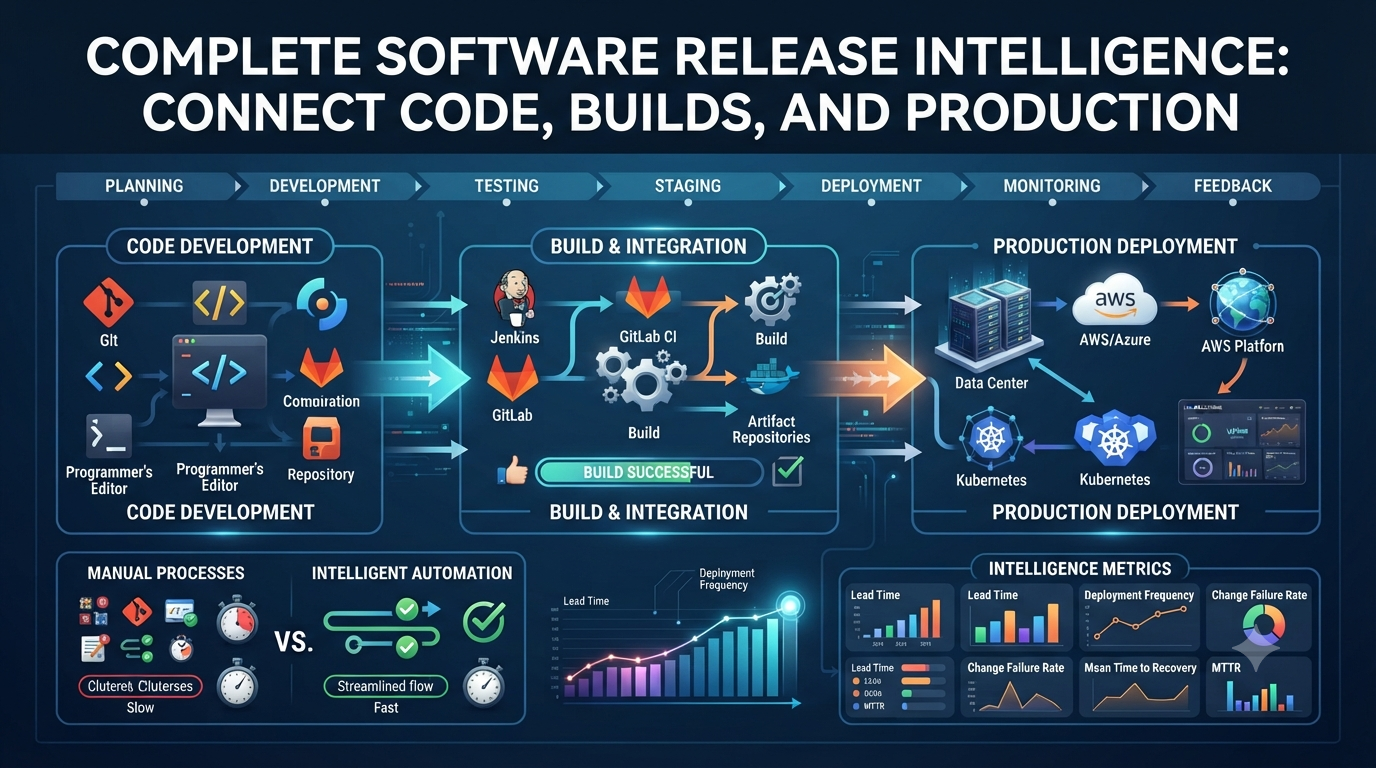
Stop Guessing What Ships to Your Production Environments
Software teams push updates to live servers at breakneck speed, yet release records rarely keep up. Developers store code commits inside Git repositories, product managers organize tasks on issue boards, and automation servers save build logs across separate tools.
Many organizations still stitch together deployment reports using manual spreadsheets and chat threads. This scattered routine hides release ownership and leaves risky blind spots across live infrastructure.
When outages hit, responders lose critical minutes hunting down recent updates. A connected view of every release removes guesswork and shows teams exactly what went live.
Bridge GitHub, Jira, and CI/CD Workflows Automatically
Development teams depend on specialized tools to plan, build, and deploy code. Developers commit updates in Git, planners manage backlogs in issue trackers, and pipelines execute automated tests.
Strong GitHub Jira release tracking links daily coding work directly to project planning. Connecting pull requests to Jira issues reveals which features belong to an upcoming release. Pairing those links with a CI/CD deployment tracking dashboard gives teams live visibility into build health and rollout execution.
Reloqui connects to your delivery stack through twelve connector types. Its ecosystem covers GitHub, GitLab, Bitbucket, and Azure DevOps alongside Jira, Linear, CI/CD pipelines, artifact registries, Terraform, and incident tools. Because every tool exposes different technical metadata, each connector gathers the specific evidence that system provides.
How Release Intelligence Outperforms Basic Version Trackers
A software release tracking tool follows updates as they travel from initial commits to live servers. It links version numbers with pull requests, project tickets, build runs, software packages, and target environments.
Traditional trackers mostly display static checklists or basic deployment statuses. A release intelligence platform goes much further by collecting and analyzing actual engineering evidence across your toolchain.
Reloqui connects these technical signals into one clear release record. Instead of replacing your Git hosts, issue trackers, or deployment pipelines, Reloqui works alongside them to prove what actually shipped.
Reconcile Technical Signals Into One Version Timeline
Gathering raw logs from separate tools solves only half the problem. Your platform must match each piece of technical evidence to the exact software version it supports.
Reloqui accomplishes this through an 11-stage release reconciliation engine. The engine collects raw signals, classifies each item, and connects pull requests, tickets, builds, artifacts, and deployments into a single version timeline.
To help teams judge data completeness, the platform calculates an explainable release confidence score using concrete signals:
- Verified Git tags and properly linked pull requests.
- Passing continuous integration build records.
- Confirmed artifact availability inside package registries.
- Verified deployment events in staging or production environments.
- Orphaned code changes that lack a matching project ticket.
- Recent force-push actions that rewrite commit history.
This confidence score offers an evidence-backed assessment of your release records. Teams should treat it as a practical diagnostic guide rather than an absolute guarantee of error-free software.
Trace Every Code Change From Ticket to Production
Software release change traceability lets engineers follow any update from an initial ticket to a live server. You can trace a running feature directly back to its build artifact, pull request, and original task.
Clear traceability brings immediate advantages to daily engineering operations:
- Faster incident triage: On-call engineers locate the exact commit behind a production error in minutes.
- Informed code reviews: Reviewers inspect business context and linked tickets alongside every code change.
- Quicker root-cause analysis: Responders avoid digging through disconnected server logs during outages.
- Simpler audit checks: Teams present complete records showing who wrote, tested, and approved each update.
Check Release Readiness and Map Service Dependencies
Pushing code to production without checking your delivery evidence invites avoidable downtime. Release readiness confirms that a version holds all expected code, passing builds, and verified packages before launch.
Release readiness assessment software automates these pre-deployment checks. It flags unlinked tickets, broken builds, or missing container images before teams trigger a live rollout. Human judgment remains vital, so engineering leads should always inspect flagged exceptions rather than relying solely on a readiness score.
Modern applications also depend on interconnected microservices, shared databases, and cloud infrastructure. A central service catalog maps your applications, infrastructure components, and deployment targets, while dependency graphs show how those services interact. Before launching a new version, release comparison and impact analysis tools highlight exact differences between releases so engineers spot downstream services that an update might affect.
Enforce Approval Policies and Release Controls
Growing engineering organizations need consistent guardrails to protect production stability. Informal sign-offs in chat channels break down as teams and services scale.
Effective governance relies on approval thresholds, publishing rules, and scheduled freeze windows. Using release approval workflow software ensures designated reviewers inspect and authorize updates before rollout.
Reloqui enforces these controls with customizable approval policies, freeze windows, and permanent release snapshots. While structured workflows encourage consistent engineering decisions, governance software alone cannot eliminate every operational risk.
Generate Audience-Specific Notes and Immutable Audit Trails
Drafting release summaries manually drains valuable engineering hours. Different stakeholders also require very different details from every software update.
An automated release notes generator transforms verified technical evidence into tailored summaries for every reader:
- Developers inspect commit logs, dependency updates, and resolved bug tickets.
- Operations and SRE staff review infrastructure modifications, configuration changes, and rollout steps.
- Product managers read clear summaries of shipped features and customer fixes.
- Business leaders track delivery milestones and overall product momentum.
- Compliance teams examine structured records of approvals, tickets, and change history.
Shared technical evidence keeps every summary consistent across teams. Furthermore, immutable release snapshots preserve this history to create a dependable software release audit trail. Strong records simplify audit reviews, though documentation alone does not guarantee regulatory compliance.
How Engineering Roles Use Release Intelligence
Unified release intelligence supports every team involved in shipping software:
- DevOps engineers verify deployment status immediately without searching through scattered pipeline logs.
- Site Reliability Engineers correlate sudden system alerts with recent code or Terraform updates in seconds.
- Platform engineering teams give developers a standardized, self-service portal for release health.
- Release managers coordinate complex multi-service launches without maintaining manual tracking sheets.
- Engineering leaders measure delivery speed and spot workflow bottlenecks using real evidence.
- Compliance professionals inspect complete approval histories without interrupting active developers.
Select Self-Hosted or Managed Release Software
Security policies and infrastructure preferences vary widely across companies. Some organizations require complete internal control over engineering metadata, while others prefer cloud convenience.
| Hosting Approach | Infrastructure Control | Best Fit |
|---|---|---|
| Self-Hosted Platform | Teams manage servers, network boundaries, and local data storage directly. | Organizations with strict data privacy rules or air-gapped networks. |
| Managed Enterprise | Vendor operates dedicated infrastructure, backups, updates, and disaster recovery. | Teams wanting rapid onboarding without extra maintenance overhead. |
Deploying self-hosted release management software keeps sensitive release data inside your own network perimeter. Reloqui offers a free self-hosted edition containing its full feature set. Organizations wanting hands-off operations can choose Reloqui's managed enterprise option, which provides dedicated infrastructure, service-level commitments, operational support, backups, and disaster recovery.
Checklist for Evaluating Release Intelligence Platforms
Ask these practical questions when comparing platforms for your engineering organization:
- Does the platform integrate cleanly with our existing Git repositories, issue trackers, and CI/CD tools?
- Can engineers trace individual code commits directly to live production deployments?
- Does the system flag missing tickets, orphaned commits, or disconnected evidence?
- Can teams inspect the exact signals behind every release confidence score?
- Does the software enforce custom approval workflows and scheduled freeze windows?
- Can it capture immutable snapshots of release evidence and sign-off records?
- Does the vendor offer a hosting option that meets our security requirements?
- Can developers access clear technical documentation and a REST API for custom automation?
Teams evaluating Reloqui can test these workflows immediately through a no-login guided demonstration powered by synthetic release evidence. Engineers can also inspect the technical documentation and REST API to verify integration options.
Essential Questions About Release Intelligence
Which teams gain immediate value from a software release tracking tool?
DevOps engineers, SREs, release managers, developers, and compliance teams all gain immediate value from a software release tracking tool. It links version tags with pull requests, project tickets, build runs, and target environments so every stakeholder knows what shipped and where it runs.
How does a release intelligence platform unify disconnected engineering tools?
A release intelligence platform gathers raw technical signals from your existing Git hosts, issue boards, and deployment pipelines. It reconciles those separate records into one verified release timeline, giving teams an explainable view of readiness and history without replacing existing tools.
Why does software release change traceability speed up outage recovery?
Software release change traceability lets responders trace a live production error straight back to the exact pull request, build artifact, and ticket that introduced it. Engineers pinpoint root causes in minutes instead of manually searching through server logs.
What records belong inside a reliable software release audit trail?
A reliable software release audit trail captures immutable records of every code change, build result, approval sign-off, and deployment event. Preserving this verified evidence helps organizations answer auditor questions quickly without scrambling to reconstruct past releases.
Can an automated release notes generator create summaries for non-technical leaders?
Yes, an automated release notes generator organizes verified release data into structured summaries for specific audiences. Developers see technical commits and fixes, while product managers, business leaders, and compliance teams receive clear updates focused on features and approvals.
What checks does release readiness assessment software run before launch?
Release readiness assessment software verifies that a version holds passing builds, available artifacts, and properly linked tickets before deployment. Automated checks catch missing evidence early so teams resolve gaps before users experience production issues.
How does GitHub Jira release tracking keep engineering and product teams aligned?
GitHub Jira release tracking links code commits and pull requests directly to project issues. Developers and managers see which tasks belong to each release version automatically, eliminating manual status updates across separate planning boards.
What visibility does a CI/CD deployment tracking dashboard provide?
A CI/CD deployment tracking dashboard displays live build results, artifact creation, and environment rollouts in one view. Engineering teams confirm whether software packages built cleanly and reached target servers without checking multiple pipeline interfaces.
Why do security-focused enterprises prefer self-hosted release management software?
Security-focused enterprises prefer self-hosted release management software because it keeps sensitive code metadata and deployment records inside private infrastructure. Internal hosting gives security teams full control over network access, data storage, and compliance boundaries.
How can engineering teams test release management software before adopting it?
Engineering teams can test release software by checking tool integrations, verifying change traceability, and reviewing how the system highlights missing evidence. Trying a guided demonstration, reading technical documentation, and testing API endpoints confirm whether the platform fits daily workflows.
Turn Every Software Release Into Verified Progress
Dependable software delivery demands clear technical evidence rather than manual spreadsheets. Uniting end-to-end traceability, pre-release readiness checks, structured approvals, and immutable snapshots turns complex rollouts into predictable operations.
Scattered engineering data forces teams to rely on guesswork during critical releases. Connecting those records gives developers, operators, and leaders shared visibility into every update. Organizations ready to replace manual release tracking with evidence-backed intelligence can explore Reloqui to support their delivery workflow.



Top comments (0)