
Introduction
Administrative staff and operations leads burn productive hours every week repeating identical answers about parking gates, bank transfer numbers, and corporate tax records. Endless phone calls, emails, and chat replies disrupt deep work and delay routine tasks.
When employees rush to paste old replies, typos and stale details slip into critical correspondence. Meanwhile, guests and clients waste energy digging through crowded inboxes for scattered instructions.
Dedicated web pages and scannable QR codes remove this friction by storing vital operational facts in one dependable hub. Teams simply distribute a permanent link or code instead of rewriting the same answer.
Proezi brings digital visitor arrival instructions, payment information pages, and business identity sharing together inside a single browser-ready platform.
Why Everyday Business Communication Demands a Central Hub
Organizations exchange logistics, billing, and corporate identity facts with customers, visitors, couriers, and partners around the clock. Without a central hub, routine communication quickly fractures into repetitive manual tasks.
Reception and support teams spend valuable energy sending identical replies to dozens of contacts each week. Moreover, vague directions, outdated payment numbers, or missing registration records stall everyday transactions.
Guests frequently walk through the wrong building wing when text directions lack visual cues. Additionally, maintaining accurate details across multiple branches turns chaotic when documents sit in isolated folders.
Centralized, reusable digital pages keep operational facts uniform and effortless to update. Consequently, every recipient views current guidance without digging through past conversations.
How Proezi Simplifies Core Business Information Sharing
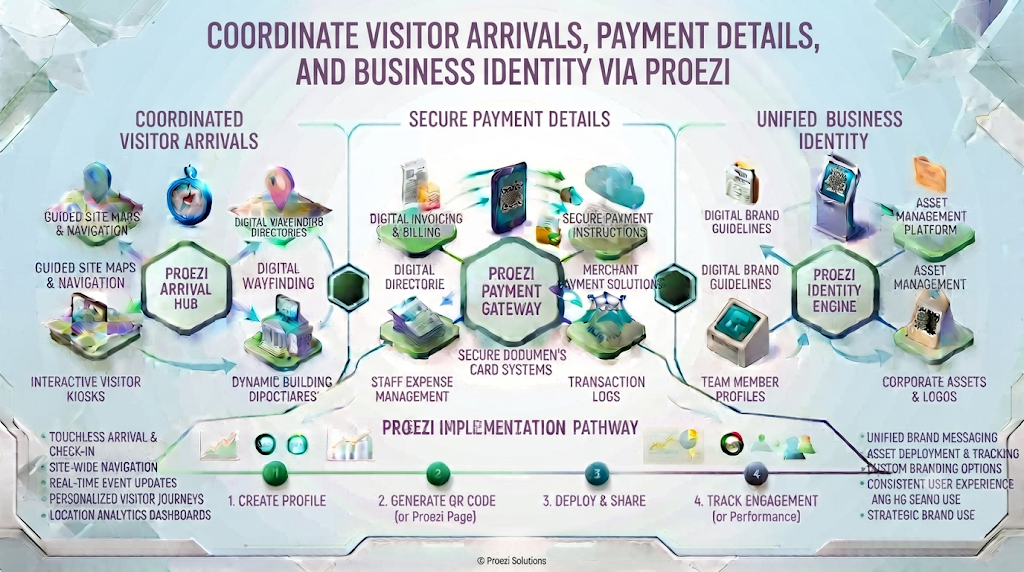
Proezi operates as a web-based business information-sharing platform that lets organizations publish and maintain vital operational records via reusable links and QR codes. Instead of scattering facts across chat threads, teams manage dedicated pages for clients, guests, vendors, and partners.
The platform centers on three core pillars:
- Digital visitor arrival instructions: Clear, sequential steps covering parking zones, entry gates, building doors, reception counters, and specific suites.
- Business payment information pages: Clean layouts displaying bank transfer numbers, UPI identifiers, PayPal accounts, and payment references.
- Business identity information pages: Shareable profiles presenting registered business names, company registration numbers, and tax identifiers.
Teams distribute these pages via direct links or printable QR codes across daily touchpoints. Best of all, recipients open shared pages immediately inside their web browser without installing an app or creating an account.
How Proezi Adapts to Offices, Clinics, Hotels, and Event Venues
Different industries face unique arrival and communication hurdles, yet clear digital guidance improves daily operations across every sector:
- Offices: Teams direct job applicants, employees, clients, and guests to the proper building door and reception counter.
- Clinics: Staff share clear parking zones, step-free entrances, check-in desks, and department wings.
- Hotels and hospitality: Operators send guests straightforward arrival and property access steps prior to check-in.
- Event venues: Organizers route attendees, speakers, vendors, and crew members to their designated gates and halls.
- Warehouses and logistics: Dispatchers specify delivery gates, vehicle rules, and loading docks before drivers arrive.
Customizing instructions for each visitor group keeps foot and vehicle traffic moving smoothly while cutting down on repetitive phone calls.
Why Separate Visitor, Payment, and Identity Pages Outperform Single Files
Keeping visitor directions, payment instructions, and corporate identity facts on distinct pages prevents visual clutter and reader confusion. Each audience searches for specific details at different stages of working with your company.
| Page Type | Main Purpose | Typical Information | Intended Audience |
|---|---|---|---|
| Visitor directions page | Guide people to a physical spot | Parking, entrances, gates, reception, floors | Visitors and delivery partners |
| Payment details page | Share payment instructions | Bank details, UPI information, payment references | Customers and suppliers |
| Business identity page | Share company records | Registered name, registration numbers, tax identifiers | Customers and business partners |
Separating these three categories simplifies routine edits and prevents recipients from reading irrelevant facts. Consequently, every link performs one focused job cleanly.
How to Share Bank Details with Customers Securely
Sharing bank details with customers through organized digital payment information pages prevents typing errors and scattered chat messages. Clean, structured formatting helps payers enter transfer numbers accurately on the first attempt.
Depending on the transfer method, an organization may list the registered account holder name, bank name, account number, and IFSC or local clearing code. Cross-border payments may also call for SWIFT or BIC codes, payment purpose notes, reference numbers, or supported payment identifiers.
Before publishing any payment page, teams must verify every digit and apply appropriate access controls. Outdated or incorrect account numbers cause frustrating delays, so careful proofreading remains essential.
Proezi shares payment instructions strictly for reference; it never processes, collects, or transfers funds, and customers execute all payments directly through their own banking or payment apps.
UPI QR Code Payment Page: Simplifying Payment Instructions
A UPI QR code payment page gives payers fast access to transfer details through a scannable code and clear on-screen instructions. Instead of hunting through old chats for an ID, customers view organized payment facts in one place.
These pages commonly display UPI payment identifiers, scannable QR codes, payment-purpose references, one-tap copyable fields, or matching printed counter signs. Payers then open their preferred banking or payment app to complete the transfer.
Displaying payment instructions differs completely from processing a financial transaction. Opening a payment page never confirms a completed transfer, so teams must verify incoming funds through their own bank records or payment alerts.
Share Business Registration Details Online
Organizations frequently need to share business registration details online with vendors, enterprise clients, partners, and compliance reviewers. A dedicated business identity information page keeps official corporate records accessible in one central spot.
Common entries include the registered business name, company registration number, tax identification number, and related corporate identifiers. Having these facts organized stops teams from answering repetitive onboarding and billing questions.
Staff should verify every entry before publishing and keep confidential records off public pages. Notably, format or checksum validation checks character structure only; it never independently confirms government registration or legal ownership.
QR Code Directions for Visitors: Instant On-Site Guidance
QR code directions for visitors let people scan a code with their phone camera and immediately read clear arrival steps. Rather than squinting at dense email paragraphs, guests access structured guidance right as they reach your property.
Organizations generate scannable codes that launch dedicated arrival pages tailored to their exact premises. This practical approach serves corporate offices, medical clinics, hotels, event venues, commercial parks, warehouses, schools, and service centers.
Staff place these QR codes on calendar invites, reception desks, parking poles, event badges, and entrance signs. Therefore, visitors move smoothly from the curb to check-in without interrupting staff for basic directions.
Last Mile Navigation for Businesses: Closing the Final Stretch
Last mile navigation for businesses resolves the common hurdle after someone reaches your street address or building exterior. Pulling up to the street curb rarely guarantees finding the right entrance or suite.
Picture offices tucked inside large commercial complexes, clinics across multi-building campuses, or convention halls with separate doors. Warehouses with dedicated freight gates, multi-wing hotels, and upper-floor studios create the exact same confusion.
Popular map apps like Google Maps, Apple Maps, or Waze handle highway and street routing smoothly. Pairing those outdoor navigation tools with detailed on-site arrival steps bridges the final stretch to your exact destination.
Understanding Visitor Wayfinding Software
Visitor wayfinding software directs people from a nearby road or parking lot straight to a specific room or counter on your site. While standard street maps display roads and neighborhoods, wayfinding covers the final on-site path.
Effective digital wayfinding delivers sequential steps, doorway details, parking rules, floor and room numbers, and visual landmarks. It also provides exact map coordinates, step-free routes, and temporary alerts during maintenance or construction.
When evaluating wayfinding tools, organizations should weigh their property layout, daily foot traffic, accessibility standards, and team workflows. Proezi supports this operational need by focusing on clear digital visitor arrival instructions and practical last-mile guidance.
Digital Visitor Arrival Instructions: Seven Milestones from Street to Suite
Digital visitor arrival instructions divide an entire trip into logical, stress-free stages. Structuring the path sequentially prevents wrong turns and eliminates late arrivals.
A thorough visitor journey progresses through seven key milestones:
- Reaching the surrounding neighborhood
- Locating the authorized parking area
- Identifying the proper entry gate
- Finding the right building entrance
- Checking in at the reception desk
- Taking the elevator or stairs to the right floor
- Arriving at the final room or office
Annotated photos, obvious landmarks, concise text, and map coordinates remove guesswork at every turn. Furthermore, teams can publish custom routes for drivers, pedestrians, taxi passengers, delivery couriers, and guests requiring step-free access.
Parking and Entrance Directions for Visitors
Parking and entrance directions for visitors perform best when teams treat them as connected yet separate parts of an arrival plan. Finding a parking bay does not automatically tell a driver which building door to use.
Businesses should clearly outline visitor parking zones, reserved spaces, time limits, and accessible stalls. Teams should also describe pedestrian walkways, main and side doors, security gates, reception counters, and access rules.
Whenever parking rules, gates, or building entry policies change, staff must refresh the page right away. Prompt updates prevent drivers from circling closed lots or waiting outside locked doors.
How to Find Us Page for Business: Building Complete Arrival Guides
A well-crafted how to find us page for business equips guests with every detail needed for an easy arrival. Dropping a single map pin rarely explains which security gate or elevator bank to choose.
Complete location pages present the business or venue name, neighborhood overview, map coordinates, and nearby landmarks. They also cover parking rules, main entrance details, gate instructions, reception locations, floor and room numbers, visitor phone contacts, accessibility notes, and temporary access alerts.
Because basic web maps omit interior hallways and security checkpoints, thorough arrival notes fill that gap. Reusable digital arrival pages strengthen standard website location pages by keeping practical on-site steps easy to read and update.
Event Venue Directions QR Code: Streamlining Crowded Arrivals
An event venue directions QR code gives guests instant arrival instructions before and during an event. Large gatherings generate sudden crowds and complex routing that standard street maps cannot untangle.
Event teams regularly juggle multiple entrances, temporary overflow parking, sprawling grounds, and security lines. Attendees, speakers, exhibitors, and staff also need separate paths to registration desks, specific halls, VIP doors, and loading bays.
Organizers embed or print QR codes across digital invites, registration confirmations, tickets, posters, and directional boards. As a result, guests arrive calmly on schedule while event staff spend far less time directing foot traffic.
How QR Codes Make Visitor Communication More Practical
QR codes simplify arrival communication across both printed signs and digital messages. Guests simply point their phone cameras at a code and launch clear instructions right away.
Organizations display QR codes on exterior signs, lobby boards, event invites, booking confirmations, websites, parking poles, delivery slips, and welcome packets. Because the linked page stays reusable, teams avoid reprinting physical signs whenever minor instructions shift.
Still, staff must maintain the underlying page so every scan delivers accurate facts. Thoughtful placement paired with routine checks turns simple codes into reliable wayfinding tools.
Designing Multilingual and Accessible Visitor Directions
Guests arrive with varying language skills, mobility needs, and familiarity with your neighborhood. Designing arrival guides around universal clarity helps every visitor navigate independently.
Write in plain language, attach clear photos, highlight obvious landmarks, and format pages for rapid mobile loading. Include step-free paths, accessible parking notes, elevator locations, and alternative doors wherever possible.
Offering clear visual cues and accessible route details welcomes international visitors and guests with mobility needs. Furthermore, straightforward instructions ease stress for anyone visiting your location for the first time.
Ten-Step Blueprint for Better Digital Arrival Instructions
Creating dependable digital arrival instructions becomes simple when you follow a repeatable sequence. Apply this ten-step blueprint to build clear directions:
- Define the visitor's starting point.
- Specify the exact final destination.
- Pinpoint authorized parking zones.
- Identify entry gates and doors.
- Highlight unmistakable landmarks.
- Detail the walk to reception.
- State floor and room numbers.
- Include step-free accessibility guidance.
- List direct visitor contact numbers.
- Test the entire route from a guest's perspective.
Before distributing your link widely, walk or drive the path yourself while viewing the page on a phone. Real-world testing catches missing signs or confusing turns before actual guests encounter them.
Keeping Shared Business Information Accurate Over Time
Even the clearest digital page loses usefulness when details turn stale. Scheduled reviews keep shared links and QR codes dependable month after month.
Common triggers for page updates include redesigned parking lots, relocated entrances, shifted reception desks, and new bank accounts. Teams must also refresh pages whenever tax identifiers, temporary construction alerts, or support phone numbers change.
Assigning a dedicated team member to audit pages regularly protects accuracy. Whenever site conditions shift, updating the central page immediately spares visitors and partners from following outdated instructions.
Practical Checklist for Digital Information Sharing
Use this actionable checklist to standardize daily information sharing across your organization:
- List the core facts visitors, customers, and partners ask for most often.
- Build separate pages for visitor directions, payment details, and business identity.
- Verify every number, address, and name for complete accuracy.
- Draft sequential, easy-to-read arrival instructions.
- Attach clear photos and recognizable landmarks.
- Double-check parking rules and entrance details.
- Generate QR codes and test them on multiple phones.
- Audit bank and payment identifiers carefully.
- Confirm corporate registration numbers before publishing.
- Add step-free accessibility notes and plain language.
- Place QR codes across high-visibility physical and digital spots.
- Refresh pages immediately whenever operational details change.
Working through these steps converts ad-hoc messaging into a reliable, repeatable workflow.
Structuring Content for AEO, GEO, LLMO, AISEO, and E-E-A-T
Well-structured business content serves both human readers and modern search engines by presenting clear, direct facts. Organizing operational details logically makes answers effortless to find and summarize.
These content habits align directly with five essential optimization principles:
- AEO — Answer Engine Optimization delivers direct, concise responses to specific user questions.
- GEO — Generative Engine Optimization structures clear, factual explanations that AI tools can reference accurately.
- LLMO — Large Language Model Optimization prioritizes clean terminology, clear context, and unambiguous facts.
- AISEO — AI Search Optimization matches practical, helpful guides with intent-driven search queries.
- E-E-A-T — Experience, Expertise, Authoritativeness, and Trustworthiness demonstrates real-world accuracy, clarity, and reliability.
Accurate, transparent explanations earn reader trust, even though no formatting method can guarantee search rankings or visibility.
Why Proezi Is Worth Exploring
Proezi offers a straightforward platform to unite digital visitor directions, reusable QR codes, business payment information pages, and business identity records. Organizations keep essential operational details structured in one place instead of repeating them across messages.
Because visitors open shared pages directly inside a web browser without installing an app or creating an account, accessing information takes seconds. Reusable links and QR codes help teams share clear details with guests, customers, suppliers, and partners.
Share anything with ease.
FREQUENTLY ASKED QUESTIONS
1. How do QR code directions for visitors streamline guest arrivals?
Visitors scan a QR code with their smartphone camera to open a dedicated digital arrival page in their browser. Rather than hunting through emails or chat logs, guests read clear, step-by-step instructions for reaching your exact location.
2. Which operational hurdles does visitor wayfinding software eliminate?
Visitor wayfinding software guides guests from a nearby street or parking lot directly to a specific entrance, floor, or room on your property. It combines sequential written steps, visual landmarks, doorway details, and parking rules to prevent confusion.
3. Why do digital visitor arrival instructions prevent late appointments?
Digital visitor arrival instructions break an entire journey into logical stages, moving from the surrounding road to parking, gates, reception, floors, and rooms. Guests read the guidance in their browser and pair it with their preferred navigation app for outdoor driving.
4. What core information belongs on a how to find us page for business?
A complete how to find us page lists your business name, general area, map coordinates, nearby landmarks, and parking instructions. It also covers gates, building doors, reception desks, floor and suite numbers, step-free access notes, contact numbers, and temporary alerts.
5. Where should venues display an event venue directions QR code?
Organizers print or embed QR codes on digital invites, registration confirmations, tickets, posters, and venue signs. Scanning the code launches immediate guidance for parking lots, security lines, registration desks, event halls, or vendor entrances.
6. How do parking and entrance directions for visitors complement each other?
Treating parking and entrance guidance as distinct steps ensures guests know both where to leave their vehicle and which door to enter afterward. Clear notes on visitor bays, reserved spots, pedestrian paths, and reception desks keep arrivals smooth.
7. What problem does last mile navigation for businesses solve?
Last mile navigation for businesses bridges the final gap after a visitor reaches your street address or building exterior. It guides people to exact gates, lobbies, elevators, floors, or suites inside large commercial complexes or multi-building sites.
8. How can companies share bank details with customers securely?
Companies organize transfer details—such as account holder name, bank name, account number, bank codes, and payment references—on a dedicated payment page. Proezi shares payment instructions only and never processes, collects, or transfers money, so customers pay through their own banking or payment apps.
9. What role does a UPI QR code payment page serve for payers?
A UPI QR code payment page displays UPI identifiers, scannable QR codes, and payment references in one organized view. Customers complete transfers inside their own banking or payment apps, and opening the page never confirms a completed payment.
10. What should companies know before they share business registration details online?
Organizations publish their registered business name, company registration number, and tax identification number on a dedicated business identity page. Format or checksum validation checks character structure only and never independently verifies government registration or ownership.
FINAL THOUGHTS
Consolidating visitor directions, payment instructions, and company identity records onto reusable digital pages eliminates repetitive daily messaging. Guests, clients, suppliers, and partners enjoy a smoother experience when accurate details remain one click or scan away.
Proezi brings these three everyday information-sharing capabilities together through clean, browser-ready pages, links, and QR codes.



Top comments (0)