
Navigating Hidden Traps in Modern Wireless Deals
Telecom providers splash giant data buckets, rapid download speeds, and tiny monthly rates across every screen. Yet those bold headlines rarely reveal the complete truth. Surprise setup charges, strict hotspot limits, and short 28-day billing windows often hide deep inside the contract fine print.
Expats, digital nomads, international students, and frequent flyers lose money when they pick a plan on impulse. You risk paying for unused gigabytes or losing signal right when you need directions. Reviewing complete plan rules before purchasing protects your wallet and secures steady connectivity.
Verified, up-to-date plan records remove the guesswork from your search. Comparing confirmed tariff conditions side by side lets you spot genuine value right away.
Country-by-Country Rules for Smarter Mobile Shopping
Wireless pricing, billing cycles, and registration rules differ sharply across borders. Keep these regional details in mind when comparing local plans.
Germany
Strict telecom laws govern prepaid SIM plans Germany providers distribute. German regulations mandate official identity verification via passport or national ID—completed through an online video call or at a retail shop—before any prepaid card activates. Many German tariffs renew every four weeks (28 days) and include European Union roaming under fair-use limits.
Australia
Vast geographic distances make rural tower reach essential when you compare mobile plans Australia providers offer. Inspect regional coverage maps beyond major coastal cities, and note that Australian prepaid plans typically run on 28-day recharge cycles rather than full calendar months. Unused data rollover perks add strong value for changing schedules.
International students and incoming travelers often choose prepaid eSIM plans Australia carriers support to get online immediately upon arrival. Confirm your handset is network-unlocked and supports Australian frequency bands before buying.
Canada
Provincial boundaries shape wireless pricing when you compare mobile phone plans Canada carriers advertise. Compare bring-your-own-device (BYOD) rates inside your specific province, check whether voice minutes cover nationwide or local calling, and watch for high data overage fees. Review 4G and 5G coverage maps alongside US roaming add-ons if you cross the border frequently.
United States
When you compare prepaid phone plans USA carriers sell, paying upfront eliminates credit checks and long-term contracts. Calculate the full checkout total, since advertised rates often exclude state taxes, regulatory surcharges, and activation fees. Look for auto-pay discounts and multi-month bundle savings to lower your effective monthly rate.
Consumers who compare 5G mobile plans USA networks promote should remember that 5G access depends on carrier tier, phone hardware, and local tower coverage. Many entry-level prepaid plans limit users to 4G LTE networks or slow down data speeds during heavy network congestion.
United Kingdom
Shoppers who compare SIM only deals UK networks offer enjoy fierce price competition and flexible terms. Choose between 30-day rolling plans and cheaper 12-to-24-month agreements, and check whether the provider enforces annual mid-contract price increases. Verify local signal maps, 5G access, and hotspot tethering rules before signing up.
Heavy data users frequently search for unlimited data SIM only deals UK carriers advertise. Read the fair-use clauses carefully, because providers often reduce speeds after you exceed a high monthly usage threshold. If you rarely use mobile internet, pay as you go SIM deals UK operators provide let you pay strictly for individual calls, texts, and megabytes without monthly commitments.
MNO vs MVNO: How Tower Ownership Shapes Your Plan
Every mobile brand operates as either an MNO or an MVNO. Knowing who owns the physical cell towers helps you unlock lower prices without sacrificing signal quality.
A Mobile Network Operator (MNO) builds, owns, and runs physical cell towers, fiber networks, and wireless spectrum licenses. Because MNOs fund expensive infrastructure, they generally charge higher retail rates while offering priority network speeds and direct customer perks.
A Mobile Virtual Network Operator (MVNO) owns zero cell towers. Instead, an MVNO purchases network capacity in bulk from one or more MNOs and sells plans under its own brand name. Lower operating expenses let MVNOs offer cheaper monthly rates and flexible, contract-free deals.
Tower ownership alone never guarantees the best user experience. During peak traffic hours, an MNO may temporarily slow down MVNO data speeds to prioritize its direct subscribers. Always inspect speed policies, customer support channels, and plan conditions before signing up.
SIM vs eSIM Plans: Picking Your Hardware Format
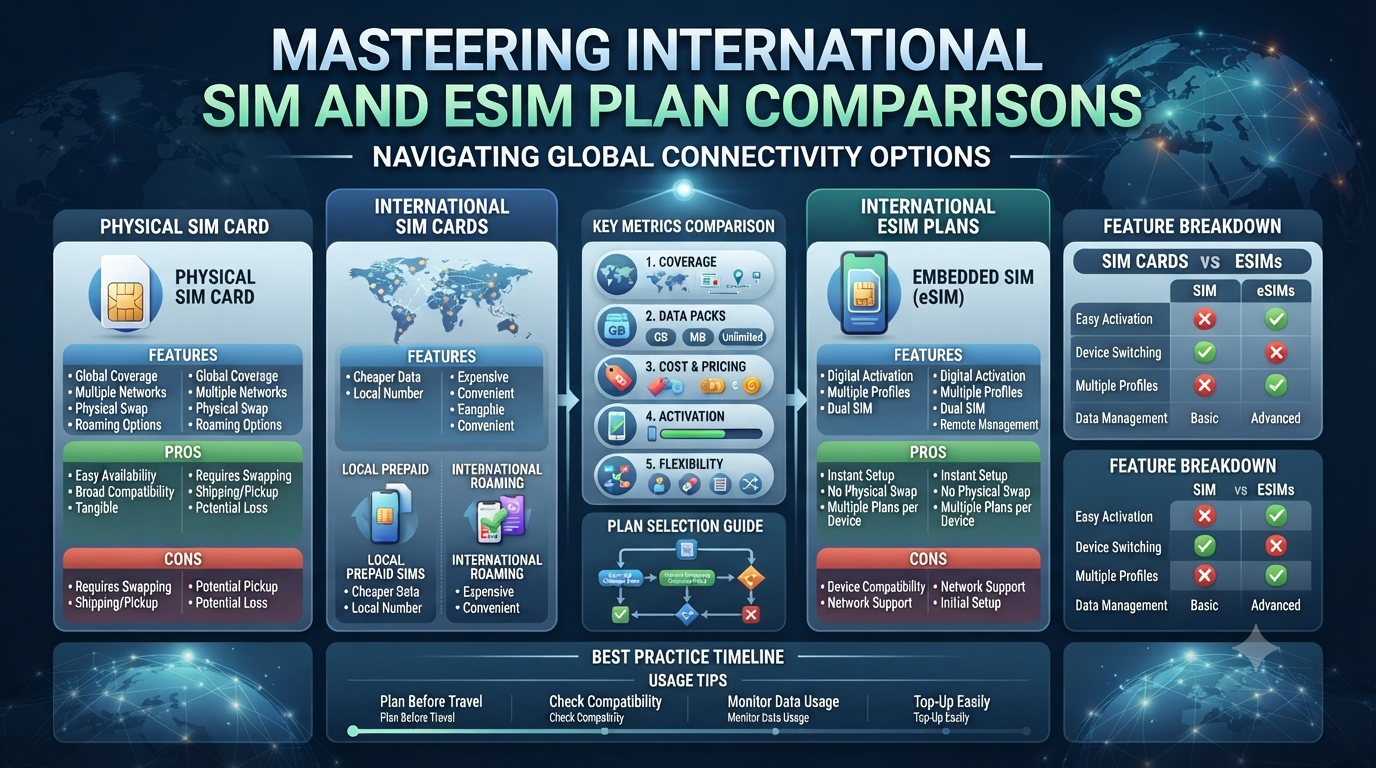
Weighing SIM vs eSIM plans comes down to removable hardware versus embedded software. A standard SIM uses a plastic chip that slides into your phone tray. An eSIM (embedded SIM) relies on a tiny programmable chip soldered directly onto your phone's internal motherboard.
Both formats connect your handset to cellular networks, yet each delivers distinct practical benefits:
- Device compatibility: Nearly every phone accepts a plastic SIM card. Only modern smartphones and tablets house eSIM hardware, so verify your device settings before ordering a digital tariff.
- Activation speed: Physical cards require postal shipping or a retail store visit. Digital eSIM profiles install within minutes via a QR code scan or carrier app.
- Carrier switching: Changing networks on an eSIM takes just a few taps on your screen. Swapping physical cards forces you to wait for replacement plastic hardware to arrive.
- Multi-profile storage: Most eSIM-ready handsets hold multiple digital profiles simultaneously. You keep your primary number active for texts while running a local data plan overseas.
- Travel readiness: Flyers install destination eSIMs before boarding their flight and connect the moment the plane lands.
- Network support: Major carriers widely support eSIM activation, while several budget providers still distribute physical cards exclusively.
Physical SIM cards remain practical if you switch phones often or carry an older handset. Digital eSIM technology provides modern convenience rather than universal superiority.
Seven Mobile Plan Categories Explained
Wireless carriers organize their services into distinct billing and delivery styles. Knowing how each option works helps you balance cost control with everyday flexibility:
- Data-only plans: You receive mobile internet access without traditional voice or SMS allowances. Tablets, mobile Wi-Fi hotspots, and app-based travelers use these plans effectively.
- SIM-only plans: You purchase cellular service alone without financing a new phone. These deals cut monthly expenses and run on rolling 30-day or annual agreements.
- Pay-as-you-go plans: You load credit onto an account and pay strictly per minute, text, or megabyte used. Light callers and backup phone owners gain total spending control from this model.
- Prepaid plans: You pay upfront for a set allowance of data, calls, and texts. Service stops or pauses when your credit expires, eliminating unexpected monthly bills.
- Postpaid plans: You use wireless services all month and settle your invoice at the end of the cycle. Carriers usually run a credit check and often bundle extra perks.
- Bundled mobile plans: Providers combine cellular service with a new smartphone, home internet, or streaming subscriptions under one monthly charge.
- eSIM plans: You download a digital cellular profile straight onto a compatible handset instead of inserting a plastic chip.
Every shopper brings unique priorities to the table. Your ideal plan category depends on your trip duration, payment habits, and phone hardware.
Measuring Your True Monthly Data Needs
Evaluating your everyday smartphone usage before browsing carrier offers prevents costly mistakes. Buying a huge monthly data bucket wastes money if you stay connected to home or office Wi-Fi all day. Conversely, picking a tiny data allowance triggers expensive top-up charges.
Measure your daily routine against these core mobile activities:
- Web browsing and messaging: Checking emails, reading news, and sending texts consume very little bandwidth. Small monthly data tiers handle these tasks effortlessly.
- Video streaming: Watching high-definition movies, short clips, or live sports burns through gigabytes every single hour.
- Online meetings: Remote professionals joining daily video calls need steady upload speeds and generous monthly data limits.
- Gaming and app downloads: Downloading large games or operating system updates requires fast, uninterrupted connections.
- Navigation and maps: Exploring unfamiliar cities relies on consistent regional signal coverage rather than massive data volume.
- Mobile hotspot tethering: Sharing cellular data with a laptop drains your balance rapidly, and many providers cap hotspot speeds.
- International roaming: Frequent travelers must confirm whether a tariff includes cross-border usage or charges steep daily roaming fees.
Matching your actual consumption to the right allowance stops you from overpaying for unused bandwidth.
How RankeSIM Delivers Verified Plan Data
Telecom markets shift daily. Providers adjust monthly rates, revise data limits, launch short-term promos, and update 5G or hotspot rules constantly. Relying on outdated forum posts or old promotional ads often leads to surprise charges at checkout.
Checking official-source references, verification statuses, and last-checked dates protects you from stale data. RankeSIM solves this challenge by tracking when editors verify plan terms against official carrier documentation. Whenever a provider leaves a rule unclear—such as tethering caps or renewal terms—RankeSIM displays that status transparently instead of guessing.
As an independent SIM and eSIM plan comparison platform, RankeSIM organizes structured plan facts rather than promoting sponsored rankings. Its interactive comparison tool generates personalized plan-fit scores matched to your usage habits, letting you evaluate:
- Effective monthly costs and exact validity windows.
- High-speed data caps and 5G network access.
- Mobile hotspot rules and supported SIM formats.
- Provider pages distinguishing MNOs from MVNOs.
- Verification badges, official-source links, and ageing-data alerts.
RankeSIM tracks nine active markets: Australia, Canada, France, Germany, India, Ireland, New Zealand, the United Kingdom, and the United States. Published directory snapshots include 68 plans in the UK, 35 in Australia, 29 in the USA, and 27 in Germany. Because wireless offers change daily, these counts serve as current published comparison snapshots rather than permanent totals of every plan on the market.
Community members submit data corrections, and telecom providers claim their pages to keep details accurate. RankeSIM is also introducing a separate travel eSIM comparison mode to help international travelers compare short-term data packages soon.
Ten-Point Pre-Purchase Inspection List
Run through these ten essential questions before you finalize any mobile plan order:
- Does the monthly data cap match my real daily usage?
- Does the quoted price include all taxes, setup fees, and potential annual increases?
- Does the network deliver strong signal quality at my home, office, or campus?
- Do I need 5G speeds, and does this specific tier include 5G access?
- Is my smartphone unlocked and compatible with eSIM profiles?
- Does the plan include unlimited domestic calls and text messages?
- Can I use my phone as a mobile hotspot without speed caps or extra fees?
- How many days does each billing or recharge cycle last?
- What auto-renewal rules or early cancellation penalties apply?
- Did an independent platform verify these plan details recently?
Your daily routine, location, device compatibility, and budget ultimately point to the right option.
Frequently Asked Questions
1. Which situations favor prepaid plans over SIM-only contracts?
Prepaid plans work best when you want upfront spending control without credit checks or surprise bills. SIM-only plans fit buyers who already own a handset and want lower recurring monthly rates under rolling 30-day or fixed-term agreements.
2. Which steps help shoppers compare SIM-only deals in the UK?
Measure your monthly data usage first, then check local signal maps for your postcode. Compare 30-day rolling plans against 12-month contracts while watching for annual inflation price hikes. Confirm that your chosen deal includes 5G access, EU roaming, and mobile hotspot tethering.
3. Do unlimited data SIM plans truly avoid speed limits?
Most unlimited mobile plans enforce fair-use policies despite removing strict gigabyte caps. If you download massive files nonstop or tether multiple devices heavily, carriers often slow your connection speeds during busy network hours. Always check the provider's traffic rules before purchasing.
4. What details should buyers check before choosing a prepaid phone plan in the USA?
Check whether the advertised rate excludes state taxes, regulatory fees, and SIM starter charges. Verify whether auto-pay enrollment lowers your monthly bill, confirm local 4G and 5G signal reach, and check if high-speed data slows down after a set usage threshold.
5. Can prepaid mobile plans deliver 5G speeds?
Many prepaid plans include 5G connectivity, though budget tiers sometimes limit users to 4G LTE networks or cap peak download speeds. Inspect the plan specifications carefully and confirm that your phone supports the carrier's specific 5G frequency bands.
6. How do travelers activate prepaid eSIM plans in Australia?
Purchase your chosen plan online, complete the mandatory digital identity check, and scan the provider's QR code to install the cellular profile onto your device. Make sure your handset is carrier-unlocked and supports eSIM hardware before placing your order.
7. Does a physical SIM card outperform an eSIM?
Neither format wins across every use case. Digital eSIMs activate instantly and hold multiple carrier profiles on one phone for easy travel. Physical SIM cards swap effortlessly between different devices and work reliably in older phones lacking embedded SIM hardware.
8. How do MNOs and MVNOs differ from one another?
Mobile Network Operators (MNOs) own and run physical cell towers and wireless spectrum directly. Mobile Virtual Network Operators (MVNOs) buy network capacity in bulk from MNOs to sell consumer plans under their own brand, often delivering lower prices and simpler contracts.
9. What should Canadian residents check when comparing mobile phone plans?
Compare bring-your-own-device rates inside your specific province, since regional pricing varies widely. Confirm whether calling minutes cover nationwide or local calls, inspect data overage fees, and check 5G coverage maps alongside US roaming options.
10. Why should consumers use a mobile plan comparison platform?
A dedicated comparison platform organizes complex carrier rules into one clear view. Instead of jumping across dozens of provider websites, you evaluate effective costs, data limits, hotspot rules, and verification dates side by side to select a plan that fits your needs.
Building a Smarter Mobile Strategy Today
Locking in the right wireless tariff becomes simple once you look past eye-catching headline rates. Checking total effective costs, realistic data allowances, tower coverage, billing cycle lengths, and device compatibility protects you from hidden traps.
Because telecom deals shift rapidly, relying on recently verified plan records gives you a clear advantage. Visit RankeSIM whenever you want to compare SIM and eSIM plans using transparent evidence, clear verification dates, and personalized plan-fit scores built around your real connectivity needs.



Top comments (0)