
Introduction
Great engineering teams build reliable systems through disciplined daily habits rather than luck. Even carefully written software experiences avoidable outages when organizations lack automated deployment pipelines, deep system telemetry, and coordinated incident workflows.
Technology leaders must evaluate operational practices systematically, uncover hidden architectural risks, and establish repeatable engineering standards. Without structured assessments, teams frequently discover fragile dependencies only after a live failure disrupts customers.
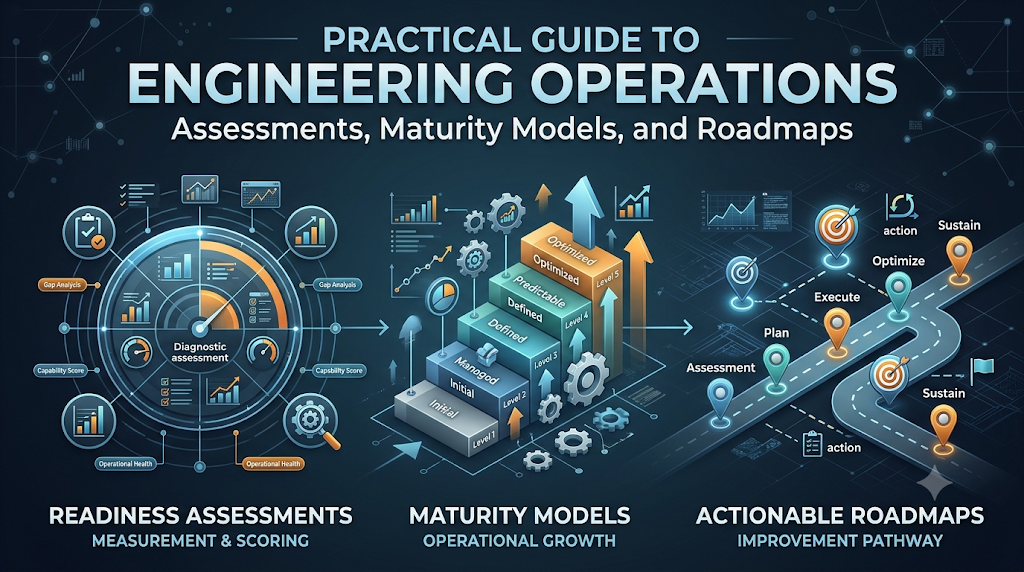
OpsRoadmaps bridges this operational divide as an engineering operations assessment and improvement platform. It connects structured operational evaluations, explainable maturity scoring, practical technical documentation, and prioritized improvement roadmaps in one unified workspace.
Rather than offering individual developer tutorials, OpsRoadmaps helps entire engineering teams and organizations strengthen how they operate production systems.
Exploring the Nine Domains of Engineering Operations
Software operations span dozens of interconnected practices that succeed only when teams align them across the entire organization. Automating Kubernetes deployments alone cannot protect uptime if incident response, observability, or cloud security lag behind.
OpsRoadmaps organizes 42 specialized engineering operations disciplines across nine foundational domains:
- Delivery and Automation: Encompasses DevOps, GitOps, release engineering, and continuous delivery workflows.
- Reliability and Resilience: Covers Site Reliability Engineering, chaos engineering, and capacity management.
- Security and Compliance: Integrates DevSecOps, secrets governance, and software supply chain security.
- Observability and Telemetry: Addresses Observability Engineering, distributed tracing, logging, and alerting.
- Incident and Operations Management: Focuses on Incident Management, on-call rotations, and blameless postmortems.
- Cloud and Infrastructure Operations: Guides Cloud Operations, networking, backup routines, and disaster recovery.
- Platform and Developer Experience: Encompasses Platform Engineering, internal developer portals, and golden paths.
- Cloud Financial Management: Drives FinOps practices, cost allocation, and resource right-sizing.
- Specialized AI and Data Operations: Supports MLOps, LLMOps, and data pipeline reliability.
Evaluating capabilities across all nine domains keeps teams from over-investing in one specialty while ignoring dangerous weaknesses elsewhere. Each discipline applies distinct evaluation criteria matched to its real-world operational role.
How to Choose the Right Engineering Operations Assessment Platform
Selecting an engineering operations assessment platform requires evaluating methodological rigor, technical accuracy, and day-to-day usefulness for practicing engineers. Technology leaders can apply twelve practical selection criteria:
- Assessment coverage: Breadth across core disciplines including DevOps, SRE, Kubernetes, security, observability, and FinOps.
- Clear scoring methodology: Transparent rules explaining exactly how responses translate into maturity scores.
- Explainable results: Detailed technical rationale behind every flagged risk and recommended action.
- Maturity evaluation: Practical capability levels grounded in authentic engineering workflows.
- Technical accuracy: Up-to-date, vendor-neutral guidance written for practicing engineers and architects.
- Source-backed recommendations: Advice anchored in established operational principles rather than arbitrary checklists.
- Improvement prioritization: Logical sequencing accounting for technical dependencies and operational risk.
- Roadmap usability: Actionable steps that convert cleanly into engineering sprint tasks.
- Assessment versioning: Version-controlled scoring models preserving consistent benchmarking across quarters.
- Progress tracking: Built-in capability to re-evaluate teams and measure maturity growth over time.
- Practical knowledge resources: Integrated checklists, runbooks, and blueprints accelerating execution.
- Security and data handling: Clear safeguards protecting sensitive architectural and operational assessment inputs.
Choosing a platform aligned with your current technical stack and organizational goals ensures assessments drive real engineering improvements rather than administrative busywork.
Understanding Maturity Scoring and Explainable Assessments
Practicing engineers rightfully question assessment tools that display opaque scores without explaining the underlying logic. Transparent, explainable scoring builds genuine credibility across engineering teams and technical leadership.
Trustworthy maturity scoring rests on nine core principles:
- Published scoring rules: Clear documentation detailing how each evaluation response contributes to capability ratings.
- Versioned assessment methodologies: Explicit framework versions enabling accurate comparisons across quarters as standards evolve.
- Capability-based evaluation: Granular scoring across specific engineering practices rather than vague organizational labels.
- Maturity levels: Objective progression tiers describing observable engineering behaviors at each stage.
- Risk identification: Direct callouts highlighting severe vulnerabilities or single points of failure uncovered during review.
- Prioritized findings: Ordered recommendations separating urgent foundational fixes from long-term optimizations.
- Evidence and supporting context: Guidance prompting teams to verify answers with real artifacts rather than assumptions.
- Repeatable assessments: Standardized criteria supporting consistent benchmarking across multiple squads or services.
- Progress tracking: Historical score comparisons demonstrating measurable operational improvement over time.
Teams must distinguish self-reported maturity scores from formal external audits. Self-assessments evaluate internal responses and available evidence, whereas independent audits verify regulatory compliance through external examiners. OpsRoadmaps delivers deterministic, explainable scoring paired with source-backed recommendations so engineers understand the exact rationale behind every suggested action.
Understanding Engineering Operations Maturity
Engineering operations maturity defines how reliably, safely, and efficiently an organization builds, releases, observes, and maintains live software. High-maturity engineering teams rely on automated guardrails and repeatable standards instead of late-night heroics during outages.
Ten core operational capabilities determine overall engineering maturity:
- Software delivery practices: Standardized version control, automated test suites, and dependable continuous integration pipelines.
- Infrastructure automation: Declarative infrastructure code and automated configuration management that prevent manual server drift.
- Reliability engineering: Quantified service targets, error budgets, and proactive resilience testing.
- Security integration: Automated vulnerability scanning, encrypted secrets storage, and continuous compliance checks.
- Incident response: Fast anomaly detection, clear escalation paths, and blameless post-incident reviews.
- Observability: Correlated metrics, logs, and traces that reveal real-time system behavior under live load.
- Cloud operations: Multi-zone resilience, elastic capacity scaling, and strict identity access governance.
- Platform engineering: Self-service internal developer platforms that lower daily cognitive load for product squads.
- Cost management: Transparent spend ownership, workload right-sizing, and continuous cloud budget discipline.
- Continuous improvement: Regular operational reviews that convert outage lessons into prioritized engineering work.
Structured maturity assessments give engineering leaders a concrete baseline of current capabilities. Scoring practices across these ten pillars exposes critical blind spots and guides smart resource allocation.
How Engineering Operations Assessments Turn Findings into Improvement Roadmaps
Identifying operational gaps produces lasting value only when teams convert findings into concrete, sequenced engineering work. A disciplined assessment-to-roadmap workflow connects evaluation directly to execution:
- Evaluate existing engineering capabilities: Choose operational domains aligned with immediate business and reliability goals.
- Collect assessment responses and evidence: Gather candid team input backed by concrete artifacts like runbooks, pipelines, and dashboards.
- Identify operational gaps: Document missing controls, manual bottlenecks, and inconsistent practices across squads.
- Understand risks and dependencies: Rank gaps by outage or security impact and map prerequisite technical foundations.
- Review maturity levels: Establish clear baseline capability scores across each evaluated discipline.
- Prioritize improvement opportunities: Sequence high-impact, realistic initiatives based on team bandwidth and risk reduction.
- Define practical actions: Break strategic goals into concrete engineering tasks, checklists, and architectural updates.
- Assign responsibilities: Designate clear team owners and realistic delivery milestones for every action item.
- Track progress: Embed operational improvements directly inside regular sprint and quarterly planning cycles.
- Reassess operational maturity: Run periodic follow-up assessments to verify capability gains and adjust priorities.
OpsRoadmaps streamlines this entire progression by connecting structured capability assessments directly to prioritized, dependency-aware improvement roadmaps tailored to team readiness.
Technical Knowledge Resources for Engineering Teams
Assessments pinpoint where operational practices fall short, while practical technical resources equip engineers to close those gaps efficiently. Combining diagnostics with actionable documentation prevents teams from reinventing standard operational patterns.
An effective engineering knowledge library provides six essential resource formats:
- Engineering improvement roadmaps: Phased adoption blueprints covering SRE practices, platform engineering, DevSecOps, and FinOps.
- Operational checklists: Actionable verification guides for Kubernetes production readiness, service launches, and disaster recovery drills.
- Incident troubleshooting runbooks: Step-by-step diagnostic playbooks resolving common production failures such as Kubernetes CrashLoopBackOff errors.
- Architecture blueprints: Reference designs demonstrating resilient multi-zone deployments, telemetry pipelines, and zero-trust controls.
- Technology decision guides: Objective trade-off analyses helping teams evaluate infrastructure, CI/CD, and observability tools.
- Software tools and reusable templates: Ready-to-adapt starter configurations for SLO definitions, postmortem documents, and readiness reviews.
Accessible technical guidance helps engineering teams move smoothly from identifying an operational weakness to deploying a dependable fix.
Common Challenges in Improving Engineering Operations
Operational improvement programs often stall when teams encounter organizational, technical, or cultural friction. Addressing twelve common obstacles proactively keeps transformation efforts moving forward:
- Unclear improvement priorities: Teams feel overwhelmed by competing technical debt. Solution: Rank the top three highest-risk operational gaps each quarter using structured assessments.
- Legacy infrastructure: Aging monoliths resist automated deployment and testing. Solution: Apply incremental strangler patterns and wrap critical interfaces with automated tests first.
- Limited engineering resources: Feature delivery deadlines crowd out reliability work. Solution: Reserve dedicated engineering capacity through explicit error budget policies.
- Skill gaps: Engineers lack hands-on experience with Kubernetes, SRE, or FinOps. Solution: Combine phased roadmaps with internal workshops and reusable templates.
- Inconsistent processes: Individual squads deploy and monitor services differently. Solution: Offer voluntary golden paths and standardized production readiness checklists.
- Tool fragmentation: Overlapping monitoring and CI/CD tools create blind spots. Solution: Standardize telemetry schemas and consolidate around core platform capabilities.
- Poor observability: Responders spend hours hunting for root causes during outages. Solution: Prioritize distributed tracing and SLO-driven alerting across critical user flows.
- Security weaknesses: Manual security gates slow releases or miss vulnerabilities. Solution: Integrate automated dependency, container, and code scans directly into CI pipelines.
- Cloud cost visibility: Developers deploy infrastructure without seeing financial impact. Solution: Enforce mandatory resource tagging and publish team-level spend dashboards.
- Resistance to organizational change: Engineers view new standards as top-down bureaucracy. Solution: Co-design workflows with practitioners and focus on automation that reduces on-call toil.
- Unclear ownership: Shared components lack accountable operational owners. Solution: Maintain an explicit service catalog mapping every system to a responsible team.
- Difficulty measuring progress: Leaders struggle to quantify operational improvements. Solution: Track SLO attainment, mean time to recovery, and periodic maturity reassessments.
What Is a Production Readiness Assessment?
A production readiness assessment confirms that a new application or major release meets strict reliability, security, and support standards before serving live traffic. Engineering teams run this structured review to catch operational gaps early.
During a readiness review, teams verify ten critical operational pillars:
- Application reliability: Graceful error handling, retry policies, timeouts, and dependency fallbacks.
- Infrastructure readiness: High-availability topologies, network routing rules, and automated provisioning scripts.
- Security controls: Least-privilege access rules, encrypted network traffic, and hardened container images.
- Monitoring and alerting: Actionable alerts tied directly to user-facing symptoms and clear runbooks.
- Backup and recovery: Automated data backups, verified restoration drills, and documented recovery objectives.
- Deployment procedures: Automated rollout pipelines, health verification gates, and rapid rollback paths.
- Incident response: Assigned on-call rotations, escalation contacts, and dedicated communication channels.
- Performance testing: Load and stress test benchmarks validating capacity under expected peak traffic.
- Capacity planning: Resource quotas, autoscaling triggers, and infrastructure growth forecasts.
- Operational documentation: Current architecture diagrams, dependency maps, and troubleshooting guides.
Running a thorough readiness evaluation exposes missing safeguards before they trigger customer-facing outages. Keep in mind that an internal readiness review evaluates available evidence and never replaces an independent external audit or formal compliance certification.
DevOps Maturity Assessment: Evaluating Software Delivery Practices
A DevOps maturity assessment measures how effectively development and operations teams collaborate to ship software safely and rapidly. It evaluates automation coverage, feedback speed, and shared accountability across the entire delivery lifecycle.
Teams examine ten essential delivery capabilities:
- Continuous integration and continuous delivery pipeline automation
- Infrastructure as Code adoption and automated drift detection
- Version control branching workflows and peer code review discipline
- Automated unit, integration, and end-to-end test coverage
- Deployment frequency and commit-to-production lead times
- Progressive release strategies such as canary and blue-green deployments
- Cross-functional collaboration across engineering, operations, and security
- Automated post-deployment telemetry and fast rollback feedback
- Streamlined change approvals and automated policy gates
- Elimination of repetitive manual release tasks
Analyzing assessment results helps engineering managers pinpoint exact workflow bottlenecks. Rather than buying tools blindly, leaders can focus engineering effort on the specific friction slowing down software releases.
Kubernetes Production Readiness Checklist
Operating containerized workloads on Kubernetes introduces operational complexity across cluster infrastructure, networking, storage, and security. Teams must validate both cluster-level controls and application manifests before serving production traffic.
A comprehensive Kubernetes production readiness checklist verifies twelve vital controls:
- Cluster architecture: Multi-zone control planes and isolated worker node pools separating critical workloads.
- Resource requests and limits: Accurate CPU and memory boundaries preventing noisy-neighbor starvation and out-of-memory terminations.
- Readiness and liveness probes: Calibrated health checks ensuring Kubernetes routes traffic only to healthy pods and restarts frozen containers.
- Container image security: Minimal base images, automated vulnerability scans, and strict policies blocking root container execution.
- Network policies: Default-deny ingress and egress rules restricting pod-to-pod traffic strictly to authorized services.
- Secrets management: Encrypted secret stores and external secret managers instead of plain-text credentials inside manifests.
- Persistent storage: Validated storage classes, automated volume snapshots, and durability guarantees for stateful workloads.
- Autoscaling: Horizontal Pod Autoscalers and cluster autoscalers tuned to absorb traffic surges smoothly.
- Monitoring and logging: Centralized log shipping and real-time container metrics across all nodes and namespaces.
- Backup and recovery: Scheduled backups covering etcd state, cluster manifests, and persistent data volumes.
- Deployment strategies: Rolling updates configured with controlled surge and unavailability limits to prevent downtime during releases.
- Disaster recovery planning: Documented and tested failover playbooks for regional cloud outages or cluster corruption.
Following a consistent checklist helps teams evaluate operational risks before deploying workloads. Still, completing a checklist alone never guarantees a fault-free or completely secure Kubernetes environment without continuous operational discipline.
Kubernetes CrashLoopBackOff Troubleshooting
When Kubernetes reports a CrashLoopBackOff status, a container repeatedly starts, exits with an error, and enters an exponentially increasing restart delay. This status signals a persistent startup or runtime failure loop rather than a single isolated bug.
Common causes behind container crash loops include:
- Uncaught application startup exceptions or syntax errors
- Incorrect container entrypoint commands or runtime arguments
- Missing or misspelled environment variables
- Corrupted configuration files mounted through ConfigMaps
- Overly aggressive liveness probes terminating slow-starting applications prematurely
- Memory limits triggering Out-Of-Memory (OOMKilled) container terminations
- Filesystem permission errors when running under non-root user IDs
- Unreachable upstream databases, message brokers, or external APIs
- Missing or malformed Kubernetes Secrets
- Native binary crashes or segmentation faults
Engineers resolve these failures systematically through a structured Kubernetes CrashLoopBackOff troubleshooting sequence:
- Run
kubectl get podsto verify current pod status, restart counters, and target namespace. - Run
kubectl describe pod <pod-name>to inspect termination exit codes, OOMKilled flags, probe failures, and warning events. - Run
kubectl logs <pod-name>to read standard output and error streams from the active container. - Run
kubectl logs <pod-name> --previousto capture logs from the crashed container instance right before termination. - Run
kubectl get events --sort-by='.lastTimestamp'to inspect recent scheduling, volume mount, or image pull warnings. - Run
kubectl get deploymentsand inspect the workload specification to validate environment variables, volume mounts, resource limits, and command overrides.
Comparing termination exit codes against previous container logs quickly narrows down whether the failure stems from application code, missing configuration, probe timing, or memory exhaustion. Choosing the right fix always depends on the specific error output and workload configuration.
Platform Engineering Adoption Roadmap
Platform engineering builds reusable internal developer platforms that simplify infrastructure provisioning and application deployment. By offering curated golden paths and self-service workflows, platform teams reduce cognitive load while embedding organizational standards automatically.
Organizations execute a successful platform engineering adoption roadmap across ten deliberate stages:
- Understand developer needs: Interview application teams to uncover daily friction in testing, provisioning, and deployment.
- Evaluate existing engineering workflows: Map how code moves from local workstations to production across different squads.
- Identify repeated operational tasks: Catalog frequent manual requests such as database provisioning, certificate generation, and pipeline creation.
- Define platform goals: Establish measurable targets for developer onboarding speed, self-service adoption, and deployment consistency.
- Design the platform architecture: Select composable APIs, portals, and orchestration layers matching internal engineering skills.
- Build reusable infrastructure capabilities: Publish standardized, versioned templates for common cloud and Kubernetes resources.
- Introduce self-service workflows: Enable developers to spin up environments and deploy services independently via CLI tools or developer portals.
- Integrate security and governance: Embed policy-as-code, identity guardrails, and compliance checks directly inside platform templates.
- Measure adoption and developer experience: Track platform usage rates, developer satisfaction scores, and delivery lead-time improvements.
- Improve the platform continuously: Evolve internal platform capabilities iteratively based on real developer feedback.
Expanding platform capabilities gradually around genuine developer pain points keeps teams from building rigid internal tools that engineers avoid using.
SRE Adoption Roadmap: Building Reliable Software Systems
Site Reliability Engineering applies software engineering principles to infrastructure and operations challenges. Rather than chasing impossible perfection, SRE balances rapid feature delivery against explicit, measurable reliability targets.
Foundational SRE practices include:
- Service Level Indicators (SLIs): Quantitative metrics tracking user-facing behavior such as request latency, error rates, and availability.
- Service Level Objectives (SLOs): Specific reliability targets established for each SLI across a rolling measurement window.
- Error budgets: The allowable margin of unreliability calculated from an SLO, governing trade-offs between feature velocity and stability work.
- Reliability reviews: Regular architectural check-ins examining single points of failure, dependencies, and SLO trends.
- Incident response: Coordinated on-call rotations and clear incident command structures for resolving live disruptions rapidly.
- Automation: Writing maintainable software to replace manual operational procedures and repetitive maintenance tasks.
- Capacity planning: Forecasting traffic growth and provisioning infrastructure headroom ahead of demand spikes.
- Toil reduction: Systematically identifying and automating manual, repetitive, tactical operational work.
- Post-incident learning: Running blameless postmortems to uncover systemic flaws after service disruptions.
- Continuous improvement: Prioritizing reliability backlog tasks funded directly by error budget policies.
Teams launch an effective SRE adoption roadmap by selecting one or two business-critical services, defining user-centric SLIs and SLOs, and aligning product and engineering leaders around shared error budget rules. Lasting SRE success demands cross-team collaboration, transparent metrics, and ongoing engineering commitment.
Incident Management Maturity Model
An incident management maturity model enables engineering organizations to evaluate how effectively they detect, classify, resolve, and learn from operational disruptions. Advancing along the maturity spectrum replaces chaotic firefighting with calm, predictable recovery.
| Maturity Dimension | Early / Reactive Stage | Mature / Proactive Stage |
|---|---|---|
| Incident detection | Customers report outages before internal monitoring triggers. | Synthetic probes and SLO burn-rate alerts detect degradation early. |
| Alert quality | Noisy, non-actionable alerts overwhelm responders and cause fatigue. | Every page maps to user impact and links directly to a verified runbook. |
| Incident classification | Responders debate severity levels while outages actively unfold. | Objective severity criteria trigger standardized response workflows immediately. |
| Escalation procedures | Engineers rely on personal contacts to find service specialists. | Automated paging routes incidents directly to primary and backup owners. |
| On-call responsibilities | Informal coverage causes responder burnout and uneven knowledge sharing. | Equitable, structured rotations feature documented handoffs and shadowing. |
| Communication | Stakeholders receive inconsistent updates across scattered chat threads. | Dedicated incident channels and status pages broadcast timely updates. |
| Root cause analysis | Investigations stop at surface triggers or immediate operator actions. | Reviews trace deeper architectural, process, and tooling contributors. |
| Post-incident reviews | Postmortems occur inconsistently or turn into blame sessions. | Blameless postmortems follow every significant incident consistently. |
| Corrective actions | Follow-up items sit untouched inside unprioritized backlogs. | Remediation tasks carry clear owners, deadlines, and leadership tracking. |
| Incident trend analysis | Organizations repeat identical failures across separate services. | Engineering leaders analyze recurring failure patterns to drive platform fixes. |
Constructive incident management focuses strictly on strengthening systems and workflows rather than blaming engineers who acted within existing system constraints.
DevSecOps Implementation Roadmap
DevSecOps embeds security verification directly into daily software development and delivery workflows instead of treating security as a late-stage release hurdle. Integrating security early helps teams fix vulnerabilities when remediation requires the least time and effort.
Essential DevSecOps implementation pillars cover:
- Secure coding guidelines and practical developer security training
- Static application security testing integrated into pull request workflows
- Software composition analysis and automated third-party dependency scanning
- Container image vulnerability scanning and trusted registry enforcement
- Infrastructure as Code scanning to catch cloud misconfigurations early
- Automated secrets detection across source repositories and CI runners
- Policy-as-code guardrails and continuous compliance verification
- Hardened CI/CD build pipelines and cryptographic artifact signing
- Centralized vulnerability triage, prioritization, and SLA-driven remediation tracking
- Runtime workload protection and real-time security event monitoring
A practical DevSecOps implementation roadmap begins by enabling repository, dependency, and cloud configuration scans in non-blocking audit mode. Teams next establish clear vulnerability triage rules, enforce automated CI gates for critical flaws, and automate secrets rotation. Security automation accelerates safe delivery, yet it complements—rather than replaces—skilled security architecture reviews and governance.
Observability Maturity Model: Improving Operational Visibility
Observability measures how accurately engineers can understand the internal state of a distributed system purely from its external telemetry outputs. An observability maturity model guides organizations from basic host uptime checks toward deep, context-rich diagnostic insight.
Comprehensive observability correlates three primary telemetry signals:
- Metrics: Aggregated numeric measurements ideal for tracking request rates, latency distributions, and resource saturation over time.
- Logs: Timestamped discrete event records capturing detailed error stacks, state transitions, and transaction context.
- Traces: End-to-end execution paths following individual requests across microservices, queues, and databases.
Higher observability maturity integrates distributed tracing, application performance monitoring, service-level dashboards, standardized telemetry collection, automated dependency maps, and rapid troubleshooting workflows. Simply collecting massive volumes of raw telemetry never guarantees better operational insight on its own. Engineering teams must standardize context attributes, filter out redundant noise, and tie dashboards directly to customer experience.
Cloud Cost Optimization Roadmap
Cloud cost management—central to FinOps—ensures engineering teams extract maximum business value from cloud infrastructure spending. Without active financial governance, self-service cloud provisioning easily generates unnecessary budget waste.
Frequent causes of avoidable cloud expenditure include:
- Over-sized compute instances and database clusters running far below capacity
- Idle virtual machines, unattached storage volumes, and orphaned static IP addresses
- Expensive storage tiers retaining historical logs and backups indefinitely
- Inefficient application queries consuming excessive CPU and database operations
- Static resource provisioning lacking dynamic autoscaling policies
- Unmonitored cross-region or internet egress data transfer charges
- Development and staging environments running continuously outside business hours
- Missing resource tags and unclear engineering team cost ownership
Engineering leaders can execute a practical cloud cost optimization roadmap across ten focused steps:
- Establish cloud spending visibility: Enforce consistent resource tagging across teams, services, and environments.
- Identify major cost drivers: Break down monthly cloud bills by service, account, and architectural component.
- Review resource utilization: Compare historical CPU, memory, disk, and network usage against provisioned capacity.
- Find idle and unused resources: Decommission orphaned volumes, unused load balancers, and abandoned test clusters.
- Evaluate workload requirements: Align compute families, storage tiers, and database engines with actual performance demands.
- Improve resource allocation: Right-size over-provisioned instances, enable autoscaling, and schedule off-hours shutdowns.
- Introduce budgets and alerts: Configure automated spend anomaly detection and team budget thresholds.
- Track cost trends: Monitor unit economics such as cloud cost per active user or per thousand requests.
- Review architecture decisions: Factor data transfer, licensing, and managed service pricing into technical design reviews.
- Repeat optimization reviews: Embed monthly FinOps reviews into regular engineering operations governance.
Effective cost optimization balances financial discipline with application performance, reliability, security controls, and business growth priorities.
How OpsRoadmaps Supports Engineering Operations Improvement
OpsRoadmaps brings operational assessments, technical knowledge resources, and structured improvement planning together inside one cohesive platform built for engineering teams and technology leaders.
Visitors can run a free operational health scan immediately without creating an account to obtain a fast snapshot of their operational posture. Signed-in users unlock deeper production readiness and reliability assessments across specialized engineering domains.
Every assessment applies published, versioned scoring rules to deliver explainable maturity scores alongside prioritized findings. Rather than presenting vague tips, OpsRoadmaps generates source-backed recommendations and dependency-aware improvement plans that highlight which foundational capabilities teams should build first.
Alongside assessments, practitioners can explore an extensive library of technical roadmaps, operational checklists, troubleshooting runbooks, architecture blueprints, technology decision guides, and reusable templates. Whether preparing a Kubernetes service for production, trimming cloud waste, or formalizing incident response, teams can discover practical guidance, evaluate current capabilities, and build an actionable execution plan.
Like any self-assessment framework, OpsRoadmaps evaluations reflect team responses and available evidence; they inform sound engineering decisions without serving as independent audits, formal compliance certifications, or guarantees of production readiness.
Frequently Asked Questions About Engineering Operations and OpsRoadmaps
Why do engineering teams conduct a production readiness assessment?
Conducting a production readiness assessment uncovers gaps in error handling, monitoring coverage, security hardening, backup restoration, deployment rollbacks, and on-call ownership so teams fix risks before live users encounter them.
How does a DevOps maturity assessment improve software delivery?
Evaluating CI/CD pipeline automation, Infrastructure as Code adoption, automated test coverage, and cross-team collaboration through a DevOps maturity assessment gives leaders an objective baseline to eliminate software release bottlenecks.
Which controls complete a Kubernetes production readiness checklist?
Verifying multi-zone cluster architecture, container resource requests and limits, readiness and liveness probes, image vulnerability scanning, network policies, encrypted secrets, persistent storage backups, autoscaling, centralized logging, and tested rollback strategies builds a complete Kubernetes production readiness checklist.
Where do platform teams start a platform engineering adoption roadmap?
Interviewing application developers to uncover daily workflow friction, cataloging repetitive operational requests, and defining measurable goals launches an effective platform engineering adoption roadmap before teams create standardized templates and self-service workflows.
How can organizations begin a practical SRE adoption roadmap?
Choosing one or two business-critical services, defining user-centric Service Level Indicators (SLIs) and Service Level Objectives (SLOs), establishing error budget policies, and running blameless post-incident reviews initiates a practical SRE adoption roadmap.
What value does an incident management maturity model provide during outages?
Measuring detection speed, alert quality, severity classification, escalation paths, on-call health, and postmortem rigor through an incident management maturity model guides teams from reactive firefighting toward systemic failure prevention.
In what ways does a DevSecOps implementation roadmap reduce security risk?
Embedding automated code analysis, dependency scanning, container image verification, and Infrastructure as Code policy checks directly inside CI/CD workflows lets teams remediate vulnerabilities early without slowing delivery.
Which telemetry signals does an observability maturity model track?
Correlating metrics, logs, and distributed traces alongside SLO-driven alerting, automated dependency mapping, and unified service dashboards defines an observability maturity model that accelerates root-cause diagnosis.
How do FinOps teams execute a cloud cost optimization roadmap?
Enforcing mandatory resource tagging for complete spend visibility, identifying major cost drivers, terminating idle resources, right-sizing over-provisioned compute instances, and configuring automated budget alerts launches a successful cloud cost optimization roadmap.
Which kubectl commands drive Kubernetes CrashLoopBackOff troubleshooting?
Running kubectl get pods to verify restart counts, kubectl describe pod to inspect exit codes and warning events, and kubectl logs --previous to read error output from the crashed container instance drives Kubernetes CrashLoopBackOff troubleshooting.
Final Thoughts
Thriving software organizations build operational resilience through deliberate engineering habits rather than chance. As cloud-native ecosystems expand in scale and complexity, forward-looking leaders pair rapid feature delivery with structured operational assessments, transparent maturity models, and prioritized roadmaps.
Uniting production readiness checks, DevOps automation, SRE reliability targets, platform engineering, DevSecOps guardrails, deep observability, blameless incident response, and FinOps discipline empowers teams to scale systems safely and efficiently.
OpsRoadmaps supports this continuous evolution by connecting explainable engineering operations assessments with practical technical roadmaps, checklists, runbooks, and dependency-aware improvement plans that help teams turn operational insight into measurable progress.



Top comments (0)