
Hidden Realities Behind Eye-Catching Mobile Ads
Cellular providers fill billboards with ultra-low monthly prices and massive data numbers, yet your actual phone bill often reveals a very different picture. Extra government surcharges, speed throttles, and short validity cycles quickly turn an appealing offer into a costly frustration.
Wireless markets across different nations build their plans around unique rules. One operator renews your allowance every 30 days, while another resets your balance every 28 days. Some tariffs unlock full 5G network speeds, whereas budget tiers slow your connection during busy hours.
Checking exact plan conditions before you buy protects your budget and keeps your smartphone online at home, at university, or overseas.
Decoding Common Mobile Plan Models
Operators organize wireless services into distinct billing structures. Matching the right format to your daily phone habits stops you from paying for features you never use.
- SIM-only plans: You bring your own unlocked handset and pay strictly for cellular service without financing a new phone.
- Prepaid plans: You pay upfront for a set allowance of data, minutes, and texts, stopping service automatically when your balance expires.
- Postpaid plans: You use cellular data and calling throughout the month and settle a single invoice at the end of the cycle.
- Data-only plans: You buy pure mobile internet without traditional voice calling or text messaging, which suits tablets, portable routers, and messaging-app travelers.
- Bundled packages: Carriers combine mobile service, phone installments, and occasional streaming perks into one monthly payment.
- Pay-as-you-go plans: You load cash credit onto your account and pay small per-minute, per-text, or per-megabyte rates only when you use your phone.
- Digital eSIM plans: You install a virtual carrier profile directly onto your smartphone chip instead of inserting a plastic card.
Plan rules shift across international borders. A prepaid plan in one country often lasts a full calendar month, while another market sells prepaid recharges as short-term seven-day passes.
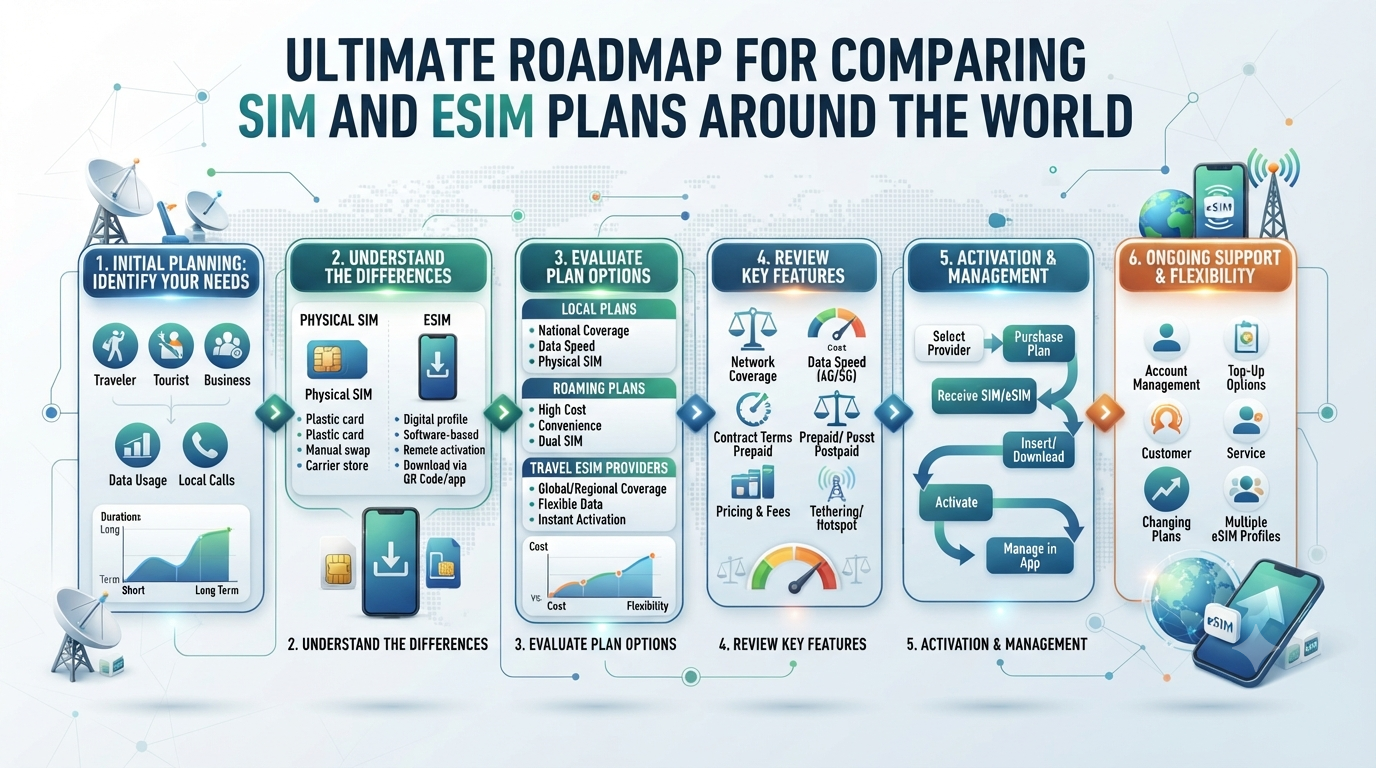
Physical SIM Cards vs. Digital eSIM Profiles
Comparing SIM vs eSIM plans lets you align your smartphone hardware with your lifestyle. Both formats connect your handset to cellular towers, yet they handle installation and multi-line storage in completely different ways.
| Comparison Metric | Physical SIM Card | Digital eSIM Profile |
|---|---|---|
| Setup Process | Slide a small plastic chip into your handset tray. | Scan a QR code or tap through a carrier mobile app. |
| Changing Carriers | Wait for postal delivery or visit a retail shop. | Download and activate a new cellular plan within minutes. |
| Device Support | Fits virtually every unlocked mobile phone worldwide. | Works only on newer smartphones with built-in eSIM chips. |
| Multiple Profiles | Restricted to one or two physical card slots on your phone. | Stores several digital carrier profiles on a single handset. |
| Travel Convenience | Forces you to swap tiny cards and store your home SIM safely. | Keeps your primary line active while adding a local travel plan. |
An eSIM does not outperform a physical card for every buyer. Many budget smartphones and regional handset models lack eSIM hardware altogether, so check your device settings before ordering a digital plan.
Network Engineering vs. Personal Plan Suitability
Choosing the biggest wireless network does not automatically give you the smartest deal. Network infrastructure quality and personal plan value measure two entirely different things.
Mobile Network Operators (MNOs) build, own, and run physical cell towers and wireless spectrum. Mobile Virtual Network Operators (MVNOs) lease wholesale network access from MNOs to sell their own branded plans without owning physical towers.
An MVNO connects your phone to the exact same signal towers as its parent MNO, yet service details often differ. MVNOs frequently offer lower prices and simpler prepaid terms, while occasionally experiencing lower data priority during peak hours or excluding international roaming perks. Paying extra for a giant network brings poor value if you buy 100GB of data when you only consume 9GB each month.
Nine Essential Details That Reveal True Plan Value
A bargain sticker price brings poor value if your reception drops indoors or your high-speed data disappears halfway through the month. Inspect these nine factors before choosing any wireless carrier:
- Total effective price: Add up the base rate, government taxes, SIM card fees, and mandatory top-ups.
- High-speed data cap: Confirm how many gigabytes you receive at full speed before the provider slows your internet.
- Billing validity duration: Count the exact number of days your plan stays active before requiring another payment.
- Local network reach: Verify that the underlying towers deliver strong reception across your neighborhood, workplace, and commute.
- 5G and 4G network tiers: Check whether the tariff includes 5G connectivity or restricts your device to 4G LTE.
- Hotspot and tethering rules: Confirm whether you can share mobile data with laptops and tablets without hitting strict caps.
- Voice and SMS inclusions: Check whether local calls, text messages, and international minutes come included.
- Device SIM compatibility: Verify that your unlocked smartphone accepts either the physical card size or digital eSIM profile.
- Expiry and rollover policies: Find out whether unused data carries forward or vanishes when your billing cycle ends.
Regional Playbook Across Five Major Mobile Markets
Canada: Data Buckets and Provincial Coverage
Canadian wireless shoppers balance data allowances against regional reach across vast provinces. When you compare mobile phone plans Canada, calculate your realistic monthly data consumption first, because larger data buckets carry noticeably higher prices. Check provincial signal reach across your home region, confirm whether 5G speeds come standard, verify whether unlimited calling covers all of Canada, inspect daily United States roaming fees, and check whether the carrier slows your speeds or charges overage fees once you finish your full-speed bucket.
Germany: Mandatory ID Checks and 28-Day Cycles
German telecommunications laws enforce strict customer registration across every mobile provider. Before purchasing prepaid SIM plans Germany, prepare to verify your identity using a valid passport or national ID card before your line activates. Check the exact billing duration on German prepaid tariffs, since most operators run on 28-day periods rather than full calendar months, and review European Union roaming limits, maximum download speeds, and current carrier rules instead of relying on outdated forum advice.
Australia: Regional Reach and Prepaid eSIMs
Australia spans an enormous landmass, making broad cellular tower reach vital for dependable service. When you compare mobile plans Australia, check whether the provider runs on a network serving regional towns and highways rather than coastal cities alone. Arriving students, backpackers, and digital nomads regularly look for prepaid eSIM plans Australia so they can connect immediately upon landing, while long-term residents often prefer 28-day or 365-day recharges with data rollover. Because not every Australian operator supports eSIM activation on prepaid plans, verify digital SIM eligibility and hotspot rules before paying.
United States: Tax Rules and 5G Coverage Tiers
American wireless plans vary sharply in tax treatment, rural signal reach, and speed tiers. When you compare prepaid phone plans USA, check whether the advertised rate includes state taxes and regulatory fees, because some carriers quote flat tax-inclusive prices while others add extra charges at checkout. Shoppers seeking faster downloads also compare 5G mobile plans USA across major national carriers and smaller operators, keeping in mind that budget prepaid tiers do not always unlock 5G and real-world speeds depend on your phone modem, nearby towers, and local congestion.
United Kingdom: Flexible Contracts and Unlimited Data
Fierce competition among British networks gives shoppers plenty of flexible choices. When you compare SIM only deals UK, weigh flexible 30-day rolling plans against 12-month and 24-month contracts, and verify whether European roaming comes included. Heavy streamers and remote workers frequently seek out unlimited data SIM only deals UK so they can work online without watching a meter, though you should always inspect fair-use speed caps and tethering limits first. Light phone users often prefer pay as you go SIM deals UK to skip monthly commitments, provided they check whether unused credit expires after inactivity.
Why Fresh, Verified Plan Information Protects Buyers
Carriers revise pricing, shrink data allowances, and update hotspot rules continuously. Relying on outdated comparison posts often leads to unexpected checkout charges or missing features.
Trustworthy comparison platforms solve this problem by showing official-source references, verification statuses, and clear last-checked dates. Ageing-information warnings also alert you whenever a listing needs fresh review.
RankeSIM applies an evidence-based approach to mobile plan data. Whenever an operator leaves a detail unclear—such as hotspot limits or 5G eligibility—RankeSIM marks that specification as unknown rather than guessing. Clearly labeling unverified fields protects you from false assumptions.
How RankeSIM Helps You Compare Plans Transparently
RankeSIM operates as an independent SIM and eSIM comparison platform built to make mobile plan research clear and reliable. Instead of pushing paid rankings, it lets you evaluate plans using verified facts and structured data.
Through its interactive comparison tool and personalized plan-fit scores, you can filter plans based on how you actually use your phone. You can review effective plan costs, data allowances, validity periods, 5G availability, hotspot restrictions, and supported SIM formats side by side.
RankeSIM provides dedicated provider pages covering both MNOs and MVNOs, complete with official-source references, user-submitted corrections, and provider page claims. Its published country comparisons include snapshots such as 68 plans in the United Kingdom, 35 plans in Australia, 29 plans in the United States, and 27 plans in Germany. Because carriers update offers frequently, these figures represent published comparison snapshots rather than permanent live totals.
Across the platform, RankeSIM tracks nine active markets: Australia, Canada, France, Germany, India, Ireland, New Zealand, the United Kingdom, and the United States. The platform is also introducing a separate travel eSIM comparison mode for international travelers.
Pre-Purchase Checklist Before Switching Carriers
Answer these ten practical questions before ordering a new SIM card or downloading an eSIM profile:
- How many gigabytes of data do I consume in a typical month?
- Do I genuinely need unlimited data, or will a fixed data cap reduce my bill?
- Does my daily routine require 5G speeds, or does steady 4G LTE work fine?
- Does the underlying network deliver strong reception at my home and office?
- Does my unlocked phone support eSIM profiles, or do I need a physical SIM card?
- Does the advertised price include unlimited local calls and text messages?
- Does the carrier restrict mobile hotspot tethering or cap hotspot speeds?
- How many days does the plan remain active before renewal?
- Did an independent source recently verify the listed prices and terms?
- Does activation require extra taxes, setup fees, or government ID verification?
Your best plan choice depends on your actual data habits, location, unlocked handset hardware, and monthly budget.
Frequently Asked Questions
1. Which differences separate SIM-only plans from prepaid cellular tariffs?
SIM-only plans supply mobile connectivity without bundling a phone handset, and carriers offer them as either monthly contracts or prepaid plans. Prepaid plans specifically require upfront payment for a set validity period, stopping service automatically when your balance expires so you never face surprise bills.
2. How do buyers effectively compare mobile plans across different carriers?
Calculate your monthly data usage, set your budget, and check whether your phone supports eSIM or physical cards. Then compare effective prices, validity cycles, network coverage, 5G access, and hotspot rules side by side on an independent comparison platform to spot hidden limits quickly.
3. Will an eSIM always beat a traditional physical SIM card?
Neither format wins in every situation. An eSIM activates digitally within minutes and stores multiple carrier profiles on one phone, which helps frequent travelers. However, a physical SIM card works inside almost any unlocked phone and lets you swap your line between devices effortlessly.
4. Where can shoppers locate affordable SIM-only deals in the UK?
Compare both major UK network operators and smaller MVNO carriers, since virtual operators often offer lower prices on identical tower networks. Weigh flexible 30-day rolling tariffs against 12-month contracts, check European roaming allowances, and pick a data bucket matching your real monthly usage.
5. Do unlimited data SIM plans truly offer unrestricted internet?
Most unlimited plans let you use large amounts of data without overage charges, yet fair-use policies still apply. Carriers frequently slow your internet speeds after you pass a high monthly threshold, limit video streaming quality, or cap how much data you share via mobile hotspot.
6. Can prepaid cellular plans deliver 5G network speeds?
Many modern prepaid plans include 5G connectivity, though entry-level prepaid tiers sometimes limit speeds to 4G LTE. Getting 5G requires a 5G-capable smartphone, local 5G tower coverage, and a prepaid plan that explicitly includes 5G access.
7. How should travelers choose a prepaid eSIM plan in Australia?
Confirm first that your smartphone is unlocked and supports digital eSIM profiles. Check which Australian mobile network delivers strong coverage across your destination cities or regional routes, then compare recharge validity periods, data allowances, and included local calls and texts.
8. What separates a traditional MNO from an MVNO?
An MNO (Mobile Network Operator) owns and operates physical wireless towers and radio spectrum. An MVNO (Mobile Virtual Network Operator) leases wholesale network capacity from an MNO to sell its own branded plans, often offering lower prices with varying data priority or roaming features.
9. Why must buyers confirm mobile plan terms before checkout?
Carriers regularly adjust monthly prices, shorten recharge validity periods, and update hotspot or roaming rules. Checking recently verified plan information protects you from buying an expired offer or discovering strict usage caps after paying for a non-refundable SIM card or recharge.
10. How does RankeSIM simplify comparing SIM and eSIM plans?
RankeSIM organizes country-specific mobile plans into an interactive comparison tool with personalized plan-fit scores. You can review effective prices, data allowances, validity periods, 5G access, hotspot rules, and SIM formats alongside official-source references and last-checked dates before confirming terms directly with providers.
Navigating Your Next Wireless Decision
Building a reliable mobile setup takes more than chasing the lowest monthly price on banner ads. Reviewing data caps, validity periods, network coverage, 5G access, and device compatibility protects you from weak reception and frustrating restrictions.
Whether you live locally, study abroad, or work remotely across borders, transparent and recently verified plan details make every choice easier. Checking side-by-side comparisons and verification timestamps on RankeSIM equips you with clear facts before you confirm your next plan directly with a carrier.



Top comments (0)