
Introduction:
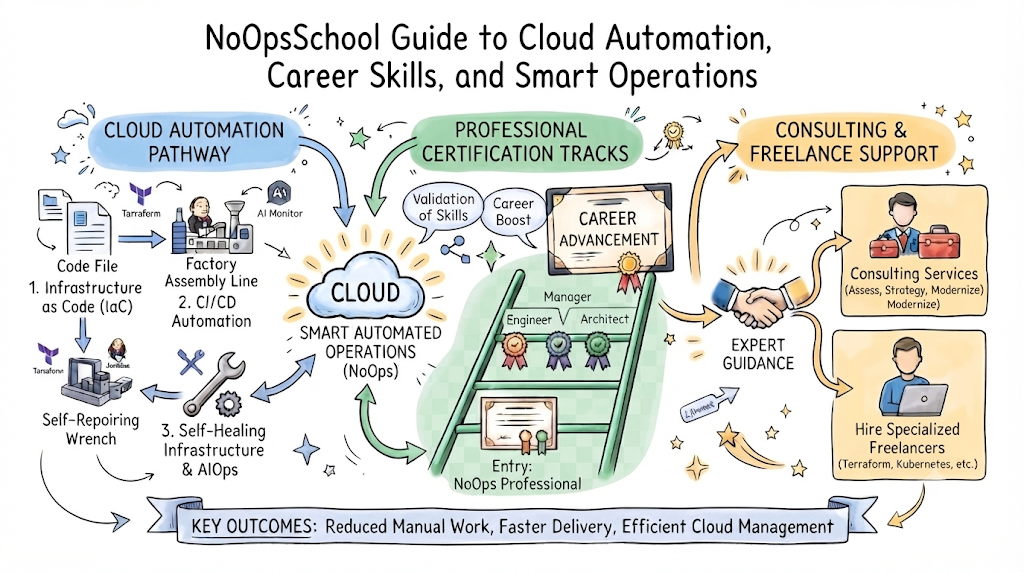
Have you ever wished a computer could fix its own broken apps? That is the big dream behind NoOpsSchool. The name NoOps means "No Operations." It is a smart way to run computer systems. Instead of people fixing bugs all night, smart software does the hard work.
At NoOpsSchool, teachers help students learn how to build these smart systems. Many tech teams spend too much time on boring, manual tasks. So, they get tired and make mistakes. NoOpsSchool shows engineers, managers, and builders how to use code to run servers automatically.
Even better, learning these skills can boost your tech career fast. Whether you write code or plan live shows on MyEventNow, smooth systems matter. You do not need to be a genius to start. Let us explore how this learning hub works and how you can grow your skills.
1. NoOps certification: A Practical Path to Modern Operations Expertise
Getting a NoOps certification proves you know how to automate cloud computers. Think of it like a driver's license for modern tech systems. Employers love this badge because it shows you can save their company time and money.
To get certified, you do not just read boring books. Instead, you pass hands-on tests where you fix real cloud problems. First, you learn how to set up servers using simple lines of code. Next, you practice making apps heal themselves when they crash.
Here is a simple step-by-step path to earn your badge:
Pick a track that matches your current job role.
Complete the guided practice labs on your home computer.
Pass the final test to show your real skills.
As one senior cloud coach says, "Automation turns late-night panic into peaceful sleep." Because you hold this proof, hiring managers trust your work right away.
2. NoOps training course: Validate Your Skills and Advance Your Technology Career
A good NoOps training course breaks scary tech topics into tiny, easy steps. At NoOpsSchool, instructors teach using real-world stories from busy tech companies. For example, imagine an online ticket app crashing right before a big concert. A trained student knows how to prevent that crash before it starts.
During class, you learn popular tools like Docker and Kubernetes. Docker packs software into neat digital boxes so it runs anywhere. Kubernetes acts like a smart traffic cop that moves those boxes safely. You also learn Terraform, which builds cloud servers with a few clicks.
Most students see big career wins after finishing their lessons. Industry research shows that automated teams deploy software twice as fast as manual teams. Plus, these teams face far fewer broken updates. So, taking a structured class helps you stand out and earn better pay.
3. NoOps engineer certification:A Complete Learning Roadmap for Beginners and Professionals
The NoOps engineer certification is built for people who love building things. You might be a total beginner or a seasoned coder. Either way, this roadmap guides you from basic setups to smart, self-running clouds.
First, you master "Infrastructure as Code." This simply means writing a text file to create computers instead of clicking buttons. Next, you build CI/CD pipelines. A pipeline is like a factory belt that tests and ships new code automatically.
Beginner
- Main Focus: Basic cloud rules and code setup
- Key Outcome: Build safe test servers
Mid-Level
- Main Focus: Containers and smart pipelines
- Key Outcome: Ship app updates fast
Pro Engineer
- Main Focus: Self-healing and AI alerts
- Key Outcome: Run zero-touch clouds
I once spoke with a junior developer who felt lost with cloud servers. After following this exact roadmap, he automated his team's entire testing setup in two weeks.
4. What is NoOps: Master the Core Concepts, Practices, and Tools
You might ask, what is NoOps in plain English? It means creating a setup where software runs itself without human babysitting. In the past, tech workers had to watch screens and restart broken servers by hand. Now, smart rules tell the system how to fix itself.
Think of a modern home thermostat. You set your favorite room temperature once. Then, the heater and air conditioner turn on and off by themselves. NoOps does the exact same thing for websites and mobile apps.
Still, humans do not disappear completely. People still design the rules, check safety, and build new features. A great use case is an event platform like MyEventNow during a massive ticket sale. When thousands of fans rush the site, NoOps tools add extra servers instantly. Then, when the rush ends, the tools turn extra servers off to save cash.
5. NoOps vs DevOps: Understanding the Evolution of Modern IT Operations
Many people get confused when comparing NoOps vs DevOps. Both methods help teams build and run software better. However, they handle daily computer chores in very different ways.
In DevOps, software writers and server fixers work together as one team. They share tools and fix problems side by side. Yet, people still spend lots of time managing servers and watching alerts.
NoOps takes the next big leap forward. It uses deep automation and smart software to remove almost all manual server work.
Daily Focus
- DevOps Approach: Teamwork between coders and ops
- NoOps Approach: Full automation of ops tasks
Server Care
- DevOps Approach: Humans manage servers
- NoOps Approach: Software manages itself
Speed
- DevOps Approach: Fast updates with team checks
- NoOps Approach: Instant updates via smart rules
Using a clear framework helps teams move from DevOps to NoOps safely. You simply automate one boring task every week until the system runs smoothly.
6. NoOps architect training: Essential Technologies for Smarter and Automated Operations
NoOps architect training teaches you how to draw the big blueprint for smart clouds. An architect is like the person who designs a whole city before builders lay bricks. You decide how data flows, where apps live, and how systems stay safe.
In this program, you explore GitOps and serverless computing. GitOps uses a central code folder as the single source of truth for your whole system. Serverless computing lets you run code without ever worrying about the underlying hardware.
You also master observability. Observability means giving your software smart sensors so you can see inside it clearly. If a payment button slows down, the system spots the exact line of code causing trouble. With these architect skills, you design rock-solid systems that never let users down.
7. NoOps consulting services: Building Expertise in Continuous Delivery and Engineering Excellence
Sometimes a company needs expert help right away. That is why NoOps consulting services are so valuable for growing businesses. Skilled coaches visit your team, check your current setup, and find slow spots.
First, consultants run a full health check on your cloud tools. Next, they build a custom plan to cut wasted time and high server bills. For instance, one mid-sized retail company struggled with slow website updates every Friday. Consultants stepped in and set up automated security checks and faster delivery belts. Within a month, the company cut its deployment errors by eighty percent.
Also, consultants train your current staff while they fix things. This way, your team learns how to keep the smart systems running long after the coaches leave. It is a fast, safe way to modernize any tech business.
8. NoOps automation tools: Developing Skills for Intelligent and Automated IT Operations
To build a self-running cloud, you need the right NoOps automation tools. These digital helpers watch your apps, test your code, and fix errors while you sleep. Learning how to connect them is a superpower for any tech worker.
At NoOpsSchool, you practice with the best tools in the industry. Here is how the main tool groups work together:
Build Tools: Terraform and Ansible create cloud servers from simple text files.
Delivery Tools: Jenkins and GitHub Actions test and ship new app updates fast.
Watch Tools: Prometheus and Grafana track speed and spot bugs early.
Smart AI Tools: AIOps platforms predict crashes before users even notice a glitch.
When you link these tools together, they act like a well-trained pit crew. Every part knows its job and moves in seconds.
9. NoOps manager certification: Your Roadmap to Scalable Machine Learning Operations
Tech leaders need different skills than hands-on coders. The NoOps manager certification helps team leads guide smart projects and machine learning workflows. Today, many apps use artificial intelligence to suggest movies, routes, or local shows.
Managing these AI models takes special care. Models need fresh data and fast computers to stay accurate. This certification teaches managers how to scale machine learning operations without blowing the budget.
You learn how to measure team success using clear, simple numbers. For example, you track how fast new ideas reach customers and how quickly systems recover from bugs. By earning this badge, managers learn to lead calm, happy, and high-performing tech teams.
10. Hire NoOps freelancers: Strengthening Modern Data Management and Delivery Skills
If you have a short project, you can hire NoOps freelancers to get the job done fast. Many startups and busy event teams do not need a full-time cloud expert all year. Instead, they bring in a skilled specialist for a few weeks.
Freelancers from the NoOpsSchool network know Kubernetes, Terraform, and automated safety checks inside out. Suppose you are launching a new feature on MyEventNow for local workshop bookings. A freelancer can build your automated database backups and traffic shields in days.
Before hiring, always ask for past examples of automated setups they built. Good freelancers explain complex ideas simply and leave clean notes behind. This smart hiring move keeps your tech strong while keeping your business costs low.
Frequently Asked Questions About NoOpsSchool
What is the main goal of NoOpsSchool?
NoOpsSchool teaches IT workers how to automate cloud tasks so software runs itself without constant human fixing.
Do I need coding skills before starting a NoOps course?
Basic computer knowledge helps, but beginner classes explain every coding step in simple, easy-to-follow words.
How does NoOps help save money for businesses?
Automation turns off unused cloud servers automatically and stops costly human mistakes before they break live apps.
Can non-engineers take classes at NoOpsSchool?
Yes, IT managers and team leaders can take special management tracks to learn how to guide automated teams.
What tools will I learn to use in the labs?
You will practice with popular tools like Kubernetes, Docker, Terraform, GitOps, and smart AI monitoring systems.
Does NoOps mean companies will fire all their IT staff?
No, it simply removes boring, repetitive chores so workers can focus on building cool new features and safety rules.
How long does it take to finish a certification track?
Most students finish their lessons and pass their hands-on practice labs within a few weeks of steady study.
Are the training classes available online for global students?
Yes, all courses, practice labs, and tests are online so anyone around the world can join from home.
How can a small business get help with cloud automation?
Small teams can book consulting services for a full system checkup or hire skilled freelancers for quick projects.
Why is hands-on lab practice so important in NoOps?
Reading books is not enough, because fixing real virtual servers builds the true confidence needed for live tech jobs.
Final Thoughts
Moving toward automated operations is one of the smartest steps a tech worker or business can take. By letting smart software handle daily server chores, teams gain more time to create, innovate, and solve big problems. Whether you want a new career badge, expert consulting, or quick freelance help, NoOpsSchool gives you a clear path forward. Start small, automate one boring task today, and watch how smooth your digital world becomes.



Top comments (0)