
Introduction
The modern digital economy thrives on platforms that bridge the gap between fragmented supply and decentralized demand. Yet, building an online marketplace for physical assets like vehicles reveals a fundamental truth: a digital interface cannot simply impose a uniform template across wildly different geographic and economic landscapes. When a platform deals with transport, the physical reality of the road dictates everything. A software design that ignores local infrastructure, regional topography, or specific community mobility patterns will quickly fail both the traveler and the local asset owner.
Developing a functional, enduring vehicle rental marketplace requires more than a simple listing directory. It demands a deep appreciation of local context, transparent information architectures, and meaningful connections between the people who need transport and those who provide it. Examining how regional requirements shape platform design—using MotoShare Africa as a real-world business context—illustrates how digital marketplaces must adapt to the diverse environments they serve.
Why Local Context Matters in Mobility Platforms
In traditional e-commerce, digital transactions are largely detached from physical terrain; a book or a gadget functions identically whether shipped to a bustling financial district or a quiet rural town. Mobility, however, is intensely place-based. The mechanical demands placed on a vehicle navigating a high-speed coastal highway differ drastically from those encountered on unpaved mountain tracks or crowded metropolitan commuter corridors.
When a digital marketplace operates across multiple countries and distinct municipal zones, it must account for these variations. Customer expectations shift depending on journey purpose, ranging from corporate professionals keeping tight schedules to tourists seeking independent leisure exploration. If a marketplace treats a rugged utility vehicle the same way it treats an urban hatchback, or treats a dense urban center like a remote regional hub, the resulting mismatch creates friction. A useful marketplace must therefore respect local operational contexts, ensuring that vehicle categories align precisely with the geographical and cultural realities of each destination.
The Marketplace Information Challenge
Connecting decentralized vehicle supply with active demand introduces a complex information challenge. Unlike centralized corporate fleets where every vehicle is standardized, an open marketplace features diverse assets owned by independent individuals and varied local rental providers.
To make this ecosystem function smoothly, the platform must prioritize data clarity. Accurate vehicle descriptions, transparently communicated rental periods, clearly stated daily prices, and precise location details are non-negotiable. When customers compare options online, they rely entirely on the integrity of this information to make informed choices.
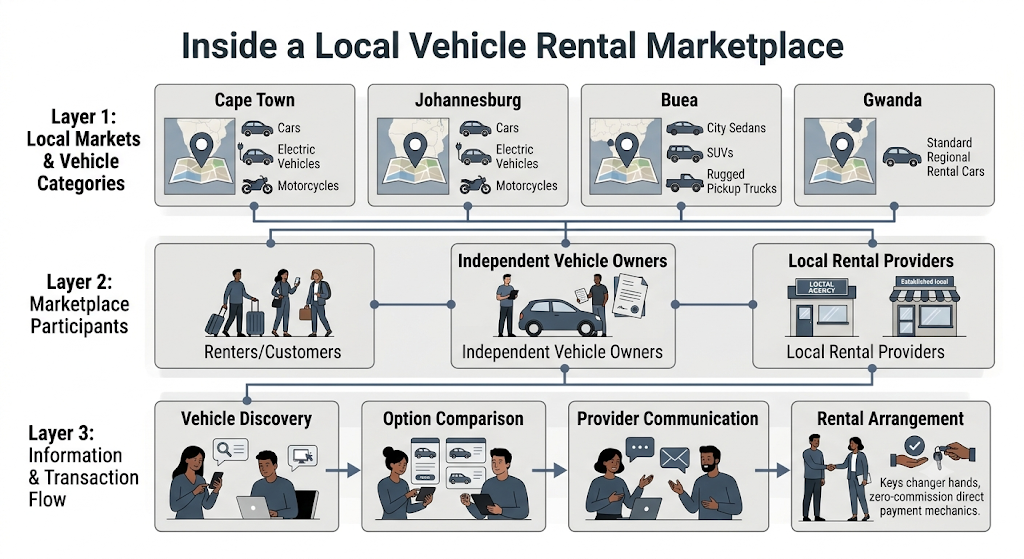
Furthermore, efficient communication channels between customers and providers are essential. Before a booking is finalized, both parties need a transparent mechanism to clarify expectations regarding handover schedules, vehicle conditions, and direct payment arrangements. Platforms that emphasize zero commission and direct payment models place a high premium on this transparent communication, empowering local partners and vehicle owners to manage their own terms while providing users with clear, unclouded insight into their rental choices.
Four Distinct Local Market Contexts
To understand how marketplace dynamics play out in practice, it is helpful to examine four specific regional markets, each characterized by its own unique travel patterns and vehicle requirements.
South Africa: Urban Metros and Coastal Corridors
South Africa presents a highly diverse economic and geographical landscape, blending rapid corporate commuting with world-class tourism.
In the Western Cape, international and domestic visitors frequently seek flexible transport to navigate both city appointments and scenic peninsula routes. For many travelers, securing a dependable car hire Cape Town provides the necessary autonomy. Simultaneously, the region's famous coastal passes draw open-air enthusiasts; opting for a motorcycle rental Cape Town offers an agile way to experience winding coastal roads while bypassing heavy traffic.
Further inland, Gauteng’s high-octane economic hub operates at a relentless corporate tempo. For professionals and couriers navigating dense metropolitan arteries, utilizing a motorcycle rental Johannesburg is a popular choice for maintaining precise daily schedules. When travel requirements extend into multi-province expeditions, opting for a self drive car rental South Africa model grants total independence over itineraries. Additionally, as urban centers prioritize environmental sustainability, eco-conscious drivers can explore an electric car rental Cape Town to align their travel choices with developing charging infrastructure.
Beyond traditional commercial rentals, private vehicle sharing has gained traction. Suburban car owners who leave their vehicles parked during the workweek can choose to rent out your car South Africa through community-oriented channels, while visitors seeking alternative arrangements often lean toward a peer to peer car rental South Africa model to connect directly with local asset owners.
Cameroon: Topography and Utility in Buea
Shifting focus to Central Africa, transport demands adapt immediately to local topography and regional commerce. In Cameroon, the vibrant academic and commercial hub of Buea sits at the foot of Mount Cameroon, creating a distinct environment where vehicle capability is paramount.
For professionals and visitors navigating the city's paved administrative avenues, securing a reliable car rental Buea Cameroon ensures daily routines run smoothly. However, the steep volcanic inclines, heavy seasonal rains, and unpaved rural tracks surrounding the mountain demand much more than a standard city sedan. To tackle these challenging outdoor environments, travelers and commercial workers frequently utilize a pickup truck rental Buea, ensuring they have the necessary ground clearance, robust suspension, and expansive cargo capacity required for fieldwork or rough-terrain travel.
Zimbabwe: Regional Connectivity in Gwanda
In Southern Africa, smaller regional towns play an indispensable role in linking agricultural and mining communities with major national commercial networks. In Zimbabwe, hubs like Gwanda require accessible, dependable transport for visiting professionals, NGO personnel, and local residents.
When traveling into Matabeleland South, organizing a reliable car rental Gwanda Zimbabwe removes the logistical friction of regional mobility. Having direct access to a dependable automobile ensures that multi-stop administrative visits and community development projects proceed without the unpredictability of public transport schedules.
The Participants Behind the Marketplace
A digital marketplace is only as strong as the community of participants who populate it. In an ecosystem like MotoShare Africa, the platform acts as a digital connective tissue uniting three distinct groups:
- Renters and Customers: Individuals, families, and businesses seeking flexible, short-term transport tailored to their specific travel needs.
- Independent Vehicle Owners: Everyday citizens who wish to monetize underutilized personal assets by sharing their vehicles when not in use.
- Local Rental Providers: Established regional operators who leverage digital discovery to reach a broader audience of domestic and international clients.
The success of the marketplace depends on aligning the incentives of these groups. When expectations are clear and communication is transparent, participants can coordinate reliable bookings through trusted local partners with confidence.
Discovery, Comparison, and Owner Participation
Online marketplace discovery fundamentally changes how customers approach mobility. Instead of accepting the limited inventory of a single agency, users can explore a diverse array of options tailored to their exact itinerary. However, digital discovery comes with the responsibility of careful evaluation; customers must compare vehicle specifications, daily pricing, and rental terms to ensure a proper match for their journey.
On the supply side, vehicle owners and independent rental operators face their own set of practical considerations before listing an asset. Successful participation requires maintaining accurate vehicle condition records, setting transparent availability schedules, and managing customer inquiries promptly. By presenting clear, honest information about their vehicles, owners build trust within the community, fostering a sustainable, mutually beneficial rental environment.
Conclusion
Building a more useful vehicle rental marketplace is an exercise in balancing digital efficiency with local reality. As platforms like MotoShare Africa demonstrate across South Africa, Cameroon, and Zimbabwe, success does not come from imposing a rigid corporate mold, but from honoring regional context, facilitating transparent communication, and empowering local participants. By prioritizing clear information and respecting the distinct mobility needs of every community, digital marketplaces can continue to foster a more flexible, resilient, and connected transportation future.



Top comments (0)